Cat Carrier for Anxiety: Calming Design
A calming cat carrier reduces arousal through five measurable mechanisms: 60-80% visual occlusion, interior illuminance held at 5-30 lux, 8-15 dB of acoustic attenuation in the 500-4,000 Hz band, an enclosure volume of 1.3-1.8 times the animal's own body volume, and tip resistance at 12 degrees of incline. None of them is a fabric choice.
Most products sold as calming reduce to a soft lining and a printed claim, which is why the category has a weak evidence base and a high return rate. This page treats calming as an engineering problem with five independent mechanisms, each of which can be specified and measured before tooling, and each of which has a cost. The mechanisms are visual, acoustic, spatial, mechanical and olfactory, and they do not substitute for one another: a carrier that blocks sight well and transmits every road transient still produces an aroused animal, and one that is quiet and dark but wobbles under the animal's own movement does too. The order of effectiveness matters for budget allocation, and on the evidence available, mechanical stability and visual occlusion dominate while olfactory additions are marginal. Commercial terms follow the standard programme: MOQ 500 pieces per colourway, prototypes in 6-10 working days, bulk production 35-50 days after sample approval, final random inspection to AQL 2.5, T/T 30/70 and FOB Xiamen.
A dog carrier manufacturer is expected to hold the cat carrier pattern card for at least twelve months, so a reorder matches the approved sample rather than drifting.
Arousal Loads: Separating the Triggers That Matter
Calming design starts by separating triggers, because a product that addresses the wrong one appears to do nothing. Five triggers account for most transit arousal in cats, and each has a different mechanism and a different engineering answer.
Unpredictable motion is the first and, on behavioural evidence, the largest. Cats tolerate self-generated motion and react strongly to imposed motion, particularly at low frequency: sway at 0.5-2 Hz and rotation about any axis produce the strongest response. The mechanism is vestibular rather than psychological, which is why no amount of lining helps and why the answer is mechanical.
Visual exposure is the second. An animal that can see a moving environment it cannot control is more aroused than one that cannot see it; this is the mechanism behind the effectiveness of covering a carrier with a towel, which is the behaviour the product is trying to replace. The relevant measurement is occlusion ratio and interior illuminance, not whether a cover exists.
Acoustic exposure is the third and it interacts with the first two: a startle response produces movement, which produces imposed motion on the animal, which compounds. The sensitive band for cats is broad, roughly 500 Hz to 45 kHz, with best sensitivity around 2-8 kHz, so a specification limited to human-audible low frequencies misses the point.
Novelty is the fourth and it is olfactory and tactile rather than visual. A carrier that smells of detergent and feels unfamiliar is a novel object; retaining the animal's own scent between uses measurably reduces the response. This is the mechanism behind the common advice to leave a carrier out before travel, and it is the one that product design can only partially address.
Confinement geometry is the fifth and it is the most counter-intuitive. A larger interior is not calmer; an interior close to the animal's own body volume is, because it provides contact on several surfaces at once. This is denning behaviour and it sets the geometry rule that follows.
| Trigger | Mechanism | Design answer | Measured target | Cost adder |
|---|---|---|---|---|
| Imposed motion | Vestibular | Stability, sway damping | Tip at 12 degrees, sway under 3 degrees | 2.40-6.80 USD |
| Visual exposure | Lack of control | Occlusion panels | 60-80% occluded, 5-30 lux | 1.20-3.60 USD |
| Acoustic startle | Auditory, 2-8 kHz | Damping layers, quiet hardware | 8-15 dB at 500-4,000 Hz | 0.90-2.80 USD |
| Novelty | Olfactory, tactile | Scent-retentive lining | Detergent-free finish | 0.20-0.90 USD |
| Confinement geometry | Denning | Volume ratio, contact | 1.3-1.8 times body volume | 0.00-1.40 USD |
Note that the two largest cost adders are mechanical and visual, and that the confinement geometry answer can cost nothing at all — it is a sizing decision rather than a component. Addressing arousal means addressing its mechanism; a soft lining is not a calming feature and no fabric choice substitutes for stability.
Visual Management: Occlusion Ratio, Sightlines and Light Level
Visual management is the mechanism most closely associated with calming in the consumer mind and the one most easily measured. It has two parameters rather than one, and products that get the first right and the second wrong underperform.
Occlusion ratio is the first: the fraction of the animal's horizontal field of view blocked from its normal travelling position. The working target is 60-80%. Below 50% the animal still has a wide moving view and the effect is small; above 85% the animal is effectively blind to its surroundings, which increases rather than decreases arousal in a substantial share of cats and makes monitoring impossible for the owner.
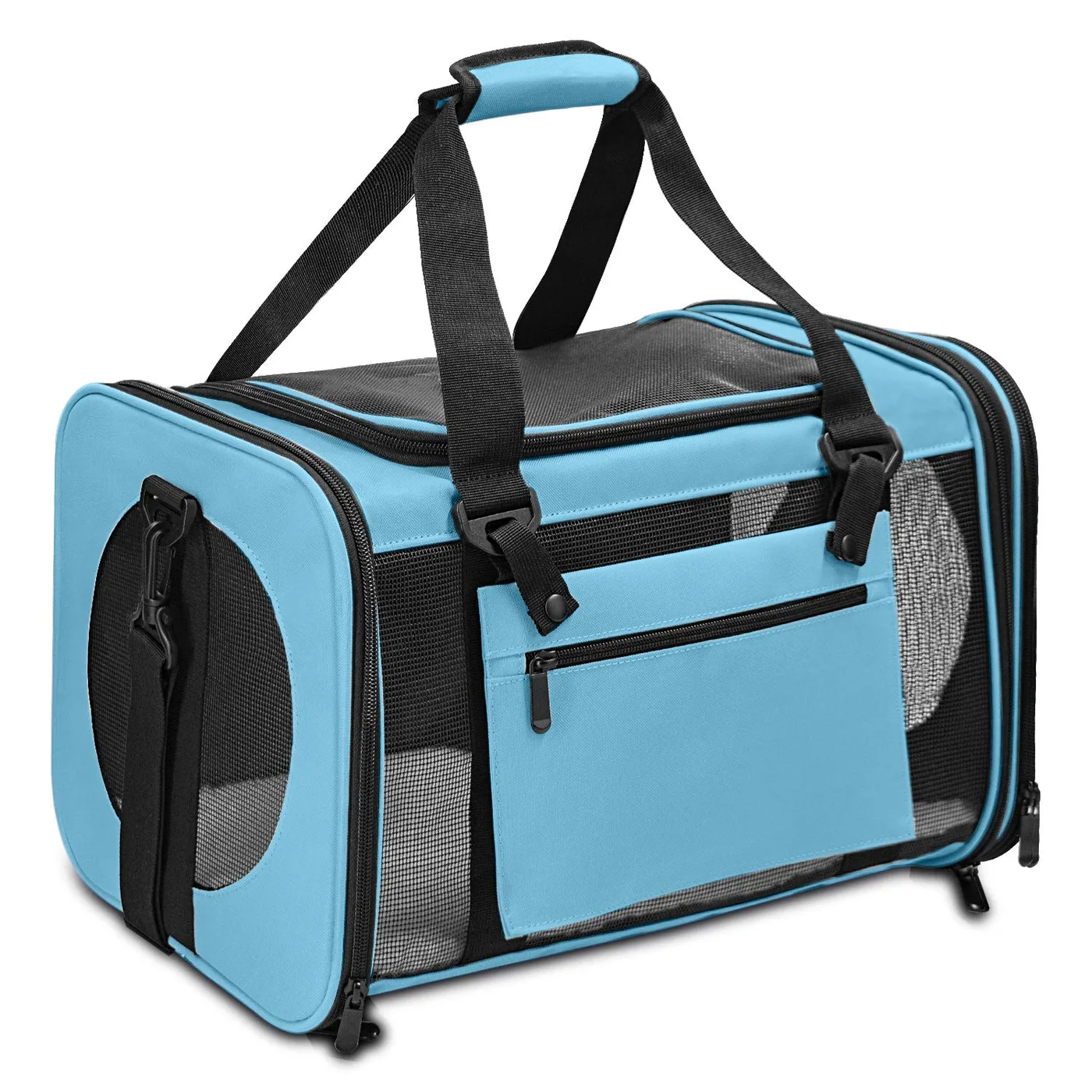
Measurement is geometric rather than subjective. A 180-degree field is drawn from the animal's eye position at 60-90 mm above the floor, the solid angle subtended by opaque or low-transmission surfaces is computed, and the ratio is reported. A single mesh panel of 300 x 200 mm at 400 mm from the eye position blocks about 12%; the same area in opaque fabric blocks essentially all of it. In practice, 60-80% occlusion means opaque panels on at least three faces with a mesh aperture on one or two.
Interior illuminance is the second parameter and it is where most designs fail. Occluding the field of view while leaving a clear mesh roof produces an interior at 300-1,500 lux in daylight, which is bright enough to defeat the effect of the occlusion. The target is 5-30 lux at the animal's position, which requires a roof panel with a transmission of 8-25% and side panels that are opaque rather than tinted.
Sightline direction matters as much as occlusion. An animal that can see forward but not to the sides is calmer than one with the reverse, because forward vision gives predictability. The practical rule is to occlude laterally and to the rear, and to leave a low-transmission forward panel if any.
Removability is a commercial requirement that engineers often resist. Owners want to see the animal, and a fully occluded product generates complaints. The resolution is a roll-up or fold-back panel with a defined detent, so the occlusion is present during transit and removed at rest — with the caveat that the panel must not rattle, which is an acoustic specification.
Verification combines the geometric computation with a lux survey at the animal's head position in three conditions: indoor shade, indirect daylight and direct sun. Acceptance is 5-30 lux with panels deployed and no more than 200 lux with panels stowed. Occlusion without illuminance control is half a specification; a clear mesh roof undoes an opaque side wall.
Acoustic Damping: Materials, Hardware and Measured Attenuation
Acoustic work in this category is often specified as a lining weight, which is not the right parameter. Two mechanisms matter — absorption inside the compartment and transmission loss through the shell — and they respond to different constructions.
Absorption reduces reverberant build-up inside the compartment, which is where a startle becomes a sustained arousal. The parameter is the sound absorption coefficient, and a needled or lofted layer of 12-30 mm at 150-400 g/m² gives 0.25-0.55 across 500-4,000 Hz. A smooth coated fabric gives 0.05-0.15, which is effectively reflective.
Transmission loss is the second and it is governed by mass and by decoupling rather than by absorption. A single shell layer of 600D polyester at 250 g/m² gives roughly 4-7 dB at 1,000 Hz; adding a decoupled inner layer with an air gap of 6-15 mm adds a further 4-8 dB in the same band. The air gap is doing most of the work, which is why a laminated two-layer construction performs worse than two separated layers at the same total weight.
The combined target is 8-15 dB of attenuation across 500-4,000 Hz, measured as the difference between an external broadband source at 80 dB and the level at the animal's position. That is achievable with a lofted inner layer, a decoupled wall and an absorptive floor; it is not achievable with a lining alone.
Hardware is the third element and it is cheaper than any of the above. Stamped metal buckles and exposed zip chains produce transients at 70-90 dB at 300 mm during ordinary handling; moulded polymer hardware and a covered chain bring that to 55-65 dB. The change costs 0.30-1.10 USD and is the highest-value acoustic decision in the product.
Low-frequency structure-borne noise below 250 Hz is not addressed by any of the above, because absorption and mass law both perform poorly there. It is addressed by the same isolation layer used for vibration: 6-12 mm of elastomer at 25-45 kg/m³ with a loss factor of 0.15-0.35, which reduces structure-borne input by 4-9 dB in the 100-250 Hz band.
Measurement uses a calibrated sound level meter or a two-microphone setup, with the source at one metre and the receiver at the animal's head position, in third-octave bands from 250 Hz to 8 kHz. Published textile acoustic test practice is drawn from standards work at ASTM International. Attenuation comes from a decoupled air gap and absorptive loft, not from lining weight; hardware quietening is the cheapest decibel in the product.
Enclosure Geometry: Volume Ratio, Contact and Headroom
The spatial mechanism is the one most often designed backwards. The instinct is to give an anxious animal more room; the evidence from denning behaviour points the other way, toward a compartment sized close to the animal's own body volume with contact available on several surfaces.
The parameter is volume ratio: interior volume divided by the animal's body volume, where body volume is estimated from mass at roughly 1.0 litre per kilogram for a lean cat and 0.85 litres per kilogram for an overweight one. The working target is 1.3-1.8. Below 1.2 the animal is physically compressed; above 2.2 the denning response weakens measurably and the animal paces.
Contact surfaces are the mechanism behind the ratio. At a ratio of 1.3-1.8 the animal is in contact with the floor and with one or both side walls while resting, which is the condition that produces the calming effect. The design consequence is that side wall padding matters as much as floor padding, and that a compartment with a large plan area and low walls provides contact on one surface only.
Headroom interacts. A low roof gives a sense of enclosure but risks contact pressure on the animal's back and restricts the standing posture; the practical rule is a roof clearance of 40-70 mm above the standing shoulder height, which is less than the 60-90 mm used for a general carrier and is a deliberate reduction rather than a compromise.
Zoning is the refinement that lets a product serve both the denning response and the owner's wish for space. A compartment at a ratio of 1.6-1.8 with a deployable extension that raises it to 2.2-2.6 gives a calm transit configuration and a roomy rest configuration, at 2.60-6.40 USD for the extension panel and its closure.
Floor recess is a small detail with a measurable effect. A support surface sunk 15-30 mm below the aperture sill increases lateral contact and reduces the sense of exposure, at no material cost — it is a pattern change rather than a component.
Verification is behavioural rather than numerical: time to first rest and the number of repositioning events over a thirty-minute trial, run at ratios of 1.3, 1.8 and 2.4 on the same shell with adjustable panels. In our experience the difference is largest between 1.8 and 2.4, which is where the specification should be set. Calm geometry is a volume ratio of 1.3-1.8 with contact on three surfaces, and it costs nothing to specify correctly.
Stability and Motion: Tip Resistance, Sway and Rattle
Mechanical stability is the highest-value calming mechanism and the least likely to be specified, because it is invisible on a shelf. Three failure modes matter: tipping, sway during carry, and rattle from loose components.
Tip resistance is the first. A carrier set down on a surface that is not level, or pushed by an animal moving inside, should not rotate. The acceptance test is a static hold at 12 degrees of incline with a load representing the animal placed at the least favourable position, with no further rotation and no sliding. That requires a base with a width-to-height ratio of at least 1.4 and a coefficient of friction against the supporting surface of at least 0.35.
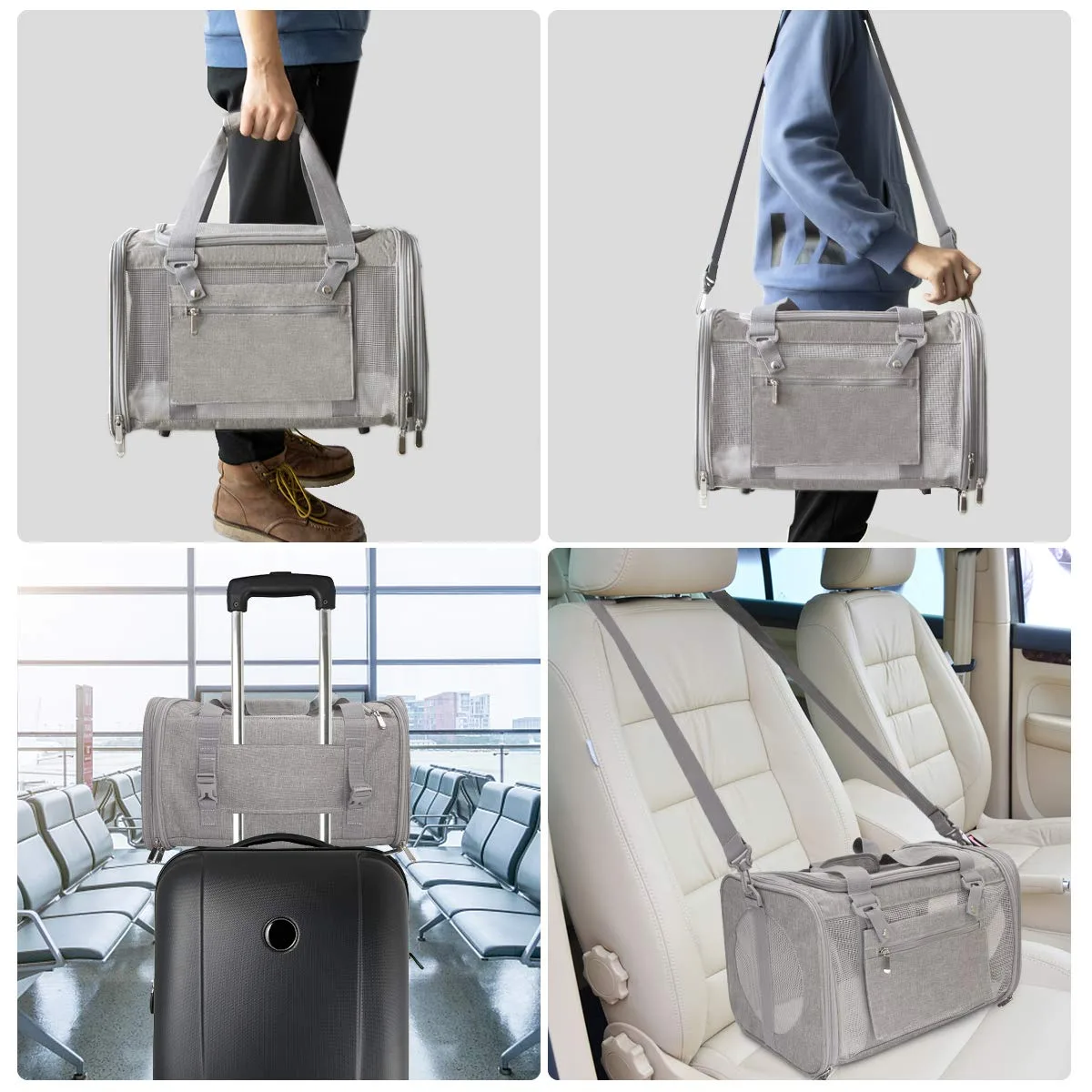
Carry sway is the second and it is the largest single contributor to imposed motion. A handheld carrier behaves as a pendulum with a natural period governed by the distance from the hand to the load's centre of gravity; at 350-450 mm that is roughly 1.2-1.4 seconds, or 0.7-0.85 Hz, which is inside the band that produces the strongest vestibular response. The engineering answers are to shorten the carry distance — a handle geometry that places the centre of gravity within 250-320 mm of the grip — and to add damping at the handle attachment, which a 6-12 mm elastomer grip does at 0.60-1.80 USD.
Rotational control is the third. A single-point handle allows the load to rotate about the vertical axis, which is strongly arousing; a two-point harness or a handle with a rotational constraint of 4-6 Nm at 30 degrees reduces it. This is the mechanism behind the general observation that backpack configurations are calmer than single-handled ones, and it is available on any configuration.
Rattle is the fourth and it is a tolerance problem rather than a material one. Any component with clearance — a removable panel in a loose pocket, a hardware item on a webbing tail, a zip slider on an unsecured chain — will rattle under road input. The specification is a maximum clearance of 1.5 mm on all fitted components and positive retention on all hardware, verified by a shake test at 5 Hz and 0.3 g for fifteen minutes with a sound level ceiling of 55 dB at 300 mm.
Floor stiffness contributes too. A floor that deflects 15-20 mm under the animal returns energy as motion; the acceptance limit for a calming product is deflection under 8 mm at 150 N, which is tighter than the 12 mm used for a general carrier.
Verification is instrumented: a triaxial accelerometer on the floor panel during a standardised 400-metre carry and a thirty-minute road course, with acceptance of peak sway under 3 degrees, root-mean-square acceleration under 0.25 g in the 0.5-2 Hz band, and no transient above 55 dB. Stability is worth more than every other calming feature combined, and it is bought with handle geometry, base geometry and clearance control.
Olfactory Design, Pheromone Compatibility and Cleaning Chemistry
The olfactory mechanism is real but smaller than the visual and mechanical ones, and it is the area where unsupported claims are most common. Three items are worth specifying; the rest is marketing.
Scent retention is the first and it is a material property. An animal's own scent persists on a hydrophobic, low-surface-energy fibre far longer than on an absorbent one, because the scent compounds partition into the fibre rather than being washed out. A polyester or polypropylene face fabric retains detectable scent across 3-7 days of normal use; a cotton or viscose face loses it within a day. Specifying a synthetic face fabric for the removable pad is therefore a functional decision at zero cost.
Detergent residue is the second and it works against the first. Scented laundry detergent leaves a residue that both masks the animal's scent and is itself a novel odour; the specification is a detergent-free rinse cycle for pads and a residual surfactant screen on incoming fabric, which costs nothing beyond process discipline.
Pheromone compatibility is the third and it needs care in both directions. Synthetic pheromone products are applied to a surface and evaporate from it; a surface that absorbs them reduces their effective life, and a surface treated with a strong antimicrobial finish may degrade them. Where a product is intended to be used with a pheromone diffuser or spray, the interior surface should be a low-absorption synthetic with no antimicrobial finish, and any claim must be about compatibility rather than about efficacy — the efficacy belongs to the pheromone product and is not the carrier manufacturer's to make.
Antimicrobial finishes deserve a specific caution. They are widely sold as calming or hygiene features, they have no effect on arousal, and several of the common agents are restricted in the markets this product sells into. Their inclusion adds 0.30-1.20 USD and creates a regulatory surface for no measurable benefit.
Cleaning chemistry is the last item and it interacts with the first two: the interior has to be cleanable without destroying the scent-retentive property, which argues for a removable pad that can be rinsed without detergent for routine cleaning and laundered only occasionally. The coating resistance requirement is unchanged — pH 6-11 across 300 cycles.
All interior textiles and finishes are screened against OEKO-TEX criteria, and welfare claims about transport stress are kept consistent with guidance published by the American Veterinary Medical Association. Scent retention is a fibre-selection decision that costs nothing; pheromone claims belong to the pheromone product, not to the carrier.
Measuring Calm: Physiological Markers and Behavioural Protocols
A calming claim is only defensible if it is measured, and the measurement is more tractable than most manufacturers assume. Two classes of marker are used, and they answer different questions.
Physiological markers are the objective ones. Resting heart rate in a calm adult cat is 120-160 beats per minute and rises to 180-240 under transit stress; respiratory rate runs 16-30 at rest and 40-80 under stress. Both can be logged with a wearable sensor on a small panel of animals, and both respond to interventions within minutes. The acceptance criterion for a calming design is a resting heart rate no more than 20% above the animal's own baseline within ten minutes of placement, and a return to within 10% within twenty minutes.
Behavioural markers are the practical ones and they scale better. Four are scored: latency to first rest, number of repositioning events in thirty minutes, vocalisation events per minute, and attempts to exit. A calming design should produce latency under four minutes, fewer than three repositioning events, under one vocalisation event per minute, and no exit attempts in at least 80% of trials.
Protocol design is what makes the result usable. Each animal is tested in both the test carrier and a control carrier in a randomised order with at least 48 hours between trials, and the handler is blinded to which is which. Ten to fifteen animals give a usable result; fewer than eight does not, because individual variation in cats is large enough to swamp a real effect.
Controls matter because most of the effect that gets attributed to a product is actually habituation. A control arm in which the same animals are tested in a plain carrier on the same schedule separates the product effect from the familiarisation effect, and without it any before-and-after result is unreliable.
Measurement of the physical parameters runs in parallel, because a behavioural result without a physical explanation cannot be transferred to the next product. Occlusion ratio, interior illuminance, attenuation in third-octave bands, tip angle and sway are all logged for the same units used in the behavioural trial, and the two data sets are reported together.
Documentation closes the loop: the protocol, the sample size, the control condition and the raw scores are retained for three years, which is what makes a claim defensible to a retailer or a regulator rather than merely assertable. Measure heart rate and behaviour against a randomised control, and log the physical parameters on the same units — a claim without a control arm is habituation, not design.
Cost, Material Selection and Programme Planning
A calming specification adds 5.70-17.50 USD over a comparable general-purpose carrier, and the money is best spent in a specific order. Allocating it in any other order produces a more expensive product that performs worse.
The order is: stability first at 2.40-6.80 USD, because it dominates the behavioural result; visual management second at 1.20-3.60 USD; acoustic work third at 0.90-2.80 USD; geometry fourth at 0.00-1.40 USD, since it is largely a pattern decision; and olfactory work last at 0.20-0.90 USD. A programme that spends first on a premium lining is spending its budget on the smallest effect.
Component detail: the stability package is a wider base panel with a moulded or bonded foot at 1.20-3.20 USD, a shortened and damped handle geometry at 0.60-1.80 USD, and a rotational constraint at 0.60-1.80 USD. The visual package is opaque side panels with a low-transmission roof at 0.80-2.40 USD and a roll-back mechanism at 0.40-1.20 USD. The acoustic package is a lofted absorptive layer at 150-400 g/m² at 0.50-1.60 USD, a decoupled inner wall at 0.30-0.90 USD and moulded hardware at 0.10-0.30 USD.
Material selection should follow the mechanisms. For the absorptive layer, a needled polyester wadding at 200-320 g/m² and 12-25 mm thickness outperforms a foam of the same thickness above 1,000 Hz and is cheaper; below 500 Hz neither works and the isolation layer is required instead. For the visual panels, an opaque face fabric with a black inner layer gives a transmission under 5%, which is what the illuminance target needs — a single-layer tinted fabric gives 25-40% and does not.
Tooling is modest throughout. The roll-back panel needs a pattern change and possibly a magnet or hook-and-loop detent at 0.20-0.60 USD; the damped handle needs a moulded grip at 600-1,400 USD; and the wider base needs a die at 200-450 USD. Total tooling for a calming variant of an existing shell is under 2,500 USD.
Claims and documentation need planning early. A calming claim supported by a fifteen-animal randomised protocol with logged physical parameters can be stated in retail copy and defended; the same claim without the protocol is a liability in several markets. Budget for the protocol before launch rather than after a challenge.
Our production team builds calming programmes through the SGS-verified production base under ISO 9001 and BSCI coverage, with prototypes in 6-10 working days, bulk production 35-50 days after sample approval, final random inspection to AQL 2.5, T/T 30/70 and FOB Xiamen. Spend the budget in order of effect size — stability, then vision, then acoustics — and fund the measurement protocol before the claim goes into print.
Order and quality terms
- MOQ 500 pieces per colourway; samples in 6-10 working days
- Bulk production 35-50 days after approval; AQL 2.5 inspection standard
- T/T 30/70 terms, FOB Xiamen, full document set per shipment
People Also Ask
What actually calms a cat in a carrier?
Five measurable mechanisms: 60-80% visual occlusion, 5-30 lux interior, 8-15 dB attenuation at 500-4,000 Hz, a volume ratio of 1.3-1.8 times body volume, and tip resistance at 12 degrees.
Does a bigger carrier reduce anxiety?
No. An interior close to the animal's own volume is calmer, with a target ratio of 1.3-1.8 and contact on three surfaces. Above 2.2 the denning response weakens and the animal paces.
How much of the carrier should be covered?
60-80% of the horizontal field of view. Below 50% the effect is small; above 85% arousal increases in many cats and the owner cannot monitor the animal.
Why is interior light level part of a calming design?
Occluding the sides while leaving a clear mesh roof gives 300-1,500 lux inside, which defeats the occlusion. The target is 5-30 lux, needing a roof transmission of 8-25%.
How is acoustic attenuation achieved?
With a decoupled inner layer and a 6-15 mm air gap, plus a lofted absorptive layer at 150-400 g/m². Mass law and absorption alone give only 4-7 dB; the gap is what adds the rest.
Why does carry sway matter more than padding?
A handheld carrier behaves as a pendulum at 0.7-0.85 Hz, inside the band producing the strongest vestibular response. Shortening the carry distance to 250-320 mm and damping the grip address it directly.
How is a calming claim verified?
By a randomised crossover trial on ten to fifteen animals against a plain control, scoring latency to rest, repositioning events and vocalisation, with heart rate logged and physical parameters measured on the same units.
Frequently Asked Questions
What resting heart rate indicates a calm cat in transit?
120-160 beats per minute at rest against 180-240 under stress. Acceptance is no more than 20% above the animal's own baseline within ten minutes and within 10% by twenty minutes.
Why is a randomised crossover protocol required?
Because most of the apparent effect is habituation rather than design. Testing each animal in both carriers in randomised order separated by 48 hours separates the product effect from familiarisation.
What behavioural scores define a calming design?
Latency to first rest under four minutes, fewer than three repositioning events in thirty minutes, under one vocalisation event per minute, and no exit attempts in at least 80% of trials.
What panel transmission is needed to reach 5-30 lux?
An opaque face fabric with a black inner layer giving under 5% transmission. A single-layer tinted fabric gives 25-40% and does not reach the target.
Why should some forward vision be retained?
Forward vision gives predictability, and an animal that can see forward but not laterally is calmer than one with the reverse. Occlude laterally and to the rear.
What loss factor should the isolation layer have?
0.15-0.35, with 6-12 mm at 25-45 kg/m³. That reduces structure-borne input by 4-9 dB in the 100-250 Hz band, which absorption and mass law cannot address.
How much clearance is acceptable before a component rattles?
1.5 mm maximum on all fitted components with positive retention on all hardware, verified by a shake test at 5 Hz and 0.3 g for fifteen minutes with a ceiling of 55 dB at 300 mm.
What floor deflection limit applies to a calming product?
Under 8 mm at 150 N, tighter than the 12 mm used for a general carrier, because a floor that deflects 15-20 mm returns energy to the animal as motion.
How much roof clearance should a den-style interior have?
40-70 mm above standing shoulder height, deliberately less than the 60-90 mm used for a general carrier, while still allowing the standing posture.
What does a deployable extension cost and do?
2.60-6.40 USD, raising the volume ratio from 1.6-1.8 to 2.2-2.6, giving a calm transit configuration and a roomy rest configuration in one product.
Which face fabric retains the animal's own scent?
A hydrophobic synthetic such as polyester or polypropylene, retaining scent across 3-7 days. Cotton and viscose are absorbent and lose it within a day.
Why is an antimicrobial finish not recommended?
It has no effect on arousal, common agents face restrictions in several markets, and it can degrade applied pheromone products. It adds 0.30-1.20 USD for no measurable benefit.
Can a carrier make a pheromone efficacy claim?
No. Efficacy belongs to the pheromone product. The carrier can claim compatibility, which requires a low-absorption synthetic surface with no antimicrobial finish.
What is the recommended budget order for a calming build?
Stability at 2.40-6.80 USD first, then visual management at 1.20-3.60 USD, acoustics at 0.90-2.80 USD, geometry at 0.00-1.40 USD and olfactory work at 0.20-0.90 USD last.
Talk to QUANZHOU JUNYUAN BAGS about a pet carrier program: MOQ 500 pieces per colourway, samples in 6-10 working days, bulk production in 35-50 days under AQL 2.5 inspection.
Get a free quote Request a sample