Cat Carrier for Senior Cats: Comfort Features
A senior cat carrier should keep the entry sill at or below 90 mm, use a support layer with an indentation force deflection of 90-140 N at 40% compression and a support factor above 2.2, isolate vibration in the 4-8 Hz band, and hold the interior at 20-26 °C with a lining of 0.45-0.70 clo. Pressure redistribution matters more than softness.
Specifying for a geriatric animal is a different exercise from specifying for comfort in general, because the load case is dominated by what the animal can no longer do. An older cat jumps less, thermoregulates less well, tolerates pressure less, and is more likely to be incontinent; each of those maps to a measurable engineering requirement and none of them is satisfied by adding softness. Softness in fact works against the most important one: a very soft support layer increases contact area but also increases the pressure at the bony prominences once the animal bottoms out, which is the mechanism behind pressure irritation on long journeys. The correct target is pressure redistribution through a layer with the right indentation force deflection and support factor, combined with an entry geometry the animal can manage without jumping, and a suspension that keeps road input out of the 4-8 Hz band where arthritic joints are most sensitive. Commercial terms follow the standard programme: MOQ 500 pieces per colourway, prototypes in 6-10 working days, bulk production 35-50 days after sample approval, final random inspection to AQL 2.5, T/T 30/70 and FOB Xiamen.
Pet carrier OEM builds to your drawing, while pet carrier ODM adapts an existing cat carrier platform and removes the tooling cost. Both start from the same tech pack.
Geriatric Load Profile: What Changes and What It Means for Design
The first step is to translate clinical change into loads. Four changes matter for a carrier, and each has a threshold at which it starts to affect the design rather than merely the marketing copy.
Mobility decline is the first. Cats over eleven years show radiographic evidence of degenerative joint disease in 60-90% of cases, and the functional consequence is measurable as a reduced jump height: an affected animal that cleared 700-900 mm at five years manages 250-450 mm at twelve. That sets the entry sill height directly, and it is a hard number rather than a preference — an animal that cannot clear the sill either refuses the carrier or is lifted, and lifting an arthritic animal is both a welfare problem and a handling-injury risk.
Thermoregulatory decline is the second. Older cats have a lower resting metabolic rate and reduced behavioural thermoregulation; the practical effect is a narrower comfortable band, roughly 20-26 °C against 15-30 °C for a young adult, and a much slower recovery from cold exposure. This raises the insulation requirement and, more importantly, makes drafts and cold floors a design problem rather than a comfort nuance.
Pressure tolerance is the third. Reduced muscle mass and reduced subcutaneous fat mean less natural padding over the greater trochanter, the elbow and the sternum. Sustained pressure above the capillary closing pressure of roughly 4.3 kPa at those points produces tissue changes within one to two hours, which is within the range of an ordinary journey. This is the load that governs the support layer specification.
Continence is the fourth and the most mundane. Inappropriate elimination and reduced grooming appear in a substantial share of cats over ten, which converts the carrier from a dry product into a liquid-handling one. It also changes the cleaning cycle frequency, which drives the coating and seam specification rather than the comfort one.
| Change | Measured effect | Design requirement | Acceptance test |
|---|---|---|---|
| Reduced jump height | 700-900 mm to 250-450 mm | Entry sill 90 mm or lower | Voluntary entry trial |
| Narrowed thermal band | 15-30 °C to 20-26 °C | 0.45-0.70 clo lining | Temperature hold test |
| Reduced padding over prominences | Sustained pressure risk above 4.3 kPa | IFD 90-140 N, support factor above 2.2 | Interface pressure mapping |
| Reduced continence | Daily soiling events | Welded containment, sewn comfort pad | 300-cycle clean-down |
| Reduced hearing and vision | Startle, disorientation | Stable lighting, low-transient hardware | Sound level and lux survey |
Sensory decline is worth listing as a fifth because it is cheap to address. Reduced high-frequency hearing means hardware transients matter less than they do for a kitten, but reduced vision means a stable, predictable interior matters more: a consistent floor surface, a consistent aperture position and no loose components that move. The geriatric load case is four measurable declines, and only one of them — pressure — is addressed by the support layer.
Pressure Management: Indentation Force Deflection and Support Factor
The most common error in this category is specifying softness. A low-density foam feels right in a showroom and performs badly on a two-hour journey, because the animal's bony prominences bottom out against the floor panel and the contact pressure at those points rises above the capillary closing threshold.
The correct parameters are indentation force deflection and support factor. Indentation force deflection, measured as the force required to compress a 380 mm square by 50 mm square indenter to 40% of thickness, should be 90-140 N for a senior support layer. Below 90 N the layer bottoms out under a 4-6 kg animal; above 140 N it is too firm to redistribute pressure across the flank.
Support factor, the ratio of the 65% to the 25% indentation values, should be above 2.2. This is the number that distinguishes a foam that keeps supporting as it compresses from one that collapses into a hard feel; a high support factor is what allows a layer to be soft at first contact and still protective at full load. Standard polyurethane at 25-30 kg/m³ typically gives 1.8-2.1, high-resilience polyurethane 2.3-2.8, and latex 2.6-3.2.
Construction beats material at the margin. A two-layer build — a 10-15 mm high-resilience layer at 35-45 kg/m³ over a 20-30 mm support layer at 45-60 kg/m³ — gives first-contact softness with protection at load, and it is cheaper than a single thick slab of high-performance foam. A zoned build, with a softer region under the flank and firmer support at the perimeter, adds 0.60-1.60 USD and measurably reduces peak pressure.
Verification is interface pressure mapping rather than a hand test. A pressure mat with a 10 mm sensor pitch is placed on the support layer, a mass representing the animal is distributed across it through a compliant former, and peak pressure at the simulated prominences is recorded. Acceptance is a peak below 4.0 kPa and a contact area of at least 320 cm² for a 5 kg animal; a low-density foam typically produces 6-9 kPa and 180-240 cm² under the same load.
Compression set and recovery close the material specification: recovery of at least 92% after twenty-two hours at 50% compression, and at least 88% after the same test at 40 °C. Material test practice follows published standards work at ASTM International. Pressure redistribution is an indentation force deflection and support factor problem; specifying softness alone raises peak pressure at the points that matter.
Entry Geometry: Sill Height, Aperture Width and Reach
Entry is the feature most often cited in this category and most often specified badly, because sill height is only one of three geometric requirements. All three have to be satisfied for an animal with reduced mobility to enter without being lifted.
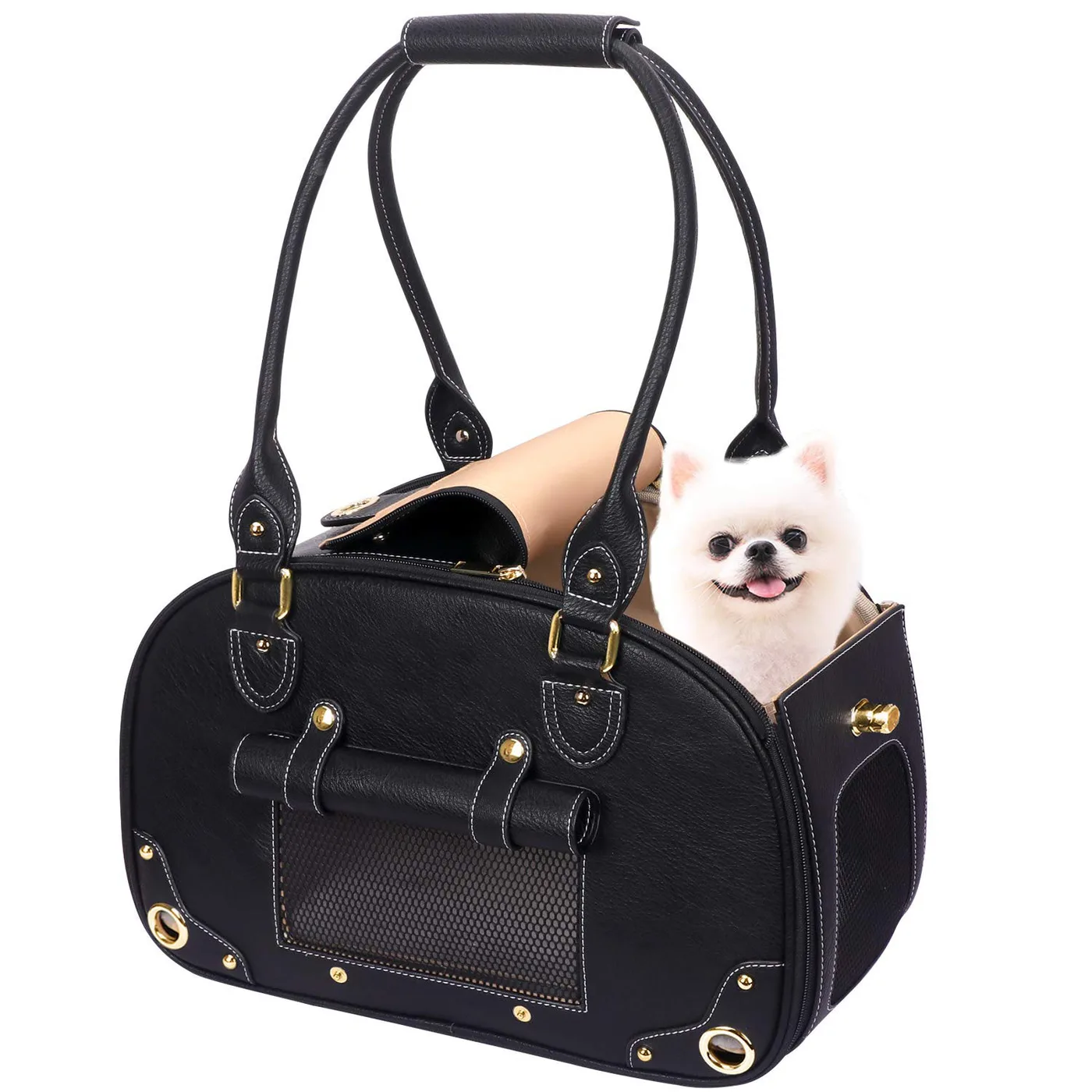
Sill height is the first. The entry sill — the vertical step from the ground or from a table surface to the interior floor — should be at or below 90 mm, and for a product aimed specifically at geriatric or arthritic animals the target is 60-80 mm. That is achieved by a dropped floor section at the aperture, by a shell that opens to a low line, or by a fold-down ramp; the dropped floor is the cheapest at 0.80-2.20 USD and the ramp is the most effective at 2.40-5.60 USD.
Aperture width is the second and it is frequently overlooked. An animal with reduced hind-limb strength enters by placing its forelimbs and dragging, which requires an aperture at least 1.4 times the shoulder width, or 200-280 mm for the adult population. A narrow, tall aperture is the common styling choice and the wrong one here.
Foot purchase is the third and it is what makes a low sill usable. The sill edge needs a coefficient of friction of at least 0.45 and a thickness of 15-25 mm so the animal has something to push against; a thin webbing-bound edge at 3-5 mm offers no purchase and an animal with reduced hind-limb drive cannot use it. An abrasive or elastomeric strip on the sill achieves this at 0.20-0.60 USD.
Reach and interior continuity matter as much as the aperture itself. Once inside, the animal should not have to step over a raised lip or a seam welt to reach the floor; any internal step should be under 20 mm and radiused. A support layer that sits proud of the floor panel by 30-40 mm creates exactly that step, which is why the support layer should be recessed into the panel or the panel should be rebated.
Handles and stability are the last consideration. A carrier that tips while an unsteady animal enters is worse than one with a higher sill; the base should resist tipping at 15 degrees of incline when empty and at 10 degrees when loaded at the aperture edge. Verification is a voluntary-entry trial on a panel of older animals, with acceptance of entry without assistance in at least 85% of trials and no lifting required. Entry is sill height plus aperture width plus foot purchase; a low sill with a narrow aperture and a webbing edge still requires lifting the animal.
Suspension and Vibration Isolation for Arthritic Joints
Vibration is the load that most directly causes discomfort in an arthritic animal, and it is the one least likely to appear in a carrier specification. Road input is broadband and low frequency, and the sensitive band for a joint with degenerative change is lower than for a healthy one.
The input spectrum is the starting point. Vehicle body resonance sits at 1-2 Hz, suspension unsprung resonance at 10-15 Hz, and the dominant energy on a typical road surface falls between 4 and 8 Hz at 0.15-0.45 g on coarse asphalt. A rigid carrier transmits that nearly unattenuated to the animal's contact surface.
The isolation requirement follows: transmissibility should be no more than 1.4 in the 4-8 Hz band, with the pad-animal system's resonance placed below 3.5 Hz so the excitation band falls on the falling part of the transmissibility curve. Placing the resonance that low requires more compliance than a comfort pad normally has, which is why the isolation layer is specified separately from the pressure layer.
A two-stage build is the practical answer. The upper layer handles pressure, with the indentation force deflection and support factor set as described; the lower layer handles isolation, typically 8-14 mm of low-damping closed-cell elastomer or a bonded elastomer pad with a loss factor of 0.15-0.35 at 5 Hz. The two are separated by a stiff spacer so the pressure layer is not pre-compressed by the isolation layer's travel.
Damping is where most designs go wrong. A highly damped material reduces the resonant peak but raises transmissibility above resonance, which is exactly the wrong trade for a 4-8 Hz input. The target loss factor of 0.15-0.35 is a compromise: enough to control the resonant peak and little enough to keep transmissibility falling through the excitation band.
Measurement is straightforward and worth doing before tooling. An accelerometer is mounted on the floor panel and on the top surface of the support layer; the assembly is excited on a shaker table with a 0.3 g sine sweep from 2 to 20 Hz, and transmissibility is computed as the ratio of the two spectra. A swept-sine result is more useful than a road recording because it identifies the resonance directly.
Load sensitivity is the last check, because an isolation layer tuned for a 5 kg animal behaves differently under a 3 kg one: the resonance rises as the mass falls, moving toward the excitation band. The acceptance test therefore runs at 3 kg, 5 kg and 7 kg, with transmissibility at 4-8 Hz under 1.4 at each. Isolation and pressure support are two different layers with two different targets; one soft material cannot do both.
Thermal Support and Draft Control for a Narrowed Comfort Band
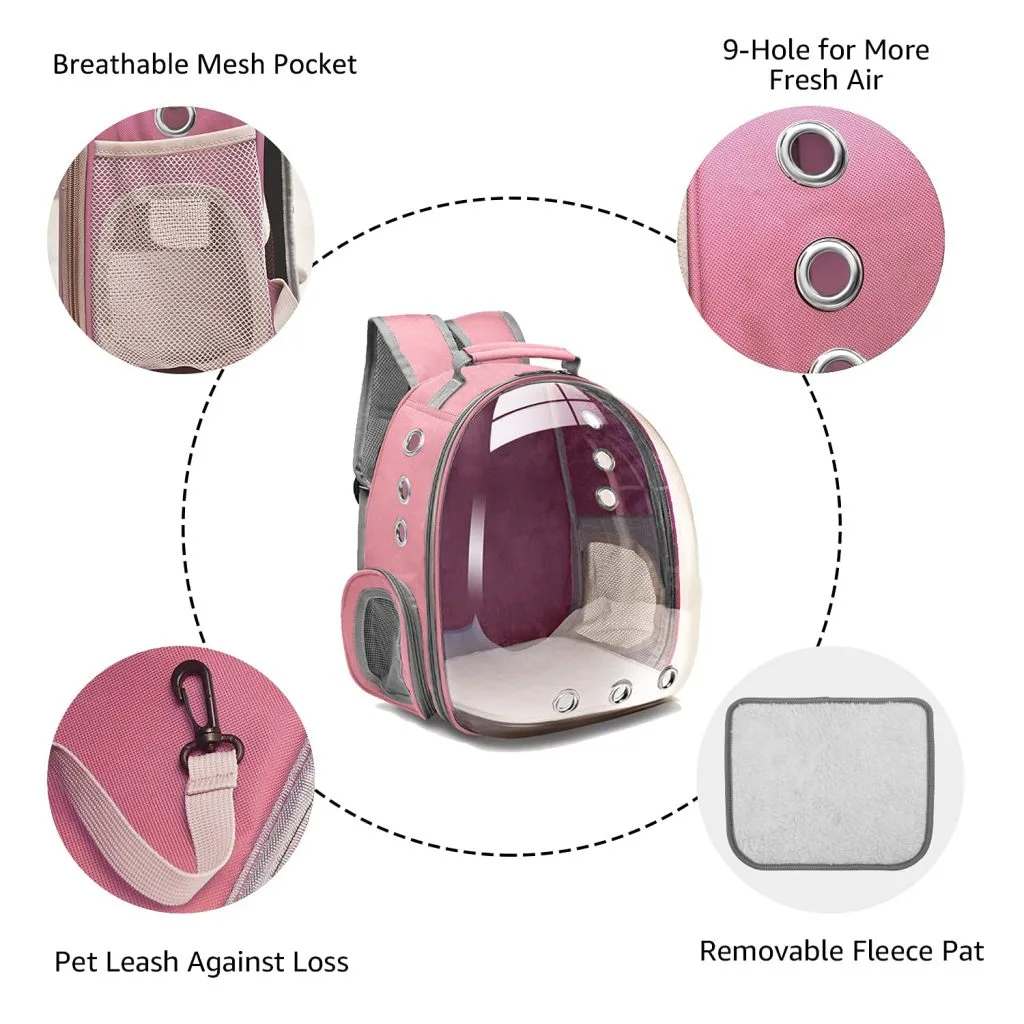
An older cat's comfortable temperature band is roughly 20-26 °C, which is narrow enough that an unmanaged carrier drifts out of it in either direction within an hour. Two mechanisms drive that drift and they need separate answers.
Conductive loss to the floor is the first. A carrier placed on a tile or metal surface loses heat through the floor panel at a rate governed by the panel's thermal resistance; a bare polypropylene panel at 4 mm gives about 0.02 m²K/W, which is effectively no insulation. The requirement is a floor assembly of 0.45-0.70 clo, or roughly 0.070-0.110 m²K/W, achieved with 12-20 mm of wadding at 200-320 g/m² or an 8-12 mm closed-cell layer at 35-50 kg/m³ with a reflective facing.
Convective loss is the second and it is where ventilation and warmth conflict. An aperture sized for air exchange also admits moving air, and an unsteadier animal is less able to reposition out of it. The answer is the same baffling used for kittens but taken further: apertures should be positioned high on the walls and offset from the animal's rest position, with a local air velocity at the animal's position of no more than 0.08 m/s while total exchange area stays above 3.5% of interior surface.
Heat gain is the third case and it is the one that is easy to forget in a geriatric product, which tends to be designed for warmth. A lined carrier in a parked vehicle is a heat trap: internal temperature reaches 45-55 °C in twenty minutes at 30 °C ambient. The mitigation that does not compromise warmth is a reflective outer layer, which reduces solar gain by reflecting short-wave radiation while the insulation layer still resists conductive loss — the two work in the same direction rather than against each other.
Verification is a two-directional temperature-hold test. With the assembly conditioned to 23 °C and a thermal mass representing a 4.5 kg animal at 38 °C inside, time to 20 °C in a 5 °C chamber should exceed ninety minutes, and time to 32 °C in direct simulated sun at 30 °C ambient should exceed forty-five minutes. Both limits are achievable with a reflective outer layer and a lined floor; neither is achievable with a single soft lining.
Condensation is the last item and it appears where insulation is added without a vapour path. A warm, humid interior against a cold outer shell produces condensation at the shell interface, which wets the insulation and destroys its performance; a vapour-permeable inner facing with a moisture vapour transmission rate above 800 g/m² per 24 hours prevents it. Textile safety and chemical declarations for linings in prolonged skin contact are screened against OEKO-TEX criteria. Warmth is a floor insulation and baffling problem, and the reflective layer is what keeps it from becoming a heat trap.
Continence, Cleaning Chemistry and Service Life
A carrier for an older animal is cleaned far more often than a general-purpose one, and the cleaning cycle is the dominant service-life load. Specifying against occasional wiping under-designs the product by roughly an order of magnitude.
Frequency is the first figure. A geriatric product in daily use is cleaned three to seven times a week, or 150-350 cycles a year, against 10-30 for a general carrier. Design targets should therefore be set at 500 cycles for a consumer claim and 1,500 for a professional or shelter claim, with inspection at 25% intervals.
Containment architecture has to resolve a conflict: the comfort layer wants to be a soft, sewn, washable pad, and the liquid wants a welded basin. The resolution used in production is a welded tray in the shell with a sewn comfort pad sitting inside it, so the pad is laundered and the tray is rinsed. The tray needs formed corners at a 25-40 mm radius and a capacity of 300-600 ml above the drain point.
Chemistry is the third requirement and the alkaline end dominates. Urine hydrolyses to pH 8.5-9.5, enzymatic cleaners run pH 7-10, and oxidizing disinfectants sit above that; the interior surfaces therefore have to tolerate pH 6-11 across 300 cycles. That excludes PVC coatings, whose plasticiser is extracted at the alkaline end, and points to thermoplastic polyurethane at 35-45 g/m² or a polyolefin coating.
Seam and weld integrity are checked across the same run. A welded seam should retain a 300 ml water hold after 300 cycles; a sewn seam in the wet zone should be seam-sealed, because an unsealed seam leaks at the stitch line from the first cycle regardless of how tight the stitch is.
Odour retention is the failure that generates returns before any visible failure does. It is measured rather than judged: a sample is soiled with a standard challenge, cleaned by the defined cycle, and assessed by a trained panel against a scale after twenty-four hours, with acceptance of no more than a slight residual after 200 cycles. Odour retention is almost entirely a function of whether liquid reached the foam, which is why the welded tray matters more than any antimicrobial finish.
Health and handling guidance for older animals during transport is normally cross-checked against published material from the American Veterinary Medical Association. Continence converts the carrier into a liquid-handling product, and the welded tray under a washable pad is what makes both requirements survivable.
Sensory Changes: Lighting, Acoustics and Predictable Handling
Sensory decline is the cheapest aspect of a geriatric design to address and the one most likely to be dismissed as cosmetic. Three senses are affected, and each has a specification.
Vision is the first. Reduced contrast sensitivity and lens changes mean an older animal navigates by remembered geometry more than by sight, which makes consistency valuable: the aperture in the same place every time, the support surface at the same height, and nothing that moves or changes shape inside. Practically that means no loose pad that slides, no hanging strap tails, and a support layer fixed at four or more points rather than laid in loose.
Lighting is the companion requirement. Interior illuminance of 20-80 lux gives enough light for an animal with reduced vision to orient without the glare that a bright interior produces; direct sun through a mesh panel gives 800-2,000 lux at the animal's position, which is both a glare and a heat problem. A layered or tinted mesh at the roof, reducing transmission to 15-30%, solves both.
Hearing is the second. Older cats lose high-frequency sensitivity first, so the 500-2,000 Hz transients that matter for a kitten matter less; what matters instead is low-frequency structure-borne noise below 250 Hz, which is felt as much as heard and which the isolation layer already addresses. The remaining specification is simply to avoid stamped metal hardware, which produces broadband transients including the low frequencies.
Tactile cueing is the third and it is the one that makes the product usable for an unsteady animal. A texturally distinct sill strip, a raised edge at the support layer perimeter, and a consistent floor surface together let the animal find its footing without looking. These cost 0.20-0.70 USD combined and are the difference between an animal that settles quickly and one that paces.
Verification combines measurement and behaviour. Illuminance is measured at the animal's head position in direct sun and in shade; interior sound level is logged at 100 mm during a standardised closure and carry sequence with an acceptance of no transient above 60 dB(A); and a settling trial on a panel of older animals records time to first rest, with acceptance of under four minutes in at least 80% of trials.
Cost, Material Selection and Programme Notes
A geriatric-focused build adds 5.20-13.40 USD over a comparable general-purpose carrier, and the money is concentrated in three places: the support layer, the isolation layer and the containment tray. Everything else is small.
The breakdown: the two-layer support assembly at 1.80-4.60 USD, the isolation layer at 1.20-3.10 USD, the welded containment tray at 1.80-3.60 USD, the thermal lining and reflective facing at 1.10-2.60 USD, the low sill and foot-purchase detail at 1.00-2.80 USD, the tinted or layered mesh at 0.40-1.20 USD, and the chemistries and coatings at 0.30-1.10 USD. Against that, a general-purpose carrier's single foam pad at 0.80-1.90 USD is removed.
Material selection should be driven by the two measured parameters rather than by grade names. For the support layer, high-resilience polyurethane at 35-45 kg/m³ with a support factor above 2.3 is the default; latex at 2.6-3.2 is better on support factor and worse on cost, odour and weight; memory foam is a poor choice here despite its reputation, because its low support factor and temperature-sensitive indentation behaviour move it out of specification in a cold vehicle.
Tooling is modest. The welded tray needs a high-frequency electrode at 900-2,200 USD on two to three weeks; the dropped floor section needs a pattern change rather than a tool; and the support layer needs a die at 200-500 USD. A moulded tray would be 9,000-20,000 USD on nine to fourteen weeks and is not justified at one colourway.
Segmentation matters because the clinical segment and the gift segment are different products. A carrier sold to an owner of a fourteen-year-old cat with confirmed joint disease is a clinical product and justifies the full build; a carrier sold as comfort for older pets is a consumer product that justifies the support layer and the low sill but not necessarily the isolation layer or the welded tray. Selling one product into both segments over-builds the consumer one.
Our production team builds geriatric programmes through the SGS-verified production base under ISO 9001 and BSCI coverage, with prototypes in 6-10 working days, bulk production 35-50 days after sample approval, final random inspection to AQL 2.5, T/T 30/70 and FOB Xiamen. The money goes into the support layer, the isolation layer and containment; adding softness instead of those three produces a product that feels better and performs worse.
Why brands source here
- Pet carrier programs run since 2014; founding team in sewn goods since 2004
- SGS-verified production floor of 4,950 m² with 137 workers across 7 lines
- Monthly capacity of 200,000 units, audited to BSCI and ISO 9001
People Also Ask
What makes a cat carrier suitable for a senior cat?
An entry sill at or below 90 mm, a support layer with an indentation force deflection of 90-140 N and a support factor above 2.2, vibration isolation below 1.4 transmissibility at 4-8 Hz, and 0.45-0.70 clo of floor insulation.
Why is a soft foam pad wrong for an arthritic cat?
A soft layer bottoms out under load and raises pressure at the bony prominences above the 4.3 kPa capillary closing threshold. Support factor above 2.2 is what keeps protection at full compression.
How low should the entry sill be?
90 mm or lower, with 60-80 mm as the target for a geriatric-specific product. An affected cat that cleared 700-900 mm at five years manages 250-450 mm at twelve.
How wide should the entry aperture be?
At least 1.4 times shoulder width, or 200-280 mm for the adult population. An animal with reduced hind-limb strength places its forelimbs and drags, which a narrow tall aperture prevents.
What vibration frequency matters for an arthritic animal?
4-8 Hz, where road energy concentrates at 0.15-0.45 g. The pad system resonance should sit below 3.5 Hz so the excitation band falls on the falling part of the transmissibility curve.
How is pressure performance actually measured?
By interface pressure mapping on a 10 mm pitch mat under a compliant former, with acceptance of a peak below 4.0 kPa and a contact area of at least 320 cm² for a 5 kg animal.
What insulation does a senior cat carrier need?
0.45-0.70 clo, or 0.070-0.110 m²K/W, in the floor assembly, with a reflective outer layer and baffled apertures holding local air velocity under 0.08 m/s.
How often is a geriatric carrier cleaned, and what does that require?
150-350 cycles a year, so the target is 500 cycles for a consumer claim. That requires a welded tray of 300-600 ml under a washable pad and coatings tolerant of pH 6-11.
Frequently Asked Questions
What is indentation force deflection and why does it govern the pad?
It is the force needed to compress the layer to 40% of thickness with a standard indenter. Below 90 N the layer bottoms out under a 4-6 kg animal; above 140 N it is too firm to redistribute pressure across the flank.
What is support factor and what value is needed?
The ratio of the 65% to the 25% indentation values, and it should exceed 2.2. Standard polyurethane gives 1.8-2.1, high-resilience polyurethane 2.3-2.8 and latex 2.6-3.2.
Is memory foam a good choice for a senior cat pad?
No. Its low support factor and temperature-sensitive indentation behaviour move it out of specification in a cold vehicle, which is exactly the condition an older animal tolerates least.
Why does the sill need a foot purchase strip?
An animal with reduced hind-limb drive needs something to push against. A webbing-bound edge of 3-5 mm offers no purchase; a 15-25 mm sill with a coefficient of friction of at least 0.45 does.
Why should the support layer be recessed into the floor panel?
A pad sitting 30-40 mm proud of the panel creates an internal step the animal must climb. Any internal step should be under 20 mm and radiused.
How much should the carrier resist tipping during entry?
It should hold at 15 degrees of incline empty and 10 degrees loaded at the aperture edge. A carrier that tips while an unsteady animal enters is worse than one with a higher sill.
Why should the isolation layer be separate from the support layer?
The isolation layer needs a resonance below 3.5 Hz, which requires more compliance than a pressure layer can have while holding its indentation force deflection. A stiff spacer separates them so one does not pre-compress the other.
What loss factor should the isolation material have?
0.15-0.35 at 5 Hz. A highly damped material controls the resonant peak but raises transmissibility above resonance, which is the wrong trade for a 4-8 Hz input.
Why is the isolation test run at three different masses?
Resonance rises as mass falls, moving toward the excitation band. Running at 3, 5 and 7 kg confirms transmissibility stays under 1.4 across the population the grade serves.
How much moisture vapour transmission should the inner facing have?
Above 800 g/m² per 24 hours. Without a vapour path, condensation forms at the cold shell interface, wets the insulation and destroys its performance.
Why is a sewn comfort pad used inside a welded tray?
The comfort layer wants to be soft, sewn and washable, while liquid wants a welded basin. Putting the pad inside the tray lets the pad be laundered and the tray be rinsed.
What interior light level suits an older cat?
20-80 lux, against 800-2,000 lux under direct sun through a mesh roof. A layered or tinted roof mesh transmitting 15-30% solves both the glare and the heat problem.
Why should the support layer be fixed rather than laid in loose?
An animal with reduced contrast sensitivity navigates by remembered geometry, so anything that moves or changes shape inside is disorienting. The layer should be fixed at four or more points.
What acceptance target applies to the settling trial?
Time to first rest under four minutes in at least 80% of trials, with no closure or carry transient above 60 dB(A) measured at 100 mm.
Talk to QUANZHOU JUNYUAN BAGS about a pet carrier program: MOQ 500 pieces per colourway, samples in 6-10 working days, bulk production in 35-50 days under AQL 2.5 inspection.
Get a free quote Request a sample