Cat Carrier Wholesale Price: Cost Breakdown
A cat carrier wholesale quote splits into roughly 52-64% materials, 14-22% direct labour, 8-14% factory overhead, 3-7% compliance and documentation, and 6-11% margin, before freight and duty. On a soft-sided 600D build with a welded liner, that lands at 8.40-14.80 USD FOB Xiamen at MOQ 500 per colourway; a hard-shell EVA build runs 15.20-26.40 USD.
Price is not a number a supplier invents, it is the sum of about thirty line items, and buyers who negotiate on the total without seeing the breakdown usually end up paying more per unit for a product they did not specify. This page opens the bill of materials the way our production team costs it: fabric by denier and coating weight, hardware by alloy and finish, closure and webbing by width and breaking strength, then labour minutes per station, overhead absorption, tooling amortisation and the compliance and documentation layer. Each is given as a band so a buyer can see which lever actually moves the quote; in practice the fabric and coating choice moves it 2.40-6.80 USD, hardware moves it 1.20-4.60 USD, and everything downstream of the sewing line moves it less than 2.00 USD combined. Commercial terms follow the standard programme: MOQ 500 pieces per colourway, prototypes in 6-10 working days, bulk production 35-50 days after sample approval, final random inspection to AQL 2.5, T/T 30/70 and FOB Xiamen.
The difference between one dog carrier factory and another is rarely the stitch count - it is whether the cat carrier pattern survives a 1.5x static load without permanent set.
What Actually Moves a Cat Carrier Quote
A quote for a cat carrier is assembled from a bill of materials, a labour route, an overhead rate and a set of one-off costs amortised over the order quantity. Buyers who understand which of those four is dominant spend their negotiation in the right place; buyers who do not tend to push on margin, which is the smallest and least flexible of them.
Materials dominate and they dominate more than most buyers expect, because a carrier is a fabric-and-hardware product with relatively little processing. On a mid-specification soft carrier, fabric, coating, mesh, webbing, foam, lining and hardware together account for 52-64% of the ex-works price. That figure is the reason specification changes have such a large effect on price, and the reason a 2.00 USD saving on fabric is worth more than a week of negotiation.
Direct labour is the second block at 14-22%, and it is far more stable than buyers assume. A soft carrier consumes 14-26 minutes of direct labour across cutting, sewing, welding, assembly and packing; at a loaded rate of 0.42-0.68 USD per minute depending on region and season, that is 5.90-17.70 USD per unit in the extreme, but in practice 6.40-11.20 USD. Labour is not where the savings are.
Factory overhead — cutting-room rent, equipment depreciation, utilities, quality staff, indirect labour — is absorbed as a percentage of direct labour, typically 55-80%. It is invisible in a quote and it is rarely negotiable, but it explains why two suppliers with identical material costs can differ by 8-12%: the one running higher utilisation absorbs overhead over more units.
One-off costs are the block that behaves non-linearly with quantity, and it is the reason MOQ matters. Tooling, electrodes, dies, printing plates, sample courier and compliance testing are fixed; at 500 units a 2,400 USD electrode costs 4.80 USD per unit, and at 5,000 units it costs 0.48 USD. The single largest controllable driver of unit price after materials is the quantity over which the one-off costs are spread.
Fabric and Trim: Costing by Denier, GSM and Coating Weight
Fabric is priced by the metre but specified by denier, weave and coating weight, and the relationship between the three is what determines cost per unit. A 600D polyester at 210 g/m² with a 30 g/m² PU coating is a different product from a 600D polyester at 190 g/m² with the same coating, and the cheaper one will fail a different test.
Denier sets the yarn cost. 300D, 420D, 600D, 900D and 1680D are the working range for cat carriers, with 600D the default for the shell and 210D or 420D for linings. Moving from 600D to 900D adds 0.55-1.10 USD per metre and typically 0.90-1.80 USD per unit on a mid-size carrier; moving down to 420D saves 0.60-1.40 USD per unit but drops abrasion resistance measurably.
Coating weight is the second lever and the more cost-effective one. A PU coating at 20 g/m² costs less than one at 40 g/m² by 0.18-0.42 USD per metre, but hydrostatic head roughly doubles across that range, which is the difference between a carrier that survives a wet floor and one that strikes through. TPU costs 1.6-2.4 times PU at the same weight and buys hydrolysis resistance and low-temperature flexibility.
| Specification | Price USD/m | Hydrostatic head mm | Abrasion cycles | Delta per unit USD |
|---|---|---|---|---|
| 420D polyester, PU 20 g/m² | 1.30-2.10 | 600-1,000 | 8,000-12,000 | -1.40 to -0.60 |
| 600D polyester, PU 20 g/m² | 1.80-2.90 | 800-1,200 | 12,000-18,000 | Baseline |
| 600D polyester, PU 40 g/m² | 2.20-3.40 | 1,500-2,500 | 15,000-22,000 | +0.50 to +1.30 |
| 900D polyester, TPU 30 g/m² | 3.10-4.80 | 2,000-3,500 | 25,000-40,000 | +1.40 to +2.90 |
| 1680D ballistic nylon, PU | 4.20-6.90 | 1,800-3,000 | 40,000-70,000 | +2.60 to +5.20 |
| Recycled rPET 600D, PU | 2.40-3.90 | 800-1,400 | 12,000-18,000 | +0.40 to +1.10 |
Mesh, webbing and foam are the trim items that quietly add up. A polyester mesh at 220-320 g/m² costs 1.10-2.60 USD per metre; a vinyl-coated polyester mesh, which is the specification that survives clawing, costs 2.40-4.80 USD. Webbing at 20-25 mm with a 600-900 daN breaking strength runs 0.10-0.26 USD per metre; EVA or EPE foam at 45-60 kg/m³ adds 0.30-1.20 USD per unit.
Consumption is where estimation errors occur. A mid-size soft carrier consumes 1.6-2.4 m of shell fabric, 0.5-0.9 m of mesh, 3.5-6.0 m of webbing and 0.4-0.8 m of lining, before waste. Cutting waste of 8-14% on a marker, plus a 3-5% fabric defect allowance, is standard and should appear in the costing rather than being discovered on the line.
Textile chemical compliance is a cost line in its own right and is often omitted from a first quote. Every fabric lining and trim is declared against OEKO-TEX criteria, and testing runs 180-600 USD per material family per colour, amortised over the order. Fabric choice moves unit price by up to 6.80 USD, and denier is the expensive way to buy performance while coating weight is the cheap one.
Hardware, Closures and Structural Components
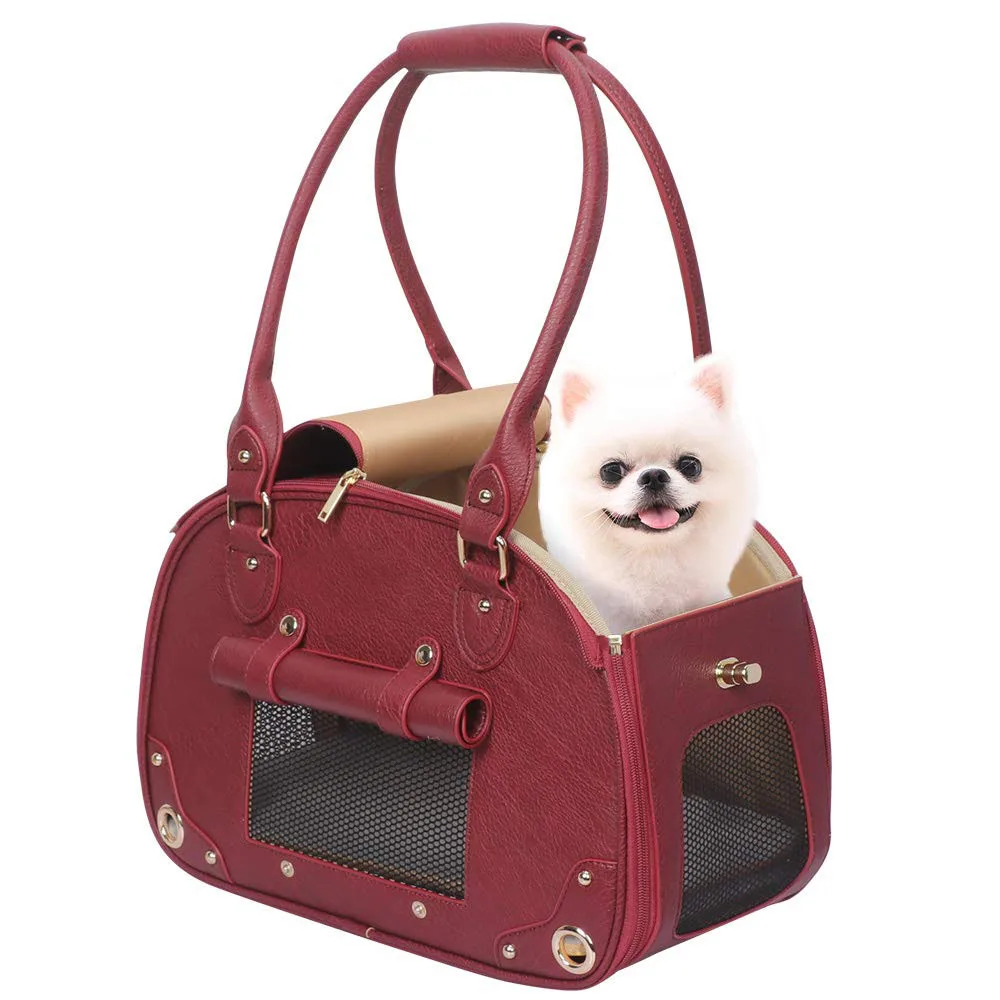
Hardware is the second-largest material block and the one where the gap between a cheap quote and a durable product is widest, because the failure mode is a broken part rather than a worn surface. It is also the block where a buyer can save money without losing visible quality, by specifying fewer and better components.
Zippers are the largest single hardware line. A #5 nylon coil zipper on a mid-size carrier costs 0.55-1.30 USD; a #8 or #10 reverse-coil with a locking slider costs 1.10-2.60 USD; a metal-toothed #5 costs 1.40-3.20 USD and adds weight. The specification that matters is not the brand but the chain type and the slider: a reverse coil with an auto-lock slider is the working choice for a carrier, at 0.90-1.90 USD.
Buckles, adjusters and hooks follow a similar pattern. Acetyl (POM) side-release buckles at 20-25 mm cost 0.12-0.34 USD each and are adequate to 250-400 N; aluminium or steel hardware costs 0.45-1.80 USD and is specified where a buyer wants a metal look or a declared breaking strength above 800 N. A typical carrier carries two to four buckles, two to four adjusters and two hooks, so the difference between acetyl and alloy across the set is 1.10-4.20 USD per unit.
| Component | Entry set USD | Mid set USD | Premium set USD | Typical qty |
|---|---|---|---|---|
| Main zipper, reverse coil | 0.55-0.90 | 0.90-1.60 | 1.60-2.90 | 1-3 |
| Side-release buckle | 0.12-0.20 | 0.20-0.34 | 0.45-1.20 | 2-4 |
| Ladderlock adjuster | 0.06-0.12 | 0.10-0.20 | 0.24-0.60 | 2-4 |
| Swivel hook / snap hook | 0.10-0.18 | 0.16-0.32 | 0.40-0.95 | 2 |
| D-ring or webbing anchor | 0.05-0.10 | 0.08-0.18 | 0.20-0.50 | 2-6 |
| Structural frame / base board | 0.30-0.70 | 0.70-1.60 | 1.80-4.20 | 1 |
| Full set, per unit | 1.60-3.10 | 3.10-5.90 | 6.40-12.60 | — |
Structural components — a base board, a frame, a moulded shell — are the item that changes the product category rather than its grade. A 4-6 mm EVA or PP base board costs 0.70-1.80 USD and gives a soft carrier a flat, load-spreading floor; a moulded EVA hard shell costs 6.00-14.00 USD per unit at volume plus tooling and makes the product a hard-shell carrier.
Finish and plating are worth specifying explicitly because they are a common silent downgrade. Nickel-free plating, black nickel, gunmetal and anodised finishes each add 0.04-0.35 USD per component, and an unspecified "metal colour" will drift between lots. Where a hardware item is in prolonged contact with the animal or the handler, nickel release and lead content are declared against CPSC limits for the US market and REACH Annex XVII for the EU.
Hardware is where 1.20-4.60 USD is decided, and the durable saving is to specify fewer components at a higher grade rather than more at a lower one.
Labour Minutes, Line Efficiency and Overhead Absorption
Labour is costed as minutes per unit across a defined route, multiplied by a loaded hourly rate, and it is the part of the quote most resistant to negotiation because the route is set by the design. Changing the route is the only way to change the cost, and the route is fixed long before costing.
A standard soft carrier route runs: cutting 1.5-3.0 minutes, preparation and sub-assembly 2.0-4.0 minutes, sewing 5.0-11.0 minutes, high-frequency welding or taping 1.0-3.0 minutes, hardware assembly 1.5-3.5 minutes, closing and turning 1.0-2.5 minutes, inspection 0.8-1.8 minutes, packing 0.7-1.6 minutes. Total 13.5-26.4 minutes for a soft carrier and 9.0-18.0 minutes for a moulded hard-shell, which is cheaper to assemble and more expensive to tool.
The loaded rate is not the wage. It is wage plus social contributions, plus indirect labour, plus a share of line supervision, expressed per productive minute, and it runs 0.006-0.011 USD per minute in the production regions used for pet carriers. At 18 minutes and 0.0085 USD per minute, direct labour is 0.15 USD, which is why a quote showing several dollars of labour is showing absorbed overhead as well.
Line utilisation is the hidden variable. A line running at 70% utilisation absorbs the same fixed cost over fewer units than one at 92%, and the difference shows up as 4-9% on the ex-works price. This is one reason a supplier with a full book quotes better than an idle one, and why booking production in a shoulder month — typically February to April or September to early November in this product category — can be worth more than a volume discount.
Design-for-assembly is the buyer's lever. Four specific decisions dominate: reducing the number of separate pattern pieces, using a single webbing width throughout, specifying a closure that does not require a jig, and avoiding a turned-and-topstitched seam where a bound seam will do. Each removes 0.5-2.5 minutes, and four of them together can remove 4-8 minutes, which is 0.03-0.09 USD in direct labour but 0.60-1.90 USD in absorbed cost.
Labour cost is a design outcome, not a negotiation outcome: the route is fixed by the pattern, and the pattern is fixed before costing.
Tooling, Sampling and One-Off Costs Amortised Over Volume
One-off costs are the reason unit price falls steeply between 500 and 3,000 units and then flattens. They are quoted separately in a well-structured programme and buried in the unit price in a poorly-structured one, and the buyer should always insist on seeing them separately.
Tooling for a soft carrier is modest: a cutting die set at 180-650 USD, a high-frequency welding electrode at 900-2,400 USD, screen or plate artwork at 60-260 USD, and a jig or two at 80-400 USD. A hard-shell programme is a different order of magnitude: a thermoforming or injection tool at 9,000-34,000 USD on an eight to fourteen week path, plus a trimming fixture.
Sampling costs are recurring rather than one-off in most programmes, because most buyers iterate. A first prototype costs 120-420 USD in materials and line time plus 40-120 USD in courier; a second and third iteration each cost 80-260 USD. A realistic allowance for a new design is 600-1,400 USD of sampling before approval.
| Order qty (pcs) | Tooling per unit USD | Sampling per unit USD | Testing per unit USD | Total per unit USD |
|---|---|---|---|---|
| 500 | 5.20 | 2.00 | 1.60 | 8.80 |
| 1,000 | 2.60 | 1.00 | 0.80 | 4.40 |
| 2,500 | 1.04 | 0.40 | 0.32 | 1.76 |
| 5,000 | 0.52 | 0.20 | 0.16 | 0.88 |
| 10,000 | 0.26 | 0.10 | 0.08 | 0.44 |
Compliance testing is the one-off cost buyers most often forget to budget. A physical and chemical test package for a carrier — abrasion, tear, seam strength, zipper cycle, colour fastness, plus restricted-substance screening on the fabric and hardware — runs 800-2,800 USD per colourway depending on how much is already covered by existing supplier test reports. Where a material already carries a valid report under one year old, that line drops to 0-300 USD.
The practical consequence for a buyer at MOQ 500 is that one-off costs can add 6-11% to the ex-works price, and the cheapest way to reduce them is not to negotiate them down but to reuse existing tooling, existing electrodes and existing test reports. That means designing within a supplier's existing component library, which is worth more than any discount a first order can extract.
At MOQ 500, one-off costs are typically 8.80 USD per unit; at 5,000 they are 0.88 USD, and that curve is the strongest argument for consolidating colourways.
Compliance, Audit and Documentation Cost
Compliance is a real cost line with three parts: product testing, social and quality system audit, and document preparation per shipment. It is small per unit at volume and large per unit at a first small order, and it is the line most likely to be missing from a competing quote that looks cheaper.
Product testing for the US market is driven by CPSC requirements for consumer products, including lead and phthalate limits on accessible components and a tracking label on the product and its packaging. For the EU, REACH Annex XVII and, where a substance of very high concern is present above 0.1%, an obligation routed through ECHA; California Prop 65 warnings are assessed against the list published by OEHHA.
Physical testing follows published methods rather than internal ones, and this matters for cost because third-party labs price per method. Seam strength, tear strength, abrasion resistance, colour fastness to rubbing and light, zipper cycle life and a load or drop test are the usual set, at 60-260 USD per method per sample. A full package is 900-2,600 USD and is valid for twelve months or until a material change.
System audit is normally already absorbed by the supplier rather than charged per order. The SGS-verified production base used for these programmes runs under ISO 9001 for quality management and BSCI for social compliance, and those certificates are shared with the buyer rather than billed. What is billed is any buyer-specific audit: a customer's own social audit, a brand's security audit, or a second-party quality audit typically costs 400-1,600 USD per visit including correction of findings.
Documentation per shipment is small but unavoidable: a commercial invoice, packing list, certificate of origin, bill of lading, test report copies, a declaration of conformity where required and, for some markets, a fumigation or material declaration. Allow 60-220 USD per shipment in preparation and courier. Where a buyer needs a document legalised or notarised, add 120-400 USD and two to three weeks.
Compliance adds 3-7% to ex-works cost and is the line most likely to be absent from a quote that looks 8% cheaper.
Freight, Duty and Incoterms: From FOB Xiamen to Landed Cost
An FOB Xiamen price and a landed cost are different numbers, and the gap between them is frequently larger than the amount a buyer is negotiating. Freight, insurance, duty, port charges, customs brokerage, inland delivery and currency and financing costs together add 18-52% depending on mode, market and season.
Cat carriers are bulky relative to their weight, which makes them a volumetric freight problem rather than a weight problem. A mid-size soft carrier packed flat measures roughly 480 x 320 x 90 mm; nested in a carton of 10, that is about 14.5 kg and 0.070 m³ per carton, giving a volumetric-to-weight ratio in the region of 5:1 on the air freight divisor of 6,000. That is why sea freight is almost always correct for this product and why flat-pack and nesting decisions have a direct freight consequence.
Sea freight on a 40-foot high-cube container carries 62-68 m³ of usable volume, so a container holds roughly 850-970 cartons of ten carriers, or 8,500-9,700 units, depending on how tightly the product nests. Freight cost per unit at typical rates is therefore 0.60-2.40 USD by sea against 4.80-11.60 USD by air, which is the entire business case for planning around the 35-50 day production window plus transit rather than expediting.
| Cost element | Sea, USD/unit | Air, USD/unit | Note |
|---|---|---|---|
| FOB Xiamen ex-works price | 12.60 | 12.60 | Includes amortised tooling |
| Ocean or air freight | 0.95 | 7.40 | Volumetric on air |
| Insurance, 0.3% of CIF | 0.05 | 0.07 | Institute cargo clauses |
| Import duty, pet textile | 0.76 | 0.76 | 6.0% of FOB, EU indicative |
| Port, THC and brokerage | 0.34 | 0.41 | Per shipment amortised |
| Inland delivery to DC | 0.42 | 0.42 | 300-600 km |
| Landed cost | 15.12 | 21.66 | Before duty deferral benefit |
Incoterms change who carries which of these lines and therefore change the apparent price. FOB Xiamen places risk and cost on the buyer from the ship's rail; CIF adds freight and insurance to the seller's side; DDP adds duty, clearance and inland delivery. A buyer comparing an FOB quote from one supplier with a DDP quote from another is comparing numbers that differ by 20-45% for reasons unrelated to manufacturing.
Duty classification deserves specific attention, because pet carriers are classified differently across markets — as textile travel goods, as plastic articles, or as animal equipment depending on the dominant material — and the duty rate across those headings can differ by 4-11 percentage points. A binding tariff information ruling obtained before the first shipment costs 100-400 USD and removes a recurring uncertainty.
Freight mode is worth 4.80-11.60 USD per unit, which is more than the entire labour content of the product.
Price Bands by Specification Tier and How MOQ Shapes Them
Putting the blocks together produces the bands buyers actually quote against. The numbers below are FOB Xiamen for a mid-size cat carrier — roughly 430 x 300 x 300 mm — at MOQ 500 pieces per colourway, with a welded liner, a reverse-coil zipper set, acetyl hardware and a printed retail box.
An entry soft carrier built on 420D with PU 20 g/m², a sewn lining, acetyl hardware and a plain mailer runs 8.40-11.20 USD. It is a legitimate product for a promotion or an entry price point, and its predictable limits are abrasion life and coating strike-through, which is where the warranty cost of a cheap carrier is incurred.
A mid-tier soft carrier on 600D with PU 40 g/m², a welded removable liner, a reinforced base board, a #8 reverse-coil zipper and a retail box with a hang tag runs 11.80-16.40 USD. This is the band most private-label programmes land in, because it clears the physical and chemical test set without a hard-shell tooling commitment.
A premium soft carrier on 900D TPU with an anti-static grid, a moulded tray, covered zipper chains and a full colour box runs 17.60-24.80 USD. A hard-shell EVA carrier with a moulded shell, a welded liner, metal hardware and a four-colour box runs 15.20-26.40 USD at volume, with the tooling commitment that implies.
| Tier | Materials USD | Labour and overhead USD | One-off amortised USD | FOB band USD |
|---|---|---|---|---|
| Entry soft | 4.60-6.20 | 2.40-3.60 | 1.40-2.20 | 8.40-11.20 |
| Mid soft | 6.80-9.40 | 3.20-4.80 | 1.80-2.80 | 11.80-16.40 |
| Premium soft | 10.60-14.80 | 4.20-6.40 | 2.40-3.60 | 17.60-24.80 |
| Hard shell EVA | 9.20-14.60 | 3.00-5.20 | 3.00-6.60 | 15.20-26.40 |
| Hard shell, ABS/PC | 12.40-19.80 | 3.40-5.80 | 3.60-7.40 | 19.40-32.60 |
Quantity moves these bands by the amortisation curve and by material purchasing, and the effect is front-loaded. Moving from 500 to 1,000 units removes 1.20-3.40 USD; from 1,000 to 2,500 removes a further 0.60-1.60 USD; from 2,500 to 5,000 removes 0.20-0.60 USD. Beyond that, the curve is flat and the remaining levers are material consolidation and design-for-assembly.
Colourway consolidation is the cheapest available lever at low volume and the one most often overlooked. Running three colourways at 500 each costs more per unit than running 1,500 in one colourway, by 0.60-2.20 USD, because fabric is bought in three shorter lots, the line is changed over twice more, and the test package multiplies.
Our production team costs every programme on this structure through the SGS-verified production base, quoting the blocks separately so a buyer can see which lever to pull. Prototypes in 6-10 working days, bulk production 35-50 days after sample approval, final random inspection to AQL 2.5, T/T 30/70 and FOB Xiamen. Ask for the quote in blocks; the total is the least useful number in it.
Production capability
- SGS-verified production space of 4,950 m², 149 machines, 7 assembly lines
- Pet carrier and pet bag output since 2014 from a 137-person team
- 200,000 units shipped monthly under BSCI and ISO 9001 systems
People Also Ask
What is the typical wholesale price of a cat carrier?
FOB Xiamen runs 8.40-11.20 USD for an entry soft carrier, 11.80-16.40 USD for a mid-tier build with a welded liner, and 15.20-26.40 USD for a hard-shell EVA carrier, all at MOQ 500 pieces per colourway.
What percentage of a cat carrier price is materials?
Between 52% and 64% of the ex-works price. Direct labour is 14-22%, overhead 8-14%, compliance 3-7%, and the balance is margin and amortised one-off costs.
How much does MOQ affect unit price?
Going from 500 to 1,000 units removes 1.20-3.40 USD per unit, mostly through tooling amortisation. From 2,500 to 5,000 removes only 0.20-0.60 USD, because the fixed costs are already spread thin.
Why is freight so significant for cat carriers?
The product is bulky and light. A carton of ten nested carriers is about 14.5 kg and 0.070 m³, giving a volumetric ratio near 5:1 on air freight, so air costs 4.80-11.60 USD per unit against 0.60-2.40 USD by sea.
Does choosing 900D fabric cost more than 600D?
Yes, 0.90-1.80 USD per unit more on a mid-size carrier. Coating weight is the cheaper lever: doubling PU coating from 20 to 40 g/m² adds 0.50-1.30 USD and roughly doubles hydrostatic head.
What one-off costs should a first order budget for?
Cutting dies 180-650 USD, a welding electrode 900-2,400 USD, sampling 600-1,400 USD across iterations, and a compliance test package of 800-2,800 USD per colourway.
How is import duty classified for pet carriers?
Classification varies by dominant material — textile travel goods, plastic articles or animal equipment — and the duty rate can differ by 4-11 percentage points. A binding tariff ruling costs 100-400 USD and removes the uncertainty.
Is a cheaper quote usually missing something?
Usually the compliance and testing line, which is 3-7% of ex-works cost. A quote 8% below a competitor's frequently omits third-party testing, a tracking label or a valid restricted-substance report.
Frequently Asked Questions
How many minutes of labour go into a soft cat carrier?
13.5-26.4 minutes across cutting, sub-assembly, sewing, welding, hardware, closing, inspection and packing. A moulded hard shell takes 9.0-18.0 minutes but carries far heavier tooling.
What is a loaded labour rate and why is it not the wage?
It includes wage, social contributions, indirect labour and supervision per productive minute, typically 0.006-0.011 USD. A quote showing dollars of labour is showing absorbed overhead as well.
How much fabric does a mid-size carrier consume?
1.6-2.4 m of shell, 0.5-0.9 m of mesh, 3.5-6.0 m of webbing and 0.4-0.8 m of lining, plus 8-14% cutting waste and a 3-5% fabric defect allowance.
Why is a reverse-coil zipper specified over a standard one?
A reverse coil hides the chain from clawing and, with an auto-lock slider, resists being pushed open from inside. It costs 0.90-1.90 USD against 0.55-0.90 USD for a basic #5 coil.
How much does metal hardware add over acetyl?
Across a full set of buckles, adjusters and hooks, 1.10-4.20 USD per unit. Acetyl is adequate to 250-400 N; alloy is specified where a declared breaking strength above 800 N is needed.
What does a welded liner cost compared with a sewn one?
1.80-3.60 USD against 0.80-2.40 USD for a sewn coated fabric liner. The welded version holds water and rinses clean, which is why it is specified wherever cleaning is part of the use case.
How much tooling does a hard-shell programme require?
A thermoforming or injection tool at 9,000-34,000 USD on an eight to fourteen week path, plus a trimming fixture. That is why hard-shell programmes need a volume commitment beyond MOQ 500.
How long is a third-party test report valid?
Twelve months, or until a material, colour or component changes. Where a material already carries a valid report, the testing line drops from 800-2,800 USD to 0-300 USD.
Why does line utilisation affect the quoted price?
A line at 70% utilisation absorbs the same fixed cost over fewer units than one at 92%, a difference of 4-9% on ex-works price. Booking in a shoulder month can be worth more than a volume discount.
What design decisions reduce assembly time most?
Fewer pattern pieces, a single webbing width throughout, a closure that needs no jig, and bound seams instead of turned-and-topstitched ones. Each removes 0.5-2.5 minutes from the route.
How much does shipping one container of carriers hold?
62-68 m³ of usable volume in a 40-foot high cube, so roughly 850-970 cartons of ten nested carriers, or 8,500-9,700 units depending on how tightly the product nests.
What is the cost of a second or third sample iteration?
80-260 USD each in materials and line time, plus 40-120 USD courier. A realistic allowance for a new design is 600-1,400 USD of sampling before approval.
Does consolidating colourways reduce unit cost?
Yes, by 0.60-2.20 USD. Three colourways at 500 each cost more per unit than 1,500 in one colourway, because fabric is bought in shorter lots, the line changes over more often and the test package multiplies.
What does DDP add over FOB?
Freight, insurance, duty, clearance and inland delivery, typically 20-45% on top of the FOB figure. Comparing an FOB quote against a DDP quote without converting is the most common costing error in this category.
Talk to QUANZHOU JUNYUAN BAGS about a pet carrier program: MOQ 500 pieces per colourway, samples in 6-10 working days, bulk production in 35-50 days under AQL 2.5 inspection.
Get a free quote Request a sample