Dog Carrier Backpack for Corgis: Short Legs Design
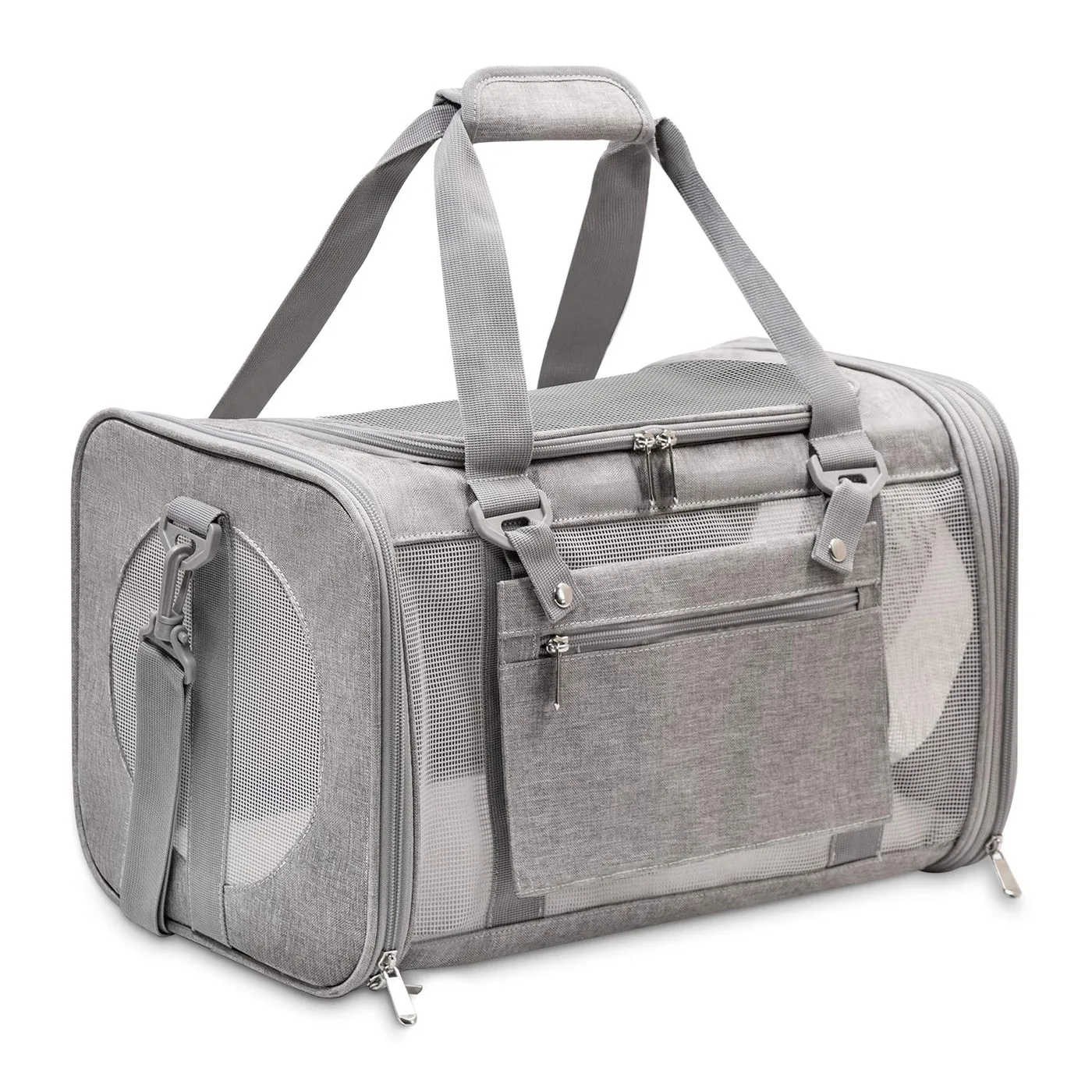
A Corgi-capable carrier is proportioned for a long spine on short limbs: 10-14 kg over a 420-500 mm back length with a withers height of only 250-300 mm. The interior runs 320-380 mm wide by 560-660 mm long by 380-440 mm high, with a full-length flat floor holding a deflection gradient under 1 mm per 100 mm, a step-in sill at 110-150 mm and no interior perch or ledge above the floor plane.
This page addresses a proportion problem rather than a weight problem. The Corgi carries the mass of a mid-size dog on the limb length of a small one, over a spine that is long relative to both, and that combination rules out several features that are harmless in a proportioned breed. Full-length flat support becomes mandatory, entry height becomes a design constraint rather than a convenience, and any interior feature that lifts part of the body off the floor becomes a hazard rather than a comfort. The structural consequence is a floor specified by deflection gradient rather than by maximum deflection, because a long, low body is sensitive to a sloping support in a way a compact body is not. Commercial terms follow the standard program: MOQ 500 pieces per colourway, prototypes in 6-10 working days, bulk production 35-50 days after sample approval, final random inspection to AQL 2.5, T/T 30/70 payment and FOB Xiamen loading.
In a private label pet carrier brief for dog carrier backpack, the artwork file and the label compliance text are the two items that most often delay a first shipment.
Corgi Proportions and the Support Envelope
The defining measurement in this class is the ratio between body length and limb length, and it is the reason a Corgi cannot be specified as a small dog that happens to weigh 12 kg. Back length runs 420-500 mm at the withers-to-tail measurement, while height at the withers is only 250-300 mm. The ratio sits near 1.7-1.8, against roughly 1.1-1.2 for a proportioned breed of similar mass.
Weight is 10-14 kg for the Pembroke variety and 11-17 kg for the Cardigan, so the mass is squarely mid-size while the standing height is that of a much smaller animal. Chest depth is 230-290 mm and chest width 200-250 mm, both substantial, and neck girth runs 320-400 mm.
Derived interiors follow from length and chest depth rather than from height. Length is back length plus 120-160 mm, landing at 560-660 mm; width is chest width plus 120-140 mm, landing at 320-380 mm; height is withers height plus 100-140 mm, landing at 380-440 mm. The result is a compartment that is long, wide and comparatively low — a proportion almost opposite to the tall, short compartments used for the toy breeds.
| Measurement | Corgi | Proportioned 12 kg breed | Design consequence |
|---|---|---|---|
| Back length | 420-500 mm | 430-470 mm | Long interior, full-length support |
| Withers height | 250-300 mm | 430-500 mm | Low compartment, low sill |
| Length to height ratio | 1.7-1.8 | 1.0-1.1 | Flat floor mandatory |
| Chest depth | 230-290 mm | 270-320 mm | Height driven by lying posture |
| Body mass | 10-14 kg | 11-14 kg | Mid-size floor specification |
The support envelope follows directly: the animal must be supported along the entire length of its trunk on a single plane, with nothing that lifts one part of the body relative to another. A raised rear platform, a contoured bolster or a wedge cushion all violate that requirement, and each is a common feature in a generic mid-size carrier. The Corgi specification is a single flat plane supporting the whole trunk, and every interior feature is measured against that rule.
Floor Specification: Flatness and Deflection Gradient
Maximum deflection is the usual floor criterion and it is the wrong one for this class. A floor that deflects 4 mm uniformly under a long body is acceptable; a floor that deflects 4 mm at one end and 0 mm at the other is not, because it puts a long spine on a slope, and the animal cannot stabilise against a slope with short limbs. The governing criterion is therefore the deflection gradient, specified as 1 mm per 100 mm of length or less.
Achieving that at a 560-660 mm span requires stiffness rather than thickness. A 5.0 mm board with a central support rib, or a moulded tray with longitudinal ribs of 12-14 mm on a 45-50 mm pitch, holds the gradient across the full load range. A 4.0 mm board supported only at its perimeter deflects acceptably in the middle but produces a gradient of 2-3 mm per 100 mm near the ends, which is the failure this specification exists to prevent.
Load position matters because the load is not centred. A Corgi's mass is distributed with roughly 55-60% over the forequarters, and the animal shifts between a sternal lie and a standing posture during a journey. The floor is therefore tested at three load positions — forward, central and rear — and the gradient criterion applies at each, not just at the centre.
Flatness in the unloaded state is a separate requirement and is often missed. A floor that is flat at rest and slopes under load fails the gradient test; a floor that is already dished at rest fails it worse. Incoming inspection measures unloaded flatness across a straightedge with a 1 mm feeler, and the production tolerance is set at 1.5 mm across the span.
Surface friction is specified higher here than in most classes, because a low-slung animal with short limbs has less ability to recover from a slide. A coefficient of friction above 0.65, achieved with a moulded EVA mat with 1.5-2.5 mm transverse ribs at 8-12 mm pitch, gives bidirectional grip without presenting a texture deep enough to catch a claw. Flatness is a gradient specification, not a maximum-deflection one, and it is tested at three load positions rather than one.

Entry Geometry and Step-In Height
Entry is where a Corgi-specific design diverges most visibly from a generic mid-size one. A breed with a 250-300 mm withers height cannot clear a 300 mm sill comfortably, and forcing it to do so produces the jumping and scrambling behaviour the specification exists to avoid. The sill becomes a governed dimension rather than a consequence of the pattern.
The working figure is a step-in sill of 110-150 mm at the largest size, achieved by cutting the entry opening down to near floor level rather than by adding a ramp. A ramp is the intuitive answer and is the wrong one: a ramp introduces a slope inside the compartment, violates the flat-plane rule, and gives a short-limbed animal a surface it will slide on. A low, wide opening is correct and a ramp is not.
Opening width is the compensating dimension. If the sill is low, the opening has to be wide enough for the animal to walk in rather than to be lifted, which means an aperture of 320-400 mm at the entry face and a clear interior width of 320-380 mm. A low, wide, walk-in entry is the design goal and it conflicts with the structural preference for a small aperture, which is why the entry is framed.
Framing the low entry costs stiffness at the base, and the cost has to be paid back. A peripheral rail at floor level, tied into the longitudinal ribs at two points and returned up the side panels, restores the bending stiffness the opening removes. Without it, a low-cut entry produces a shell that twists visibly when lifted at one end.
Closure at a low opening is the practical difficulty. A zipper that runs down to 110 mm above the floor is at the animal's level and is the first thing a dog will investigate, so the closure is a covered coil with a 6-8 mm garage and a clip secondary, exactly as it would be for a scent-driven breed. A low sill and a wide framed opening replaced the ramp, and the stiffness removed at the base has to be paid back with a floor-level rail.
Load Distribution and the Spinal Constraint
The reason full-length flat support is treated as mandatory rather than preferable is mechanical. A long spine carried on short limbs has limited ability to absorb a change in support height: the animal cannot flex a limb to level itself, so any step or slope in the support plane is taken up by the spine itself. That is the constraint every interior feature has to be measured against.
Load distribution across the floor shows where the risk concentrates. At a sternal lie the mass splits roughly 57% forequarters and 43% hindquarters over a contact length of 400-480 mm; standing shifts that to a four-point pattern with higher local pressure at each paw. The floor has to be stiff at both, and the rib pattern is pitched at 45-50 mm so that no load position falls between supports.
Interior features are then screened. A bolster, a raised edge, a contoured foam base, a wedge cushion and a divided floor mat all create a height difference within the trunk's support length and are all rejected. Tolerable features are those that do not lift the body: a flat mat, a flat padded floor covering, and a head-end panel that the animal can choose to rest against without being required to.
Dynamic loading is the second half of the constraint. A short-limbed animal cannot absorb vertical acceleration with its limbs, so a bump or a mis-step transmits more of the motion into the spine than it would in a proportioned breed. That is an argument for a damped floor rather than merely a stiff one: a 4-6 mm closed-cell interlayer with a loss factor high enough to shorten the decay, which reduces the peak transmitted acceleration by 20-35% against an undamped floor of the same stiffness.
Wearer-side behaviour is part of the same chain. Because the animal cannot stabilise itself, the wearer's gait matters more at this class, and lateral sway is held to a 25 mm limit rather than the 30 mm used elsewhere. Every interior feature is screened by one question: does it change the height of the support plane under the trunk? If it does, it is out.
Interior Height, Headroom and the No-Perch Rule
Interior height at this class is set by the lying posture plus clearance, not by standing height plus clearance, and the difference is the point. A Corgi rarely stands in a carrier — the compartment is long and low and the animal lies — so the height figure of 380-440 mm comes from chest depth of 230-290 mm plus 100-150 mm of clearance above the back.
That clearance is not arbitrary. Too little and the animal cannot shift from a sternal lie to a lateral one, which it needs to do on a longer journey; too much and the compartment's centre of mass rises, the wearer-side moment arm grows, and the animal can rear up inside. The 100-150 mm band is the working compromise and it is narrower than most designers expect.
The no-perch rule follows from the spinal constraint and covers more features than it first appears to. A raised window ledge, a padded sill, a bolster at the head end, a step at the entry and a raised floor section at the rear are all perches. Each creates a support height difference across the trunk, and each is prohibited by the specification rather than discouraged.
Window placement is affected by the same rule, which is why a Corgi-capable compartment places any viewing aperture at the animal's head height when lying — 180-260 mm above the floor — rather than at the top of the compartment. A window placed high invites the animal to rear up to use it, which loads the spine in exactly the way the design is trying to avoid.
Dimensional tolerance interacts with the rule in a way that is easy to miss. A head-end bolster that is nominally flat can rise 8-12 mm above the floor plane once the mat and the floor covering compress differently under load, and that rise is enough to matter. The control is a tolerance stack on the assembled floor system rather than on each component: the mat, the covering and the board are measured together under a 14 kg load, with a combined rise limit of 3 mm anywhere in the trunk support zone.
Headroom at the entry is the last dimension in this group. The animal has to clear the opening without ducking, which at a withers height of 250-300 mm plus ear allowance means an opening height of 320-380 mm measured from the floor. That is larger than the sill figure alone implies and is the dimension most often cut when a pattern is value-engineered. The no-perch rule is a design screen applied to every interior feature, and it is what separates a Corgi-capable compartment from a short wide box.
Ventilation, Thermal Load and Contact Cooling
A low, wide compartment changes the ventilation problem in two ways. The air volume is spread over a larger footprint and a shorter height, so a horizontal airflow path works better than a vertical stack, and the animal's body occupies a larger fraction of the floor area, which blocks part of the path. Both argue for intake and exhaust placed at the sides rather than at the front and rear.
Open area of 24-30% suits the class, with intake low on both side faces over a wide, short area and exhaust high on the rear face. The cross-flow path runs laterally across the animal rather than along its length, which is more effective in a wide, low volume and avoids drawing air across the animal's face.
Blockage by the body is the practical issue. A long animal lying sternal occupies 400-480 mm of a 560-660 mm floor, and side intake panels placed at the midpoint of the length are partly occluded. The resolution is to split intake into two panels per side, placed at 25% and 75% of the length, so at least one pair stays clear of the body in any posture.
Thermal behaviour is governed by contact rather than by convection at this class. A low-slung animal with a dense double coat has a large contact area with the floor and dumps a meaningful fraction of its heat through it, so the floor should stay relatively conductive — a coated surface rather than a thick insulating foam — while the roof carries a 4-6 mm insulating layer. That is the same asymmetry used for heat-sensitive small animals and it applies here for a different reason.
Acceptance is measured, not assumed: interior temperature and humidity logged at the lying position for 60 minutes in chambers at 12 °C and 28 °C, with a temperature rise under 4 °C and a relative humidity under 72% at the warm extreme. Animal welfare framing for transport is commonly cross-checked against guidance from the American Veterinary Medical Association.
Test Protocol for Corgi-Class Release
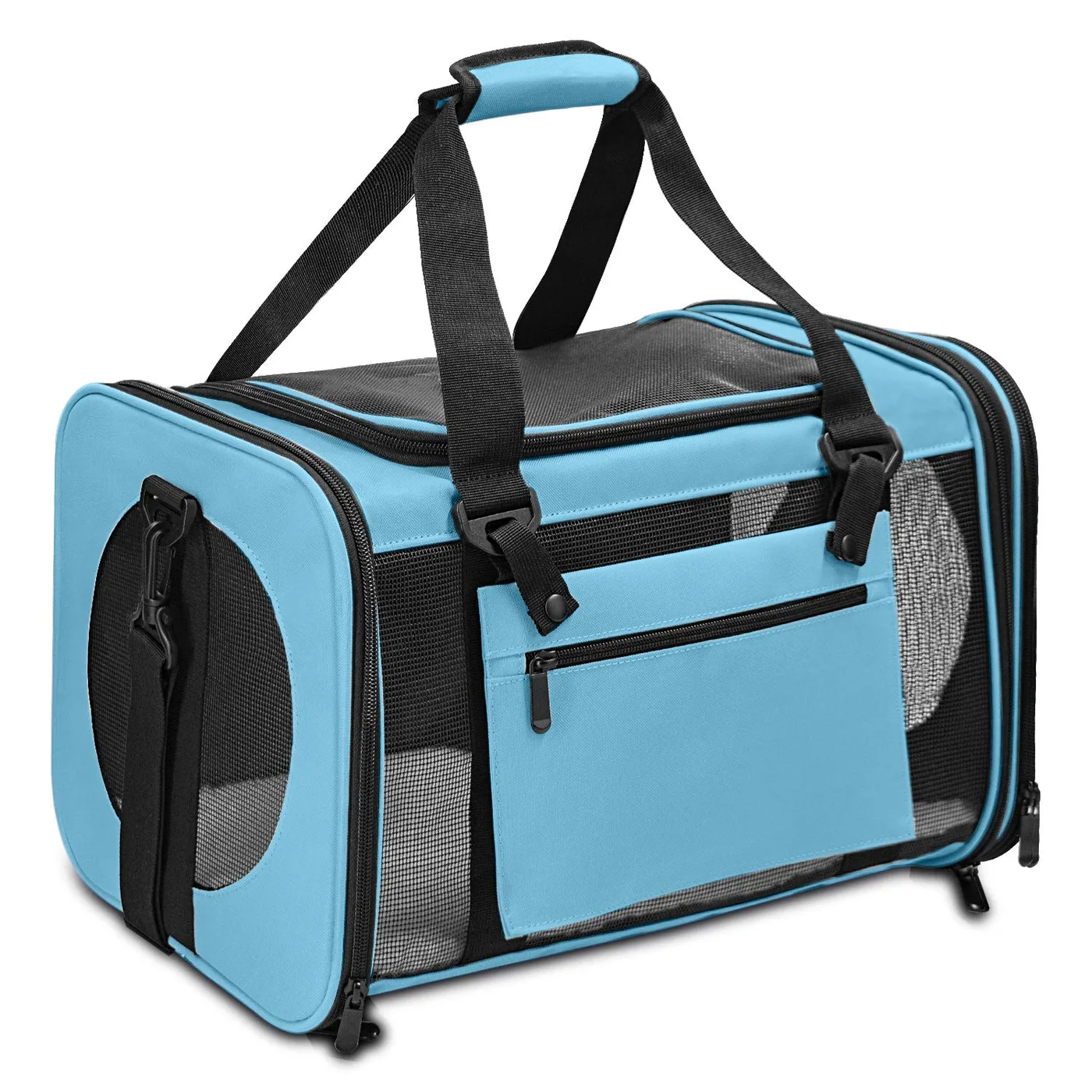
Corgi-class release runs the mid-size protocol with three proportion-specific additions: a deflection gradient test at three load positions, a step-in test with a live-fit panel or a dimensional gauge, and an interior feature screen against the no-perch rule. The additions are dimensional and cheap, which makes the class straightforward to qualify.
The gradient test is the core addition. A 14 kg load is applied at forward, central and rear positions in turn, and floor profile is measured with a dial gauge at 50 mm intervals along the length. Acceptance is a gradient under 1 mm per 100 mm at every position and an absolute deflection under 4 mm. Unloaded flatness is checked first with a straightedge and a 1.5 mm tolerance.
Structural testing is standard for the mass. Rated load of 16 kg, static proof at 64 kg for 60 seconds, then 10,000 cycles at 24 kg at 0.5 Hz with acceptance of no seam opening above 2 mm and no permanent set above 1 mm. Attachment testing runs at 5x carried mass on the shoulder straps and 4x on the hip belt, with a low-cut entry frame tested separately in torsion since that is where the opening costs stiffness.
The step-in test uses a dimensional gauge rather than an animal: a 150 mm sill height gauge and a 320 mm width gauge must pass through the opening with the closure open, and the floor at the opening must be within 3 mm of the plane of the main floor. The feature screen is a documented checklist applied at design review and again at first article, verifying that no interior element changes support height across the trunk length.
Conditioning and method references follow practice published by ASTM International, and quality system requirements are held to ISO 9001. Every report records measured values rather than pass or fail, so drift across lots is visible before it becomes a field problem.
Cost, MOQ and Programme Notes
A Corgi-capable build costs modestly more than a generic mid-size carrier, and almost all of the increment is in the floor. The ribbed tray or stiffened board adds 2.20-4.40 USD over a standard board, the floor-level rail that restores the stiffness removed by the low entry adds 1.20-2.40 USD, the damping interlayer adds 0.35-0.75 USD, the high-friction mat adds 0.50-1.10 USD, and the framed low closure adds 1.40-2.80 USD. Total unit cost lands at 21-34 USD FOB.
Tooling depends on the floor decision. A moulded ribbed tray runs 7,000-14,000 USD on a ten to fourteen week path and is the correct answer at volume; a die-cut laminated board with bonded rails costs 1.00-2.00 USD more per unit and no tooling, and is the right answer for a first programme. The gradient criterion is achievable either way, which is worth noting because it is not true at the large-breed class.
MOQ is 500 pieces per colourway as usual. The commercial caution for this class is about proportion rather than quantity: the product looks like a wide, short box, and buyers comparing on interior volume will judge it as smaller than a taller carrier of the same litres. The retail copy should lead with floor length and the flat-support specification, which is where the value actually is.
Range planning deserves a closing note. The Corgi interior is close enough to the Dachshund pattern that a single platform can serve both with a gusset change, and both are long-and-low classes with the same support rule. A programme that develops the long-low platform once and derives two breed SKUs from it recovers the floor tooling across twice the volume.
Schedule and commercial terms are unchanged: prototypes in 6-10 working days once the floor and entry decisions are frozen, bulk production 35-50 days after approval, final random inspection to AQL 2.5 with gradient and step-in checks added to the defect list, T/T 30/70 and FOB Xiamen. The Corgi class is the clearest example in the range of proportion overriding mass: the specification is a flat plane, a low sill and a gradient limit.
Production capability
- SGS-verified production space of 4,950 m², 149 machines, 7 assembly lines
- Pet carrier and pet bag output since 2014 from a 137-person team
- 200,000 units shipped monthly under BSCI and ISO 9001 systems
People Also Ask
Why does a Corgi need a flat floor rather than a contoured one?
A long spine on short limbs cannot absorb a change in support height, so any step or slope is taken up by the spine. The rule is one flat plane supporting the whole trunk, with a deflection gradient under 1 mm per 100 mm.
What interior size suits a Corgi?
320-380 mm wide by 560-660 mm long by 380-440 mm high, derived from a 420-500 mm back length. Height follows the lying posture and chest depth, not standing height.
Why is a ramp the wrong answer for a short-legged breed?
A ramp introduces a slope inside the compartment, violates the flat-plane rule, and gives a short-limbed animal a surface to slide on. A low wide walk-in opening at a 110-150 mm sill is correct.
What is a deflection gradient and why does it matter here?
The change in floor height per unit of length, limited to 1 mm per 100 mm. A uniform 4 mm sag is tolerable; a floor that sags at one end and not the other puts a long spine on a slope.
Which interior features are prohibited?
Anything that changes the support height under the trunk: bolsters, raised edges, contoured foam bases, wedge cushions, padded sills and raised rear platforms. Flat mats and flat padded coverings are acceptable.
How much ventilation does a Corgi need?
24-30% open area, with intake split into pairs at 25% and 75% of the length on both side faces so the body cannot occlude the whole path, and rear exhaust high.
Frequently Asked Questions
What rated load suits the Corgi class?
16 kg against a 10-14 kg animal, with a static proof of 64 kg and a 10,000-cycle fatigue run at 24 kg. The Cardigan variety at 17 kg sits at the top of the band and should be sized upward.
Why is the floor tested at three load positions?
Mass splits roughly 57% forequarters and 43% hindquarters at a sternal lie and shifts when standing. The gradient limit has to hold at forward, central and rear positions, not only at the centre.
What friction coefficient is required on the floor?
Above 0.65, using a moulded EVA mat with 1.5-2.5 mm transverse ribs at 8-12 mm pitch. A low-slung animal with short limbs has less ability to recover from a slide.
Why is the floor left conductive while the roof is insulated?
A low-slung animal with a dense coat has a large floor contact area and dumps a meaningful fraction of its heat through it. Insulating the floor removes that path; insulating the roof slows solar gain.
How wide must the entry opening be?
320-400 mm at the entry face with a clear interior width of 320-380 mm, so the animal walks in rather than being lifted. Width compensates for the low sill.
What opening height is needed above the floor?
320-380 mm measured from the floor, covering a 250-300 mm withers height plus ear allowance. This is the dimension most often cut during value engineering.
Where should a viewing window be placed?
At 180-260 mm above the floor, the animal's head height when lying. A window placed high invites rearing, which loads the spine.
How is the low-cut entry framed?
A peripheral rail at floor level tied into the longitudinal ribs at two points and returned up the side panels. Without it the shell twists visibly when lifted at one end.
What closure suits a low opening?
A covered coil with a 6-8 mm garage and a clip secondary. A zipper 110 mm above the floor is at the animal's level and will be investigated.
Why is lateral sway limited to 25 mm?
The animal cannot stabilise itself with short limbs, so more of the wearer's motion is transmitted to the spine. The limit is tightened from the 30 mm used for proportioned breeds.
How is the step-in test performed?
A 150 mm sill gauge and a 320 mm width gauge must pass through the open closure, and the floor at the opening must sit within 3 mm of the plane of the main floor.
What does the damping interlayer buy?
A 4-6 mm closed-cell layer shortens the decay of floor motion and reduces peak transmitted acceleration by 20-35% against an undamped floor of the same stiffness, for 0.35-0.75 USD.
Can the platform be shared with another breed?
Yes. The long-low platform serves the Dachshund class with only a gusset change, and both share the flat-support rule, which recovers the floor tooling across two breed SKUs.
What is the expected FOB unit cost?
21-34 USD, with the ribbed or stiffened floor at 2.20-4.40, the floor-level rail at 1.20-2.40, damping at 0.35-0.75, the high-friction mat at 0.50-1.10 and the framed low closure at 1.40-2.80 USD.
Talk to QUANZHOU JUNYUAN BAGS about a pet carrier program: MOQ 500 pieces per colourway, samples in 6-10 working days, bulk production in 35-50 days under AQL 2.5 inspection.
Get a free quote Request a sample