Dog Carrier Backpack for Golden Retrievers: Family Dog
A Golden Retriever-class carrier is specified for 25-34 kg and, more importantly, for a family duty cycle: roughly 300 clean cycles and 5,000 closure operations over three years. Specify coated 900D with hydrolysis-resistant TPU, a welded floor basin, a number 10 zipper validated to 5,000 cycles, colourfastness above grade 4 and small-parts screening to CPSC limits.
This page treats the Golden Retriever class as a duty-cycle problem rather than a weight problem. The mass band is unremarkable; what is unusual is how the product is used. A family carrier is cleaned repeatedly, operated by several people of different sizes, left in a vehicle, exposed to sunscreen and lawn chemicals, and handled by children. Each of those is a specification item that a weight-driven tech pack omits. The sections below cover the envelope, the cleaning chemistry, closure cycle life, colour and odour retention, child-safety controls and a service-life validation regime built around cycles rather than single events. Commercial terms follow the standard programme: MOQ 500 pieces per colourway, prototypes in 6-10 working days, bulk production 35-50 days after sample approval, final random inspection to AQL 2.5, T/T 30/70 payment and FOB Xiamen loading. Data quoted here comes from our production team at SGS-verified production base partner facilities certified to ISO 9001 and BSCI.
A dog carrier manufacturer is expected to hold the dog carrier backpack pattern card for at least twelve months, so a reorder matches the approved sample rather than drifting.
Duty Cycle Definition: How a Family-Use Product Is Actually Used
Engineering a product for a family with a retriever starts from use frequency rather than from the animal. A working or sport carrier might be used twice a month. A family carrier is used one to three times a week for veterinary visits, travel and grooming, which is 50-150 uses a year and 150-450 over a three-year service life. Each use is followed by a clean, so the cleaning specification is not a secondary consideration — it is the dominant ageing mechanism in the product.
The duty cycle therefore has four drivers: mechanical load from the animal, wet cleaning cycles, chemical exposure from cleaners and from the environments the product sits in, and operator variance from multiple users. Only the first appears in a conventional tech pack, and only the first is routinely tested.
Quantifying the cycle is the first engineering task. A realistic model for the class is 300 clean cycles at 40 °C, 5,000 closure operations, 2,000 shoulder strap adjustments, 600 vehicle loading events with the associated abrasion and ultraviolet exposure, and continuous ultraviolet and thermal exposure for a product that lives in a car or a hallway rather than a cupboard. Each of those numbers maps to a test in the validation section, and the product is accepted or rejected against the cycle rather than against a single proof load.
Operator variance is the second driver with no equivalent in a professional product. A carrier used by two adults and a teenager will be adjusted through a far wider strap range, loaded by people with different lifting technique, and set down on different surfaces. Adjustment hardware has to survive 2,000 cycles across the full range rather than at one setting, and the strap root has to tolerate loading at angles a single trained user would never produce.
Environmental exposure completes the picture. Family products encounter sunscreen, insect repellent, lawn fertiliser residue and, in a vehicle, prolonged temperatures above 60 °C. Each is a chemical aggression that a coated textile must be declared against, and sunscreens in particular are aggressive plasticisers that attack both PU coatings and some printed inks.
The conclusion is a specification method rather than a single number. A family-class carrier is engineered to a stated cycle count across mechanical, chemical and thermal axes, and the tech pack declares the cycle rather than implying it.
Mass and Geometry: The 25-34 kg Retriever Envelope
Golden Retrievers run 25-34 kg for adult males and 25-32 kg for females, with field-line individuals at the lower end and some show-line males above 36 kg. The declared envelope for a single stock-keeping unit is 25-34 kg, and the structural rating follows the standard convention: working load at 1.5 times declared maximum, so 51 kg, proof at three times, so 102 kg, and ultimate at 4.5 times, so 153 kg.
Body dimensions are moderate and forgiving compared with the long-backed breeds. Body length runs 640-720 mm nose to tail base, height at the shoulder 540-610 mm, chest girth 70-90 cm and chest depth 250-300 mm. Derived interior dimensions of 400-460 mm wide, 700-790 mm long and 540-620 mm high cover the envelope without the extreme span that drives frame requirements in the Shepherd class.
That moderate geometry has a useful consequence: the span is short enough that a soft shell with a stiff floor works, and a perimeter frame is optional rather than mandatory. At 700-790 mm the mid-span deflection of a 10 mm board stays inside the 4 mm limit at working load, so the product can be built without the 3.20-7.80 USD frame cost and the associated flat-pack complexity.
The breed's build does, however, put a specific demand on the floor: retrievers are broad and heavy through the chest and forequarters, and they settle in a sternal position with the chest carrying most of the mass. Load distribution is front-biased at roughly 55:45, which is the opposite of the Shepherd case and changes where the floor joint needs its bar-tacks. Testing ballast is distributed accordingly.
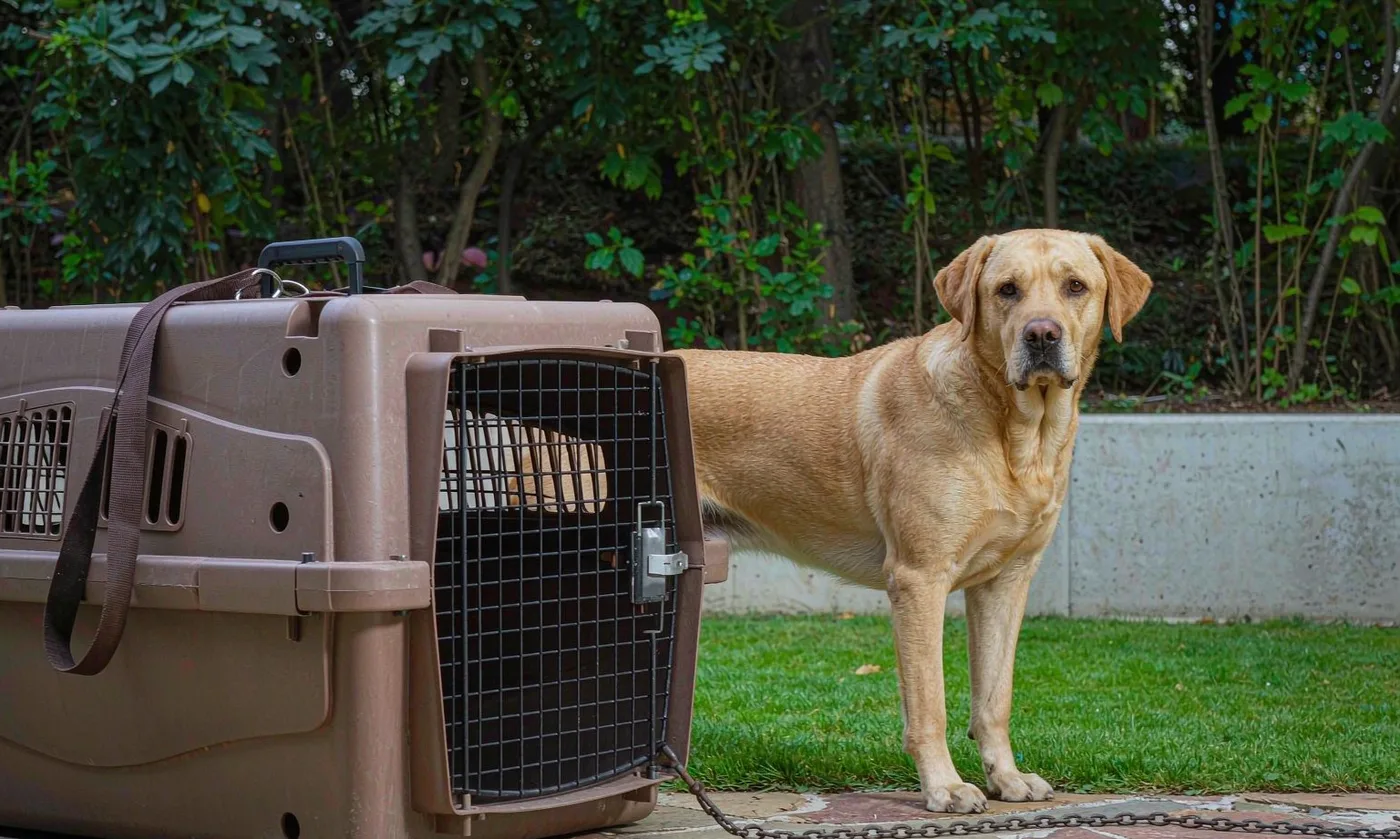
Coat is the second breed-specific input. A Golden carries a dense, water-repellent double coat with a heavy seasonal shed, and the coat holds water: a dog that has been swimming carries 0.8-1.6 kg of water in its coat into the compartment. The floor specification therefore includes genuine liquid containment rather than the token splash resistance of a small-breed product, and the lining has to dry within a realistic window or it will mildew.
Interior proportion closes the geometry section. Retrievers tolerate a lying posture more readily than the standing breeds, so the interior can be 60-80 mm lower than a standing-class product of the same footprint, which reduces cube by roughly 12-15% and is a direct freight benefit at this size.
Cleaning Chemistry: Detergent, Enzyme and Disinfectant Exposure
Cleaning is the dominant ageing mechanism in a family-class product, and it is specified as a chemistry problem rather than as a laundering instruction. Three agent families are in play: anionic and non-ionic detergents at 40 °C, enzyme cleaners used for organic soiling, and oxidative or quaternary disinfectants used after a veterinary visit or an accident. Each attacks the coating, the print and the thread differently.
Polyurethane coatings are the weak point. Aromatic PU hydrolyses in warm, alkaline, wet conditions, and a domestic wash at 40 °C with a pH 9-10 detergent is exactly that environment. The visible result is coating chalking and then flaking at fold lines after 60-100 cycles, which is well inside the 300-cycle target. Aliphatic PU resists better at 150-250 cycles; TPU and polyolefin coatings reach the full 300. The specification for the class is therefore a TPU or PVC-free polyolefin coating at 45-60 g/m² of dry solids, with PU restricted to non-critical trim.
Enzyme cleaners are the second risk and are usually omitted from the test plan entirely. Protease and amylase formulations are marketed specifically for pet soiling, they are used at high concentration and left to dwell, and they attack the protein-based finishes and some adhesives used in laminated constructions. Testing should include a 30-minute dwell with a protease cleaner at label concentration, repeated 50 times, with acceptance of no coating softening, no delamination and no colour change above grade 4.
Disinfectants matter because a family product is disinfected after any veterinary visit. Quaternary ammonium compounds are generally benign to coated polyester; chlorine-releasing agents and accelerated hydrogen peroxide are not, and both are used in clinics. The declaration is a compatible-agents list on the care label rather than an instruction to test every formulation, and the list itself is generated from a 50-cycle test on the three most aggressive common agents.
Thread and hardware are part of the same specification. Bonded polyester thread resists the chemistry well; bonded nylon loses strength slowly in chlorine environments. Coated metal hardware survives; untreated zinc alloy corrodes visibly after 30-50 disinfection cycles, and the specification is a clear-coated or stainless finish on anything a user will touch after cleaning. Verification of all of this is a 300-cycle wash test with inspection at 50, 100, 200 and 300 cycles, recording coating condition, seam integrity, dimensional change and colour.
Closure and Zipper Cycle Life Under Family Use
A family product is opened and closed far more often than any other class, and the closure is the component that fails first. The usage model is four operations per use — open, close, open, close — at 100-150 uses a year, which is 400-600 a year and 1,200-1,800 over three years. That figure understates reality because a family product is also opened for cleaning, for storage and by children, and the specification is set at 5,000 cycles with a safety margin rather than at the arithmetic minimum.
Chain selection follows. A number 8 coil is adequate for a professional product and marginal here; number 10 coil or number 8 metal chain is the specification, with a declared lateral strength near 900 N and a slider tested to 5,000 cycles under a 150 N spreading load. Coil zippers outlast metal in this application because a metal chain accumulates grit and hair in the teeth, and grit is abrasive to the slider.
Slider specification is where most programmes go wrong. A non-locking slider walks open under vibration and is the single most common cause of a pet escaping a soft carrier. Locking sliders are mandatory, the pull is specified at a size a gloved adult and a nine-year-old can both operate, and the slider is tested for retention after 5,000 cycles with no measurable increase in the force required to lock it.
Hair and grit ingress into the coil is the specific failure mechanism in a retriever product, and two controls address it. A zipper garage with a covered coil at the termination keeps the coil out of the accumulation zone, and a storm flap over the full length of the closure keeps hair out of the teeth during use. Both are cheap; neither is optional.
The secondary restraint matters more in a family product than anywhere else, because the operator may be a child who has not fully closed the zipper. A snap-hook or a strap closure that carries load independently of the zipper means a partially closed product is still a contained product. This is also the argument the CPSC-facing risk assessment uses when a buyer asks how escape is prevented, and the general product safety framework maintained by the U.S. Consumer Product Safety Commission is the reference most retailers cite.
Interior tethering is specified as standard: 20 mm webbing, 300 mm effective length, 1.5 kN clip, anchored to a reinforced panel rather than to the lining. It is a containment device and a loading aid at the same time, and it reduces the lateral load on the closure during loading by keeping the animal from pushing against a partly closed opening.
Colourfastness, Odour Retention and Lining Specification
Appearance retention is a commercial requirement in the family class in a way it is not in a working product. A carrier that looks grey and smells of dog after one season generates returns and bad reviews regardless of whether it is structurally sound, and both problems are specification failures rather than user errors.
Colourfastness is specified against four agents, not one. Wash fastness at 40 °C to grade 4 or better, rub fastness dry and wet to grade 4, light fastness to grade 5 for a product that lives in a vehicle, and — the one usually omitted — fastness to disinfection, tested with the three declared agents and accepted at grade 4. Solution-dyed yarn is preferred where colourway volume supports the minimum because it holds light fastness far better than piece-dyed fabric and it resists the fading that ultraviolet exposure through a car window produces.
Odour retention is a lining problem, not a fabric one. Volatile compounds from the coat, from saliva and from any accident are absorbed by foam and by needle-punched non-wovens, and they are released slowly over months. The specification is a closed-cell, non-absorbent lining over any foam, thermally bonded rather than resin-bonded so it does not contribute its own odour, and a removable mat that can be washed at 60 °C.
Antimicrobial finishes are frequently requested and should be handled carefully. A silver-based or quaternary finish on the lining reduces odour-causing bacterial growth measurably, but biocidal finishes on an article in prolonged skin contact are regulated in the European Union and the substance has to be an approved active under the biocidal products regime administered by ECHA. The practical answer for a stock programme is no biocidal claim at all and an odour-control strategy built on washable, non-absorbent materials instead.
Mildew resistance closes the lining specification. A retriever enters the compartment with up to 1.6 kg of water in its coat, the lining will be wet for hours, and a product stored in a hallway cupboard between uses will mildew. The controls are a hydrophobic lining, ventilation that stays open when the product is stored, and a 14-day humidity chamber test at 30 °C and 90% relative humidity with no fungal growth on the lining or the mat.
Colour selection is a final commercial note with an engineering basis. Mid-tone interiors with a small-scale pattern hide hair and soiling better than either extreme, and a light solid interior should not be specified for this class without a soil-release finish rated to 50 wash cycles.
Child-Safety and Small-Parts Controls
A family product is handled by children and is within reach of children when it is not in use, which brings a set of requirements that have nothing to do with the dog. These are screening requirements rather than performance requirements, and they are cheap to satisfy at design stage and expensive to retrofit.
Small parts is the first control. Any detachable component that fits entirely within the 31.7 mm by 57.1 mm small-parts cylinder is a choking hazard and must either be eliminated or be tested to a 90 N pull force in every direction. In practice this rules out decorative rivets, small logo plates, detachable charm tags and press-stud trims, and it requires specified pull testing on any snap fastener or eyelet.
Sharp edges and points is the second. Frame ends, tube cut ends and any stamped hardware need a deburr and a radius, and a probe test is applied to every edge a hand can reach. This is a straightforward inspection item but it has to be written into the inspection plan, because a burr on a cut tube is invisible in a finished-unit visual check and is found only when someone is cut.
Cord and strap lengths matter because a long loose strap is an entanglement hazard. Any strap that can form a loop larger than 360 mm in circumference and that hangs from the product is either shortened or provided with a retainer, and the adjusters are specified to stay where they are set so a loop does not form during use.
Chemical screening is the fourth control and is the one where the family class is held to a higher standard than a professional product. Children mouth objects, so the accessible materials are screened for restricted substances beyond the general REACH obligation, and programmes sold in California additionally carry a Proposition 65 assessment against the substance list maintained by the Office of Environmental Health Hazard Assessment. Lead in coatings and substrates and phthalates in any flexible polymer are the two that most often need a declaration.
Flammability is a minor requirement for a pet carrier but is asked for by some retailers, and a simple 1-second flame-contact test on the exterior fabric with a burn rate under 100 mm per minute is usually sufficient documentation.
Fatigue and Service-Life Validation: Cycles, Not Events
The validation regime for the class is built around cycle counts, because the failure modes are fatigue and chemical ageing rather than overload. It runs in parallel tracks rather than in sequence: a mechanical track, a chemical track and an environmental track, all applied to the same sample set so that interactions are visible.
The mechanical track applies 5,000 closure cycles under a 150 N spreading load, 2,000 strap adjustment cycles across the full range under 400 N, 10,000 floor joint cycles between 30% and 90% of working load, and 500 set-down events onto a concrete edge from 200 mm with the rated ballast in place. Acceptance is functional throughout, with no seam opening above 6 mm, no hardware deformation and no loss of slider locking force.
The chemical track runs 300 wash cycles at 40 °C with a pH 9-10 detergent, 50 enzyme-cleaner dwells at label concentration and 50 disinfection cycles with each of three declared agents. Units are inspected at 50, 100, 200 and 300 cycles for coating condition, seam integrity, dimensional change within 2% and colourfastness grade.
The environmental track is 500 hours of ultraviolet exposure for a product that lives in a vehicle, 500 thermal cycles between minus 10 °C and 60 °C, and a 14-day humidity chamber hold for mildew. Ultraviolet is the one that produces most failures, and it is the reason solution-dyed yarn and an ultraviolet stabiliser package in the coating are both specified.
| Track | Cycles or duration | Load or agent | Acceptance |
|---|---|---|---|
| Closure | 5,000 | 150 N spreading load | Locks throughout, no coil wear-through |
| Strap adjustment | 2,000 full range | 400 N | No slip, no webbing glazing |
| Floor joint | 10,000 | 30-90% of 51 kg WLL | No opening over 6 mm |
| Set-down | 500 | 200 mm onto concrete edge | No seam or board damage |
| Wash | 300 at 40 °C | pH 9-10 detergent | Coating intact, dimension within 2% |
| Enzyme cleaner | 50 dwells, 30 min | Protease at label strength | No softening or delamination |
| Disinfection | 50 per agent, 3 agents | Quaternary, peroxide, chlorine | Colour grade 4 or better |
| Ultraviolet and thermal | 500 h UV, 500 cycles | -10 °C to 60 °C | Light fastness grade 5, no embrittlement |
Sampling closes the regime. One sample set per colourway at development, and one pulled unit per 5,000 in production re-tested on the mechanical track only. Reports are dated and retained, and the cycle counts are stated on the product specification rather than being implied by a single proof-load certificate, because a proof load says nothing about cycle life.
Cost, Packaging and Programme Parameters
Unit cost for a compliant family-class build lands at 24-38 USD FOB Xiamen. The floor assembly is 2.80-4.60 USD, panels and mesh 5.40-8.20 USD, the closure and hardware set 4.60-7.80 USD, the lining and mat package 3.20-5.60 USD and labour 5.80-8.60 USD. The premium over a generic medium-dog carrier of the same footprint is 6.80-11.40 USD, and roughly half of it is in the coating chemistry, the closure and the lining rather than in structure.
That distribution is worth noting because it is where cost reduction pressure usually lands first and does the most damage. Downgrading from a TPU to an aromatic PU coating saves 0.60-1.10 USD and costs roughly two thirds of the service life. Downgrading a number 10 coil to number 8 saves 0.30-0.60 USD and removes about 40% of the closure cycle life. Both are invisible at sample approval and both appear in the field in year two.
Packaging for the class has two requirements beyond protection: it has to communicate the care chemistry and it has to carry the safety declarations. A printed care label with the compatible-agent list, a small-parts warning where applicable and the declared weight limit of 34 kg are all part of the deliverable, and they are best produced as a woven or printed permanent label rather than as a hangtag that is discarded.
Carton parameters are moderate. Flat-packed the unit measures about 780 mm by 450 mm by 200 mm, or 0.070 cubic metres; two per carton at 800 by 470 by 430 mm gives 0.162 cubic metres at roughly 9.6 kg gross. A 40-foot high-cube takes 400-430 cartons and is volume-limited, so a further 20 mm of packed height costs about 40 cartons per container and is worth chasing at design stage.
Programme economics are straightforward at this size. Pattern development runs 800-1,300 USD, a moulded floor tray would add 8,000-14,000 USD and is usually not justified below 6,000 units a year, and the standard MOQ of 500 pieces per colourway is the practical floor for a colourway-specific fabric buy. Buyers who want to test the market should run one colourway at 500 and add colourways after the second reorder, because a second colourway at 500 pieces adds 0.40-0.90 USD per unit across the whole programme through smaller fabric lots.
Order and quality terms
- MOQ 500 pieces per colourway; samples in 6-10 working days
- Bulk production 35-50 days after approval; AQL 2.5 inspection standard
- T/T 30/70 terms, FOB Xiamen, full document set per shipment
People Also Ask
How many wash cycles should a family carrier survive?
300 cycles at 40 °C with a pH 9-10 detergent, with inspection at 50, 100, 200 and 300. Aromatic PU coatings chalk at 60-100 cycles, so TPU or polyolefin at 45-60 g/m² of dry solids is the specification.
What zipper cycle life suits family use?
5,000 operations under a 150 N spreading load with a locking slider. Metal chains are avoided because hair and grit pack into the teeth and abrade the slider.
Why is a secondary closure required?
The operator may be a child who has not fully closed the zipper. A snap-hook or strap that carries load independently means a partially closed product is still a contained product.
How much water does a wet retriever carry inside?
0.8-1.6 kg held in a dense double coat, which is why the floor is a genuine welded basin rather than a token splash-resistant pocket, and why mildew testing is part of the specification.
Are antimicrobial finishes worth specifying?
Rarely. Biocidal finishes on articles in prolonged skin contact are regulated in the European Union, so a washable non-absorbent lining achieves the same odour result without a biocidal claim.
What weight limit should be declared?
34 kg declared, with working load at 51 kg, proof at 102 kg and ultimate at 153 kg. The rating is printed on a permanent label rather than a hangtag.
Frequently Asked Questions
What interior dimensions suit the Golden Retriever class?
Around 400-460 mm wide, 700-790 mm long and 540-620 mm high. The breed tolerates a lying posture, so the interior can be 60-80 mm lower than a standing-class product of the same footprint.
Is a perimeter frame required at this size?
No. At a 700-790 mm span a 10 mm board holds mid-span deflection inside the 4 mm limit at working load, so the frame cost of 3.20-7.80 USD can be avoided.
How is load distributed front to rear?
Front-biased at roughly 55:45, because a retriever settles sternally with the chest and forequarters carrying most of the mass. Test ballast is distributed to match, which places the bar-tacks differently from a rear-biased breed.
Which cleaning agents are declared compatible?
Non-ionic detergent at 40 °C, quaternary ammonium disinfectant and a defined enzyme cleaner, each validated over 50 cycles. Chlorine-releasing agents and accelerated hydrogen peroxide are excluded from the compatible list.
Why is thread chemistry part of the cleaning specification?
Bonded polyester resists the declared agents; bonded nylon loses strength slowly in chlorine environments. Untreated zinc alloy hardware also corrodes visibly after 30-50 disinfection cycles.
What colourfastness grades are specified?
Wash and rub at grade 4 or better, light fastness at grade 5 for a product kept in a vehicle, and disinfection fastness at grade 4 against all three declared agents.
How is odour controlled without a biocidal finish?
A closed-cell non-absorbent lining over any foam, thermally bonded rather than resin-bonded, plus a removable mat washable at 60 °C. Foam and needle-punched non-wovens absorb volatiles and release them for months.
What is the mildew test?
Fourteen days at 30 °C and 90% relative humidity with no fungal growth on the lining or mat, supported by a hydrophobic lining and ventilation that stays open during storage.
Which small-parts rules apply?
Anything detachable fitting the 31.7 by 57.1 mm cylinder is eliminated or pull-tested to 90 N in every direction, which removes decorative rivets, small logo plates and press-stud trims from the design.
How are strap entanglement hazards handled?
Any strap that can form a loop above 360 mm in circumference is shortened or given a retainer, and adjusters are specified to hold their setting so a loop cannot form in use.
What does a compliant build cost?
24-38 USD FOB Xiamen, with the floor at 2.80-4.60 USD, panels at 5.40-8.20 USD, closure and hardware at 4.60-7.80 USD, lining and mat at 3.20-5.60 USD and labour at 5.80-8.60 USD.
Which cost reductions are dangerous?
Downgrading TPU to aromatic PU saves 0.60-1.10 USD and removes two thirds of the service life; a number 10 coil to number 8 saves 0.30-0.60 USD and removes about 40% of closure cycle life. Neither shows at sample approval.
How should a new colourway be launched?
One colourway at the 500-piece minimum, then add colourways after the second reorder. A second 500-piece colourway raises fabric cost 0.40-0.90 USD per unit across the whole programme through smaller lots.
Talk to QUANZHOU JUNYUAN BAGS about a pet carrier program: MOQ 500 pieces per colourway, samples in 6-10 working days, bulk production in 35-50 days under AQL 2.5 inspection.
Get a free quote Request a sampleKeep reading
- Dog Carrier Backpack for Large Dogs: Design Considerations
- Dog Carrier Backpack for Labradors: Popular Breed
- Dog Carrier Backpack Zippers: YKK vs SBS Comparison
- Dog Carrier Backpack Bottom: Reinforcement Options
- Best Dog Carrier Backpack Materials: A Complete Comparison
- Dog Carrier Backpack Padding: Foam Density Guide