Dog Carrier Backpack for Rhodesian Ridgebacks: African
A Rhodesian Ridgeback carrier is designed around a vertical impulse case rather than a static one. The 29-45 kg class takes a 420-480 mm interior, a 7 mm board rated for a 2.6 kN vertical impulse, a reinforced non-stretch roof with 25 mm travel, 42-48% open area with a 55-70% opacity sight-control panel, and a #8 closure with a frame-anchored restraint at 4 kN.
This page derives a specification for a heat-adapted, high-drive hound from three load cases that a weight-based sheet misses: a vertical impulse when the animal bolts upward, a sustained forward push generated by prey fixation, and radiant heat load in hot, high-insolation markets. Each is converted into a numeric acceptance value below, and the sight-line requirement in particular drives panel layout in a way that has no counterpart in the companion-breed classes. Commercial terms follow the standard program: MOQ 500 pieces per colourway, prototypes in 6-10 working days, bulk production in 35-50 days after sample approval, final random inspection at AQL 2.5, T/T 30/70 payment and FOB Xiamen loading. Air-transport dimensional rules are read against the IATA Live Animals Regulations, thermal limits against guidance from the American Veterinary Medical Association, and production is executed by our production team at an SGS-verified production base.
Private label pet bags sit at the centre of most dog carrier backpack briefs we handle: the buyer owns the brand, the barcode and the artwork, while our production team holds the pattern.
Ridgeback Mass, Stature and the Vertical Impulse Case
The Rhodesian Ridgeback is a large, athletic hound. Males run 36-45 kg and females 29-38 kg, standing 61-69 cm at the withers with a chest depth of 30-36 cm and a body length of 66-78 cm. The animal is slightly longer than tall, deep in the chest, and carries substantially more muscle per kilogram than a companion breed of the same mass.
Derived interior dimensions are 420-480 mm wide, 780-860 mm long and 620-680 mm high. Height is the controlling dimension and is set by withers minus 40-60 mm, because this breed stands squarely and does not crouch. Length follows the standing footprint, as with the other long-limbed classes.
The distinctive load case is vertical impulse. A Ridgeback that sights something will drive upward with both hind limbs, and the resulting force is an impulse rather than a sustained push: measured on a load plate during development at 2.0-2.6 kN peak over 80-140 milliseconds, against a static weight of 0.42 kN for a 43 kg animal. That is a load ratio of roughly five to six times body weight, and it is applied through the floor into the board and, if the roof is in the way, upward into the roof structure.
An impulse of that shape cannot be designed against with a static deflection limit alone. The board must survive the peak without delamination, and the roof must limit travel so the animal cannot strike it. The specification therefore adds a peak-with-duration acceptance to the static figures: a 2.6 kN half-sine pulse of 100 milliseconds applied through a 200 x 200 mm pad at the board centre, with acceptance of no delamination, no core crush above 0.5 mm and no permanent deflection above 1 mm after twenty pulses.
The second dynamic case is the forward push. Prey fixation produces a sustained forward load of 0.5-0.8 kN into the front panel, held and released repeatedly rather than applied once. That is a fatigue case, and it is why the front panel is framed rather than fabric-suspended, with the load taken by a 16 mm tube member rather than by a seam.
Prey Drive and Sight-Line Control
Sight-line management is the requirement that most distinguishes this class. A hound with a strong chase instinct will fixate on a moving animal or person, and fixation produces the forward push and the vertical bolt described above. Removing the sight line removes the trigger, so the panel layout is designed around controlled viewing rather than maximum visibility.
The control system has three states. State one is open: a mesh panel with 42-48% open area and full outward visibility. State two is partial: a 55-70% opacity knit panel deployed over 50-70% of the viewing area, which disrupts shape recognition while retaining airflow and admitting diffuse light. State three is closed: a coated opaque flap over the full panel, reducing open area to 12-16% and removing the sight line entirely.
The partial state is the interesting one and it is worth explaining why it works. Shape recognition in a dog is driven by motion and silhouette rather than by detail, and a knit at 55-70% opacity removes the silhouette while leaving moving highlights visible, which is enough to reduce fixation without producing the sensory isolation that makes a fully closed carrier stressful. In observation during development, animals in the partial state showed roughly a third of the forward-push events recorded in the open state.
Deployment is from the outside only, on hook-and-loop tape at 25 mm width with a 20 mm bound edge and two 15 mm side-release buckles, so it cannot be dragged loose from inside. The partial panel is a separate layer that stows in a 180 mm rear pocket, and the opaque flap is integrated at the roof line and rolls down. Both are serviceable items.
One further consequence of fixation is that the animal will paw at a partial panel repeatedly at the same point. The knit is therefore specified at 260-340 g/m² with a tear strength above 110 N and is bound into a 20 mm webbing frame rather than sewn to the shell.
Thermal Design for a Heat-Adapted Coat
The breed originates in a hot climate and is adapted to it: the coat is short at 8-15 mm and dense but without an undercoat, and the animal tolerates high ambient temperature better than most large dogs. The thermal design therefore targets radiant load rather than air temperature, because in the markets where this breed is popular the dominant heat input is direct sun rather than warm air.
The response is rejection, not insulation. The outer face carries a near-infrared reflective pigment on all colourways, which lowers surface temperature by 8-14 C under 900 W/m² irradiance against an equivalent untreated face. A metallised 12 micron film sits on the inner face of the roof only, where it reflects long-wave radiation back outward, and no wadding is used anywhere in the assembly.
Shade geometry is as important as material. The roof overhangs the side panels by 60-90 mm on each side, which shades the upper third of the intake area at solar elevations above 45 degrees, and the overhang is stiffened with a 3 mm HDPE insert so it does not droop. Measured interior temperature with a 45 W source at 32 C ambient and 900 W/m² irradiance was 2.1-3.4 C above ambient with the overhang, against 5.6-7.2 C without it.
Ambient acceptance is an interior rise under 3 C at 24 C and under 4.5 C at 32 C with the intake open and the shade deployed, logged over one hour with a 45 W source, and no interior contact surface above 48 C. No insulation liner is offered for this class: the animal does not need one in the markets where it is sold, and a liner would compromise the airflow figure that does the real work.
Shell and Mesh Specification
Shell selection is driven by the impulse case and by abrasion from repeated contact at the front panel. The specification is 900D polyester at 850-1050 g/m² with a TPU coating at 30-45 g/m² on the general panels, rising to 1050D at 950-1150 g/m² with a 12 x 12 mm ripstop grid on the front panel and the lower 300 mm of each side.
Abrasion acceptance is 25,000 Martindale cycles at 12 kPa on the front and lower zones and 15,000 elsewhere to ISO 12947-2. Tongue tear is above 220 N in warp and weft, and grab tensile above 1100 N warp and 950 N weft, both of which are checked because the impulse case loads the shell in a direction a standard abrasion test does not reproduce.
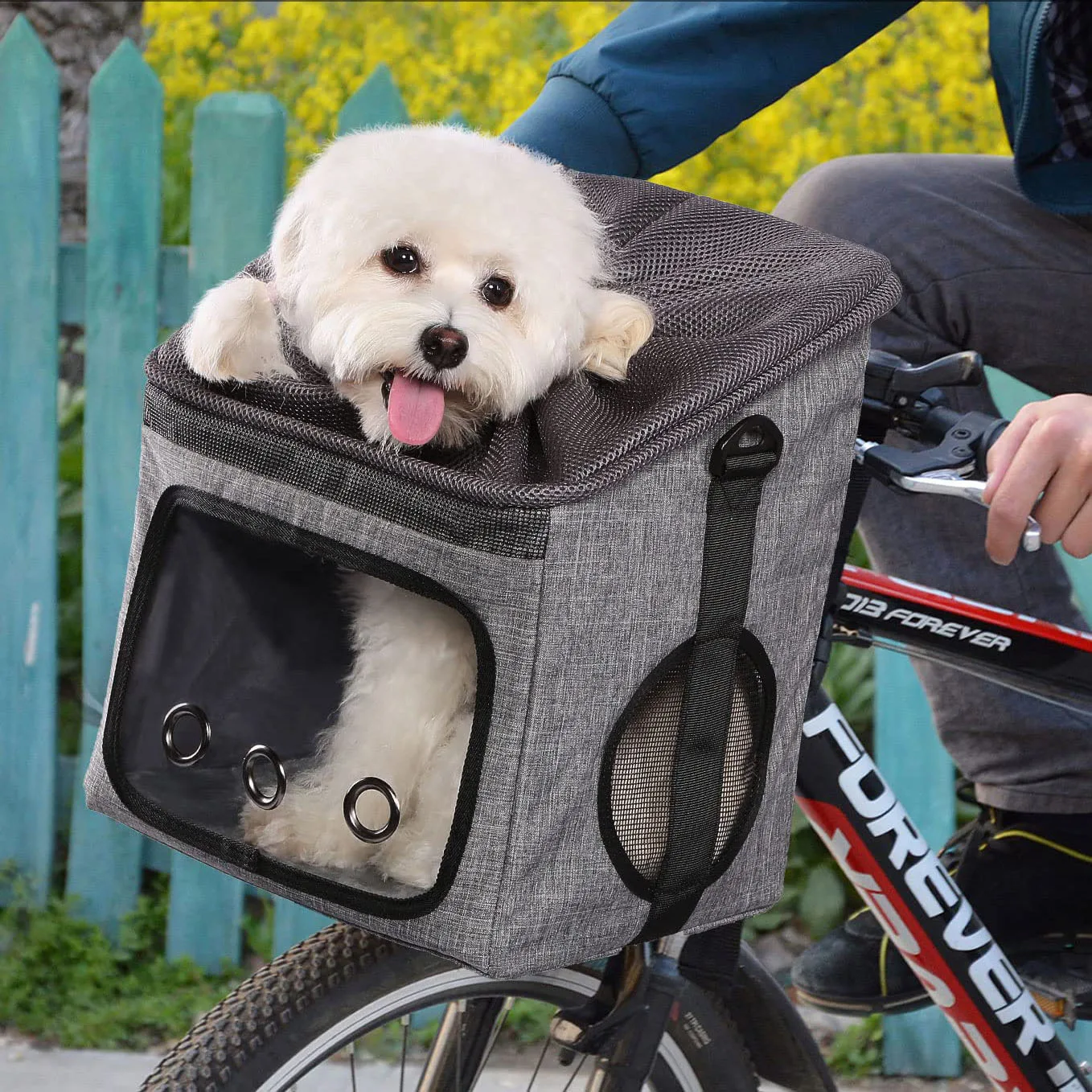
Mesh is a monofilament at 0.50-0.60 mm filament with a 1.4-1.8 mm aperture, chosen heavier than the airflow optimum because the animal will push its muzzle and paws into the panel when fixated. Permeability is above 1000 l/m²/s at 100 Pa and tear strength above 110 N. The mesh is recessed 12-18 mm behind the outer plane and bound into a 20 mm webbing frame, so contact lands on the frame first.
Interior surfaces are a wipe-clean TPU film at 0.18-0.25 mm welded at the seams, because the short coat transfers oil and dust, and a welded surface can be hosed. Weld peel acceptance is 40 N per 25 mm after seven days at 70 C and 95% relative humidity.
Dust Ingress in Arid Markets
Several of the principal markets for this breed are arid, and airborne dust is a real service condition rather than an edge case. The intake carries a laminated non-woven of 50-70 g/m² with filtration efficiency above 60% for particles over 10 micrometres, in a removable frame so it can be rinsed. Dust loading was measured at 4-7 g of accumulated material over 40 hours of use in a dusty environment, which reduced permeability by 18-26% and is the reason the filtration layer is serviceable rather than bonded in.
Floor, Roof, Frame and the Parameter Set
The floor board is 7 mm laminated: 2.5 mm EVA over a 3.5 mm PP honeycomb core and a 1 mm skin, with a deflection limit of 3.5 mm under the 0.93 kN static design load and the separate impulse acceptance described earlier. The core is specified at 80-120 kg/m³ density because a lower-density core crushes under the impulse peak even when it passes the static deflection limit.
The roof is the structural element that separates this class from every other large-breed product. It is a non-stretch 1050D panel over a 16 mm tube bow, with travel limited to 25 mm at the centre and two transverse 25 mm webbing straps that transfer upward load into the frame. The straps are the critical item: without them the tube bow alone allows 60-80 mm of travel, which is enough for a bolting animal to strike its own spine against the frame.
The frame is 6061-T6 tube at 16 mm outside diameter and 1.5 mm wall, with glass-filled nylon corners and two 5 mm rivets per joint. Corner radius is above 30 mm. The front panel carries an additional vertical member at the centreline, which is where the forward-push load lands and is the reason the front panel is framed rather than suspended.
| Parameter | Heat-adapted hound (Ridgeback) | Sleek gundog (Weimaraner) | Medium lean (Vizsla) |
|---|---|---|---|
| Design mass and load | 45 kg, 0.93 kN | 42.5 kg, 0.92 kN | 32 kg, 0.69 kN |
| Vertical impulse peak | 2.0-2.6 kN over 100 ms | not a design case | not a design case |
| Interior W x L x H | 420-480 x 780-860 x 620-680 mm | 400-460 x 780-860 x 580-640 mm | 340-400 x 680-760 x 560-620 mm |
| Floor board | 7 mm, core at 80-120 kg/m³ | 6 mm plus drain tray | 5 mm |
| Roof travel limit | 25 mm, two transverse straps | 30-40 mm | 30-40 mm |
| Sight control | three states, 55-70% opacity | not required | not required |
| Mesh open area | 42-48% | 40-46% | 38-44% |
| Roof overhang | 60-90 mm, stiffened | not specified | not specified |
| Intake filtration | 50-70 g/m², serviceable | not specified | not specified |
| BOM cost FOB | 24-41 USD | 22-38 USD | 17-29 USD |
Closure, Containment and Restraint
Containment for this class is designed against a combined case: the animal pushes forward, then bolts upward, then pushes again. A closure that resists a steady push will often fail the sequence because the vertical component momentarily unloads the chain and lets a slider walk, so the specification requires a positive lock rather than a friction lock.
The primary closure is a #8 reverse-coil chain with two sliders, both lockable, engaging at any point on the chain. Chain cross-wise strength is above 750 N and slider pull-off above 650 N, tested to the zipper method published by ASTM International. Slider force is 15-28 N, deliberately at the upper end of the range so that incidental contact does not move it.
The secondary restraint is a 25 mm webbing strap with a cam buckle rated at 4 kN, anchored to the frame through a 38 mm load spreader rather than to the shell. A cam buckle is specified instead of a side-release because a side-release can be popped by a sharp upward pull from inside, whereas a cam buckle tightens under load.
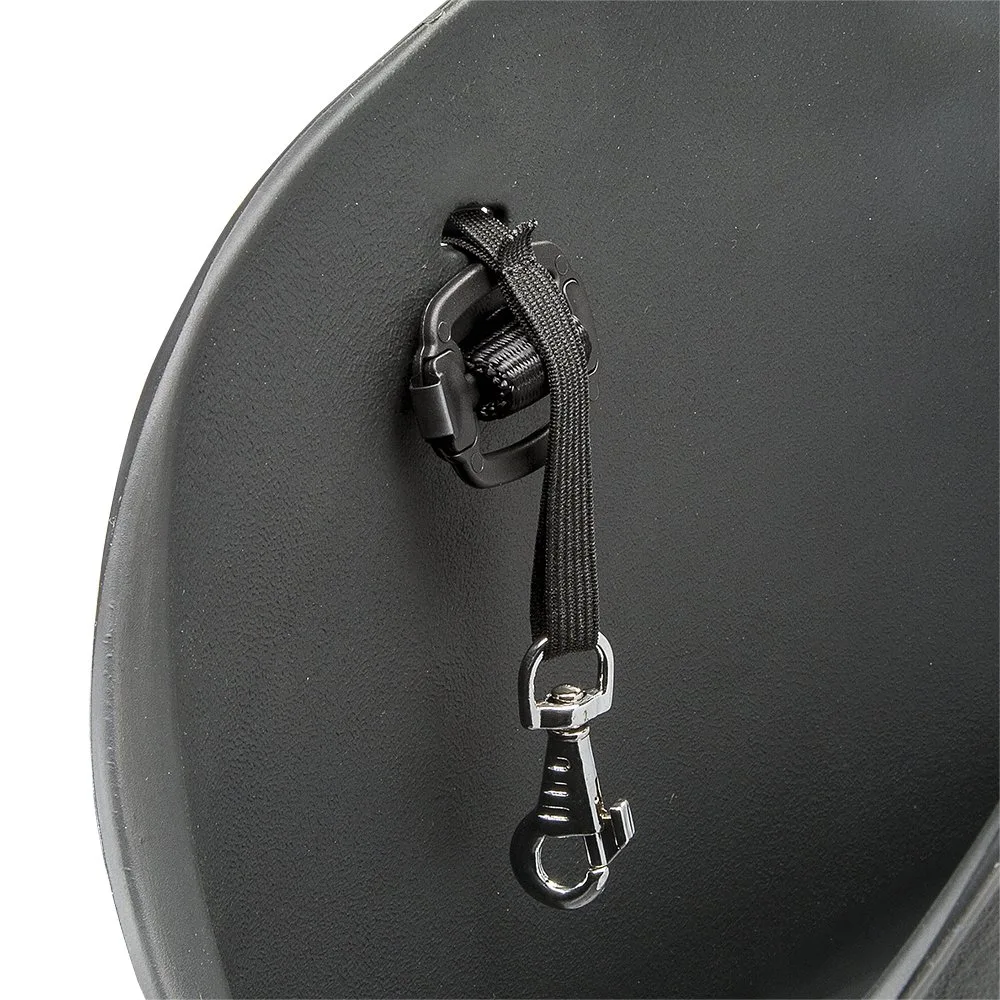
Interior restraint is a 20 mm tether with a 900 N snap hook anchored at the rear upper corner at 480-560 mm above the floor, load-spread over 60 x 60 mm. The anchorage is tested at 900 N in the direction of a forward and upward pull, which is the combined case and is different from the single-direction test used on the smaller classes.
The sight-control panels are also containment items, since a fixated animal that can see out will work the closure. Their retention is therefore specified at a peel above 10 N per 25 mm and a shear above 70 N per 25 mm after twenty laundering cycles.
Ventilation Architecture and Airflow Measurement
Open area is 42-48%, the joint highest in the set, arranged as a low intake across the front lower panel and both side panels with a high exhaust at the rear upper panel. The stack path is deliberately long, running diagonally from the front lower corner to the rear upper corner, which maximises the chimney effect when the carrier is stationary.
Airflow is measured rather than inferred. A hot-wire anemometer at four interior positions recorded 0.10-0.16 m/s with the stack layout at 24 C and a 45 W source, against 0.04-0.07 m/s for a symmetrical layout at the same total open area. Interior temperature followed: 1.6-2.4 C above ambient for the stack layout against 4.2-5.8 C for the symmetrical one.
Because the sight-control panels sit over the intake in the partial and closed states, open area is quoted for each state rather than as a single figure: 42-48% open, 26-34% partial and 12-16% closed. That is an honest presentation and it prevents the common specification error of quoting the open figure while shipping a product that will usually be used partially closed.
The exhaust is fitted with a light baffle at 45 degrees, which prevents a direct line of sight out of the rear while not measurably reducing flow, and the intake carries the serviceable filtration layer described earlier. Drainage is a simple two-channel moulded mat rather than a full tray, because this breed is not a water retriever and the added tray cost is not justified.
Verification Protocol: Seam Slippage, Zipper Reciprocation, Static Load and Drop
The matrix adds an impulse test and a fatigue test to the standard four, reflecting the two load cases that define the class. Sampling is three units per size per colourway from the first lot and one unit per 3,500 pieces thereafter.
Seam slippage runs to ISO 13936-2 with acceptance under 5 mm opening at 140 N on shell seams and under 3 mm at 180 N on the front panel frame seams, which is tighter than the general large-dog limit because the forward push is a repeated load into those seams. Seam construction is a two-needle chain at 8 stitches per 25 mm in bonded nylon of 50 tex with a 15 mm allowance.
Zipper reciprocation follows the ASTM method at 600 cycles for the main opening and 250 for the access port, at 10 cycles per minute with a 2 kg lateral load, plus a sequence test in which 0.7 kN is applied to the door for 20 seconds, released, and repeated 20 times with zipper cycling between holds. Acceptance is no chain separation, no slider walk above 5 mm, retained cross-wise strength above 88% of the uncycled value and full locking function.
Static load is a 24-hour proof at 1.5 times design mass, 68 kg, accepting permanent deflection under 5 mm, no seam opening above 2 mm and full hardware function. The impulse test applies twenty half-sine pulses of 2.6 kN over 100 milliseconds through a 200 x 200 mm pad at the board centre, accepting no delamination, no core crush above 0.5 mm and no permanent deflection above 1 mm.
Drop testing is a six-face sequence from 400 mm onto concrete with a 45 kg water ballast in an ISTA-style protocol, accepting no rupture in a load-bearing seam, no frame fracture, no buckle release and full zipper function. A roof-specific check applies 1.2 kN upward at the roof centre with travel limited to 25 mm and no contact between the roof structure and a 200 mm gauge block placed on the floor, which is the check that the animal cannot strike the frame.
Cost Bands, Tooling and Production Scheduling
Unit cost lands at 24-41 USD FOB Xiamen. Shell and cutting account for 8-14 USD, frame, board and roof bow 8-13 USD, hardware 6-10 USD, the sight-control package 4-7 USD, and closing labour 5-8 USD. The sight-control system is the largest class-specific increment at 3.10-5.40 USD and is the item most often targeted for cost reduction, which is why the deployment figures are written into the specification.
Tooling is moderate. Profiling dies run 1,200-2,500 USD per size, tube bending and drilling jigs for the frame and roof bow 2,000-3,600 USD, sewing and welding jigs 900-1,700 USD, and print set-up 300-700 USD per colourway, giving a three-size program under 17,000 USD. The roof bow is the tooling item specific to this class and it is the main reason the figure sits above the gundog classes.
Cutting efficiency is 83-88%, slightly below the smaller classes because the roof panel with its overhang is a large marker. The overhang also creates a fold line that must be stiffened, which adds one operation and 0.40-0.70 USD.
Timing follows the standard cycle. Prototypes are delivered in 6-10 working days from confirmed specification, covering patterning, first-cut samples and a fit check. Bulk production runs 35-50 days after sample approval, with fabric lead time the variable; the near-infrared reflective pigment is applied as a finish rather than a dyestuff and adds 6-10 days. Final random inspection is to AQL 2.5 under general inspection level II, payment is T/T 30/70 and loading is FOB Xiamen. Monthly capacity across the network is 200,000 pieces, and this class uses roughly 6-8% of a line per 10,000 units.
Why brands source here
- Pet carrier programs run since 2014; founding team in sewn goods since 2004
- SGS-verified production floor of 4,950 m² with 137 workers across 7 lines
- Monthly capacity of 200,000 units, audited to BSCI and ISO 9001
People Also Ask
How large is the vertical impulse load for a bolting dog?
2.0-2.6 kN peak over 80-140 milliseconds, measured on a load plate against a static weight of 0.42 kN for a 43 kg animal. That is five to six times body weight, which is why a static deflection limit alone is insufficient.
Why is roof travel limited to 25 mm?
Without transverse straps a tube bow allows 60-80 mm of travel, which is enough for a bolting animal to strike its own spine against the frame. Two 25 mm straps transfer the upward load into the frame and hold travel at 25 mm.
What does the partial sight-control state actually do?
A knit at 55-70% opacity removes the silhouette that drives fixation while leaving moving highlights visible, avoiding the sensory isolation of a fully closed carrier. Forward-push events fell to roughly a third of the open-state rate in observation.
How much open area is quoted for each sight state?
42-48% open, 26-34% partial and 12-16% closed. Quoting only the open figure is a common specification error, because the product will usually be used in the partial state.
Why is a cam buckle used instead of a side-release?
A side-release can be popped by a sharp upward pull from inside, whereas a cam buckle tightens under load. The restraint is 25 mm webbing rated at 4 kN, anchored to the frame through a 38 mm load spreader.
How does the roof overhang affect interior temperature?
A stiffened 60-90 mm overhang shades the upper third of the intake above 45 degrees of solar elevation, giving 2.1-3.4 C above ambient at 32 C with 900 W/m² irradiance, against 5.6-7.2 C without it.
Is dust filtration needed on the intake?
In arid markets, yes. Accumulation reached 4-7 g over 40 hours, reducing permeability by 18-26%, so a serviceable non-woven of 50-70 g/m² capturing above 60% of particles over 10 micrometres is specified in a removable frame.
Frequently Asked Questions
What interior dimensions suit a 45 kg Ridgeback?
420-480 mm wide, 780-860 mm long and 620-680 mm high. Height is the controlling dimension at withers minus 40-60 mm, because the breed stands squarely and does not crouch into a confined space.
Why is the board core density specified separately?
A lower-density core passes the static deflection limit and still crushes under the impulse peak. The core is therefore specified at 80-120 kg/m³, and the impulse test checks for core crush above 0.5 mm after twenty pulses.
Why does the front panel have a central frame member?
Prey fixation produces a sustained forward push of 0.5-0.8 kN applied and released repeatedly, which is a fatigue case. A 16 mm vertical member takes that load into the frame rather than leaving it in a seam.
What is the forward-push fatigue test?
0.7 kN applied to the door for 20 seconds, released, repeated 20 times with zipper cycling between holds. Acceptance is no chain separation, no slider walk above 5 mm and full locking function.
How is the roof clearance verified?
1.2 kN is applied upward at the roof centre with a 200 mm gauge block on the floor. Acceptance is travel limited to 25 mm and no contact between the roof structure and the block.
Why are both sliders lockable on this class?
The bolt-then-push sequence momentarily unloads the chain, which lets a friction-locked slider walk. A positive lock engaging at any point on the chain is required, with slider force set at 15-28 N.
What tear strength is required of the sight-control panel?
Above 110 N at 260-340 g/m², bound into a 20 mm webbing frame rather than sewn to the shell, because a fixated animal paws repeatedly at the same point. Retention after twenty laundering cycles is above 10 N per 25 mm peel and 70 N per 25 mm shear.
How is airflow measured rather than inferred?
With a hot-wire anemometer at four interior positions. The stack layout recorded 0.10-0.16 m/s against 0.04-0.07 m/s for a symmetrical layout at the same total open area, with interior temperature 1.6-2.4 C above ambient against 4.2-5.8 C.
What thermal acceptance applies at high ambient?
An interior rise under 3 C at 24 C and under 4.5 C at 32 C with the intake open and shade deployed, over one hour with a 45 W source, and no interior contact surface above 48 C.
Is an insulation liner offered for this breed?
No. The animal is heat-adapted and sold into warm markets, and a liner would compromise the airflow figure that does the real work. Thermal control is by near-infrared reflective pigment and shade geometry instead.
What shell masses are used across the panels?
900D at 850-1050 g/m² generally, rising to 1050D at 950-1150 g/m² with a 12 x 12 mm ripstop grid on the front panel and the lower 300 mm. Abrasion acceptance is 25,000 Martindale cycles on those zones and 15,000 elsewhere.
How is the interior finished?
A welded TPU film of 0.18-0.25 mm, hosed clean rather than laundered, with weld peel acceptance of 40 N per 25 mm after seven days at 70 C and 95% relative humidity.
What is the tooling item specific to this class?
The 16 mm roof bow and its bending jig, at 2,000-3,600 USD, which is the main reason the three-size tooling figure of under 17,000 USD sits above the gundog classes.
Does the near-infrared pigment affect the schedule?
Yes, it adds 6-10 days because it is applied as a finish rather than a dyestuff. That sits inside the 35-50 day bulk window but should be allowed for when planning the first shipment.
Talk to QUANZHOU JUNYUAN BAGS about a pet carrier program: MOQ 500 pieces per colourway, samples in 6-10 working days, bulk production in 35-50 days under AQL 2.5 inspection.
Get a free quote Request a sample