Pet Carrier Seat Belt: Safety Harness
A crash-rated pet carrier seat belt harness is built from 25 mm polyester webbing with a minimum tensile break of 8.9 kN, hardware proof-loaded to 4.0 kN, and bar-tack stitch groups that hold webbing slip under 25 mm at a 2.2 kN working load. Validation runs on a sled at 48 km/h against a 25 g pulse, with three to six units per size block.
A seat belt harness sits in a different engineering class from a walking harness because the load case is a vehicle deceleration event, not a pull on a lead. This page sets that out in manufacturing terms: how the crash load is derived from pet mass and pulse severity, which webbing and hardware ratings answer it, how the stitch group is engineered so the seam never becomes the weak link, and what the sled protocol measures before a size block is released. It also covers fit geometry across breed blocks, retroreflective and chemical compliance, and the programme economics behind a safety-rated SKU. Commercial terms follow the standard structure: MOQ 500 pieces per colourway, prototypes in 6-10 working days, bulk production 35-50 days after sample approval, final random inspection to AQL 2.5, T/T 30/70 and FOB Xiamen. Test methods are referenced to ASTM International and ISO practice, with independent sled programmes reported against the protocol published by Center for Pet Safety.
The economics of wholesale pet carriers move with carton cubage, so pet carrier accessory programmes are quoted both by unit price and by filled container.
Crash Load Paths: What a Seat Belt Harness Actually Carries
A seat belt harness is not a walking harness sold with a different label. The load case is a deceleration event: the animal continues at pre-impact velocity while the vehicle structure decelerates around it, and the harness has to arrest that momentum through webbing, hardware and stitch groups arranged in series. Every one of those elements carries the full load, so the rating of the assembly is the rating of its weakest part.
The arithmetic is direct. A change of velocity of 48 km/h absorbed over a 90-120 ms pulse gives a mean deceleration of 20-30 g. A 12 kg animal at 25 g therefore generates roughly 2.94 kN of inertial load, and the same animal at 30 g generates 3.53 kN. Anything specified below those figures is specified below the event it claims to address, which is why a walking harness rated at 1.2-1.8 kN working load is not an adequate substitute.
Distribution matters more than the peak. A harness that spreads a 2.94 kN load over a chest contact area of 320-420 cm² holds contact pressure at roughly 0.7-0.9 N/cm². The same load concentrated through a 25 mm webbing edge bearing on 40 cm² produces 7.4 N/cm², which is the region where soft-tissue injury and tracheal bruising begin to appear in post-event examination. Width and pad geometry are therefore load-management features, not comfort features.
Two consequences follow for the specification. First, the design load must be set at the upper end of the size block rather than the median, because a size block that fits animals from 8 kg to 16 kg has to be engineered for 16 kg. Second, the assembly rating is set by the weakest element, so a 8.9 kN webbing paired with a 2.4 kN buckle delivers a 2.4 kN assembly.
| Animal mass | 18 g pulse | 22 g pulse | 25 g pulse | 30 g pulse | Design load used | Size block |
|---|---|---|---|---|---|---|
| 4 kg | 0.71 | 0.86 | 0.98 | 1.18 | 1.20 | XS-S |
| 8 kg | 1.41 | 1.73 | 1.96 | 2.35 | 2.40 | S-M |
| 12 kg | 2.12 | 2.59 | 2.94 | 3.53 | 3.60 | M-L |
| 20 kg | 3.53 | 4.32 | 4.90 | 5.88 | 6.00 | L |
| 32 kg | 5.65 | 6.91 | 7.84 | 9.41 | 9.50 | XL |
| 45 kg | 7.94 | 9.71 | 11.03 | 13.24 | 13.50 | XXL |
The last column is the number that drives procurement. It is deliberately set above the 30 g figure so that the assembly retains margin for material ageing, UV exposure and the seam efficiency loss described later, all of which erode a rating over the service life of the product.
Design the assembly for the top of the size block at 30 g and add margin for ageing: a 12 kg animal is a 3.60 kN specification, not a 2.94 kN one.
Webbing Specification: Width, Linear Mass and Tensile Break
Polyester is the correct fibre for this application and nylon is not. Polyester absorbs very little water, holds its tensile properties when wet, and resists UV degradation roughly two to three times better than nylon 6.6, which matters because a harness lives in a vehicle with a large glass area. Nylon also loses 10-15% of its tensile strength at saturation, and a harness tested dry and used wet is not the same product.
Width is the first decision. A 20 mm webbing is comfortable and cheap but concentrates load; a 25 mm webbing spreads it and is the standard for a crash-rated product; a 32 mm webbing is used only above 30 kg animal mass, where the contact area requirement outweighs the bulk. Below 20 mm the contact pressure exceeds the 3.0 N/cm² guidance even at moderate pulses, so narrower webbing is not a viable route regardless of its tensile rating.
Linear mass is the practical proxy for construction quality. A 25 mm polyester webbing built for this duty weighs 34-46 g per metre at a pick count that gives a tight, flat, non-roll surface. Cheaper webbing at 24-30 g per metre uses a looser weave that rolls under load, and rolling is what turns a 25 mm contact patch into an 8 mm one at the moment of maximum force.
| Option | Width | Linear mass | Min tensile break | Elongation at break | UV retention 500 h | Suits |
|---|---|---|---|---|---|---|
| Polyester, standard weave | 20 mm | 26-32 g/m | 6.7 kN | 14-18% | 82-88% | Under 8 kg only |
| Polyester, tight weave | 25 mm | 34-46 g/m | 8.9 kN | 12-16% | 86-92% | 8-30 kg, standard |
| Polyester, heavy weave | 25 mm | 48-58 g/m | 11.2 kN | 11-14% | 88-93% | 20-45 kg |
| Polyester, tubular | 32 mm | 56-70 g/m | 13.4 kN | 10-13% | 87-92% | Above 30 kg |
| Nylon 6.6, flat | 25 mm | 32-44 g/m | 10.7 kN | 18-24% | 62-74% | Not recommended |
| Recycled PET, tight weave | 25 mm | 36-48 g/m | 8.2 kN | 13-17% | 84-90% | Sustainability briefs |
Elongation is the parameter most often specified wrongly. High elongation feels forgiving on a lead because it cushions a pull, but in a deceleration event it increases the distance over which the animal travels before being arrested, which increases the risk of contact with the seat back or the interior trim. Tight-weave polyester at 12-16% is the correct compromise.
Every incoming lot is verified rather than trusted. A certificate of analysis accompanies each dye lot, and the production team draws a sample per lot for a tensile pull to destruction on a calibrated frame, with the result recorded against the lot number. A lot that tests below 8.9 kN is rejected before it reaches the cutting table, and the cost of that rejection is a fraction of the cost of a recall.
Specify 25 mm tight-weave polyester at 34-46 g/m and 8.9 kN minimum break, and reject nylon for this application on UV and wet-strength grounds.
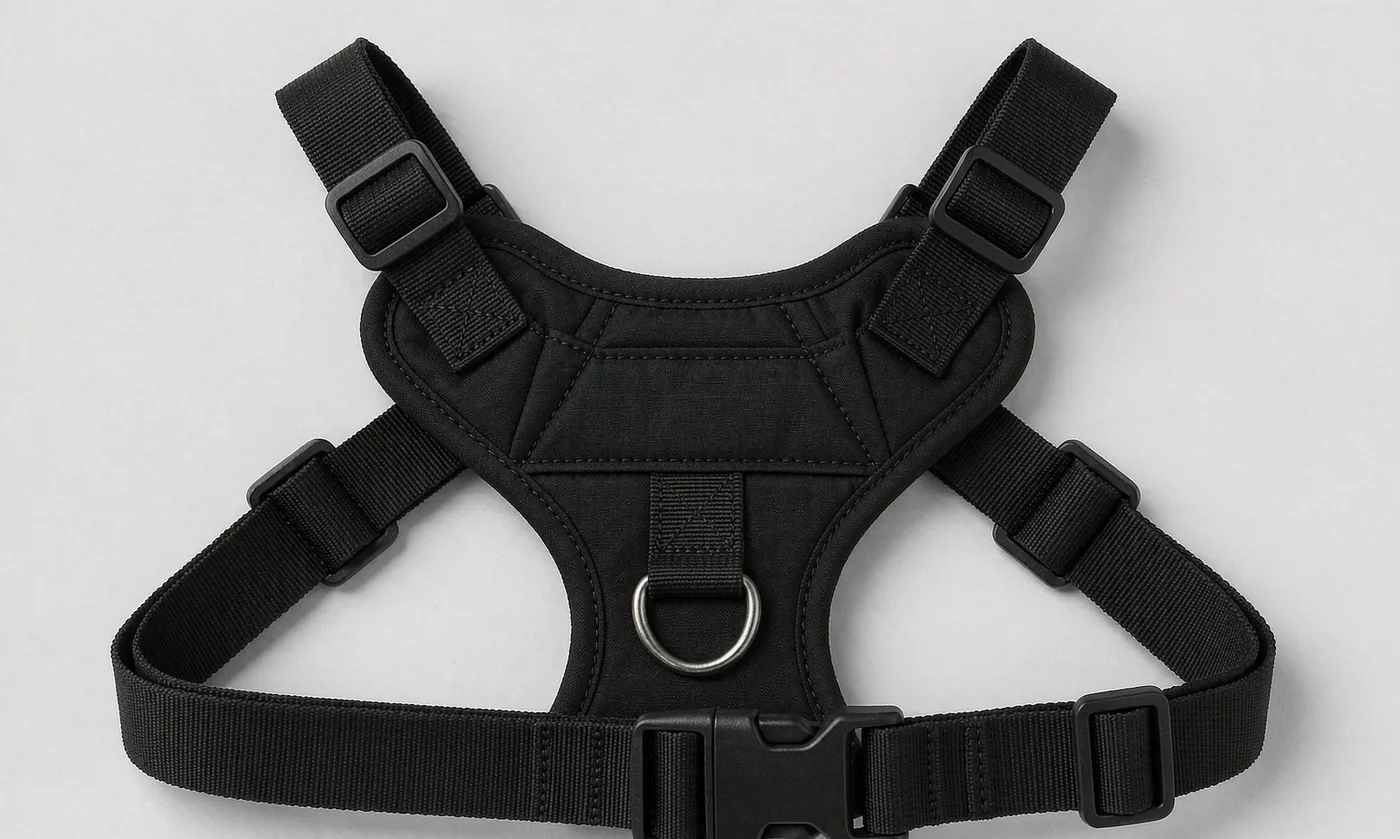
Hardware: D-Rings, Buckles and Measured Break Strength
Hardware is where assemblies usually fail, and it fails in a specific way: not by clean fracture, but by gate deformation that lets the webbing or the connector escape. A buckle that holds 4.0 kN in a straight pull may release at 1.6 kN when the load arrives at 30 degrees off axis, which is the geometry a deceleration event actually produces. Off-axis testing is therefore mandatory, not optional.
Material choice splits into die-cast zinc alloy, stamped steel and, at the top end, forged alloy. Zinc alloy is the volume standard, castable into complex shapes and plateable to a consistent finish, with a straight-pull break in the 3.4-4.6 kN range depending on section. Stamped steel reaches 5.2-6.8 kN and costs 40-90% more. Aluminium is avoided here because it is lighter but work-hardens and cracks at the gate radius.
The connector that mates with the vehicle receives the same scrutiny. A seat belt tongue stamped to vehicle geometry has to latch with an audible and tactile confirmation and release at a force between 40 N and 90 N, low enough for an adult to operate under stress and high enough that an animal cannot work it loose. Latches are cycle-tested to 5,000 engagements with re-measurement of the release force at 1,000-cycle intervals.
| Component | Material | Straight pull | 30 degree pull | Cycles to failure | Salt spray | Cost (USD) |
|---|---|---|---|---|---|---|
| D-ring, welded | Stamped steel | 6.2 kN | 4.8 kN | Above 20,000 | 96 h | 0.42-0.88 |
| D-ring, cast | Zinc alloy | 4.0 kN | 2.9 kN | 12,000-18,000 | 48 h | 0.22-0.46 |
| Side-release buckle | POM acetal | 2.4 kN | 1.3 kN | 8,000-12,000 | n/a | 0.18-0.36 |
| Side-release buckle | Zinc reinforced | 3.8 kN | 2.2 kN | 10,000-15,000 | 48 h | 0.34-0.68 |
| Seat belt tongue | Stamped steel | 7.4 kN | 5.6 kN | Above 20,000 | 96 h | 0.55-1.20 |
| Cam adjuster | Zinc alloy | 1.8 kN | 1.1 kN | 6,000-9,000 | 48 h | 0.14-0.28 |
Corrosion testing is a real constraint on a product that lives in a vehicle. Hardware is submitted to a neutral salt spray chamber for 48 hours for zinc alloy and 96 hours for steel, with acceptance at no base-metal corrosion and no more than 5% surface discolouration. A plating specification of 8-12 microns of nickel under chrome is the usual answer, and thinner plating is the most common cause of a failed corrosion cycle.
Nickel release is tested alongside corrosion because it is a market access requirement rather than a durability one. Under the REACH restriction the migration limit is 0.5 micrograms per square centimetre per week for items in prolonged skin contact, and a harness is exactly that. Compliance is declared against testing referenced to ECHA guidance, and the declaration is held on file with the production record.
Accept hardware on its 30 degree rating, not its straight-pull rating: a cast zinc D-ring rated 4.0 kN axially is a 2.9 kN component in the geometry that matters.
Stitch Engineering: Bar-Tack Groups and Seam Efficiency
The seam is the element that turns a rated webbing and a rated buckle into a product, and it is the element most likely to be under-specified. A sewn joint in webbing rarely achieves the full strength of the parent material because the needle perforates the yarns; the ratio of joint strength to webbing strength is the seam efficiency, and in this product class it runs 78-88% when the group is correctly engineered.
Thread choice sets the ceiling. Bonded polyester or bonded nylon 6.6 in the Tex 90 to Tex 135 range is standard, with polyester preferred for UV stability to match the webbing. A Tex 70 thread in a single row gives a joint around 3.2 kN and is not adequate; the same seam in Tex 135 with a bar-tack group reaches 7.1-7.8 kN, which keeps the seam above the working load with margin.
The stitch pattern is the second variable. A box stitch with an X across it, executed as a programmable bar-tack of roughly 42 mm by 12 mm over the load-bearing end of the webbing, distributes the load across 260-340 needle penetrations rather than concentrating it along a single line. Stitch density is held at 8-10 stitches per inch, and the program is locked to the style so it cannot drift between operators or shifts.
| Group | Thread | Pattern | Joint strength | Seam efficiency | Slip at 2.2 kN | Cycle time |
|---|---|---|---|---|---|---|
| Single straight row | Tex 70 | 1 line | 3.2 kN | 36% | Above 40 mm | 6 s |
| Double straight row | Tex 90 | 2 lines | 4.6 kN | 52% | 22-34 mm | 10 s |
| Box with X | Tex 90 | Box plus X | 5.8 kN | 65% | 12-20 mm | 16 s |
| Bar-tack, standard | Tex 135 | 42 x 12 mm | 7.1 kN | 80% | 6-12 mm | 19 s |
| Bar-tack, reinforced | Tex 135 | 42 x 12 mm plus tail | 7.8 kN | 88% | 3-8 mm | 24 s |
| Bar-tack plus binding | Tex 135 | Group plus bound end | 8.1 kN | 91% | 2-6 mm | 31 s |
Slip is the pass or fail criterion and it is measured, not judged. A load of 2.2 kN is applied to the assembly at a controlled rate and held for 60 seconds, after which the displacement of the webbing relative to the stitch group is measured. Acceptance is 25 mm or less with no thread fracture; production released on the bar-tack groups above typically measures 3-12 mm, which is the margin that absorbs lot-to-lot variation.
Needle and plate selection is the quiet failure mode. A needle that is too large for the thread leaves a hole that weakens the webbing; one that is too small generates heat and glazes the thread. On 25 mm webbing the pairing is a 90/14 to 100/16 needle with a matching throat plate, and needle change intervals are set at 8 hours of running time rather than left to the operator.
Specify a Tex 135 bar-tack group at 42 by 12 mm, accept the joint at 7.1 kN or better, and hold webbing slip at or under 25 mm at a 2.2 kN hold.
Sled Testing: Protocol, Sample Sizes and Pass Thresholds
A sled test is the only validation that exercises the whole assembly in the geometry it will actually see. Static pulls on components are necessary but insufficient, because they do not reproduce the pulse shape, the rotation of the animal, or the off-axis loading that a deceleration event produces. A programme that publishes a rating without sled data is publishing an extrapolation.
The rig is a deceleration sled carrying a seat assembly and a surrogate animal of the correct mass and centre of gravity. The pulse is a 48 km/h change of velocity delivered over 90-120 ms at a peak of 25 g, with the harness anchored to the vehicle seat belt geometry. Instrumentation records load at the anchor, displacement of the surrogate, and high-speed video at 500-1,000 frames per second.
Sample size is three units per size block for a development validation and six for a release validation. Every unit is a production unit drawn from the bulk run, not a hand-made prototype, and every unit is destructively examined afterwards. A single failure in a release batch of six fails the block, and the block is re-engineered and re-tested rather than re-sampled.
| Measured item | Method | Threshold | Fail action | Units | Record |
|---|---|---|---|---|---|
| Anchor retention | High-speed video | No separation at any point | Re-engineer anchorage | 3 or 6 | Video plus report |
| Webbing slip at stitch | Post-test measurement | 25 mm maximum | Change stitch group | 3 or 6 | Photo plus gauge |
| Hardware deformation | Post-test gauging | 3% of critical dimension | Upgrade material | 3 or 6 | Gauge record |
| Thread fracture | Visual at 10x | None permitted | Change thread or needle | 3 or 6 | Micrograph |
| Surrogate excursion | Video tracking | 300 mm maximum forward | Reduce elongation | 3 or 6 | Trace plot |
| Buckle unintentional release | Video plus load trace | Zero occurrences | Change latch geometry | 3 or 6 | Load trace |
| Pad displacement | Post-test measurement | 15 mm maximum | Re-bond or re-stitch pad | 3 or 6 | Photo plus gauge |
Cost and scheduling are worth stating plainly. A three-unit development validation costs 620-1,480 USD and reports in 8-14 working days; a six-unit release validation costs 1,180-2,640 USD and reports in 12-20 working days. Annual re-validation on a size block in continuous production costs 890-2,160 USD and is the line item that catches material drift before it becomes a field problem.
Independent programmes are worth the premium on a safety claim. Work reported against the protocol published by Center for Pet Safety gives a retailer and an end customer a reference point they can check, and a claim that cannot be checked is a claim that will be discounted. Test methods throughout are referenced to ASTM International standards where a relevant method exists.
Validate on the sled with production units, three for development and six for release, and treat a single failure in six as a failed block rather than a sampling artefact.
Fit Geometry: Girth Grading, Breed Blocks and Pressure Targets
Fit is a load-distribution problem before it is a comfort problem. A harness that sits too far forward loads the trachea; one that sits too far back allows the animal to rotate out of the webbing under a pulse; one that is too loose permits the excursion that the sled threshold limits to 300 mm. Grading is therefore an engineering exercise with measurable targets, not a scaling exercise.
Five size blocks cover the practical range, with chest girth increments of 4-6 cm and a webbing adjustment range of 12-18 cm inside each block. The adjustment range matters as much as the nominal girth, because a block with only 6 cm of adjustment will fit few animals well no matter how the nominal is chosen. Within each block the load-bearing straps must sit on the sternum and across the rib cage, behind the shoulder joint and clear of the trachea by 20-30 mm.
Breed blocks define the shapes that have to be accommodated. A deep-chested narrow breed, a broad-chested brachycephalic breed and a long-backed short-legged breed present three different problems, and a single pattern that fits all three fits none of them properly. Development is validated on six physical fit blocks covering those shapes, with two animals per block.
| Block | Chest girth | Adjustment | Animal mass | Pad area | Target pressure | Design load |
|---|---|---|---|---|---|---|
| XS | 28-36 cm | 12 cm | 2-4 kg | 180 cm² | 0.6 N/cm² | 1.20 kN |
| S | 36-46 cm | 14 cm | 4-8 kg | 240 cm² | 0.7 N/cm² | 2.40 kN |
| M | 46-58 cm | 16 cm | 8-16 kg | 320 cm² | 0.8 N/cm² | 3.60 kN |
| L | 58-72 cm | 18 cm | 16-28 kg | 420 cm² | 0.9 N/cm² | 6.00 kN |
| XL | 72-88 cm | 18 cm | 28-45 kg | 540 cm² | 1.0 N/cm² | 9.50 kN |
| XXL | 88-104 cm | 16 cm | 45-60 kg | 660 cm² | 1.1 N/cm² | 13.50 kN |
Pad construction converts the specification into a physical result. A closed-cell foam of 6-10 mm at 45-70 kg/m³ density, backed by a spacer mesh that moves moisture, gives the contact area the pressure target assumes. A pad that compresses to 2 mm under load has effectively removed itself from the calculation, which is why pad compression set is tested at 22 hours and 70 degrees with acceptance at 12% or less.
Adjuster placement is the last geometric decision. A cam adjuster on the load path is a 1.1 kN component in the table above, so it is placed outside the load path wherever the pattern allows, and where it cannot be moved the design load for that block is reduced accordingly rather than ignored.
Grade in five blocks with 12-18 cm of adjustment inside each, hold contact pressure at or below 1.1 N/cm², and validate on six physical breed blocks rather than one.
Reflective Trim, Colour Fastness and Chemical Compliance
Retroreflective trim is a specification item with a measurable value, not a decorative one. A harness is frequently handled at night on a roadside, and the material has to return enough light to be seen from a meaningful distance. Glass-bead tape is the volume choice and microprismatic film the premium one, and they are specified by coefficient of retroreflection in candelas per lux per square metre.
Performance decays with washing and abrasion. A glass-bead tape starting at 380-450 cd/(lx.m²) typically retains 55-70% after 25 domestic wash cycles and 40-55% after 50. A microprismatic film starting at 600-700 retains 70-85% after 25 cycles. The specification therefore states the value after 25 cycles rather than the as-new value, which is the only number that means anything at the end of the service life.
Colour fastness is tested as a set rather than a single value, because a harness meets light, sweat, rubbing and washing in normal use. Rub fastness is the one that fails most often on a webbing product, since a dyed webbing has less surface area to hold dye than a fabric. Acceptance is grade 4 or better for dry rubbing and grade 3-4 or better for wet rubbing, with light fastness at grade 4-5 for a product used behind glass.
| Item | Requirement | Test reference | Limit | Frequency | Cost (USD) |
|---|---|---|---|---|---|
| Total lead content | CPSIA | CPSC method | 100 ppm | Per colourway | 45-120 |
| Phthalates | CPSIA | CPSC method | 0.1% each | Per material | 90-210 |
| Nickel release | REACH Annex XVII | EN 1811 | 0.5 ug/cm²/wk | Per hardware lot | 70-160 |
| Azo dyes | REACH Annex XVII | EN 14362 | 30 ppm per amine | Per dye lot | 80-180 |
| Colour fastness to rubbing | ISO 105 X12 | Crockmeter | Grade 4 dry, 3-4 wet | Per colourway | 25-60 |
| Retroreflection after 25 washes | ISO 20471 class reference | Retroreflectometer | 200 cd/(lx.m²) | Per trim lot | 60-140 |
| OEKO-TEX textile declaration | STANDARD 100 | Laboratory panel | Class II | Annual | 420-980 |
Children's product rules apply more often than buyers expect. A pet product is not automatically outside the scope of the consumer product safety framework administered by the U.S. Consumer Product Safety Commission, and a harness marketed with a child-appealing character or sold in a children's channel can attract the full testing and tracking regime. The safe route is to test to the limit anyway, at 45-120 USD per colourway, which is small against the cost of a withdrawal.
Declarations are held as a document set per shipment rather than produced on request. Each colourway carries its test reports, its material declarations and its lot traceability, and the set is issued with the packing documents so that a retailer's compliance team can clear the shipment without a second round of questions.
Specify retroreflection after 25 wash cycles at 200 cd/(lx.m²) minimum, and hold rubbing fastness at grade 4 dry and 3-4 wet on every colourway.
Programme Economics, Tooling and Production Scheduling
A safety-rated harness programme carries costs that a standard accessory programme does not, and those costs are worth naming at the quotation stage rather than discovering later. Tooling, validation testing and compliance testing are the three lines that separate this product class from a fashion harness, and together they add 3,100-8,900 USD to the first season of a style.
Tooling is the smaller of the three. Hardware that is bought from a tooling catalogue carries no tool cost; a custom buckle or a custom D-ring carries a die cost of 1,800-6,400 USD with a 25-40 day tool lead time. Cutting dies and bar-tack programs are cheap by comparison at 180-620 USD, and a pattern set costs 240-700 USD per style across the size blocks.
Unit cost follows the usual ladder and the usual drivers. At MOQ 500 pieces per colourway a crash-rated harness lands at 8.40-11.90 USD depending on hardware grade and pad specification; at 2,000 units the same style lands at 6.90-9.40; at 5,000 it lands at 6.10-8.30. The hardware line is the largest single driver, and moving from cast zinc to stamped steel adds 0.90-2.10 USD across the ladder.
| Element | First season | Repeat season | Lead time | Note |
|---|---|---|---|---|
| Pattern and grading | 240-700 USD | 0-180 USD | 6-12 days | Six size blocks |
| Hardware tooling | 0-6,400 USD | 0 USD | 0-40 days | Zero if catalogue item |
| Cutting dies and programs | 180-620 USD | 0-140 USD | 4-10 days | Locked per style |
| Development sled validation | 620-1,480 USD | 620-1,480 USD | 8-14 days | Three units per block |
| Release sled validation | 1,180-2,640 USD | 1,180-2,640 USD | 12-20 days | Six units per block |
| Compliance panel | 790-1,850 USD | 420-980 USD | 10-24 days | Per colourway first time |
| Sampling | 45-120 USD per sample | 45-120 USD | 6-10 working days | Standard cycle |
| Bulk production | n/a | n/a | 35-50 days | After sample approval |
| Final random inspection | 180-320 USD per day | Same | 1-2 days | AQL 2.5 |
Scheduling runs on the standard structure and the critical path is the validation, not the sewing. Sampling takes 6-10 working days, bulk production 35-50 days after sample approval, and final random inspection to AQL 2.5 with a defect classification that puts stitch-group integrity and hardware function into the critical class. A safety claim without a critical-class stitch check is not a defensible inspection plan.
Capacity is not a constraint on this product. A line running harness assemblies produces 700-1,400 units per shift depending on stitch-group count, and a 5,000-unit order across six size blocks occupies four to six days of line time. The binding constraint is the validation laboratory calendar, which is why sled slots are booked at sample approval rather than at order confirmation.
Book the sled slot at sample approval, budget 3,100-8,900 USD of first-season engineering cost, and put stitch-group integrity into the critical defect class at AQL 2.5.
Order and quality terms
- MOQ 500 pieces per colourway; samples in 6-10 working days
- Bulk production 35-50 days after approval; AQL 2.5 inspection standard
- T/T 30/70 terms, FOB Xiamen, full document set per shipment
People Also Ask
What tensile rating should a pet seat belt harness have?
The assembly should be rated for the top of its size block at 30 g: 3.60 kN for a 12 kg animal and 9.50 kN for 32 kg. Webbing is specified at 8.9 kN minimum break and the assembly rating is set by its weakest element.
Why is polyester webbing used instead of nylon?
Polyester retains 86-92% of its strength after 500 hours of UV exposure against 62-74% for nylon, and it does not lose 10-15% strength when wet. A harness lives behind vehicle glass, so UV retention decides the choice.
How much webbing slip is acceptable at the stitch group?
25 mm or less when a 2.2 kN load is held for 60 seconds, with no thread fracture. A Tex 135 bar-tack group at 42 by 12 mm typically measures 3-12 mm.
How many units are needed for sled validation?
Three production units per size block for development and six for release. A single failure in a release batch of six fails the block rather than inviting a re-sample.
What does a sled validation cost and how long does it take?
620-1,480 USD and 8-14 working days for three units; 1,180-2,640 USD and 12-20 working days for six. Annual re-validation on a live size block runs 890-2,160 USD.
How is contact pressure kept low enough to avoid injury?
By spreading load across a pad of 180-660 cm² depending on block, holding pressure at 0.6-1.1 N/cm². The same load through a bare 25 mm webbing edge gives 7.4 N/cm².
What retroreflection level should reflective trim hold?
200 cd/(lx.m²) after 25 wash cycles. Glass-bead tape starts at 380-450 and retains 55-70%; microprismatic film starts at 600-700 and retains 70-85%.
How much does a crash-rated harness cost to produce?
8.40-11.90 USD at 500 units, 6.90-9.40 at 2,000 and 6.10-8.30 at 5,000. Moving from cast zinc to stamped steel hardware adds 0.90-2.10 USD.
Frequently Asked Questions
Why is off-axis hardware testing mandatory for this product?
A cast zinc D-ring rated 4.0 kN in a straight pull measures 2.9 kN at 30 degrees, and a deceleration event loads off axis. Rating hardware on its axial figure alone overstates the assembly by roughly 27%.
What causes a buckle to fail in service rather than in test?
Gate deformation rather than clean fracture. A buckle holds its rating axially but releases well below it when load arrives at an angle, which is why the 30 degree figure is the one written into the specification.
How many engagement cycles must a seat belt tongue survive?
5,000 cycles with release force re-measured every 1,000. Release force must stay between 40 N and 90 N: low enough to operate under stress, high enough that an animal cannot work it loose.
What plating thickness is needed to pass corrosion testing?
8-12 microns of nickel under chrome. Thinner plating is the most common cause of a failed 48 hour salt spray cycle on zinc alloy and 96 hour cycle on steel.
Why is seam efficiency below 100%?
The needle perforates the yarns it sews through, so a joint cannot reach the full strength of the parent webbing. Correctly engineered bar-tack groups reach 78-88%, and that loss is designed into the rating rather than ignored.
What needle and thread pairing is used on 25 mm webbing?
Tex 135 bonded polyester with a 90/14 to 100/16 needle and a matching throat plate, replaced every 8 hours of running time. A mismatched needle either perforates too much or glazes the thread with heat.
What is the surrogate excursion limit on the sled?
300 mm of forward travel. Exceeding it means the webbing elongation is too high, since elongation cushions a lead pull but increases travel in a deceleration event.
Why must validation use production units rather than prototypes?
A hand-made prototype does not carry lot variation in webbing, plating or thread tension. Testing one validates a sample of one, which is not what ships.
How much adjustment range should each size block carry?
12-18 cm. A block with only 6 cm of adjustment fits few animals well regardless of how the nominal chest girth is chosen.
How is pad compression set tested?
22 hours at 70 degrees with acceptance at 12% or less. A pad that compresses to 2 mm under load has removed itself from the contact area calculation.
When does CPSIA testing apply to a pet harness?
More often than buyers expect: a harness marketed with a child-appealing character or sold through a children's channel can attract the full regime. Testing to the 100 ppm lead limit costs 45-120 USD per colourway.
What document set ships with each colourway?
Test reports, material declarations and lot traceability issued with the packing documents, so a retailer compliance team can clear the shipment without a second round of questions.
How much line time does a 5,000-unit harness order take?
Four to six days across six size blocks at 700-1,400 units per shift. The binding constraint is the validation laboratory calendar, not the sewing line.
What defect class does stitch integrity fall into at inspection?
Critical. At AQL 2.5 the plan places stitch-group integrity and hardware function in the critical class, because a safety claim is not defensible without it.
Talk to QUANZHOU JUNYUAN BAGS about a pet carrier program: MOQ 500 pieces per colourway, samples in 6-10 working days, bulk production in 35-50 days under AQL 2.5 inspection.
Get a free quote Request a sample