Pet Carrier Tick Remover: Parasite
A tick remover packed into a pet carrier kit is engineered as a mechanical hand tool: three tip sizes covering 2.0-6.0 mm mouth widths, a body of POM or ABS weighing 4-12 g, extraction slot length 8-12 mm, and tip tolerances held to plus or minus 0.05 mm. It carries no active substance, so no pesticide or drug claim attaches to the finished article. Typical delivered cost sits at USD 0.18-0.55 per unit at MOQ 500.
A parasite-topic insert is the accessory most likely to pull a kit into regulated territory without anyone intending it, because the words printed on the card decide which authority has an opinion. The physical part itself is straightforward: a moulded or stamped lifter with a defined tip mouth, a grip zone, and a surface finish safe for skin contact. The work sits elsewhere, in the destination market check, the wording review, the lot code that lets a withdrawal stop at one carton instead of one container, and the packing arrangement that keeps an odorous printed card away from a fabric carrier wall. This page covers material and tolerance options first, then chemical screening, then claim boundaries, primary packaging, traceability, co-packing with pet carriers and finally the inspection plan. Commercial terms are unchanged across the accessory range: MOQ 500 pieces per colourway, prototypes in 6-10 working days, bulk production 35-50 days after sample approval, final random inspection to AQL 2.5, T/T 30/70 and FOB Xiamen. Buyers remain responsible for confirming that the destination country admits this product and approves the artwork used.
Most pet carrier accessory buyers choose between pet carrier OEM and pet carrier ODM on one question: who owns the pattern and the tooling once the programme is approved.
Where a Tick Remover Sits in a Carrier Accessory Programme
Every accessory in a pet carrier programme has a regulatory personality, and the tick remover has two. Mechanically it is a small moulded or stamped hand tool. Commercially it sits next to phrases about parasites, which is exactly where reviewers start asking whether the cardboard and the printed words have turned it into something else. Keeping those two personalities separate is the first engineering and compliance decision in the project.
A tool with no chemical active substance is normally treated as a general consumer article in both the EU and the US. It is not a pesticide because nothing in the formulation is intended to kill, repel or mitigate a pest, and it is not an animal drug because no article is intended to affect the structure or function of the animal body. That classification survives only as long as the copy stays descriptive. The moment a card says the tool deals with an infestation, removes the risk of something, or improves an animal condition, the article drifts toward a claim set that neither the supplier nor the buyer has filed for.
Our production team therefore treats the item strictly as a moulded component with a defined geometry. The brief we quote against lists material, dimension tolerance, surface condition, colour reference, print method and packing method. Nothing in the technical file describes an outcome for the animal. Any literature the buyer wants to print is reviewed against that principle before the tooling is cut, because changing artwork after cavitation is more expensive than changing it during quotation.
The commercial driver for including the item is different again. In field returns and in buyer interviews, a travel kit that contains a parasite-topic tool is perceived as complete, and the perceived value of the bundle rises well above the cost of the component. A 0.30 dollar part typically lifts the acceptable retail price band of a kit by several multiples of its own cost. That asymmetry is why the item keeps appearing in travel assortments, and why getting the compliance side right is worth more than saving two cents on resin.
Classification is ultimately a destination-market question, and it belongs to the importer. Our standard practice is to ship the physical article with a neutral technical file and to ask the buyer to have their own counsel confirm the destination position before the first bulk order. Reference points worth reading include the American Veterinary Medical Association for how the profession frames external parasite topics, and the regional rules that apply where the goods are placed on the market.
Material Selection: POM, ABS, TPE and Stainless Steel
The material decision drives everything downstream: achievable tip tolerance, cost per unit, whether the part can be overmoulded for grip, and how it behaves in a hot freight container. Four candidates cover almost every brief we receive, and the differences between them are measurable rather than subjective.
Polyoxymethylene is the default for precision. Its low and predictable shrink of 1.8-2.2 percent lets us hold tight tip dimensions across a 16-cavity tool, and its stiffness resists the splay that ruins a slot width over a long service life. It costs more and it is heavier per unit volume. ABS is cheaper, lighter, and easier to colour-match to a brand palette, but it creeps slightly under sustained load and shows witness marks more readily.
TPE arrives as an overmould rather than a body material. A Shore A 55-70 SEBS grip zone bonded onto a rigid core costs an extra step and roughly USD 0.05-0.10 per unit, but it solves the slippery-fingers problem that a smooth moulded body has in outdoor use. Bond strength is checked by peel testing on first articles, typically targeting above 2 N per 10 mm of bond width.
Stainless steel is specified when the buyer wants a metal perceived-value story. A 304 body with a hardened 420 insert at the tip pushes unit cost up substantially and requires deburring and passivation steps, but it tolerates thin sections that moulded parts cannot hold and it takes laser marking for a permanent lot code.
| Material | Key physical data | Held tolerance at tip | Unit cost band (USD) | Best fit |
|---|---|---|---|---|
| POM homopolymer | Density 1.41 g per cubic centimetre, tensile 60-70 MPa | Plus or minus 0.05 mm | 0.22-0.40 | Precision tip, tight tool |
| ABS | Density 1.05 g per cubic centimetre, tensile 40-50 MPa | Plus or minus 0.08 mm | 0.18-0.32 | Promotional kits, colour match |
| TPE overmould on rigid core | Shore A 55-70, bond above 2 N per 10 mm | Not applicable | Add 0.05-0.10 | Grip zone upgrade |
| Stainless 304 with 420 tip | Density 7.9 g per cubic centimetre, tip HRC 50-54 | Plus or minus 0.03 mm | 0.55-1.20 | Premium retail sets |
| ABS with 30-50 percent PCR content | Tensile 34-44 MPa, colour drift delta E below 2.0 | Plus or minus 0.10 mm | Add 8-12 percent | Sustainability-led programmes |
Recycled content deserves a note. Post-consumer resin shifts colour slightly between lots and costs more per kilogram than virgin because of sorting and compounding. Programmes that want PCR also need a wider acceptance window on colour, which has to be written into the specification before the first shot, not negotiated after the first shipment arrives.

Tip Geometry, Slot Tolerance and the Three-Size System
Geometry is what actually differentiates good parts from cheap ones. The functional feature is the mouth: a converging slot with a defined width, a defined entry angle, and enough throat length to grip without the tip spreading under load. Everything else on the drawing is grip comfort or cosmetics.
The three-size system is the industry norm because one size genuinely cannot cover the range encountered in the field. A small size at 2.0-2.5 mm handles the smallest specimens, a medium at 3.0-4.0 mm covers the majority of encounters on dogs in temperate climates, and a large at 5.0-6.0 mm deals with engorged specimens on large breeds. Selling all three either as a nested set or as three separate cards is a merchandising decision that we support through tooling layouts.
Tip tolerances are the nearest thing to a quality line on this part. We hold plus or minus 0.05 mm at the tip on precision tooling and plus or minus 0.15 mm on body dimensions, with a dedicated go/no-go gauge per size rather than a calliper reading that operators can interpret differently. A gauge either drops through the slot or it does not, and that binary result removes argument at the inspection bench.
Tool design details matter more than they appear to. Gate position must sit outside the contact zone so that vestige never lands where fingers or skin reach. Draft of 1-2 degrees per side keeps ejection clean without visible taper at the mouth. Sliding faces are polished to SPI-B2 so the part releases without drag marks, and the cavity layout keeps the three sizes balanced so that all three fill under the same injection profile.
Verification happens in two stages. During sampling we run a short capability study measuring slot width across 32 consecutive shots per cavity, requiring a process capability index above 1.33 before releasing the tool into bulk production. During bulk we check a smaller pull against the gauge and the drawing, then retain the measured parts with the inspection record so that any later complaint can be compared against an actual retained unit rather than a memory.
Contact Surfaces, Chemical Screening and Edge Safety
Anything that touches skin repeatedly is judged on its edges before its looks. Our standard is a minimum edge radius of 0.3 mm on all hand-contact features and a hard rejection of flash above 0.05 mm anywhere on the part. Those two numbers do more for perceived quality than any surface texture.
Deburring is mechanical. Moulded parts are tumbled for 30-45 minutes in a vibratory bowl with plastic media, then visually checked under a 10 times loupe on a sample basis. Stamped metal parts go through a secondary pass with abrasive belts followed by passivation, and every metal unit is checked for a burr at the slot exit by drawing a cotton swab across the feature and inspecting for fibre pick-up.
Chemical screening follows the destination rather than the factory default. For the EU we screen all colorants, masterbatch carriers and any surface treatment against the REACH candidate list of substances of very high concern and against the restrictions in Annex XVII. Documentation requests and substance lists are handled in line with European Chemicals Agency requirements, and our suppliers declare against the current list revision at the time of order rather than at the time of first quotation.
For California we apply Proposition 65 screening for listed substances in plasticisers, stabilisers and pigments, using the published list maintained by the state. Where a listed substance is present above a safe-harbour level, the buyer decides between reformulation and a warning label, and we support that decision with third-party test data rather than with an opinion. Guidance and the current list are available from the Office of Environmental Health Hazard Assessment.
A practical complication is retail due diligence. Many large retailers apply children-product screening on general merchandise by contract even where the law does not require it, referencing lead and phthalate limits familiar from toy compliance. Contractual requirements become technical requirements once signed, so the specification we quote against is always the one combining law and the buyer own retailer protocol, with the stricter figure winning every time.
Wording Limits on Cards, Headers and Listing Copy
Copy is where programmes fail, and it fails without anybody noticing until a marketplace delists a listing or a border authority holds a shipment. The rule we apply is simple: the card may describe what the object is and how it is built, and nothing about what it does to an animal.
Safe territory includes construction descriptors and identification language. Statement examples include the material, the number of tips, the measured tip widths, whether the body carries a grip overmould, and which entry routes the kit is intended to be carried through. Those are verifiable facts about manufactured objects, and they survive review anywhere.
Unsafe territory is any statement that reads as a health outcome or a protective effect. Words like prevents, treats, eliminates, protects against, reduces the risk of, or manages anything should be struck from the artwork at draft stage. Even softer constructions such as helps keep an animal free from something tend to be read as a claim by the very reviewers least inclined to give benefit of the doubt.
Where a buyer insists on functional language, the accepted pattern in the US following the dietary supplement framework is a structure or function claim paired with a mandatory disclaimer. That disclaimer reads, in substance, that the statement has not been evaluated by the food and drug authority and that the product is not intended to diagnose, treat, cure or prevent any disease. Whether that pattern is even available depends on how the destination classifies the article, which is why this belongs with the buyer own counsel and not with the factory.
E-commerce compounds the problem because the listing is artwork too. We ask buyers to apply the wording rules of the printed card to the product title, the bullet list, the A-plus content and the image text, since a marketplace review is triggered by the listing, not by the physical header card. Our own involvement stops at the physical label and its print file; anything published under the buyer own seller account is outside the file we control.
Primary Packaging: Carded Header, Blister or Pouch
Three formats cover nearly every retail request, and each carries a different cost floor, a different minimum order per design, and a different behaviour in transit.
The carded header with a sealed blister is the supermarket standard. A 300-350 gsm coated one-side board with a 0.4-0.6 mm PET blister heat-sealed to it costs roughly USD 0.12-0.22 per unit at volume and supports two-sided print without a separate insert card. The tooling cost for the blister seal die is the entry barrier, typically from USD 800 to 1,500 depending on cavity count, which is why low-volume programmes go elsewhere.
A printed card with a folded pouch avoids that tooling. The format uses a 250-300 gsm card slipped into a 40-50 micron polyethylene sleeve, sealed on one edge. It prints beautifully, it costs less to set up, and it needs a peg hole pattern agreed early because Euro-slot and standard round-slot hang differently on retail hooks.
The plain pouch suits bundle inserts. When the tool arrives inside a kit rather than hanging on a fixture, we ship it in a 60-80 micron polyethylene bag with a print of one or two spot colours, or with a small folded leaflet inside. This is the cheapest route and it is the one most of our co-packed programmes use, because the outer retail box already carries the merchandising message.
Print economics deserve their own line. Spot colour screen print typically carries a minimum of 500-1,000 units per design, offset litho for the folded card starts higher, and digital short-run sits between the two for testing. Layout changes after plate output cost real money, so locking the artwork before sampling is more valuable than shaving the unit print price.
Lot Coding, Documentation and the Withdrawal File
Traceability on a two-gram part sounds like overkill until the day a retailer asks which cartons carried a specific material lot. The cost of getting it right is a laser mark or a moulded cavity number, which is close to free. The cost of getting it wrong is destroying an entire shipment because no one can narrow it down.
Our lot code format carries production date, line or machine identity and cavity number where the tool allows it. Metal units are laser marked; moulded units carry a cavity identification pip. The code is then recorded against material batch, colour masterbatch batch, and the packing list so that a single carton can be isolated from a single material delivery.
The documentation pack that travels with every accessory shipment includes a declaration of material composition, a chemical screening statement referencing the applicable restriction list, copies of management system certification, the final inspection report referencing ISO 2859 sampling plans, and a packing list mapping lot codes to carton numbers. That mapping is the least glamorous document in the pack and the one most likely to save a programme.
Retention follows good practice: retained samples from every production batch are kept for three years, and inspection records for five. A mock withdrawal exercised once a year takes about two hours and proves whether the carton-to-lot map actually works. Programmes that run the exercise find their gaps in the quiet season; programmes that skip it find them during a live incident.
Chemical documentation also has a shelf life of its own. A REACH or Prop 65 statement issued for one order does not automatically cover a later order with a new pigment. Our policy is to re-declare at each order against the list revision in force at that moment, and to flag any formulation change as a new documentation event rather than a continuation of the previous file.
Co-Packing with Pet Carriers: Carton Geometry and Isolation Rules
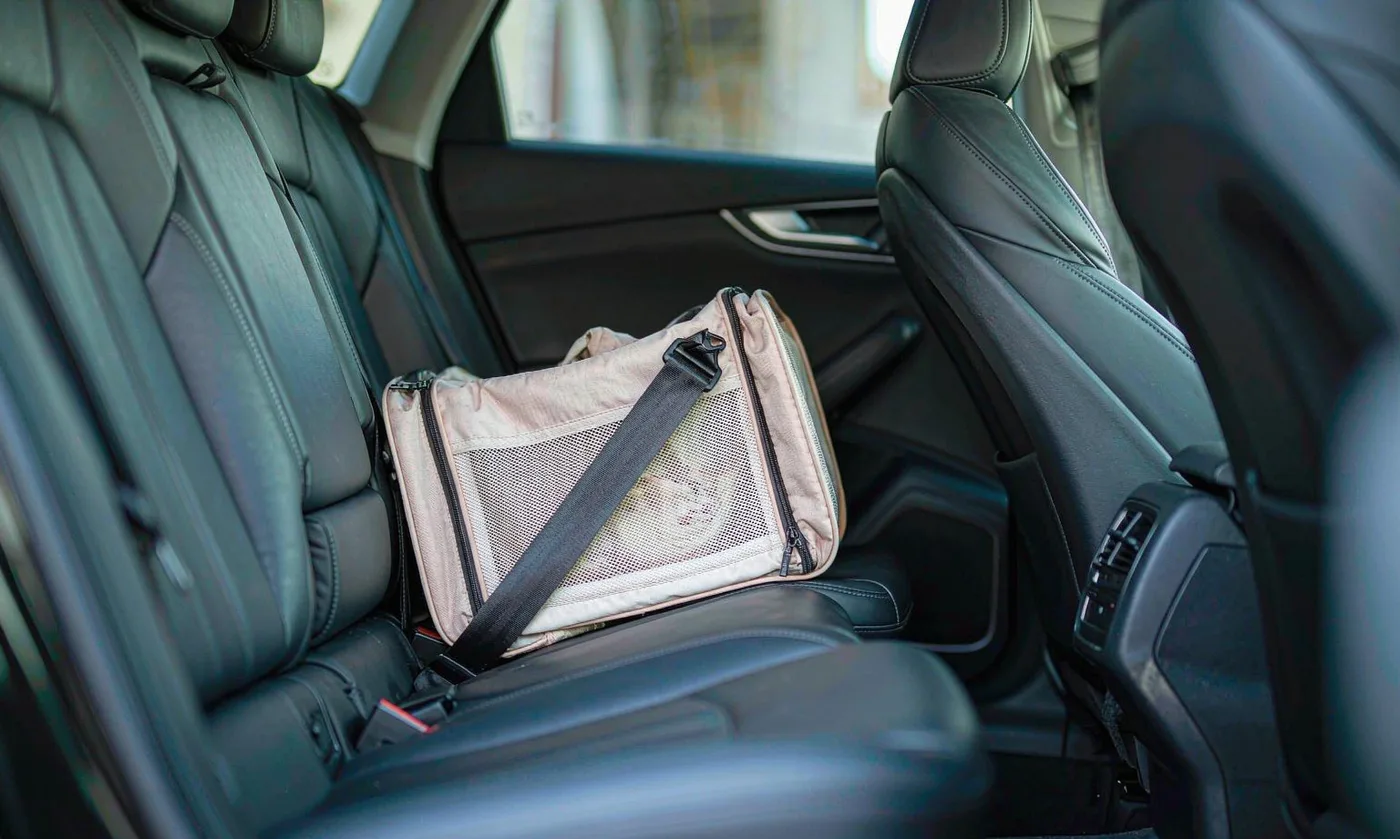
Accessories rarely ship alone in our programmes. Most arrive inside the same container as pet carriers, sometimes inside the same carton, and that combination creates three problems worth planning for: carton strength, odour transfer, and pick-count accuracy.
Carton specification is straightforward once the total weight is known. A five-ply corrugated board with an edge crush test rating of 32 kN per metre handles most mixed cartons, and we cap master carton weight at 15-18 kg to keep handling safe and to stay under common carrier limits. For purely accessory cartons where the volume is high and the weight low, the constraint flips from compression to volume, and the carton gets sized to the number of inner packs rather than to the weight.
Odour transfer is the real risk in this specific category. Printed cards, scented inks, and any essential-oil-based insert are the usual culprits, and a fabric carrier packed in the same polybag absorbs volatile compounds over a six-week voyage. Our mitigation is physical separation: accessory inner bags are sealed independently, odorous components such as scented inserts go into their own 40-micron polyethylene bag, and the carrier goes into a separate bag rather than sharing volume. Where a lane regularly exceeds 65 percent relative humidity we add 2-5 g of desiccant per master carton.
Leak risk follows the same logic. Any liquid or semi-solid companion item in a kit, such as a wipe sachet or a balm tube, is packed upright in a tray with its own secondary containment. The general principle we apply to mixed cartons is that the wettest item in the carton dictates the barrier around everything else.
Pick accuracy closes the loop. Mixed kits are weighed rather than counted at the packing line, with a target tolerance of plus or minus 1 percent of nominal kit weight, because a balance catches a missing component far faster than a visual check of twelve items. Cartons are then numbered sequentially and the sequence is recorded against lot codes so that the mapping described earlier has something real to refer to.
Inspection Plan: Applying AQL 2.5 to a Two-Gram Moulding
Inspection design for a small part is mostly about choosing defensible sample sizes and binary checks. We sample to ISO 2859 general inspection level II and accept to AQL 2.5 for major defects and AQL 4.0 for minor defects, unless a buyer protocol states otherwise.
Defect classification is agreed before production. Flash above 0.05 mm, short shots, incomplete ejection marks and wrong colour are major. Sink marks deeper than 0.2 millimetres on a non-visible face and light texture variation inside the agreed gloss window are minor. Anything that could reach skin and cut is automatically major regardless of how small it looks.
Measurement follows a gauge-first policy. Slot width is verified with go and no-go gauges for each of the three nominal widths on 20 pieces per 10,000 units produced, and dimensional data is recorded on the inspection sheet so that the distribution can be reviewed rather than only the pass and fail count. Colour is measured against a signed master chip with an acceptance of delta E at or below 1.5, read on a benchtop spectrophotometer rather than by eye under shop lighting.
Transit testing is specified for the packed carton, not for the loose part. A single-carton drop sequence covering one corner, three edges and six faces at 760 mm for cartons up to 10 kg is the common baseline, and buyers referencing standard methods usually point to the drop test procedure published by ASTM International. For programmes shipping into high-humidity lanes we add a preconditioning cycle before the drop so the board is tested in the state it will actually arrive in.
The final gate aligns this whole document chain with the rest of the accessory range: MOQ 500 per colourway, prototypes in 6-10 working days, bulk production 35-50 days after approval, and release under an AQL 2.5 inspection report. Nothing leaves the SGS-verified production base without the inspection record and the lot map closing the file.
Production capability
- SGS-verified production space of 4,950 m², 149 machines, 7 assembly lines
- Pet carrier and pet bag output since 2014 from a 137-person team
- 200,000 units shipped monthly under BSCI and ISO 9001 systems
People Also Ask
Is a tick remover classified as a pesticide product?
A tool with no chemical active substance is normally treated as a general consumer article rather than a pesticide, because nothing in it is intended to kill or repel a pest. The classification depends on the claims attached to it, so the printed card and listing copy must stay descriptive of construction only. The importer should confirm the position with destination-country counsel before the first bulk order.
What tolerance should be specified for tick remover tip dimensions?
Precision tooling in POM holds plus or minus 0.05 mm at the tip mouth, with body dimensions at plus or minus 0.15 mm. Verification is done with go and no-go gauges per nominal size on 20 pieces per 10,000 produced, which converts a subjective calliper reading into a binary result at the inspection bench.
Can PCR resin be used for small moulded pet accessories?
Yes, 30-50 percent PCR content in ABS is workable, with tensile dropping to roughly 34-44 MPa and a material cost premium of 8-12 percent. The practical trade-off is colour consistency between lots, so the colour acceptance window has to be widened in the written specification before the first production shot.
What is the minimum quantity for a printed header card?
Spot colour screen printing typically starts at 500-1,000 units per design, while offset litho for folded cards needs a higher threshold and digital short-run sits between the two for testing purposes. Tooling for a blister seal die is separate again, commonly USD 800 to 1,500 depending on cavity count.
How should objects with claims be labelled for the US market?
Where functional language is used, the accepted pattern combines a structure or function claim with a disclaimer stating the statement has not been evaluated and that the product is not intended to diagnose, treat, cure or prevent any disease. Availability of that pattern depends entirely on how the destination classifies the article, which is a determination for the importer own counsel.
Why do we separate scented inserts from fabric carriers in one carton?
Volatile compounds from scented inks and oil-based inserts migrate into textile surfaces over a multi-week voyage, producing odour complaints that are expensive to reverse. The mitigation is double-bagging each odorous component in 40 micron polyethylene and keeping the carrier in a separate sealed bag within the same master carton.
Which audit standards apply to the packing site?
The SGS-verified production base operates under BSCI social compliance and ISO 9001 quality management systems, with 4,950 square metres, 137 workers and seven lines. Certificates forming part of the ISO 9001 framework are released with each shipment against the current listing.
Frequently Asked Questions
What does MOQ 500 mean for a tick remover order?
MOQ 500 pieces applies per colourway per design, not per shipment total. A three-tip set counts as one design if all sizes share a colour, which lets a buyer cover all three sizes inside a single minimum quantity. Mixed colourways across the same tool require 500 each.
How long does sampling take for a new moulded pet tool?
Prototypes are delivered in 6-10 working days from a signed drawing and colour reference. That window covers first shots, deburring, gauge check and photographs. A new tool build runs in parallel with the concept stage and typically completes inside three weeks before first shots are pulled.
What is the bulk production lead time after sample approval?
Bulk production takes 35-50 days after written sample approval and deposit. The lower end assumes single material and single print design; programmes with three print variants or metal components should plan toward the upper end of the window.
Can we supply our own artwork for the header card?
Yes. Buyer-supplied artwork is accepted as vector or high-resolution layered files with fonts outlined and Pantone references called out. Our team pre-flights the file for bleed and die-line fit and returns a proof for written approval before plates or screens are produced.
Which physical tests are run on each production batch?
Each batch receives go and no-go slot gauge checks, visual inspection under 10 times magnification for flash and burrs, colour measurement against the signed master chip, unit weight check, and a drop sequence on the packed carton. Independently witnessed reports are available on request.
Do you provide material certificates for EU shipments?
Every shipment carries a material composition declaration and a restriction statement against the current candidate list. Third-party laboratory reports are ordered when the buyer protocol requires them, with the cost quoted separately and lead time added to the production plan.
Is laser marking available instead of a moulded lot code?
Laser marking is standard on metal bodies and available on moulded bodies where the surface permits contrast. Moulded cavity identification pips are used on small parts where there is no flat face large enough for a legible mark.
Can this item be bundled inside a pet carrier carton?
Yes, and that is how most programmes ship. The accessory is double-bagged, positioned away from textile surfaces, and the master carton is sized to keep total weight under 18 kg. Carton numbering against lot codes is recorded so a single shipment can be narrowed to specific cartons later.
What payment and shipping terms apply?
Terms are T/T with 30 percent deposit and 70 percent before shipment, with standard FOB Xiamen delivery. Document sets including packing list, commercial invoice, inspection report and declarations are issued per shipment.
Who is responsible for checking destination market admission?
The importer of record holds that responsibility. Our role covers the physical specification, the neutral technical file and the physical label we print. Any comparable work done downstream under a seller account is outside the file we control, and we recommend it follows the same wording rules.
Are scented or oil-treated cards permitted?
Any scented component triggers an extra barrier requirement, since volatile compounds migrate in transit. We can produce them, but they ship double-bagged and separated from textile items, and the buyer must confirm the scent raw material is acceptable in the destination market before we commit.
What happens if a defect is found after delivery?
Claims are handled against the retained sample set from the same batch, which is held for three years. If the defect falls inside the agreed AQL 2.5 plan and outside the agreed defect list, we work to a documented corrective action with the buyer rather than a blanket replacement.
Talk to QUANZHOU JUNYUAN BAGS about a pet carrier program: MOQ 500 pieces per colourway, samples in 6-10 working days, bulk production in 35-50 days under AQL 2.5 inspection.
Get a free quote Request a sample