Pet Carrier Trolley: Detachable Handle
A detachable trolley handle is specified by stage count, tube section, extended length and mount type. A two-stage 6063-T5 oval tube at 1.1 mm wall travels 520 to 980 mm and carries 30 kg. The detachable mount uses an 8 mm spring-loaded pin, and bushing clearance sets the wobble.
The trolley handle is the part of a wheeled carrier that a customer judges first and replaces most reluctantly, because it is the only component whose feel is evaluated every time the product is used. This page covers it as a mechanism: what stage count and tube section actually deliver, why wall thickness and bushing clearance decide wobble rather than tube diameter, how the push-button detent works and why it is the part that fails, and what separates a bolt-on, a sleeve and a spring-pin detachable mount. It covers grip geometry and hand clearance, then the test set — extension cycles, static and dynamic load, lateral deflection and corrosion — and closes with replacement supply, MOQ and inspection. Programme terms: MOQ 500 pieces per colourway, prototypes in 6-10 working days, bulk production 35-50 days after sample approval, final random inspection to AQL 2.5, T/T 30/70 and FOB Xiamen.
A dog carrier manufacturer is expected to hold the pet carrier accessory pattern card for at least twelve months, so a reorder matches the approved sample rather than drifting.
Trolley Handle Architecture: Stages, Sections and Travel
A telescopic handle is a set of nested tubes that slide inside one another and lock at defined positions. Three numbers describe it completely: how many stages it has, what section the tubes are, and how far it travels from collapsed to extended.
Stages. A two-stage handle has one sliding section inside a fixed outer tube; a three-stage has two. Two-stage is stiffer, cheaper and shorter when collapsed, which matters because the collapsed length is what determines whether a carrier fits a car boot or an airline gauge. Three-stage gives a longer extension and a shorter collapse, and it is used where a tall handler needs a long handle on a small carrier. The penalty is wobble: each additional joint adds clearance and each additional joint is a lever arm.
Sections. Tubes are oval, rectangular or round. Oval at roughly 20 × 15 mm is the mainstream choice because it resists the bending direction a handle sees while remaining comfortable to grasp. Rectangular is stiffer in one axis and weaker in the other, and it is used on chassis-mounted systems. Round is the cheapest but it rotates in the hand unless it is keyed, and a handle that rotates feels broken even when it is not.
Travel. A two-stage carrier handle typically travels from 520 mm collapsed to 980 mm extended; a three-stage from 420 mm to 1,050 mm. The extended figure should place the grip at roughly the handler wrist height when standing, which for most adults is 850-1,000 mm from the ground. Handles extended beyond about 1,050 mm put the load above the handler elbow and the carrier becomes hard to control on a slope.
Stop positions. Detent holes are spaced at 80-150 mm. Closer spacing gives more height options and more holes to weaken the tube; wider spacing gives fewer options and a handle that is either too long or too short. Three positions is the usual compromise, and the middle one should correspond to the most common handler height rather than to the midpoint of travel.
Stowed travel matters for air travel. A handle that cannot be fully collapsed may push a carrier past the dimensional limits applied to cabin baggage, and for checked transport the live-animal container rules published by the FAA and by IATA both reward a handle that stows flush.
Tube Material, Alloy and Wall Thickness
Aluminium is universal in this component and the choice is not whether to use it but which alloy, which temper and which wall.
Alloy and temper. 6063-T5 is the standard for extruded telescopic tube: it extrudes to a good surface finish, it takes an anodised finish well, and it is stiff enough at the sections used. 6061-T6 is stronger and is used where the wall has to come down to save mass, but it extrudes less cleanly and costs more. Both are heat-treatable and both lose strength if the tube is welded or over-heated after temper, which is why mounts are mechanically fixed rather than welded.
Wall thickness. 1.0 to 1.2 mm is the working range. Below 1.0 mm the tube dents from ordinary handling and the detent holes elongate; above 1.2 mm the mass rises quickly with little gain in stiffness, because stiffness at these sections is dominated by the outer dimension. A two-stage handle at 1.1 mm weighs about 380 g; the same handle at 1.4 mm weighs close to 470 g for no perceptible benefit.
Finish. Anodising at 8-12 µm is the standard: it protects against corrosion, it colours the tube consistently, and it is hard enough to resist the abrasion of sliding in and out of a bushing. A painted finish is cheaper and it wears off at the sliding surfaces within a season, exposing bare aluminium that then oxidises and stains the handler hand. Clear anodising is the safe choice for a handle that slides.
Bushing and glide. The sliding surfaces are not metal on metal. Each stage carries a polymer bushing — acetal or nylon — that sets the clearance and provides the glide. Bushing clearance is the variable that controls wobble and it is specified as a total diametral gap of 0.15-0.30 mm. Tighter than that and the handle binds when the tube is slightly bent; looser and it rattles.
| Configuration | Section | Wall | Mass | Tip deflection at 10 kg | Travel | Relative cost |
|---|---|---|---|---|---|---|
| 2-stage, 6063-T5 | Oval 20 x 15 mm | 1.0 mm | 350 g | 26 mm | 520-950 mm | 1.0 |
| 2-stage, 6063-T5 | Oval 20 x 15 mm | 1.2 mm | 410 g | 22 mm | 520-950 mm | 1.1 |
| 2-stage, 6061-T6 | Oval 20 x 15 mm | 1.0 mm | 348 g | 21 mm | 520-980 mm | 1.4 |
| 3-stage, 6063-T5 | Oval 18 x 13 mm | 1.1 mm | 430 g | 34 mm | 420-1,050 mm | 1.6 |
| 3-stage, 6061-T6 | Oval 18 x 13 mm | 1.0 mm | 405 g | 30 mm | 420-1,050 mm | 1.9 |
Tip deflection is measured with the handle fully extended, the base fixed and a 10 kg lateral load applied at the grip. Anything beyond about 35 mm reads as flimsy to a handler, which is the practical reason three-stage handles are reserved for small carriers where the collapsed length matters more than the feel.
Buttons, Springs and Detents: The Mechanism
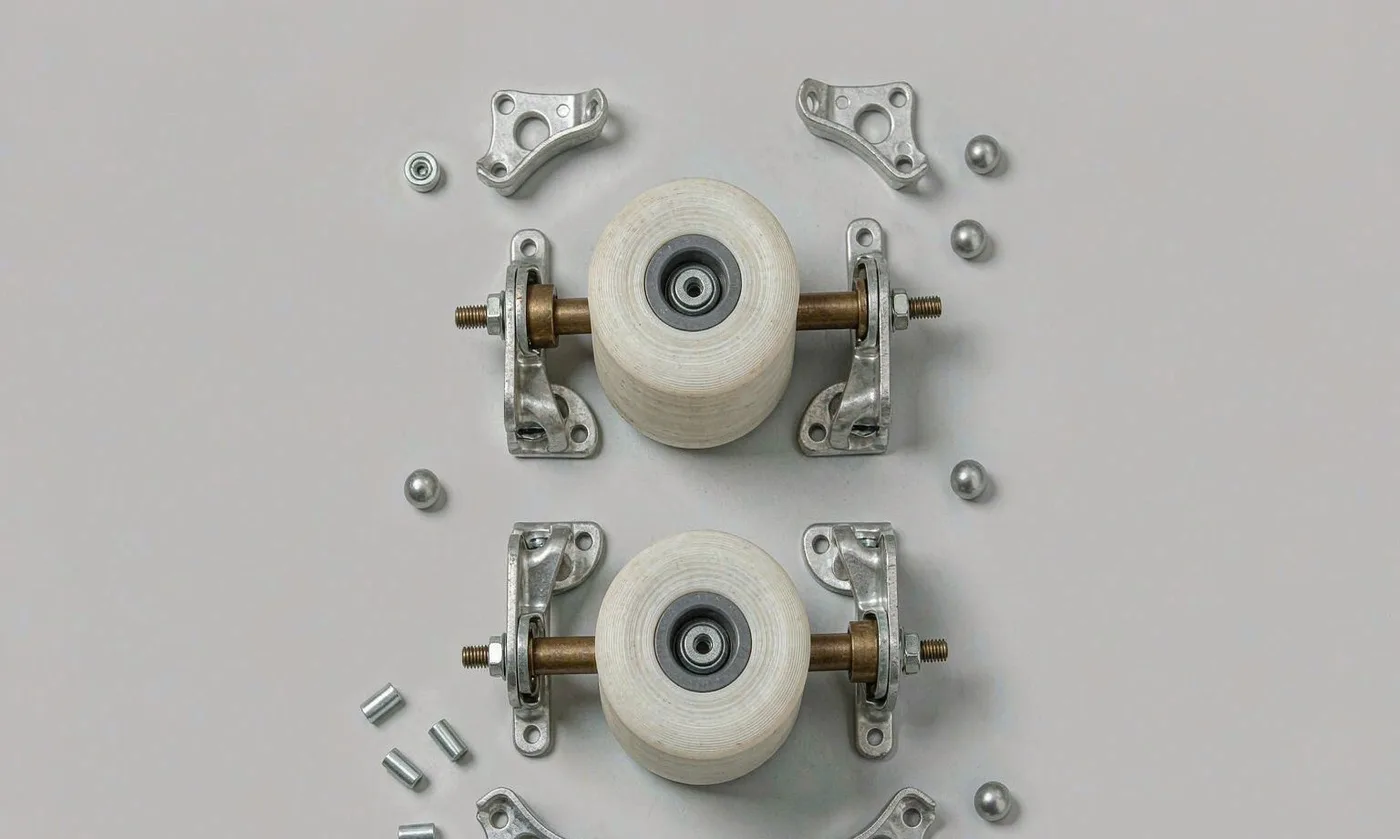
The push-button detent is the part that fails, and it fails in three recognisable ways.
Sticking. The button does not return, so the handle will not lock or will not collapse. The cause is contamination — grit, pet hair, drink sugar — in the button bore, or a spring that has taken a set. A button with a shrouded bore and a stainless spring is the specification answer, and it costs a few cents more than an open bore with a plated spring.
Spring fatigue. A compression spring cycled a few thousand times loses free length, and the button begins to sit proud or to fail to engage fully. The specification is a stainless spring rated for 10,000 cycles to a maximum 5% loss of free length, and it is verified by cycle testing on the finished handle rather than on the spring alone.
Hole elongation. The detent holes in the inner tube ovalise under repeated load, and the pin then no longer seats. This is the failure that ends the handle service life, and it is a wall-thickness and load issue rather than a mechanism issue. A reinforcement collar at each detent hole roughly doubles the cycle life for a small cost in mass.
Pin geometry. The detent pin is 4-5 mm in diameter with a chamfered or radiused nose, engaging into a hole 0.2 mm larger than the pin. A pin that is too tight will not enter when the tubes are slightly twisted; one that is too loose rattles and wears the hole faster. The pin material is steel, not aluminium, because an aluminium pin wears before the tube does and the tube is the expensive part.
Two-button versus one. A single central button is simpler and cheaper; two buttons at the sides let the handle be operated with either hand and are preferred on a wide grip. Where two buttons are used, both must release the same pin — handles with two independent pins are a recurring source of a jam that needs tools to clear.
Mounting and Detachment Geometry
A detachable handle is only as good as its mount. Three mount types exist and they differ in stiffness, in serviceability and in what happens when they wear.
Bolt-on plate fixes the handle base to a reinforced plate on the carrier, usually with two M6 bolts into threaded inserts or through a backing plate. It is the stiffest mount, it is serviceable with one tool, and it is the correct choice where the handle carries more than about 15 kg. The requirement is a backing plate — bolts through a fabric panel alone pull through under load, and a 2 mm polypropylene or aluminium backing plate spread over 60 × 40 mm is the minimum.
Sleeve mount slides the handle base into a fabric or moulded sleeve on the back panel and retains it with a strap or a clip. It is light and cheap, it distributes load along the panel rather than at a point, and it is the commonest mount on soft carriers. Its weakness is that the sleeve wears, and once the sleeve is loose the handle rocks in it — which is felt as wobble and is often misdiagnosed as a tube problem.
Spring-pin detachable is the quick-release version: an 8 mm spring-loaded steel pin through the mount that can be pulled, twisted and released one-handed. It is what makes a handle genuinely detachable in daily use rather than removable with a screwdriver, and it is the specification that matters for a carrier that has to be stowed flat or checked as baggage. The pin must be steel and must be retained by a lanyard or a captive design, because a lost pin renders the handle unusable and is the single commonest spare request in this category.
Load path. Whichever mount is used, the load from the handle goes into the base panel, and the base panel has to be stiff enough to take it. A handle mounted to a 1.2 mm board with no reinforcement will flex the board and the whole assembly will feel loose regardless of the handle quality — which is why the handle and the base are specified together rather than independently.
Wobble, Rattle and Bushing Design
Wobble is the complaint that gets a handle replaced when nothing about it is broken, and it comes from three sources that are often confused.
Joint clearance is the clearance between sliding stages, set by the bushing. Each stage contributes its own clearance at its own lever arm, so the tip deflection from clearance is the sum of clearances multiplied by their distances from the grip. That is the arithmetic behind the rule that a three-stage handle wobbles more than a two-stage one even when each joint is equally tight.
Bushing wear adds clearance over time. An acetal bushing sliding on an anodised tube wears slowly; the same bushing on a painted tube wears fast, because the paint debris is abrasive. When a handle starts to rattle after a season, the bushing is the part to replace, and a replacement bushing set is a legitimate and cheap spare item that most programmes never offer.
Structural deflection is the tube bending, and it is not wobble in the same sense — it is smooth and predictable rather than loose. A handler perceives a handle that deflects smoothly as flexible and one that has clearance as loose, and they are fixed by different changes: wall thickness and section for the first, bushing and joint count for the second.
Rattle suppression. Two measures work. A felt or polymer glide strip inside the outer tube takes up the clearance in the non-sliding axis without adding friction to the sliding one, and a light preload from a wave spring at the joint keeps the tubes loaded against one side. Both are cheap; the wave spring is the better of the two on a three-stage handle, where cumulative clearance is the problem.
Measurement. Wobble is measured as the lateral tip movement when a 20 N alternating side load is applied at the grip with the handle extended. A good two-stage handle returns 1.5-2.5 mm; above 4 mm it is audible when rolled over a rough surface.
Grip, Ergonomics and Hand Clearance
The grip is the only part of the handle the customer touches, and it is specified for three things: shape, material and clearance.
Shape. A grip 100-130 mm wide suits one hand with room to spare; below 90 mm it crowds the knuckles and above 140 mm it encourages a one-handed pull that twists the handle. The cross-section should be oval rather than round so it does not rotate, with the long axis horizontal. A slight downward angle at the ends, 5-8 degrees, keeps the wrist neutral when pulling.
Material. A thermoplastic elastomer overmoulded onto a polypropylene core at 55-70 Shore A is the standard: soft enough to grip when wet, hard enough not to roll under the hand. A bare aluminium grip is cold to touch in winter and slippery when wet, and it is the cheapest-looking option. Two-shot moulding bonds the elastomer to the core; a slip-on sleeve is cheaper and it rotates on the tube within a season.
Clearance. The distance between the grip and the carrier body when the handle is extended and loaded is the ergonomic variable most often missed. Below 60 mm the handler knuckles contact the carrier on every pull; 80-110 mm is comfortable. This is determined by the mount offset rather than by the handle, so it is specified during carrier design, and it is the reason a replacement handle from a different platform often fits and still feels wrong.
Two-hand use. A wide grip invites the handler to pull with one hand while the carrier is turning, which applies a torsion the handle was not designed for. A grip with a moulded centre index, or a slight waist that discourages an off-centre pull, reduces that. Where a platform is marketed for a heavy animal, the grip should be specified with a second hand position at 200 mm so the carrier can be steadied rather than dragged.
Button access. The release button must be reachable by the thumb of the hand that is holding the grip, which puts it within 45 mm of the grip centreline and on the upper face. A button on the underside, or one more than 60 mm away, forces a two-handed operation and is the ergonomic complaint that no amount of stiffness compensates for.
Testing: Extension Cycles, Load and Corrosion
Four tests cover a handle, and the first is the one that predicts the field result best.
Extension cycling. The handle is extended and collapsed at about six cycles per minute to a count of 5,000, with the button fully depressed each time. The endpoints are: no increase in the force required to operate the button beyond 30% of the initial figure, no visible elongation of the detent holes, and no increase in tip wobble beyond 1 mm. A handle that passes at 2,000 cycles and fails at 5,000 is a handle that will be complained about in the second year.
Static load. With the handle extended and the carrier restrained, a vertical load is applied at the grip to 1.5 times the rated carrier mass and held for five minutes. Acceptance is no permanent deformation of the tubes and no slip at the detents. This is the test that catches an undersized detent pin, because the pin shears or the hole elongates before the tube bends.
Dynamic load and drop. The loaded carrier is rolled over a defined obstacle course — a 10 mm step, a 20 mm gap, at 4 km/h — for 5,000 metres, and the handle is then re-measured for wobble and re-cycled. This is the closest thing to a real service test and it is what separates a handle that survives a showroom from one that survives a season.
Corrosion. Aluminium tubes and steel pins are exposed together, which is a galvanic couple. The control is an anodised tube, a stainless pin and spring, and a 48-hour neutral salt spray test by the method referenced in the ASTM standards, with the endpoint being operability after exposure rather than appearance. A handle that cannot be collapsed after salt spray has failed, whatever the tubes look like.
Replacement and Upgrade Supply: MOQ and Inspection
A replacement handle is a mechanical assembly bought as a complete unit — tubes, bushings, button, spring, pin and grip — because assembling one from parts costs more than the unit and produces a worse result.
Specification for a replacement. Six attributes are needed: stage count, collapsed and extended length, tube section, mount type and bolt or pin dimensions, grip width, and finish. Most "wrong handle" orders come from a missing mount dimension, because two handles with identical tubes can have completely different base plates.
Upgrade paths. Three exist. A one-stage-larger tube section reduces tip deflection by 15-20% where the mount allows it. A three-stage to two-stage change improves feel at the cost of collapsed length. And a replacement with reinforced detent collars roughly doubles cycle life for a small mass penalty, which is the upgrade most worth offering on a platform that has field complaints.
MOQ. 500 pieces per specification. Handles are the most expensive accessory in a programme and the one where a 500-piece commitment is hardest to absorb, so the practical approach is to specify one handle across two or three platform sizes where the mount is shared, which meets the commitment once. Sampling takes 6-10 working days and bulk production 35-50 days after approval.
Inspection. AQL 2.5 applies, with handle-specific definitions: a detent that does not engage is critical, a pin that is not retained is critical, a wobble above 4 mm is major, and a cosmetic anodising mark under 2 mm is minor. Extension force is measured on five units per lot, tip deflection on three, and one unit per lot goes into a 5,000-cycle endurance run that is started at the beginning of the production window so it finishes before shipment.
Our production team sources handle assemblies from qualified component partners, inspects them at the SGS-verified production base, and ships on T/T 30/70 and FOB Xiamen terms alongside the parent carrier order.
Order and quality terms
- MOQ 500 pieces per colourway; samples in 6-10 working days
- Bulk production 35-50 days after approval; AQL 2.5 inspection standard
- T/T 30/70 terms, FOB Xiamen, full document set per shipment
People Also Ask
What is the best trolley handle for a pet carrier?
A two-stage 6063-T5 oval tube at 20 x 15 mm with a 1.1 mm wall. It travels 520 to 980 mm, carries 30 kg and returns 22-26 mm of tip deflection at 10 kg, which reads as solid without the wobble of a third stage.
Can a trolley handle be removed for air travel?
Yes, if it uses an 8 mm spring-loaded steel pin, which releases one-handed. That is what lets a carrier be stowed flat or checked, since a handle that cannot collapse may push the carrier past a dimensional limit.
Why does my handle wobble?
Joint clearance in the bushings, bushing wear, or a worn sleeve mount. Wobble is measured as tip movement under a 20 N alternating side load: 1.5-2.5 mm is normal, above 4 mm is audible when rolling.
How many stages should a carrier handle have?
Two, unless a short collapsed length matters more than feel. Each extra joint adds clearance at a longer lever arm, which is why a three-stage handle wobbles more even when every joint is equally tight.
What causes the push button to stick?
Contamination in the button bore or a spring that has taken a set. A shrouded bore with a stainless spring rated to 10,000 cycles is the specification answer and costs only a few cents more.
How long should a trolley handle last?
It should pass 5,000 full extension cycles with no detent hole elongation, no more than a 30% rise in button force and no more than 1 mm of added wobble. Reinforced detent collars roughly double that life.
Can I fit a handle from another carrier?
Rarely. Two handles with identical tubes can have completely different base plates and mount offsets, so the mount dimensions matter more than the tube. Missing mount dimensions cause most wrong-handle orders.
Frequently Asked Questions
What is the minimum order for replacement handles?
MOQ 500 pieces per specification. Because a handle is the most expensive accessory in a programme, the practical approach is to specify one handle across two or three platform sizes that share a mount, which meets the commitment once.
How long does handle sampling take?
6-10 working days, with bulk production 35-50 days after approval. A handle with a custom base plate or a non-standard mount runs to the upper end of the window.
What wall thickness should the tube have?
1.0 to 1.2 mm. Below 1.0 mm the tube dents in normal handling and the detent holes elongate; above 1.2 mm mass rises quickly with little gain, because stiffness is set by the outer dimension.
Should the tube be 6063-T5 or 6061-T6?
6063-T5 for most handles: it extrudes cleanly, anodises well and is stiff enough at these sections. 6061-T6 is used only where wall must come down to save mass, and it costs more.
Why does the handle rattle after a season?
Bushing wear, usually accelerated by a painted rather than anodised tube because paint debris is abrasive. A replacement bushing set is a cheap spare item that most programmes never offer.
What clearance should the bushing have?
A total diametral gap of 0.15-0.30 mm. Tighter and the handle binds when the tube is slightly bent; looser and it rattles, and cumulative clearance is what makes three-stage handles feel loose.
How is the handle mounted to a soft carrier?
Usually a sleeve mount with a strap or clip, distributing load along the panel. A bolt-on plate is stiffer and correct above about 15 kg, but it needs a backing plate of at least 2 mm spread over 60 x 40 mm.
What grip material is used?
Thermoplastic elastomer overmoulded onto polypropylene at 55-70 Shore A, two-shot moulded rather than slipped on. A slip-on sleeve rotates on the tube within a season.
How much hand clearance is needed?
80-110 mm between the grip and the carrier body. Below 60 mm the knuckles contact the carrier on every pull, and this is set by the mount offset during carrier design rather than by the handle.
Why does aluminium corrode on a handle?
Because the tube and the steel pin form a galvanic couple. The control is an anodised tube, a stainless pin and spring, and a 48-hour salt spray test whose endpoint is operability rather than appearance.
Can a replacement handle be stiffer than the original?
Yes, one section size larger where the mount allows, which cuts tip deflection by 15-20%. A change from three stages to two improves feel but costs collapsed length.
How are handle lots inspected?
To AQL 2.5, with a non-engaging detent and an unretained pin classified as critical and wobble above 4 mm as major. Extension force is measured on five units, tip deflection on three, and one unit runs a 5,000-cycle endurance test started at the beginning of production.
Talk to QUANZHOU JUNYUAN BAGS about a pet carrier program: MOQ 500 pieces per colourway, samples in 6-10 working days, bulk production in 35-50 days under AQL 2.5 inspection.
Get a free quote Request a sample