Pet Carrier Waste Bag Dispenser: Convenience
A waste bag dispenser is specified around the roll core, not the shell: a 32-38 mm core diameter, a slit tear force of 3-8 N, and a housing that survives a 1.5 m drop at 5 degrees. ABS at 2.0-2.6 mm wall is the default. Confirm 5,000 clip cycles and 200 roll changes before approval.
The dispenser is the accessory that generates repeat revenue, because the housing is a one-time sale and the refill roll is a consumable with a reorder cycle measured in weeks. That changes how it should be engineered: the housing has to accept a standard refill, and the refill has to be a proprietary-ish fit that keeps the customer inside the programme. This page covers both sides. It sets out the four housing formats and what each costs to tool, why core diameter is the specification that determines whether a refill from a supermarket fits or jams, how slit geometry sets the tear force and therefore whether the product works one-handed, and what the clip has to survive when it is carried on a lead for a year. It also covers the low-temperature brittleness failure that only appears in winter, and the bundle economics of shipping a housing with three or six refill rolls. Commercial terms follow the standard accessory programme: MOQ 500 pieces per colourway, prototypes in 6-10 working days, bulk production 35-50 days after sample approval, final random inspection to AQL 2.5, T/T 30/70 and FOB Xiamen.
Any dog carrier factory quoting pet carrier accessory work should be able to show a current BSCI audit and an ISO 9001 certificate before a deposit is released.
Housing Formats: Bone, Cylinder, Flat Pack and Pouch-Mount
Four housing geometries cover the market, and the differences are in tooling cost, packing volume and how much roll the shell can carry. The bone and the cylinder are the two injection moulded standards. The flat pack is a cut-and-sew fabric body with a moulded insert. The pouch-mount is a moulded frame that clips inside a carrier pocket.
The cylinder is the most efficient package. A cylinder of 48-56 mm diameter and 95-115 mm length carries a full 15-bag roll at 0.19-0.26 litres of internal volume, and it packs tightly in a carton at 180-260 units per box. Tooling for a two-part cylinder with a snap-fit end cap is 3,200-6,400 USD.
The bone shape is a marketing geometry that costs real money. The same internal volume requires 18-28% more material, the two halves need a more complex tool with side actions at 5,400-10,800 USD, and the shape packs poorly, at 110-170 units per carton. It sells better on shelf and it costs more at every step.
| Format | Internal volume (L) | Tool cost (USD) | Material per unit (g) | Carton count | Unit cost (USD) |
|---|---|---|---|---|---|
| Cylinder, snap cap | 0.19-0.26 | 3,200-6,400 | 22-34 | 180-260 | 0.48-0.95 |
| Bone, two half shells | 0.20-0.28 | 5,400-10,800 | 28-44 | 110-170 | 0.72-1.45 |
| Flat pack, fabric plus insert | 0.14-0.20 | 850-1,900 | 16-26 | 240-360 | 0.42-0.88 |
| Pouch-mount frame | 0.12-0.18 | 2,600-4,800 | 14-22 | 300-460 | 0.38-0.78 |
| Silicone sleeve, no shell | n/a | 1,900-3,600 | 18-30 | 280-420 | 0.55-1.10 |
The flat pack deserves more attention than it gets. A fabric body with a moulded end insert carries a roll, weighs less, costs less to tool, and can be made in the same fabric as the carrier, which is the only format that lets a dispenser be part of a coordinated set. Its weakness is wear: the fabric body abrades at the aperture in 300-600 roll changes.
Opening mechanism separates good designs from bad ones. A threaded cap is secure and slow. A snap-fit cap opens in one motion and loses retention after 150-400 cycles as the snap tabs wear. A bayonet with a quarter turn is the best compromise at 800-1,500 cycles, and it costs 0.04-0.09 USD more in tooling per cavity.
A cylinder with a bayonet cap carries a full roll in 0.22 litres, tools for 3,200-6,400 USD, and survives 800-1,500 opening cycles against 150-400 for a plain snap fit.
Housing Material: ABS, PP, Silicone and Recycled Content
Three polymers are in regular use and the choice is a trade between impact strength, cost and the sustainability claim the brand wants to make. ABS is the default. Polypropylene is the cheap option and is brittle at low temperature. Silicone is used for sleeves rather than shells. Recycled ABS and recycled PP are available and carry a documentation burden.
Impact strength is the deciding property, because a dispenser on a lead hits the ground. ABS has a notched Izod impact of 180-260 J/m at 23 degrees and 90-140 J/m at 0 degrees. Polypropylene homopolymer is 30-60 J/m at 23 degrees and 15-25 J/m at 0 degrees, which is why PP dispensers crack in winter and ABS ones do not.
Copolymer polypropylene closes much of that gap at 80-160 J/m, and it is the correct choice when cost rules. The specification has to name the grade, not just the polymer: writing "PP" on a drawing invites a homopolymer substitute that passes incoming inspection and fails in January.
| Material | Izod impact, 23 degrees (J/m) | Izod impact, 0 degrees (J/m) | Drop pass at 1.5 m, 5 degrees | Resin cost (USD/kg) | Suits |
|---|---|---|---|---|---|
| ABS, general purpose | 180-260 | 90-140 | 92-98% | 1.60-2.30 | Standard housing |
| PP copolymer | 80-160 | 45-85 | 72-88% | 1.05-1.55 | Volume retail |
| PP homopolymer | 30-60 | 15-25 | 24-46% | 0.90-1.30 | Not recommended |
| Recycled ABS, 50% | 140-200 | 70-110 | 84-94% | 1.45-2.05 | Sustainability line |
| Silicone sleeve | n/a | n/a | 98-100% | 3.80-6.20 | Premium, quiet |
Wall section interacts with material. A 2.0-2.6 mm wall in ABS gives a stiff shell that survives drops; the same wall in PP copolymer feels flexible and the snap tabs deform. For PP the wall should go to 2.4-3.0 mm, which partly cancels the resin cost saving through material usage.
Recycled content is increasingly requested and it is workable if handled correctly. Post-consumer recycled ABS at 30-50% loading holds 78-88% of virgin impact strength and is visually acceptable in dark colours. It needs a restricted-substance test per lot, because the input stream is uncontrolled, and a brand making a recycled claim needs that report on file.
Restricted substances are administered for the EU by ECHA under REACH and for the US by the CPSC under CPSIA. Both require a test on the finished article, and a recycled resin makes that test materially more likely to find something.
ABS at 2.0-2.6 mm wall passes a 1.5 m drop at 5 degrees at 92-98%; polypropylene homopolymer passes at 24-46% and should not be specified.
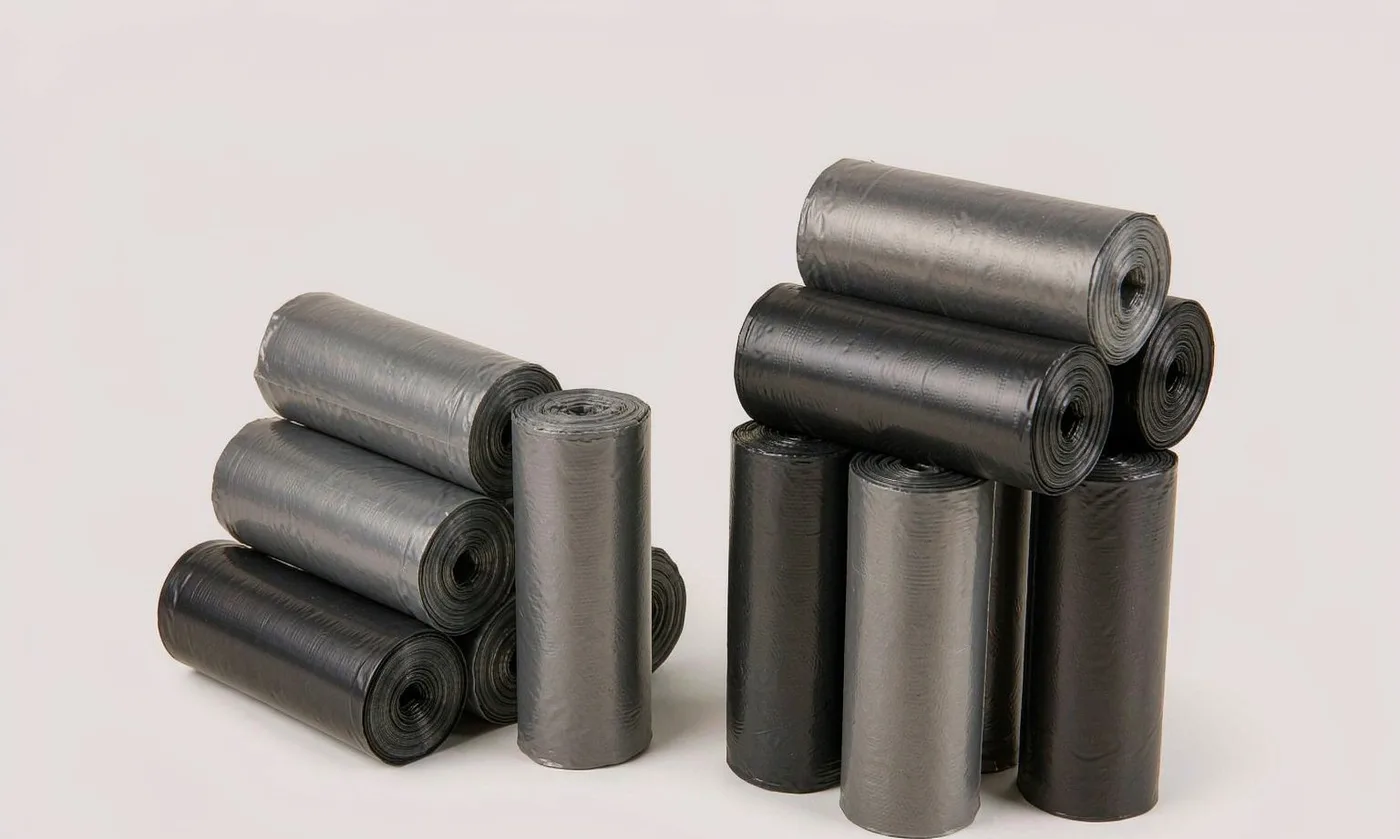
Roll Core Specification and Bag Compatibility
The core is the specification that decides whether the product is a system or a frustration, and it is the number most often taken from a sample rather than measured. Two dimensions matter: core internal diameter, which sets what fits on a spindle or post, and roll outer diameter, which sets whether the roll fits the shell.
Core internal diameter across the market clusters at 32-38 mm for a standard roll, with 25-30 mm for compact rolls and 40-45 mm for large-count rolls. A dispenser built with a fixed spindle at 36 mm will accept a 38 mm core and jam a 32 mm core. The correct design is a spindleless bore with a 30-42 mm internal clearance, which accepts every roll on the market and gives up only a small amount of roll centering.
Roll outer diameter is the harder constraint, because it is set by bag count and film gauge. Fifteen bags at 18 microns on a 36 mm core gives a roll outer diameter of 40-46 mm. Twenty bags at 22 microns gives 52-60 mm. A shell designed for 46 mm will not close on a 60 mm roll, and that is a silent failure that only appears at refill time.
| Roll type | Core ID (mm) | Roll OD (mm) | Bag count | Film gauge (micron) | Fits 46 mm bore |
|---|---|---|---|---|---|
| Compact | 25-30 | 34-40 | 10-12 | 15-18 | Yes |
| Standard | 32-38 | 40-46 | 15 | 18 | Yes |
| Standard thick | 32-38 | 46-54 | 15 | 22-25 | Marginal |
| High count | 40-45 | 52-60 | 20-30 | 18-22 | No |
| Perf-roll, coreless | n/a | 38-48 | 20-24 | 16-20 | Yes |
Bag material is the consumable specification and it drives the sustainability claim. Standard PE film at 18 microns costs 0.008-0.014 USD per bag. Oxo-degradable film is not a compliance answer in the EU and should not be marketed as compostable. Certified compostable film to EN 13432 costs 0.022-0.041 USD per bag, needs a lower storage temperature and has a shelf life of 12-18 months, which is a real logistics constraint.
Perforation quality is the defect that generates the most complaints after the roll itself. A perforation that is too weak tears inside the shell; one that is too strong needs two hands. The measured target is a tear propagation force of 2.5-6.0 N across the perforation line, tested on a tensile frame at a 200 mm per minute crosshead speed.
Specify a spindleless bore with 30-42 mm clearance and a shell that accepts a 54 mm roll outer diameter, and the dispenser takes every refill on the market instead of one.
Dispensing Aperture: Slit Geometry and One-Handed Use
The aperture is the only part of the dispenser the user touches every single time, and it is specified by one number: the force needed to pull a bag through and tear it off. Too low and bags pull out in a stream; too high and the product needs two hands, which is exactly the situation the user does not have.
The measured target is 3-8 N to draw the first bag through and 2.5-6.0 N to tear it at the perforation. Below 2 N, a dispenser hanging on a lead dispenses bags every time it swings. Above 10 N, the user has to brace the housing against a leg, and the product gets returned.
Slit geometry sets that force. A straight slit of 45-60 mm length in a rigid shell gives a low, unpredictable force because the film bunches. A contoured slit with a 6-10 mm radius at each end concentrates the film and raises the force predictably. A moulded silicone grommet with a cross-slit is the most consistent solution across film gauges and costs 0.05-0.12 USD.
| Aperture | Draw force (N) | Tear force (N) | One-handed | Consistency across gauges | Added cost (USD) |
|---|---|---|---|---|---|
| Straight slit, rigid | 1.4-3.2 | 2.2-4.8 | Yes | Poor | 0.00 |
| Contoured slit with radii | 3.2-6.4 | 2.6-5.4 | Yes | Fair | 0.02-0.05 |
| Silicone cross-slit grommet | 4.0-7.6 | 2.8-5.8 | Yes | Good | 0.05-0.12 |
| Moulded serrated tooth | 5.5-9.8 | 3.4-6.2 | Marginal | Good | 0.03-0.07 |
| Rotating collar aperture | 2.8-5.0 | 2.4-4.6 | No | Excellent | 0.14-0.30 |
Aperture position relative to the roll is the second variable. An aperture on the axis of the roll pulls the film straight and gives a lower, more consistent force. An aperture offset by more than 25 mm from the roll axis introduces a bend and raises the force by 40-80%, which is why some housings feel stiff even with a generous slit.
The first-bag problem deserves its own test. When a new roll is loaded, the leading bag has to be presented at the aperture rather than tucked inside the roll. A starter tab on the roll, or a lead-in ramp moulded inside the shell, resolves this; without it, roughly one user in four opens the housing to fish out the first bag, which is the single most common negative review in the category.
A silicone cross-slit grommet on the roll axis holds draw force at 4.0-7.6 N across every film gauge, and a moulded lead-in ramp removes the first-bag problem that drives one in four negative reviews.
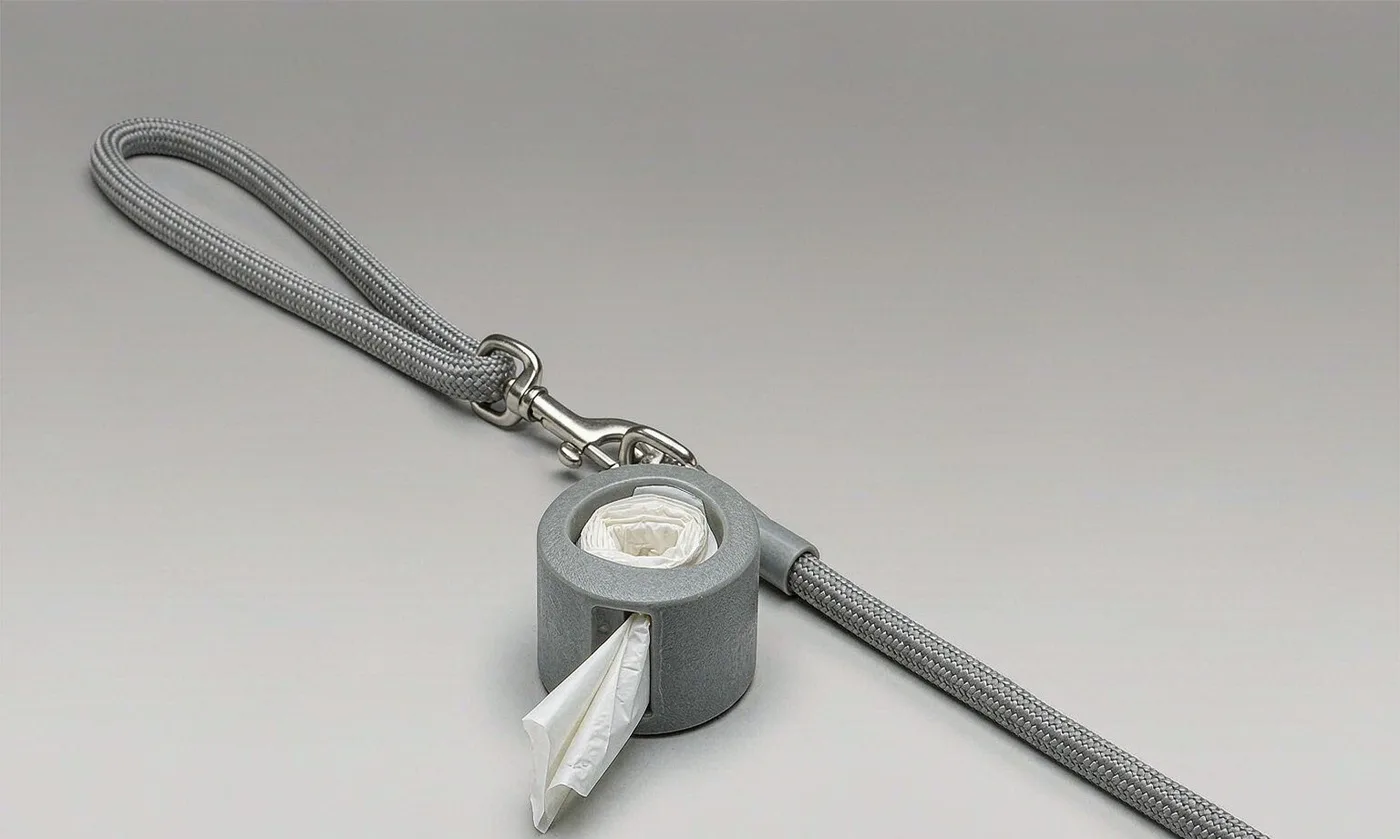
Clip and Attachment: Swivel Hook, Carabiner and Webbing Loop
The clip is the component that fails, because it is the component under continuous cyclic load while the dispenser swings on a lead. Three attachment types are in production: a moulded swivel hook, a separate metal carabiner, and a webbing loop that threads onto a lead or strap.
A moulded hook in ABS carries 3-6 kg static, and its failure mode is not breakage but gate fatigue: the hook's spring section takes a bending cycle with every step, and it cracks at 4,000-12,000 cycles. A metal swivel hook in zinc alloy carries 12-25 kg and survives 15,000-40,000 cycles, at 0.14-0.38 USD against 0.00-0.06 for the moulded version.
The carabiner option is the strongest and it is also the one that lets the dispenser be sold as part of a carrier attachment system. A small aluminium carabiner rated to 0.4-0.9 kN costs 0.28-0.75 USD and is far beyond what a dispenser needs structurally, which is deliberate: the carabiner becomes the reusable part of a consumable system.
| Attachment | Static load (kg) | Cycles to failure | Swivel | Cost (USD) | Noise |
|---|---|---|---|---|---|
| Moulded ABS hook | 3-6 | 4,000-12,000 | No | 0.00-0.06 | Silent |
| Moulded POM hook, swivel | 5-9 | 9,000-22,000 | Yes | 0.08-0.18 | Silent |
| Zinc alloy swivel hook | 12-25 | 15,000-40,000 | Yes | 0.14-0.38 | Rattles |
| Aluminium carabiner, 0.6 kN | 55-90 | 30,000-80,000 | No | 0.28-0.75 | Rattles |
| Webbing loop, bar-tacked | 30-60 | 18,000-35,000 | No | 0.06-0.14 | Silent |
Noise is an underrated specification. A metal clip on a lead rattles at walking cadence and it is audible to the user on every walk. A moulded hook or a webbing loop is silent. For a premium product, the silent option is often the right one even though the load rating is lower, because the dispenser weighs 40-90 g and never approaches its rated load.
Corrosion testing applies to any metal component. A zinc alloy hook with a standard nickel plating survives 24-48 hours of neutral salt spray before white corrosion appears; the same hook with a sealed electrophoretic topcoat survives 96-200 hours. For a product used outdoors year-round, the topcoat is worth the 0.03-0.08 USD.
A moulded POM swivel hook at 0.08-0.18 USD carries 5-9 kg, survives 9,000-22,000 cycles and is silent, which is the correct balance for a 40-90 g accessory.
Testing: Drop, Cycle and Low-Temperature Brittleness
Three tests predict field performance on this product, and the third is the one most programmes skip until a winter return wave. Drop testing catches material and wall problems. Cycle testing catches the clip and the cap. Low-temperature testing catches the material substitution that passes every ambient test.
The drop protocol is a filled housing dropped from 1.5 m onto concrete, six orientations, at 23 degrees and again at 5 degrees after four hours of conditioning. Acceptance is no crack and no separation of the cap. The cold branch is where polypropylene fails, and it is the reason the material grade has to be named on the drawing.
Cycle testing runs the clip and the cap on a fixture. The clip is loaded to 0.5 kg and cycled through a 30-degree swing at 1 Hz to 10,000 cycles. The cap is opened and closed to 2,000 cycles. Failure criteria are a visible crack on the clip, or a cap retention force below 60% of the initial value.
Standardised conditioning and impact procedures are published by ASTM International, and citing the conditioning period in the specification is what makes a drop result comparable between two suppliers. A housing tested straight from a warm mould and one conditioned for four hours at 5 degrees give results that differ by more than 40 percentage points.
| Test | Condition | Cycles or drops | Acceptance | Sample | Typical pass rate |
|---|---|---|---|---|---|
| Drop, ambient | 23 degrees, concrete | 6 per unit | No crack | 12 per 500 | 94-100% |
| Drop, cold | 5 degrees, 4 h conditioning | 6 per unit | No crack | 12 per 500 | 72-98% |
| Clip swing | 0.5 kg, 30 degrees, 1 Hz | 10,000 | No crack | 8 per 500 | 88-100% |
| Cap open-close | Hand or fixture | 2,000 | Retention above 60% | 8 per 500 | 90-100% |
| Roll change | Full roll swap | 200 | No aperture wear | 4 per 500 | 96-100% |
| Salt spray | Neutral, metal parts | 48 h | No red corrosion | 4 per 500 | 82-100% |
Cavity-level sampling is essential on an injection moulded part. A four-cavity tool with one poorly vented cavity will produce a systematically brittle housing from that cavity, and testing twelve units pulled at random will miss it roughly a third of the time. Take three units per cavity per test.
The correlation to record is between wall section and cold drop performance. Moving an ABS housing from 2.0 mm to 2.4 mm raises the cold pass rate from 92% to 98% for a material cost increase of 0.03 USD. That is the cheapest quality improvement available on this product.
Add the cold branch: a housing that passes 94-100% at 23 degrees drops to 72-98% at 5 degrees, and that gap is where winter returns come from.
Refill Economics: Cost Per Bag and Consumable Strategy
The housing is a loss leader with a purpose; the refill roll is the margin. Understanding the consumable economics is what turns a 0.60 USD accessory into a programme with a reorder cycle, and it changes what the housing should be designed to accept.
Cost per bag is the number to manage. Standard PE film at 18 microns runs 0.008-0.014 USD per bag at the factory and retails at 0.05-0.14 USD. Certified compostable film runs 0.022-0.041 USD and retails at 0.12-0.28 USD. The margin percentage is similar; the absolute margin per bag is two to three times higher on compostable, which is why the sustainability line is worth the shelf-life risk.
Reorder cadence is calculable. A dog walked twice a day consumes roughly 60-80 bags a month, so a 15-bag roll lasts five to seven days and a customer needs 4-6 rolls a month. A starter bundle of three rolls with the housing lasts about three weeks, which puts the first reorder inside the first month and establishes the habit before the customer looks at a competitor.
| Bundle | Contents | Factory cost (USD) | Retail index | Weeks of use | Reorder trigger |
|---|---|---|---|---|---|
| Housing only | 1 shell, 1 roll | 0.68-1.05 | 1.0 | 0.7 | Immediate |
| Starter set | 1 shell, 3 rolls | 0.92-1.48 | 1.8 | 2.1 | 3 weeks |
| Value set | 1 shell, 6 rolls | 1.18-1.95 | 2.6 | 4.2 | 6 weeks |
| Refill pack | 8 rolls, no shell | 0.96-2.62 | 2.2 | 5.6 | Consumable |
| Gift set | Shell, bowl, pouch | 2.40-4.80 | 3.4 | n/a | Seasonal |
Fit strategy is the commercial decision that sits behind the core specification. Designing the bore to accept every roll on the market maximises first-sale conversion and minimises refill revenue. Designing it to a proprietary core maximises refill revenue and frustrates the customer who runs out on a Sunday. The middle path is the one that works: accept standard rolls, and win the refill on film quality and price rather than on lock-in.
Shelf life on compostable film is the logistics constraint that has to be planned. Certified compostable bags degrade in storage above 30 degrees and have a working shelf life of 12-18 months. Ordering a year of refill stock in one container and holding it in a non-climate-controlled warehouse is how a compostable programme fails.
Ship the housing with three rolls: the bundle costs 0.24-0.43 USD more, lasts about three weeks, and puts the first refill order inside the first month.
Kitting, MOQ Mix and Gift Set Composition
The dispenser is the natural anchor of a carrier accessory gift set, because it is the one item a buyer recognises immediately and the one that needs refills. That makes it the component that sets the order structure for everything packed with it.
MOQ on an injection moulded accessory is 500 pieces per colourway, and the mix rule is the same as across the moulded range: where colourways share a base resin and differ only in press-side pigment, the minimum drops to 200 per colourway against a 500-piece total. A three-colour dispenser launch therefore runs at 600 units, and that is the number most programmes start at.
Refill rolls are quoted separately and have their own minimum, because they are a film conversion job rather than a moulding job. Rolls start at 2,000 pieces per print, which is 133-250 rolls depending on count, and the print plate is 180-420 USD. Unprinted rolls start at 1,000 pieces and there is no plate.
| Line | Minimum | Unit cost (USD) | Setup (USD) | Lead time | Notes |
|---|---|---|---|---|---|
| Housing, single colour | 500 | 0.48-0.95 | 0 | 35-45 days | Standard |
| Housing, three colourways | 600 total | 0.54-1.08 | 90-180 | 35-50 days | Shared resin |
| Housing, custom Pantone | 1,000 | 0.62-1.24 | 180-320 | 40-50 days | Lab dip required |
| Refill roll, unprinted | 1,000 | 0.12-0.22 | 0 | 20-30 days | Per roll |
| Refill roll, printed | 2,000 | 0.16-0.31 | 180-420 | 25-35 days | Plate retained 24 months |
| Compostable roll | 2,000 | 0.33-0.62 | 180-420 | 30-42 days | 12-18 month shelf life |
Gift set composition works best at three components. A dispenser, a collapsible bowl and a small pouch share one carton, one insert card and one freight charge, and the set carries a retail index of 3.4 against 1.0 for the dispenser alone. Sets are assembled at pack-out after each component passes inspection, and the set inherits the worst AQL 2.5 result of its parts.
Spare parts on a dispenser programme are mostly about the cap and the clip. Ordering 6-10% cap overage costs 0.03-0.09 USD per unit and covers the most common breakage; the clip, if it is a separate metal part, is reordered at 300 pieces. Full detail on the spare structure is in accessory spare component planning.
Three colourways at 600 units total plus a 2,000-piece printed refill order is the structure that launches a dispenser programme and funds its reorder cycle in the same season.
Why brands source here
- Pet carrier programs run since 2014; founding team in sewn goods since 2004
- SGS-verified production floor of 4,950 m² with 137 workers across 7 lines
- Monthly capacity of 200,000 units, audited to BSCI and ISO 9001
People Also Ask
What core size does a waste bag dispenser need?
Specify a spindleless bore with 30-42 mm internal clearance rather than a fixed spindle. That accepts compact 25-30 mm cores, standard 32-38 mm cores and high-count 40-45 mm cores, so the customer is never locked out of a refill they can buy locally.
How do you stop bags pulling out of a dispenser accidentally?
Raise the draw force to 4.0-7.6 N with a contour slit or a silicone cross-slit grommet instead of a plain straight slit, which measures 1.4-3.2 N. Below 2 N a dispenser on a lead dispenses bags every time it swings.
Is ABS or polypropylene better for a dispenser housing?
ABS, decisively. It passes a 1.5 m drop at 5 degrees at 92-98%, while PP homopolymer passes at 24-46% and cracks in winter. PP copolymer is an acceptable cost alternative at 72-88%, but the grade must be named on the drawing.
How long does a dispenser clip last?
A moulded ABS hook lasts 4,000-12,000 swing cycles, a moulded POM swivel hook 9,000-22,000, and a zinc alloy swivel hook 15,000-40,000. At two walks a day that is roughly 2 to 20 years, so even the cheapest option outlasts the product.
Are compostable waste bags worth specifying?
Financially yes: factory cost is 0.022-0.041 USD per bag against 0.008-0.014 for standard PE, and the retail multiple is higher. The constraint is shelf life of 12-18 months and a storage temperature below 30 degrees, which rules out a year of stock in an uncontrolled warehouse.
How many refill rolls should ship with a dispenser?
Three. A starter set of three 15-bag rolls lasts about three weeks at two walks a day, which puts the first reorder inside the first month and establishes the habit before the customer shops around.
Frequently Asked Questions
What is the MOQ for a custom waste bag dispenser?
MOQ 500 pieces per colourway. Where colourways share a base resin and differ only in press-side pigment, the minimum is 200 per colourway against a 500-piece order total, so a three-colour launch runs at 600 units.
How long does sampling take?
Prototypes are produced in 6-10 working days, using a soft tool or a single-cavity sample tool for a new geometry, and in 4-6 days when an existing housing is being decorated or re-coloured.
What is the bulk production lead time?
Bulk production runs 35-50 days after sample approval. Refill rolls are faster at 20-35 days because they are a film conversion job with no moulding step.
Which inspection standard applies?
Final random inspection is to AQL 2.5, with functional checks on draw force at 20 pieces per 500 units and a drop test at 12 pieces per 500 units, split three per cavity on a multi-cavity tool.
Can the dispenser be made in the same fabric as the carrier?
Yes, as a flat pack with a moulded end insert. It tools at 850-1,900 USD and can be sewn from the carrier's own fabric, which is the only format that produces a genuinely coordinated set.
What does a custom colour cost?
A custom Pantone match requires 1,000 pieces and adds 180-320 USD of setup plus 2-4 days for a lab dip. Standard colourways from the existing pigment library carry no match charge and no added lead time.
Can refill rolls be printed with a brand mark?
Yes, at 2,000 pieces per print with a plate cost of 180-420 USD. Printing on the bag itself is rarely worthwhile; printing on the roll band or the roll core is more visible and costs the same.
What is the difference between oxo-degradable and compostable film?
Oxo-degradable film fragments into microplastic and does not meet EN 13432, so it cannot be marketed as compostable in the EU. Certified compostable film meets EN 13432, costs two to three times more, and has a 12-18 month shelf life.
Do metal clips pass corrosion testing?
A zinc alloy hook with standard nickel plating survives 24-48 hours of neutral salt spray. A sealed electrophoretic topcoat takes that to 96-200 hours at 0.03-0.08 USD more, and is recommended for year-round outdoor use.
Can the dispenser be attached to an existing carrier?
Yes. A webbing loop bar-tacked to a side panel accepts any hook at 0.06-0.14 USD, or the dispenser can ship with an aluminium carabiner that clips to an existing D-ring or webbing ladder.
What causes the dispenser to crack in winter?
Polypropylene homopolymer loses more than half its impact strength between 23 and 0 degrees, passing a cold drop test at only 24-46%. Specifying ABS by name, or PP copolymer by grade, removes the failure entirely.
How should a dispenser be packed?
One polybag per unit, 180-260 units per export carton for a cylinder housing and 110-170 for a bone shape. A starter set with three rolls is packed in a folded carton at 0.18-0.42 USD per set.
What payment and shipping terms apply?
T/T 30/70, FOB Xiamen, with a full document set per shipment. Tooling is invoiced 100% in advance and is owned by the brand once paid.
Are spare caps available?
Yes, and they should be ordered with the first run. Ordering 6-10% cap overage costs 0.03-0.09 USD per unit and covers the most common breakage, which is far cheaper than a 300-piece reorder and its freight.
Talk to QUANZHOU JUNYUAN BAGS about a pet carrier program: MOQ 500 pieces per colourway, samples in 6-10 working days, bulk production in 35-50 days under AQL 2.5 inspection.
Get a free quote Request a sample