Waterproof Dog Carrier Backpack: Manufacturing Standards
A genuinely waterproof dog carrier backpack needs four things together: a shell with a hydrostatic head of at least 3,000 mm, seams that are welded or taped rather than needle-perforated, a water-resistant entry closure with a storm flap, and a leak-proof welded base tray. Coating alone does not make a carrier waterproof; the seam is where water enters. MOQ 500 per colourway, samples in 6-10 working days, bulk 35-50 days, AQL 2.5.
Executive Summary. Waterproofing a pet carrier is a system property, not a fabric property. Most products described as waterproof fail at the seam line, at the zipper, or at the base tray, in that order of frequency, and none of those three failures is solved by buying a heavier coating. This article sets out the manufacturing standards our production team applies to a waterproof programme: what to specify at each layer, which parameters are controlled on the line, and which tests actually predict field performance.
Programme terms are unchanged by a waterproof specification at the commercial level but not at the schedule level: MOQ 500 pieces per colourway, samples in 6-10 working days, bulk production 35-50 days after gold seal, inspection to AQL 2.5. Welding electrodes, a shower test rig and a longer first-off qualification add roughly 3-5 days inside that window. The QUANZHOU JUNYUAN BAGS production network runs 7 partner production lines with 149 machines and 137 people across an SGS-verified production base of 4,950 m2, at 200,000 units per month under BSCI and ISO 9001, on T/T 30/70 and FOB Xiamen.
Choose a pet bag supplier that keeps the dog carrier backpack pattern card on file for at least twelve months, so a repeat order matches the approved sample instead of drifting.
Define the Claim First: Resistant, Repellent or Waterproof
Three claims are used interchangeably in this category and they are not the same thing. Water-repellent means a face finish makes water bead and roll off under light exposure; it is a surface property and it degrades. Water-resistant means the construction resists penetration under a defined, limited exposure. Waterproof means the construction resists penetration under a sustained, defined hydrostatic load, with the seams and closures included in the claim.
The numbers that separate them are measurable. A water-repellent finish is assessed by a spray test rating, typically reported on a 0-100 scale where 80 or above indicates the surface is still shedding water after the test. Hydrostatic head, reported in millimetres of water column, measures the pressure at which a fabric begins to leak: 300-800 mm is shower resistance, 1,500-3,000 mm is rain resistance, and above 3,000 mm is the practical threshold for a waterproof claim on a soft good that will be set down on wet ground.
- Water-repellent: face finish only, spray rating 80+, degrades after 20-30 washes
- Water-resistant: coating plus construction, hydrostatic head 800-1,500 mm
- Waterproof: coating plus sealed seams plus sealed closures, hydrostatic head 3,000 mm+
- Leak-proof base: a welded tray or a taped base seam, tested separately from the shell
Decide which claim you are making before the material is booked, because it determines the coating thickness, the seam architecture and the closure type, and all three are expensive to retrofit. Our production team asks this question at the brief stage and records the answer in the tech pack as a test with an acceptance number, so the claim on the packaging and the claim in the specification are the same claim.
There is a legal dimension worth planning for at the same stage. A performance claim on retail packaging is an advertising claim, and it needs evidence behind it that predates the print run rather than following it. Keep the test report, the method number and the date on file with the artwork approval, and make sure the wording on the package matches the evidence: a product tested to 3,000 mm hydrostatic head with sealed lower seams should say so, and should not simply say waterproof if the upper panels and the entry are only water-resistant.
Market also enters here. Humid and high-rainfall markets reward a genuine waterproof build and tolerate the stiffness; dry markets rarely justify the cost, and a buyer in a dry climate paying for 5,000 mm of head is paying for a property that will never be exercised. Our production team asks which markets the programme ships to before recommending a coating stack, because the answer changes the recommendation rather than merely the price.
The Coating Stack: What Hydrostatic Head You Actually Get
Hydrostatic head is a function of the coating, not of the base cloth. A 600D polyester with no coating leaks at close to zero head regardless of how tightly it is woven, because water passes between the yarns. Add a 0.20 mm PU coating and the same cloth reaches roughly 500-800 mm. At 0.35 mm it reaches 1,500-2,500 mm. At 0.50 mm, or with a TPU lamination, it exceeds 3,000 mm.
| Coating system | Thickness | Hydrostatic head | Hand feel | Flex life | Relative cost |
|---|---|---|---|---|---|
| PU, single pass | 0.20 mm | 500-800 mm | Soft | Good | 1.00x |
| PU, double pass | 0.30-0.35 mm | 1,500-2,500 mm | Medium | Good | 1.25x |
| PU, heavy | 0.45-0.50 mm | 3,000-5,000 mm | Stiff | Fair | 1.60x |
| PVC | 0.30-0.40 mm | 2,000-4,000 mm | Stiff, cold-sensitive | Fair | 1.20x |
| TPU lamination | 0.15-0.25 mm film | 5,000-10,000 mm | Soft | Excellent | 2.10x |
| PU + DWR face | 0.30 mm + finish | 1,500-2,500 mm | Medium | Good until finish wears | 1.35x |
The trade is stiffness against performance. A 0.50 mm PU coating reaches the waterproof threshold cheaply but it makes the shell boardy, it fights the pattern maker at corner radii, and it is more prone to cracking at a repeated fold. TPU lamination reaches a higher head at a thinner gauge with better flex life, which is why it is the right answer for a genuine waterproof claim and the wrong answer for a budget programme.
Hydrolysis is the failure mode to plan against. Polyurethane coatings degrade under sustained heat and humidity, and the practical consequence is that a carrier stored sealed in a container through a humid summer can arrive with a coating that has begun to craze. TPU resists this far better. Where a waterproof programme ships to a humid market, our production team recommends breathable packaging, a desiccant in the master carton, and a TPU lamination rather than a heavy PU coating.
Seam Architecture: The Needle Hole Problem
A sewn seam through a coated fabric is a line of holes. Every needle perforation is a wick path, and under a hydrostatic load or even under sustained contact with a wet surface, water travels along the thread and into the product. This is why a carrier with an excellent shell fabric and ordinary sewn seams leaks, and why the seam architecture is the first decision in a waterproof build rather than the last.
Three seam architectures are available. A plain sewn seam is the cheapest and the leakiest; it is acceptable only above the waterline and inside the product. A taped seam is sewn and then sealed from the inside with a thermoplastic tape applied under heat and pressure, which closes the perforation line; it is the conventional solution and it works well on straight runs. A welded seam joins two coated faces by dielectric heating with no needle at all, which is the most reliable and the most capital-intensive.
- Above the waterline and internal: plain sewn seam, Tex 40 thread, 8-9 SPI
- Lower side seams and base perimeter: welded seam, qualified weld window, peel-tested
- Corner transitions where welding cannot reach: sewn plus internal tape, 20 mm minimum overlap
- Suspension and strap roots: sewn, because weld geometry cannot take a peel load at a point
Note the last line. Welded seams resist water well and peel loads poorly, so the structural load path should stay sewn and reinforced. A waterproof carrier is not uniformly welded; it is welded where water can enter and sewn where load must be carried. Deciding that map is the engineering work.
Tape specification matters as much as the decision to tape. Tape is a thermoplastic film with an adhesive, applied under heat and pressure, and it must be chemically compatible with the coating it is sealing: a tape formulated for PVC will not reliably bond to a PU coating. Specify the tape by polymer and by width, with a minimum 20 mm overlap at the start and at every transition, and require an adhesion test at first-off. Tape applied to a dirty or a damp face will lift within weeks regardless of how it was specified.
Radius is the other tape constraint. Below about a 25 mm internal radius, flat tape cannot conform without creasing, and a creased tape line is a channel rather than a seal. Where the geometry will not allow the radius, the corner has to be welded or the design has to change. This is a drawing-stage decision, and it is the reason seam architecture belongs in the pattern review rather than in the sewing room.
High-Frequency Welding: Parameters and Process Control
High-frequency welding, also called radio-frequency or dielectric welding, heats the polymer itself by subjecting it to an alternating electric field between an electrode and a ground plate. Polar molecules in the coating attempt to align with the field and the resulting internal friction generates heat. Because the heat is generated inside the polymer rather than applied from outside, the weld forms quickly and does not scorch the face fabric.
Three parameters govern the weld. Generator power is set by the electrode area and the coating thickness, typically 3-8 kW for a carrier side seam. Dwell time runs 1.5-4 seconds; too short and the weld is a tack that peels, too long and the coating degrades and becomes brittle at the fold. Electrode pressure keeps the faces in contact during the melt and determines the weld width, which should be 8-15 mm for a structural seam.
Control means qualifying the window and then holding it. Our production team welds a test matrix across power and dwell at the start of every programme, peel-tests each cell, and records the settings that produced a weld stronger than the surrounding fabric. On the line, the seam is peel-tested at first-off and every two hours, and the machine settings are logged. A weld that fails in peel rather than in the adjacent fabric is an under-weld; a weld whose surrounding fabric has embrittled is an over-weld, and both are process deviations rather than material faults.
Welding also changes the design. Welded seams need flat faces and a consistent coating, which means no folds, no binding and no printed ink in the weld zone, because ink acts as a release agent. Artwork placement has to be planned around the weld line, and that belongs in the tech pack rather than in the artwork file.
Closures: Waterproof Zippers, Storm Flaps and Roll Tops
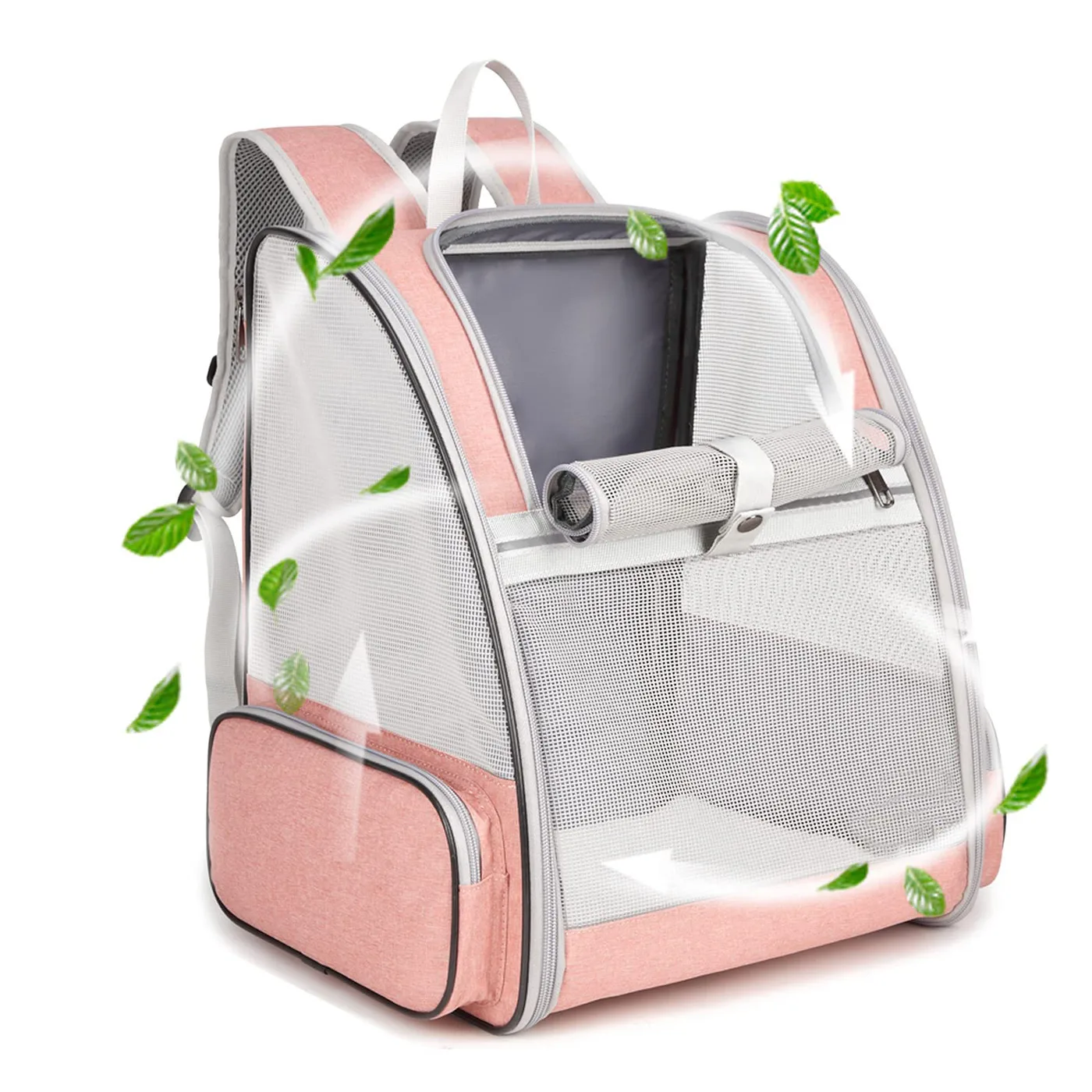
The entry closure is the second most common leak path after the seam. A standard coil zipper leaks through the tape and, if it is not water-resistant, through the coil itself. Three closure strategies cover the range, and they differ substantially in cost and in usability.
A water-resistant coil zipper uses a coated tape and a tight coil pitch, which reduces but does not eliminate ingress; it is appropriate where the closure sits above the waterline. A waterproof zipper uses a laminated tape with a sealing lip that the slider closes against, giving genuine resistance at roughly 2.5-4x the cost of a standard coil and requiring more pull force, which matters when the user is holding an animal with the other hand. A storm flap is the inexpensive and often overlooked third element: a fabric cover over the zip line, held by hook-and-loop or by magnets, which sheds the bulk of the water before it ever reaches the zip.
| Closure | Water resistance | Pull force | Relative cost | Suits |
|---|---|---|---|---|
| Standard coil #8 | Low | Low | 1.00x | Above waterline only |
| Water-resistant coil #8 | Medium | Low | 1.45x | General rain programmes |
| Waterproof laminated #8 | High | Medium-high | 3.20x | Genuine waterproof claims |
| Coil plus storm flap | Medium-high | Low | 1.60x | Best cost-to-benefit ratio |
| Roll-top closure | High | Low | 1.30x | Soft, compressible formats |
Where usability is the priority, the storm flap over a water-resistant coil gives most of the performance of a waterproof zip at half the cost and with a much lower pull force. Where the claim is the priority, use a waterproof zip and a flap together, and specify the cycle life, because a laminated zip has a shorter service life than a coil under the same duty.
The Base: Leak-Proof Bottom as a Separate Requirement
The base of a pet carrier has its own requirement and it is the one regulators and airlines actually specify. A leak-proof bottom is not the same as a waterproof shell: the shell resists water coming in, while the base must contain liquid going out. That is a containment requirement, and the conventional solution is a tray rather than a coating.
Two constructions work. A welded tray is formed from a coated fabric or a TPU-laminated fabric with the corners welded rather than sewn, then inserted into the base of the carrier; it has no perforations below the waterline and it is the reliable answer. A taped base seam sews the tray and then seals the seam from the inside with tape; it works on straight runs and needs careful handling at the corners, where tape lifts if the radius is tight.
The board and the insert sit above the tray and should be specified for this environment. Honeycomb polypropylene and PE board are both dimensionally stable when wet; EVA absorbs a little and swells at the edge. The insert should have a TPU or PU backing so it can be wiped rather than washed, and the board channel should be sealed so a soaked insert does not wick into the board. Guidance published by the FAA and the live animal provisions maintained by IATA both reference a leak-proof bottom for in-cabin animal containers, which is why the tray belongs in any carrier marketed for air travel.
Test Protocol: Which Tests Predict Field Performance
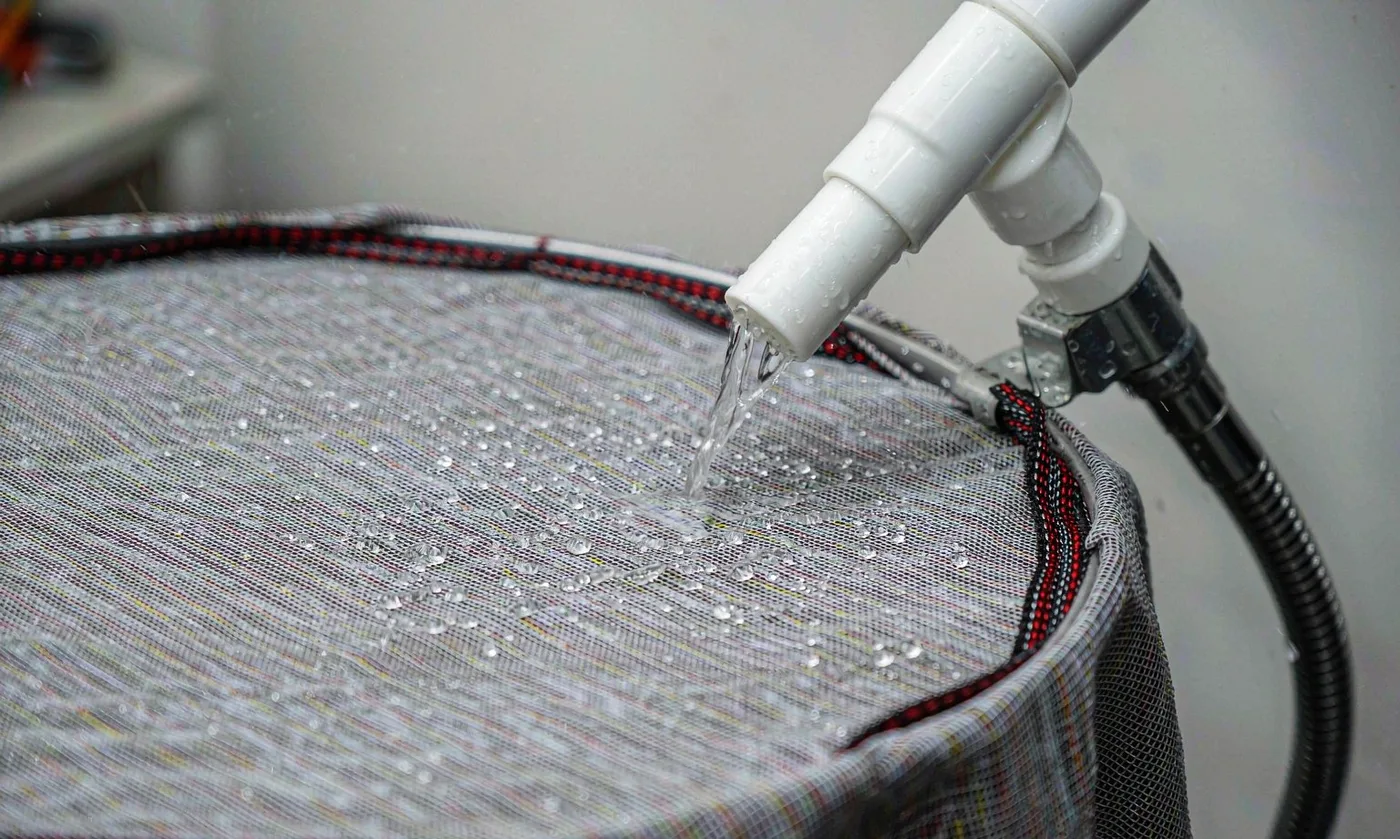
Fabric testing is easy and misleading on its own. A shell that tests to 5,000 mm hydrostatic head tells you nothing about whether the finished carrier keeps water out, because the finished carrier leaks at the seam, at the zip and at the base. The protocol has to test the assembly.
| Test | What it measures | Typical acceptance | Level |
|---|---|---|---|
| Hydrostatic head | Fabric resistance to water under pressure | 3,000 mm min for waterproof | Fabric |
| Spray test | Surface repellency of the face finish | Rating 80+ before wash, 70+ after | Fabric |
| Shower test | Assembly resistance to simulated rain | No penetration after 5 min | Assembly |
| Seam leakage | Water penetration through the seam line | No penetration at 1,000 mm head | Seam |
| Weld peel strength | Weld strength against the base fabric | Weld stronger than fabric | Seam |
| Base containment | Tray holds liquid without escape | 200 ml held 60 min, no escape | Assembly |
| Wash durability | Performance retained after laundering | 80% of head after 5 washes | Assembly |
Run the assembly tests on production units, not on samples built specially for testing, and run them after a wash cycle as well as before, because a waterproof claim that survives delivery and fails after the first clean is worse than no claim at all. Methods published by ASTM International and by ISO give the references; state the method number and the acceptance figure on the tech pack so the result is reproducible.
Sampling for a waterproof claim should be tighter than for a general cosmetic defect. Our production team treats seam leakage and base containment as critical defect classes with zero tolerance at any AQL level, and it runs a base containment check on a fixed sample from every production day rather than only at final inspection, because a welded tray that starts leaking does so systematically rather than randomly.
Failure Modes: What Actually Comes Back
Field returns on waterproof pet carriers cluster into five failure modes, and each has a specific manufacturing cause. Ranking them by frequency helps decide where to spend the specification budget.
- Wicking at the seam: the seam was sewn rather than welded or taped, or the tape lifted at a tight radius. Cause: seam architecture decision made on cost rather than on the claim.
- Zipper ingress: a standard coil zip at the entry, usually compounded by the zip run terminating at a corner where the tape cannot seal. Cause: closure specified without a storm flap.
- Base tray corner split: a welded tray corner opened under flexing. Cause: weld dwell too long, embrittling the coating at the fold.
- Delamination after storage: the coating crazed in a sealed container in a humid market. Cause: PU coating selected where TPU was required, plus packaging without desiccant.
- Repellency loss: the DWR finish stopped beading after a season. Cause: expected degradation, not presented as a maintenance item on the care label.
Four of the five are specification decisions rather than manufacturing defects, which is the useful conclusion: waterproofing failures are designed in far more often than they are built in. A programme that spends $0.90 on a welded base tray and $0.55 on a storm flap removes most of the return volume in this category.
There is one genuine maintenance item. A durable water-repellent finish does wear off, and a care label that tells the customer how and when to renew it converts a complaint into an instruction. Our production team supplies that text with the tech pack so the packaging and the label agree.
Cost, Schedule and QC Consequences of a Waterproof Spec
A waterproof specification moves unit cost and it moves the schedule, and both should be budgeted rather than discovered. On cost, the three additions are the coating or laminate upgrade at $0.60-$2.10 per unit depending on the route, the welded or taped seam operation at $0.35-$0.90, and the closure upgrade at $0.45-$2.40. Together that is roughly $1.40-$5.40 on FOB, which on a core-tier carrier is a 10-30% increase.
On schedule, the additions are the weld window qualification at first-off, which consumes 1-2 days, and the assembly test protocol, which adds 2-3 days if it is run in-house and 5-8 days if it goes to a third-party laboratory. Both sit inside the 35-50 day bulk window rather than on top of it, provided they are planned at the tech pack stage. They fall outside it when a brand decides to add a waterproof claim after bulk has started.
On quality control, the change is a reclassification. Seam leakage and base containment move to critical, weld peel becomes a logged inline check, and the AQL sheet gains a dimensional and a functional line rather than only a visual one. That is the part brands underestimate: a waterproof claim is not simply a material upgrade, it is a change to how the product is inspected, and the inspection regime is what protects the claim after the goods have shipped.
Production capability
- SGS-verified production space of 4,950 m², 149 machines, 7 assembly lines
- Pet carrier and pet bag output since 2014 from a 137-person team
- 200,000 units shipped monthly under BSCI and ISO 9001 systems
People Also Ask
What makes a pet carrier waterproof rather than water-resistant?
A hydrostatic head above 3,000 mm plus sealed seams and a sealed closure. Water-resistant means the shell resists limited exposure, typically 800-1,500 mm, with the seams left unsealed.
What hydrostatic head should a waterproof pet carrier have?
3,000 mm minimum for a genuine waterproof claim, and 5,000 mm or more where the product will be set down on wet ground. Shower resistance starts at around 800 mm.
Are welded seams better than taped seams?
Welded seams are more reliable because there is no needle perforation, but they resist peel loads poorly. Taped seams work on straight runs and lift at tight radii. Structural load paths should stay sewn.
Do I need a waterproof zipper?
Only if the closure sits below the waterline or the claim is genuine waterproofing. A water-resistant coil with a storm flap gives most of the performance at roughly half the cost and a much lower pull force.
How is a leak-proof bottom made?
By forming a tray from coated or TPU-laminated fabric with welded corners, then inserting it into the base. A taped base seam is the alternative and needs careful handling at the corners.
How is waterproofing tested on a finished carrier?
With assembly tests: a shower test with no penetration after five minutes, a seam leakage test at 1,000 mm head, and a base containment test holding 200 ml for 60 minutes.
Does waterproofing survive washing?
The coating does; the face finish does not. Expect a durable water-repellent finish to degrade after 20-30 washes, which is why the care label should tell the customer how to renew it.
Frequently Asked Questions
Is TPU better than PU for a waterproof carrier?
Yes for performance and flex life. A 0.15-0.25 mm TPU film reaches 5,000-10,000 mm hydrostatic head with a soft hand and excellent resistance to hydrolysis, at roughly 2.1x the cost of an equivalent PU coating.
Why does a waterproof fabric carrier still leak?
Because water enters through needle perforations at the seam and through the zipper tape, not through the cloth. Sealing the seam and the closure is what makes the product waterproof.
What is the weld window and why does it matter?
It is the qualified combination of generator power, dwell time and electrode pressure that produces a weld stronger than the surrounding fabric. Outside that window the seam either peels or the coating embrittles.
Can printed artwork sit in a weld zone?
No. Ink acts as a release agent and prevents a reliable weld. Artwork placement has to be planned around the weld line and marked on the tech pack, not only on the artwork file.
How much does waterproofing add to unit cost?
Roughly $1.40-$5.40 on FOB: coating or laminate upgrade $0.60-$2.10, welded or taped seams $0.35-$0.90, and closure upgrade $0.45-$2.40.
Does a waterproof spec extend the production schedule?
By 3-5 days inside the 35-50 day bulk window if planned at tech pack stage: 1-2 days for weld window qualification and 2-3 days for in-house assembly testing.
What causes coating delamination in storage?
Hydrolysis of polyurethane under sustained heat and humidity, usually in a sealed container. TPU resists it far better, and desiccant plus breathable packaging reduces the risk further.
Should welded seams be used everywhere on the bag?
No. Welded seams resist water and resist peel loads poorly, so the load path should remain sewn and bar-tacked. Weld where water enters, sew where load is carried.
How often should welds be tested on the line?
Peel-test at first-off and every two hours during production, with the machine settings logged. A weld failing in peel is an under-weld; embrittlement around the weld is an over-weld.
What is the acceptance for a base containment test?
Two hundred millilitres of water held for 60 minutes with no escape. It is treated as a critical defect class with zero tolerance at any AQL level.
Are waterproof claims regulated?
Textile performance claims are subject to general advertising rules in most markets, and chemical compliance is separate: coating and ink selection is governed by REACH in the EU and screened against CPSC guidance in the US.
Can I add a waterproof claim after bulk has started?
Not without rework. Seam architecture and closure type are set at cutting and assembly, so a claim added later usually means a second production run rather than a modification.
Talk to QUANZHOU JUNYUAN BAGS about a pet carrier program: MOQ 500 pieces per colourway, samples in 6-10 working days, bulk production in 35-50 days under AQL 2.5 inspection.
Get a free quote Request a sampleKeep reading
- Best Dog Carrier Backpack Materials: A Complete Comparison
- How to Choose the Right Dog Carrier Backpack for Your Brand
- Custom Dog Carrier Backpack: OEM Production Process
- Dog Carrier Backpack Testing: Quality Assurance
- Dog Carrier Backpack Bottom: Reinforcement Options
- Airline Approved Dog Carrier Backpack: Compliance Requirements