Cat Carrier Anti-Escape: Safety Features
An anti-escape cat carrier limits every aperture to 10 mm or less, holds panel deflection under 8 mm at a 100 N point load, uses a dual-slider locking zip on the primary opening, adds a secondary retention such as an interior tether rated to 250-400 N, and closes the two transfer moments when the carrier is open. Any gap above 12 mm is an escape path for an adult cat.
Escape is an engineering problem with a definable geometry, not a temperament problem. A cat gets out through an opening whose smallest dimension is smaller than the cat appears to be, because a cat skull compresses and a cat body follows its skull; the threshold is about 10-12 mm for an adult and 6-8 mm for a kitten. Everything in an anti-escape specification follows from that number: gap limits, panel deflection limits, zipper specification, frame rigidity and the two moments during a journey when the carrier is legitimately open and the animal is unsecured. Our production team writes anti-escape performance as a set of measurable limits and verifies them on a mechanical rig before any live-animal observation, because mechanical testing is repeatable and a live test is not. Commercial terms follow the standard programme: MOQ 500 pieces per colourway, prototypes in 6-10 working days, bulk production 35-50 days after sample approval, final random inspection to AQL 2.5, T/T 30/70 and FOB Xiamen.
Wholesale pet carrier buyers usually consolidate to fill one container; for cat carrier assortments our production team mixes sizes and colourways inside a single 500-piece minimum.
Escape Path Analysis: Where a Cat Actually Gets Out
Every carrier has a finite set of openings, and escape happens through one of them. The first job in an anti-escape specification is to enumerate them on the drawing rather than to assume the zip is the only risk. In practice there are seven paths, and the zip is only the most obvious.
The first is the primary closure line. A coil zip under lateral load separates at 150-300 N for a #5 chain and at 300-500 N for a #8, and a cat pushing from inside with its hind legs generates 100-250 N in a sustained push and 400-700 N in a startled lunge. The consequence is that a non-locking zip on a loaded panel will separate. The second path is the zip slider park position: if the slider can travel, the chain opens from the top down, and a cat working at a slider with a paw can move it 20-60 mm in a few seconds.
The third path is the seam between a mesh panel and its binding, where the stitch line perforates and the panel can peel. A panel bound with a single stitch row at 6 stitches per inch can be peeled back by a sustained 40-80 N load. The fourth is a ventilation cut-out or a bar grille, where a gap above 12 mm admits an adult cat head. The fifth is the door frame on a rigid carrier, where a latch with 2-4 mm of play lets the door bow outward and open a corner gap.
The sixth path is the fabric itself under load. A soft carrier with a flexible frame bows when a cat pushes against a panel, and the bow opens a gap at the zip line or at a corner. This is why panel deflection, not just aperture, is a specification item: a 10 mm gap in an unloaded panel becomes a 25 mm gap under a 100 N push if the frame is not stiff enough. The seventh path is human: the carrier is opened for a vet examination or a security check, and the cat leaves in that moment. It is the most common escape event in real use and it is addressed by procedure and by interior restraint rather than by the closure.
| Escape path | Load a cat applies | Design limit | Cost of compliance |
|---|---|---|---|
| Separating a #5 coil zip | 100-250 N sustained, 400-700 N lunge | Locking slider plus dual slider, chain rated 300 N+ | +0.35-0.70 USD |
| Slider travel | 20-60 mm in seconds | Auto-lock slider plus zip garage | +0.15-0.30 USD |
| Peeling a bound mesh panel | 40-80 N sustained | Two stitch rows, 20-25 mm tape, 8-10 spi | +0.10-0.20 USD |
| Ventilation aperture | Head compression to 10-12 mm | Aperture under 10 mm | included |
| Door frame bow | 150-300 N against a rigid door | Latch play under 1.5 mm, four-point latch | +0.60-1.30 USD |
| Frame bow opening a corner gap | 100 N push, 8 mm deflection | Frame stiffness giving under 8 mm at 100 N | +0.45-1.10 USD |
| Open-carrier transfer moment | Full body weight in a lunge | Interior tether rated 250-400 N | +0.25-0.55 USD |
The table is the checklist our production team works through on any carrier sold on a safety claim. A product that addresses the zip and ignores the transfer moment will still lose animals, because the transfer moment is where most escapes occur.
Structural Preconditions: Frame Rigidity and Panel Deflection
Anti-escape performance is impossible on a structure that flexes. Aperture limits only hold if the geometry that creates them holds, and the geometry holds only if the frame is stiff enough. This is the specification item most often skipped, and it is the one that separates a carrier that passes a bench check from one that survives a frightened animal.
The load case is a cat pushing against a panel with its forelimbs while bracing with its hind limbs. Measured on a force plate, a 4-6 kg cat produces a sustained push of 100-250 N and a transient of 400-700 N. A soft carrier frame, typically a 4-6 mm steel wire hoop or a 3-5 mm moulded polymer rod, deflects under that load, and the deflection translates directly into gap opening at the zip line and at the corners.
The measurable limit is deflection at a 100 N point load applied at the centre of the largest panel. A frame that deflects more than 8 mm at that load will open a gap at the closure line; one that deflects under 4 mm will not. Getting from 8 mm to 4 mm costs 0.45-1.10 USD, delivered either by increasing the wire diameter from 4 mm to 5 mm, by adding a diagonal brace across the largest panel, or by adding an internal base board of 3-4 mm polypropylene or corrugated board that ties the two side frames together.
Base boards are the most cost-effective stiffness measure available and the least understood. A 3-4 mm board spanning the floor of a soft carrier increases the torsional stiffness of the whole assembly by 60-120 %, which is what stops the parallelogram deformation that opens corner gaps. It costs 0.35-0.80 USD, it adds 180-320 g, and it is usually paired with a removable pad that sits on top of it so the owner never sees it.
Corner geometry is the second structural item. A corner formed by two fabric panels meeting at 90 degrees under tension is the weakest point in the assembly, and it is where escape gaps open first. The mitigation is a moulded corner insert or a three-panel construction with a 40-60 mm gusset, which converts a corner into a shallow box and distributes the load. On a rigid carrier the equivalent item is a four-point rather than a two-point door latch, which is what stops the door bowing and opening a gap at the corner furthest from the latch.
Closure Redundancy: Primary and Secondary Retention
Safety engineering in every other field uses redundancy, and a carrier holding a frightened animal should too. The principle is that no single component failure should release the animal, which means the primary closure needs a secondary that is independent of it.
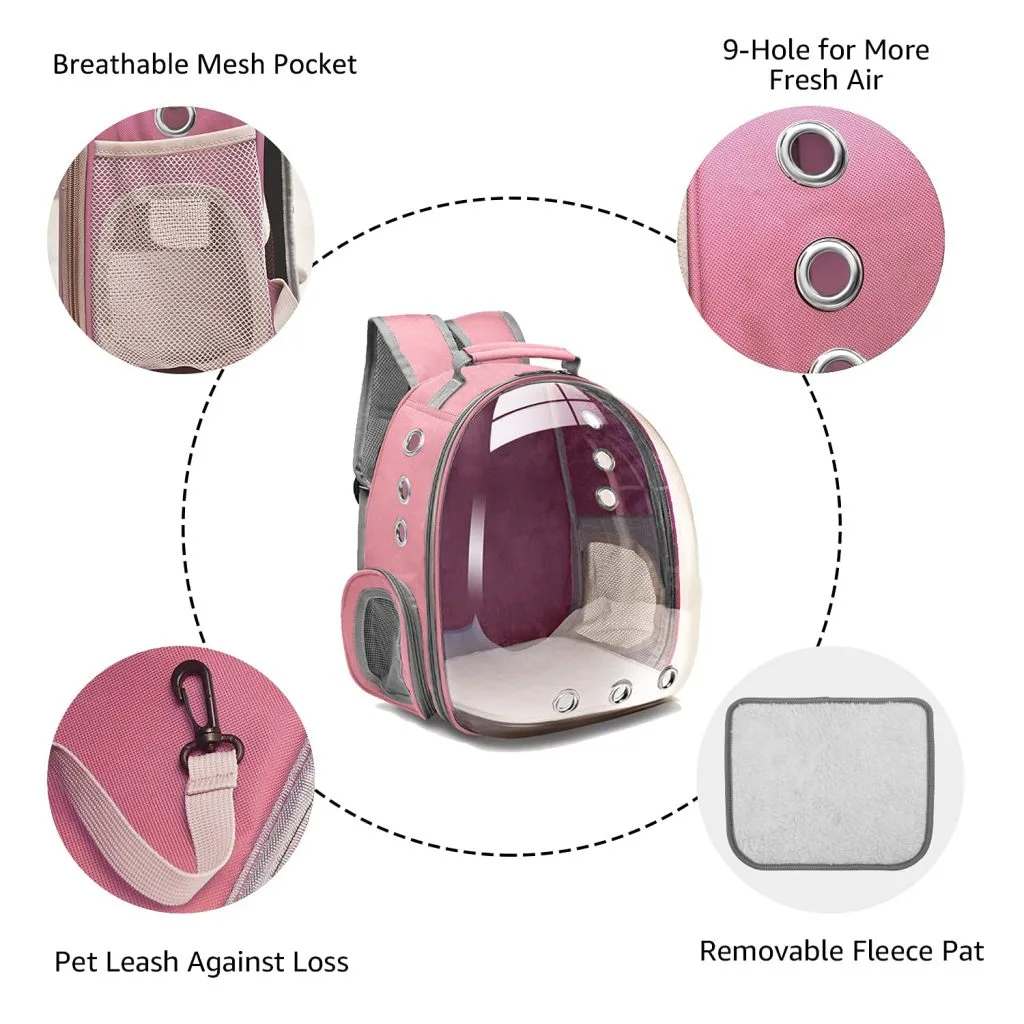
The primary closure on a soft carrier is the zip. The specification for an anti-escape build is a #5 or #8 coil chain with an auto-lock slider, which holds the slider in position unless the pull tab is lifted, and a second slider so the opening can be positioned away from the animal. An auto-lock slider resists 60-150 N of direct pull on the chain without travelling, against 10-30 N for a non-locking slider. The added detail that matters is the zip garage: a fabric pocket at the closed end that parks the slider so it cannot be worked by a paw, and so the pull tab cannot catch on anything.
The secondary retention is the item most carriers lack. Three options are used. A storm flap over the zip line, held by two or three low-profile snaps or by 25-40 mm of hook-and-loop, means that even a fully separated zip leaves the opening covered by fabric under tension. A compression strap, running over the top of the carrier and clipped with a side-release buckle, pre-loads the zip line so the chain sees less separating force in the first place; it costs 0.30-0.60 USD and it reduces the load on the chain by 30-50 %. And a secondary interior closure, such as a mesh inner door behind the outer fabric door, means an opened outer door still leaves a barrier.
On a rigid carrier the redundancy is a dual-action latch. A single-action latch releases in one movement, and a cat working a latch with a paw or a door flexing under load can release it. A dual-action latch requires two movements in different directions, typically a squeeze plus a lift, which raises the release force from 20-40 N to 70-140 N and, more importantly, requires a dexterity a cat does not have. It costs 0.85-1.80 USD and it is the single most effective anti-escape measure on a rigid design.
Third-level retention is the interior tether, and it deserves its own specification. A D-ring or a webbing loop anchored to the frame, rated to 250-400 N, gives the means to clip a harness during loading, unloading and any veterinary handling. The anchor is the critical part: a D-ring sewn into a single fabric ply pulls out at 80-150 N, while one anchored through a reinforcing patch into the frame webbing reaches 250-400 N. Our production team specifies the anchor and tests it in isolation, because a tether that fails under load is worse than no tether, since the owner believed it was holding.
The Transfer Moment: Designing for When the Carrier Is Open
The highest-risk moment in the entire journey is not travel; it is transfer. The carrier is open, the animal is awake and motivated, and the handler is distracted by a form, a ticket or a consultation. Most escape events reported to brands occur in this window, and it is addressed by design rather than by a stronger zip.
The first design answer is a top-and-side opening arrangement where the two openings can be used independently. A top opening allows a cat to be lifted out vertically with the handler controlling the shoulders, or allows a veterinary examination of the head and anterior without emptying the carrier. A side opening allows the cat to walk out on its own terms. Having both means the handler can choose the lower-risk path for the specific animal, and it means one opening can stay closed while the other is used.
The second answer is an interior tether point positioned so that a harness clip can be attached before the opening is fully unzipped, which is also the arrangement that airline and airport staff expect to see; the containment expectations for animals in transport are set out in the IATA Live Animals Regulations published at iata.org. The correct position is at the rear upper corner of the interior, diagonally opposite the primary opening, so that the cat cannot reach the opening while clipped. A tether of 150-250 mm length is long enough for the cat to lie down and short enough to prevent it reaching the door, and the specification should state the length rather than leaving it to the cutting room.
The third answer is an opening that can be partially opened. A zip with two sliders allows a 100-150 mm working gap at one end while the rest of the chain stays closed, which is enough to pass a hand through for a treat, a lead or a medication and small enough that a cat cannot exit. This is a genuinely useful feature and it costs nothing beyond the second slider that an anti-escape specification requires anyway.
The fourth answer is procedural, and it belongs on the instruction sheet rather than in the hardware: place the carrier on the floor or on a low surface before opening it, because a cat that escapes from a waist-high surface is much more likely to be injured, and open it away from a door. Brands that print this on the hangtag see measurably fewer escape complaints, and it costs nothing.
Identification: Tag Holders, Labels and Recovery
An escape that ends in recovery is a different event from one that does not, and the recovery rate depends almost entirely on identification. A carrier is the natural place to carry it, because the carrier travels with the animal in exactly the situations where an escape is most likely.
The hardware is simple and cheap. A clear PVC window pocket of 60 × 90 mm on the exterior, with a card insert for the owner name, phone number and any medical note, costs 0.18-0.35 USD and is the standard item we fit to any carrier sold on a safety or travel claim. A woven or printed label on the exterior serves the same purpose for the carrier itself, at 0.06-0.14 USD, and is useful when the carrier is lost or left behind rather than when the cat is.
The specification details that matter are attachment and legibility. A pocket heat-welded to the shell survives rain and handling; one sewn with a single row lifts at the corners within 3-6 months. The card should be printed at 8-10 point in a sans-serif face and the pocket should have a 3-5 mm drainage slot at the bottom, or condensation will fog the window within weeks. Where the card is printed rather than handwritten, a font size below 8 point is unreadable at the distance a finder will read it.
Identification of the animal itself is a veterinary matter rather than a manufacturing one, and the reference guidance on microchipping and identification is published by the American Veterinary Medical Association at avma.org. The useful manufacturing contribution is compatibility: a carrier should not interfere with a collar-mounted tag, and an interior tether should be clipped to a harness rather than to a collar, because a collar load of 250-400 N in a panic is a neck injury risk.
There is a commercial dimension here worth stating plainly. A tag holder converts a generic safety feature into a branded one, because it is a surface the owner writes on and sees every time they travel. It is also one of the few add-ons that a buyer can justify at a retail price increase of 4-6 USD against a cost of under 0.40 USD.
Escape Testing: Mechanical Rig Before Live Observation
Testing an anti-escape claim requires a repeatable method, and live-animal observation is not one: cats vary, motivation varies, and a test that a cat fails today it may pass tomorrow. The correct sequence is mechanical testing for design and limited live observation for confirmation.
The mechanical rig our production team uses applies controlled loads at the points a cat works. Four tests cover the design. A zip separation test loads the closed chain laterally at the slider park position until the coils separate, with a pass at 300 N. A panel deflection test applies 100 N at the centre of the largest panel through a 100 mm diameter pad and measures deflection, with a pass under 8 mm and a target under 4 mm. A gap gauge test passes a graduated blade around every aperture and seam, with a pass at no entry of a 10 mm blade under a simultaneous 50 N outward load. And a latch cycle test operates the closure 500 times and re-measures, because a closure that loosens is one that will fail in month six.
The load figures come from measurement rather than estimation. A force plate under a carrier records the pushes a cat applies against a panel, and the distribution matters: the median sustained push is 100-250 N and the 95th percentile transient is 400-700 N. Designing to the median produces a carrier that holds most of the time, which is the wrong target for a safety feature; designing to the 95th percentile costs 0.30-0.80 USD more and is the correct choice.
Live observation is then used for what it is good at: finding paths the engineer did not enumerate. A 20-30 minute supervised session with two or three cats of different sizes and temperaments, with the handler present and the carrier on the floor, will find a paw working a slider or a nose finding a corner gap that no mechanical test predicted. It is a discovery method, not a pass-fail test, and it should be run on a sample before tooling rather than on a production unit after.
Documentation closes the loop. The test file for an anti-escape claim should hold the four mechanical results, the load basis for the figures, the live observation notes, and a drawing with every aperture dimensioned. That file is what lets a brand state a tested containment claim rather than a hoped-for one.
Specification Checklist and Programme Economics
The anti-escape specification that goes into a tech pack is eight lines long, and every line is a number that can be verified at incoming inspection rather than a description that can be argued about.
Maximum aperture 10 mm anywhere on the product, measured under a 50 N outward load. Panel deflection under 8 mm at 100 N through a 100 mm pad, target 4 mm. Primary zip #5 or #8 coil with an auto-lock slider, dual sliders and a garage, chain separation above 300 N. Secondary retention either a storm flap or a compression strap reducing chain load by 30-50 %. Interior tether anchor rated 250-400 N, anchored into frame webbing through a reinforcement patch. Latches, where used, dual-action with release force 70-140 N. Mesh binding two rows at 8-10 stitches per inch on 20-25 mm tape. ID tag pocket of 60 × 90 mm, welded, with a drainage slot.
Cost at 500 pieces: the locking zip upgrade adds 0.35-0.70 USD, stiffness measures 0.45-1.10 USD, the compression strap or storm flap 0.25-0.60 USD, the tether anchor 0.25-0.55 USD, and the ID pocket 0.18-0.35 USD. The complete package lands at 1.50-3.30 USD over a baseline carrier, which supports a retail premium of 6-12 USD and, more importantly, removes the category of review that damages a brand fastest.
Two programme notes. First, the anti-escape package should be designed as a whole rather than added feature by feature, because the measures interact: a stiffer frame reduces the load on the zip, which means a cheaper zip can meet the same separation target. Second, every one of these items is verifiable at AQL 2.5 inspection with a gap gauge and a spring balance, which means the premium is protected through production rather than only in the sample room.
The commercial argument is straightforward. Escape is the failure mode that produces a one-star review, a lost animal and, in a vehicle or an airport, a genuine safety incident. A carrier that can state tested containment limits is selling something the customer cannot verify for themselves and is therefore willing to pay for.
Sizing Note: Kittens and Small Breeds Change the Numbers
An adult cat skull compresses to about 10-12 mm and a kitten to 6-8 mm, so a carrier sold for kittens needs a tighter aperture limit and a tighter deflection limit. Our production team applies a 6 mm aperture ceiling and a 5 mm deflection ceiling on kitten-sized products, and we add a mesh panel rather than an open grille on any unit under 40 litres.
Production capability
- SGS-verified production space of 4,950 m², 149 machines, 7 assembly lines
- Pet carrier and pet bag output since 2014 from a 137-person team
- 200,000 units shipped monthly under BSCI and ISO 9001 systems
People Also Ask
What gap size can a cat escape through?
Around 10-12 mm for an adult cat and 6-8 mm for a kitten, because the skull compresses and the body follows the skull. An anti-escape specification therefore caps every aperture at 10 mm, or 6 mm on kitten-sized products.
Do locking zippers stop a cat escaping?
They stop the commonest failure. An auto-lock slider resists 60-150 N of direct pull without travelling, against 10-30 N for a non-locking one, and it should be paired with a zip garage and a secondary flap or compression strap.
How much force can a cat apply to a carrier panel?
100-250 N sustained and 400-700 N in a transient lunge, measured on a force plate. Designing to the 95th percentile transient costs 0.30-0.80 USD more and is the correct target for a safety feature.
What is the most common escape moment?
Transfer, not travel: the carrier is open for a consultation, a security check or loading, and the animal is unsecured. It is addressed by a top-and-side opening, an interior tether and an instruction to open at floor level.
Should an interior tether clip to a collar or a harness?
A harness. A tether anchor is rated 250-400 N and that load applied to a collar in a panic is a neck injury risk. The anchor should be at the rear upper corner, diagonally opposite the opening.
How much does an anti-escape package add to cost?
1.50-3.30 USD at 500 pieces, covering the locking zip, stiffness measures, secondary retention, the tether anchor and the ID pocket. It supports a retail premium of 6-12 USD.
Is an ID tag holder worth specifying?
Yes. A welded 60 × 90 mm clear pocket with a card costs 0.18-0.35 USD, survives rain, and turns a generic safety feature into a branded one the owner sees on every trip.
Frequently Asked Questions
Why is panel deflection part of an anti-escape spec?
Because deflection opens gaps. A 10 mm aperture in an unloaded panel becomes a 25 mm gap under a 100 N push if the frame is too flexible, which is why the limit is 8 mm at 100 N through a 100 mm pad.
What makes a soft carrier frame stiff enough?
A 4-6 mm wire hoop or moulded rod plus a 3-4 mm internal base board. The base board increases torsional stiffness by 60-120 % for 0.35-0.80 USD and stops the parallelogram deformation that opens corner gaps.
Should a rigid carrier door use a two-point or four-point latch?
Four-point. A two-point latch lets the door bow outward and opens a corner gap under 150-300 N; a four-point latch holds the frame square and is paired with a dual-action release.
What release force should a safety latch have?
70-140 N with a dual action, such as a squeeze plus a lift. A single-action latch releases at 20-40 N and can be worked by a paw or by door flex.
How is a zip separation test run?
The closed chain is loaded laterally at the slider park position until the coils separate, with a pass at 300 N. A #5 chain separates at 150-300 N and a #8 at 300-500 N without a locking slider.
How long should an interior tether be?
150-250 mm, long enough for the cat to lie down and short enough to prevent it reaching the opening. The length belongs in the specification rather than being left to the cutting room.
Does a compression strap really reduce zip load?
Yes, by 30-50 %, because it pre-loads the closure line so the chain sees less separating force in the first place. It costs 0.30-0.60 USD.
How many times should a closure be cycled in testing?
500 cycles, with re-measurement afterwards. A closure that loosens with cycling is one that will fail in month six rather than in the sample room.
What is a zip garage and why does it matter?
A fabric pocket at the closed end that parks the slider so it cannot be worked by a paw and so the pull tab cannot catch on anything. It costs 0.15-0.30 USD.
Can a cat open a side-release buckle?
Rarely, but a buckle under tension from inside can be squeezed free. Where a buckle retains an opening, it should be positioned away from the interior or backed by a secondary closure.
What aperture is safe for a kitten carrier?
6 mm, with a 5 mm deflection ceiling at 100 N. A kitten skull compresses to 6-8 mm, so the adult limit of 10 mm is not conservative enough below about 40 litres.
How are anti-escape features checked in production?
With a graduated gap gauge and a spring balance at AQL 2.5 inspection, covering aperture, deflection, zip separation and tether anchor pull. All four are checkable without a laboratory.
Talk to QUANZHOU JUNYUAN BAGS about a pet carrier program: MOQ 500 pieces per colourway, samples in 6-10 working days, bulk production in 35-50 days under AQL 2.5 inspection.
Get a free quote Request a sample