Cat Carrier Center for Pet Safety: Rated Options
A Center for Pet Safety rating is a third-party result for a specific product, published after an instrumented sled test, and it is the only pet travel safety mark with a public protocol and published results. A private label buyer can design toward it, submit, and license the mark for the tested SKU, but the rating belongs to the tested article and not to the factory.
The reason a brand pursues a third-party rating rather than declaring its own test is trust: a published protocol and published results remove the argument about whether the claim is real. The reason so few products have one is that the protocol is demanding and a failure is public. Our production team treats a rating as a design target rather than a certification to be bought, which means the engineering decisions that determine the outcome are made at the specification stage: restraint topology, anchor load path, closure retention and structural stiffness. For a private label programme the ownership question then matters more than the engineering, because a rating is awarded to an article submitted by a brand and is not transferable between brands. Commercial terms follow the standard programme: MOQ 500 pieces per colourway, prototypes in 6-10 working days, bulk production 35-50 days after sample approval, final random inspection to AQL 2.5, T/T 30/70 and FOB Xiamen.
Private label pet bags and cat carrier lines share one packaging standard here, so a mixed order does not add handling cost or a second carton size.
What the Programme Is and What It Is Not
The Center for Pet Safety is an independent research and advocacy organisation that runs instrumented testing on pet travel products and publishes the results. Its work is available at centerforpetsafety.org, and it is the reference most North American buyers cite when they ask whether a pet carrier has been independently evaluated. Understanding exactly what it offers is the first step in deciding whether to pursue it.
It is a testing and rating programme with a published protocol. Products are purchased or submitted, tested on an instrumented sled with a defined pulse and a defined dummy, and the results are published as a pass or a non-pass against stated criteria. That is the entire value proposition and it is substantial, because it is independent of the manufacturer and because the method is public.
It is not a regulatory body. A rating is not a legal requirement, no jurisdiction mandates it, and holding or not holding one has no direct legal consequence. It is also not a general quality mark: it says something specific about dynamic performance in a defined test and nothing about durability, chemical safety, or workmanship, all of which remain the buyer responsibility.
Three misconceptions are worth clearing up at the outset. The first is that a rating applies to a supplier. It does not; it applies to an article, and if two brands submit the same underlying product, each is rated separately. The second is that a rating covers a size range. It covers the size tested. The third is that a rating is permanent: it applies to the article as tested, and a material or construction change requires re-evaluation, which is why the bill of materials submitted with the article matters.
| Question | Answer | Consequence for a private label programme |
|---|---|---|
| Is it a legal requirement? | No | It is a market differentiator, not a compliance item |
| Who can submit? | Any brand or organisation | A private label buyer can submit directly |
| Who owns the result? | The article, as submitted | Not transferable between brands or SKUs |
| Does it cover durability? | No | Separate abrasion, wash and chemical testing still required |
| Does a change require retest? | Yes, on a material or construction change | Bill of materials must be frozen and documented |
| Is a failure published? | Yes | Pre-compliance testing before submission is essential |
The last row is the one that shapes the programme. Because a failure is public, no brand should submit without having first run the same protocol internally on a rig, and that is the service a competent supplier provides.
How the Rating Categories and Criteria Work
The published protocol defines the pulse, the dummy, the installation and the pass criteria, and it does so in enough detail that a supplier can reproduce it. Reproducing it is exactly what a development programme should do, because an internal run at 300-900 USD each is far cheaper than a public failure.
The test is a frontal impact at 48 km/h on a sled carrying a representative vehicle seat and belt, with a segmented dummy of the rated animal mass. Instrumentation records the input pulse, the dummy acceleration and the load in the restraint path, and high-speed video records the event from two angles. The criteria are retention, excursion and structural integrity, in the same form used for any dynamic restraint test: the animal stays inside, the assembly does not travel beyond a stated limit, and nothing in the load path separates.
Results are published as a pass or a non-pass, sometimes with a differentiation of performance level, and the published entry identifies the product by name and by the configuration tested. That identification is the point of the exercise from a buyer perspective: a product page can link to a public entry that a customer can read, which is worth more than any supplier claim.
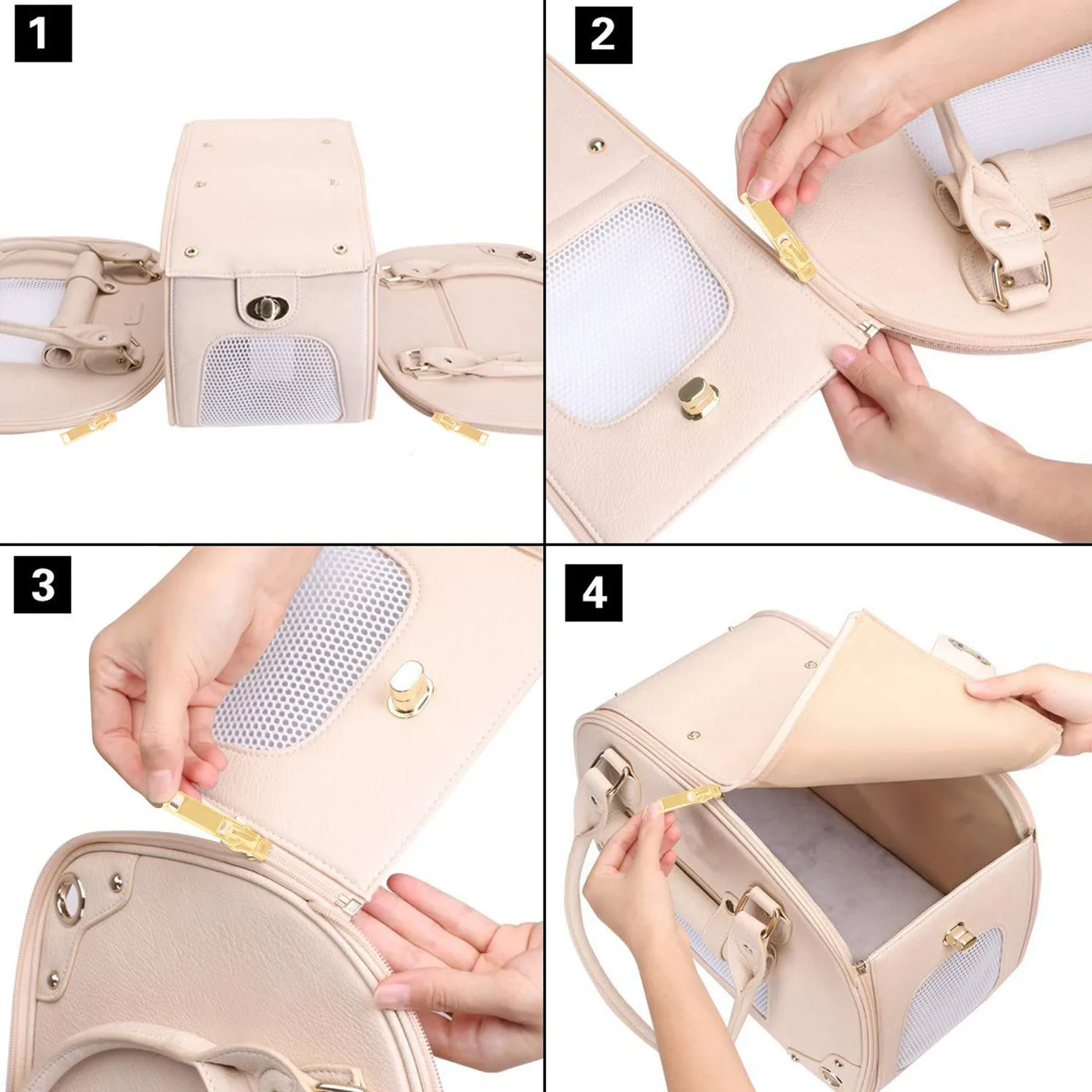
Two aspects of the criteria are worth designing for specifically because they are where products fail. Excursion is the first: an assembly that slides, rotates or tips will exceed the limit even if nothing breaks, and the fixes are a second belt path, a tether to a vehicle anchor, and a stiffer base. Closure retention is the second: the dummy loads the closure from inside, and a zip that is fine in normal use will separate under that load unless it is a locking slider on a chain of adequate gauge, backed by a storm flap or a compression strap.
A fourth area deserves attention because it is specific to cats rather than dogs: the internal volume. A cat carrier is small, and the clearance between the animal and the interior surfaces is correspondingly tight, which means there is little room for controlled excursion before the animal contacts the closure or the wall. In a 45-55 litre carrier a 4-6 kg dummy occupies 55-70 % of the floor area, and the remaining clearance in the direction of travel is 120-200 mm. A design that relies on the animal sliding into empty space for its energy absorption has none available, so the load goes straight into the closure and the frame. The engineering consequence is that a cat product needs a stiffer structure and a stronger closure than a dog product of the same mass rating, and that is a genuine design difference rather than a scaling artefact.
The third failure area is the one buyers least expect: the anchor. A restraint webbing sewn to a shell fabric pulls through at 1.2-2.0 kN, which is below the design load, and it is the most common single cause of a non-pass. The fix, taking the load to the frame or to a base board tied to the frame at four points, costs 0.55-1.20 USD and is the highest-value engineering decision in the whole programme.
Designing Toward the Protocol: The Engineering Checklist
Designing for a rating is a checklist exercise rather than a mystery, and the checklist is short. Eight items cover the outcome, and each has a measurable acceptance value that can be checked before submission.
First, the restraint topology. Two belt paths, one vertical at the back and one horizontal at the base, prevent both translation and rotation, and they cost 0.35-0.75 USD. A single path is cheaper and it tips. Second, the load path: every anchor is taken to the frame or to a 4-6 mm base board tied to the frame at four points, with a static pull acceptance of 4.5 kN.
Third, webbing: 25 mm polyester at 8-12 kN breaking strength and 8-15 % elongation, with hardware in forged or stamped metal at a 4.5 kN working load limit. Fourth, the stitch: a box-X over a 40 × 50 mm area on a 60 × 80 mm reinforcement patch, sewn with bonded polyester, reaching 2.5-4.0 kN.
Fifth, the closure: a #8 coil chain with an auto-lock slider, a garage and a storm flap or compression strap, retaining engagement with no opening above 10 mm under internal load. Sixth, structural stiffness: panel deflection under 8 mm at a 100 N point load, achieved by a stiffer frame or a base board, because a folding frame creates the opening through which an animal is ejected.
Seventh, the interior: no hard protrusion, no unshielded hardware, and a tether anchor rated 250-400 N positioned away from the primary opening. Eighth, installation clarity: a printed instruction sheet with routing, tightening and rear-seat placement, validated by an installation study of 30-50 users with a target of under 90 seconds and under 20 % misrouting.
The development sequence that works is static screening, internal sled runs, correction, then submission. Static screening at 60-150 USD per configuration catches bad anchors. Internal sled runs at 300-900 USD each catch dynamic behaviour and typically find two to four issues on a first design. Correcting them costs 1.50-3.50 USD per unit in added structure and hardware. Submitting after that sequence has a materially higher pass rate than submitting blind, and it avoids the public failure that is the real cost of a premature submission.
Submission, Fees and Timeline
The administrative side of a rating programme is straightforward but it has a schedule, and the schedule interacts with the production calendar in a way that catches first-time buyers.
Submission requires an article, a bill of materials, an installation instruction set and a fee. The fee covers the test and the administrative work of publishing the result; it is a modest sum relative to the marketing value, and it should be budgeted as part of the platform launch rather than as a unit cost. Where a brand wants to submit multiple sizes, each size is a separate submission and a separate fee, which is the practical reason most brands submit the highest-volume size first.
Timeline has three parts. Development and pre-compliance take 4-8 weeks, depending on how many internal iterations are needed. Submission and scheduling take 2-6 weeks depending on the programme calendar. Testing and publication take 1-3 weeks. The realistic total from a clean brief to a published result is 8-16 weeks, and it runs in parallel with sampling rather than after it, provided the article submitted is production-representative.
The production-representative requirement is the scheduling trap. A rating on a hand-made prototype supports no claim about what ships, so the submitted article has to come from the same tooling, the same materials and the same production process as the bulk order. In practice that means the submission happens after the second sample round and before the bulk cutting order, and it means the bulk order is placed knowing the result. Where a buyer cannot wait, the alternative is to ship the first order with a dynamically tested claim based on the accredited internal or third-party sled report, and submit to the rating programme for the second production run.
One administrative detail protects the investment: freeze the bill of materials at submission and hold the same materials for the platform life. A resin change in a buckle, a different webbing supplier or a revised stitch pattern all technically require re-evaluation, and a brand that has changed a component without re-testing is asserting a rating it no longer holds.
Using the Rating: Licence Rules and Claim Wording
A published rating is a marketing asset with rules attached, and the rules are the reason to read them before designing the packaging.
Licensing: use of the programme name and mark is governed by the programme. A rated product can say it is rated and can reference the published result; use of the mark itself is normally subject to the programme terms, including artwork standards and a defined wording. Unlicensed use of a mark is a trademark problem and, because it implies a third-party endorsement that was not given, a misrepresentation problem as well.
Scope: the claim covers the article tested. If the tested SKU is the medium size in one colourway, the packaging for that SKU can carry the claim; the packaging for a large size cannot, unless it was also tested. The cheapest compliant solution is two print versions of the hangtag, at 0.09-0.22 USD each, rather than one generic version that overstates.
Wording that works: rated by the Center for Pet Safety, plus the test speed and the result. Wording that does not: certified safe, crash proof, approved, or any construction that implies a regulatory body has acted. The second group is where marketplace compliance teams intervene, and the intervention is a listing removal rather than a warning.
Placement matters for conversion as much as for compliance. The rating belongs on the front of the packaging and at the top of the product page, because it is the element that answers the customer question before they read anything else, and it belongs next to the brand mark so that the two are associated. A brand that buries a rating in a specification table has paid for an asset and not used it.
Finally, keep the evidence current. The general product safety obligation in the US, administered in part by the Consumer Product Safety Commission and documented at cpsc.gov, requires that a safety claim be substantiated at the time it is made. A lapsed report, a changed component or an expired licence turns a substantiated claim into an unsubstantiated one.
Private Label Considerations: Who Owns the Rating
For a private label buyer the ownership question is more consequential than the engineering, and it is usually discovered late. Three points settle it.
A rating is awarded to an article submitted by a party, and it is not a property of the production base. A supplier that has had a product rated under its own name cannot license that result to a brand, and a brand that buys the same physical product under its own label holds no rating. If two brands want the same product rated, each submits and each pays. This is not a defect in the programme; it is what makes the result independent.
The practical consequence is that a private label buyer should budget for its own submission and should decide, before tooling, which SKU it will submit. Our production team supports this by supplying the technical file, the pre-compliance sled data and a production-representative sample from the actual tooling, which is what makes a submission an administrative exercise rather than an engineering project.
The second point is exclusivity of construction. Where a buyer has invested in a rated platform, it should hold the bill of materials as proprietary, which means a written agreement that the specific construction, restraint hardware specification and anchor pattern will not be supplied to another brand in the same market. That is a commercial term rather than a safety one, and it is the term that protects the return on the validation investment.
The third point is branding on the rated article. A woven brand label at 0.06-0.14 USD, a printed satin label at 0.02-0.06 USD and a two-sided hangtag at 0.09-0.22 USD together cost under 0.45 USD and they are what tie the rating to the brand in the customer mind. Where a buyer is spending four figures on validation, spending a few cents to make sure the brand is on the article that carries the claim is the obvious decision.
Documentation Package for a Rated Product
The file behind a rated product is larger than for a standard one and it should be assembled as the programme runs rather than reconstructed afterwards. Nine documents make it complete.
A construction drawing with every aperture dimensioned and the restraint load path annotated. A bill of materials listing every component with its supplier, grade and specification, frozen at submission. The static pull test results for each anchor configuration, with pass at 4.5 kN. The internal pre-compliance sled traces. The accredited or programme sled report with the pulse trace and the results against each criterion. The laboratory accreditation reference where a third-party laboratory was used. Photographs of the article before and after testing, and of the installation as tested. The installation instruction sheet as it ships. And a retained reference sample from the production batch corresponding to the tested article.
Two of these are routinely missing and both matter. The frozen bill of materials is what lets a brand answer the question of whether the product shipped is the product tested, and it is the document a marketplace or a regulator asks for first. The retained sample is what lets the result be reproduced if it is ever challenged, and it should be held for the warranty period.
The chemical and durability file is separate and still required. A rating says nothing about chemical safety or wash durability, so the OEKO-TEX or equivalent certificate, the REACH declaration, the CPSIA report on trim and the abrasion and wash test data all sit alongside it. A product that is dynamically rated and chemically non-compliant has solved one problem and left another.
Cost, MOQ and Programme Planning
The economics of a rated programme are dominated by one-time costs, which means the per-unit premium falls sharply with volume and the decision is really about whether the platform will run long enough to amortise them.
Unit cost: the engineering required to pass adds 2.50-5.20 USD at 500 pieces, covering two belt paths, frame-tied anchors with reinforcement, a base board, a #8 locking closure with a storm flap and the instruction sheet. Labelling adds under 0.45 USD. At 5,000 pieces the same package costs 2.10-4.30 USD through cutting and hardware volume efficiencies.
One-time costs: pre-compliance sled runs at 300-900 USD each, typically three to five runs, plus the programme submission and fee, plus photography and documentation at 200-500 USD. A realistic first-platform budget is 4,000-9,000 USD including the internal development work.
MOQ is 500 pieces per colourway and it is a genuine constraint here, because the validation economics improve with volume. A buyer planning a rated programme should plan a platform with a two-to-three-year life and a repeat order pattern rather than a single 500-piece drop, and should consider consolidating colourways in the first year to concentrate volume on the tested SKU.
Lead time: samples in 6-10 working days, bulk in 35-50 days after approval, and the rating timeline of 8-16 weeks running in parallel after the second sample round. The sequencing that works is to place the bulk order on the basis of the accredited sled report and to launch the rating claim when the result is published, which means the first shipment and the rating land within a few weeks of each other rather than months apart.
The recommendation for a brand entering this space is specific: pick one hero SKU, specify it to the full checklist, run pre-compliance sled testing on the first and second samples, submit the production-representative article, and put the result on the front of the packaging next to the brand mark. That single SKU then carries the category, and the rest of the range sells on the association.
Order and quality terms
- MOQ 500 pieces per colourway; samples in 6-10 working days
- Bulk production 35-50 days after approval; AQL 2.5 inspection standard
- T/T 30/70 terms, FOB Xiamen, full document set per shipment
People Also Ask
What is a Center for Pet Safety rating?
A third-party result published after an instrumented sled test on a specific product, using a public protocol and a defined dummy. It is a market differentiator rather than a legal requirement.
Can a supplier transfer its rating to a private label buyer?
No. A rating is awarded to an article submitted by a party, so a brand buying the same physical product under its own label holds no rating and must submit separately.
Is a Center for Pet Safety rating legally required?
No. No jurisdiction mandates it, and holding or not holding one has no direct legal consequence, though general product safety law still requires any safety claim to be substantiated.
Does one rating cover all sizes in a range?
No. It covers the size tested. The compliant solution is two print versions of the hangtag at 0.09-0.22 USD each rather than one generic version that overstates.
What do products most often fail on?
Anchor pull-through at the shell, which occurs at 1.2-2.0 kN, plus excessive excursion from a single belt path and closure separation under internal load.
How long does a rating programme take?
8-16 weeks from a clean brief: 4-8 weeks of development and pre-compliance, 2-6 weeks of scheduling and 1-3 weeks for testing and publication.
Can the rating mark be used freely on packaging?
Use of the programme name and mark is governed by programme terms, including artwork standards and defined wording. Unlicensed use is both a trademark and a misrepresentation problem.
Does a rating cover chemical safety and durability?
No. Abrasion, wash, REACH and CPSIA documentation all remain separate requirements alongside the dynamic result.
Frequently Asked Questions
What test speed and dummy does the protocol use?
A frontal impact at 48 km/h on a sled with a representative seat and belt, using a segmented dummy of the rated animal mass, instrumented for acceleration and restraint load.
Why run internal sled testing before submitting?
Because a failure is published. Internal runs at 300-900 USD each typically find two to four issues on a first design, and correcting them costs 1.50-3.50 USD per unit.
What does the restraint anchor need to hold?
4.5 kN static, achieved by taking the load to the frame or to a 4-6 mm base board tied at four points. A webbing sewn to shell fabric pulls through at 1.2-2.0 kN.
How many belt paths should a carrier have?
Two: one vertical at the back and one horizontal at the base, at 0.35-0.75 USD. A single path is cheaper and it rotates or tips under load.
What closure specification supports a rating?
A #8 coil chain with an auto-lock slider, a garage and a storm flap or compression strap, retaining engagement with no opening above 10 mm under internal dummy load.
What panel deflection limit is specified?
Under 8 mm at a 100 N point load through a 100 mm pad. A folding frame creates the opening through which an animal is ejected, so stiffness is a safety item.
Must the submitted article be production-representative?
Yes. It must come from the same tooling, materials and process as the bulk order, which normally means submitting after the second sample round and before the bulk cutting order.
What happens if a component changes after rating?
A material or construction change technically requires re-evaluation. The bill of materials should be frozen at submission and held for the platform life.
How much does the engineering to pass add per unit?
2.50-5.20 USD at 500 pieces, falling to 2.10-4.30 USD at 5,000, covering belt paths, frame-tied anchors, a base board, the closure package and instructions.
What is a realistic first-platform validation budget?
4,000-9,000 USD including three to five pre-compliance sled runs, the programme submission and fee, and documentation and photography.
Should a brand consolidate colourways in the first year?
Yes, to concentrate volume on the tested SKU. MOQ is 500 pieces per colourway and validation economics improve sharply with volume.
What branding should go on the rated article?
A woven label at 0.06-0.14 USD, a printed satin label at 0.02-0.06 USD and a two-sided hangtag at 0.09-0.22 USD, placed so the brand mark sits beside the rating claim.
Talk to QUANZHOU JUNYUAN BAGS about a pet carrier program: MOQ 500 pieces per colourway, samples in 6-10 working days, bulk production in 35-50 days under AQL 2.5 inspection.
Get a free quote Request a sample