Dog Carrier Backpack for Great Danes: Extra Large
A Great Dane-class carrier is an oversize transport device rather than a backpack: 45-70 kg over a 1000-1150 mm span. Require a mandatory perimeter frame, a 12 mm board or 20-24 mm ribbed tray holding deflection under 5 mm at 105 kg, two-person lift handles rated to 1.5 kN each, and a carton of about 0.31 cubic metres planned for 40-foot high-cube rather than parcel freight.
This page addresses the dimensional and logistic ceiling. Above roughly 900 mm of compartment length a soft shell stops behaving like a bag and starts behaving like a beam with no flange, and above 45 kg of animal the product stops being carried by one person. Both are hard limits rather than preferences, and a programme that ignores either produces a product that fails structurally or commercially. The sections below set out the ceiling, the geometry and load envelope, the mandatory frame, floor engineering at a 1000 mm span, handling systems, carton and container engineering, test-rig limitations at oversize and the economics of when to build and when to decline. Commercial terms follow the standard programme: MOQ 500 pieces per colourway, prototypes in 6-10 working days, bulk production 35-50 days after sample approval, final random inspection to AQL 2.5, T/T 30/70 payment and FOB Xiamen loading. Capacity data reflects our production team across SGS-verified production base partner facilities.
Any dog carrier factory quoting dog carrier backpack work should be able to show a current BSCI audit and an ISO 9001 certificate before a deposit is released.
The Dimensional Ceiling: Where a Soft Carrier Stops Being a Carrier
There is a length at which a soft-sided compartment stops working, and it sits near 900 mm. Below it, a coated fabric shell over a stiff floor holds its shape because the shell is short enough that the floor controls the geometry. Above it, the shell's own lack of bending stiffness governs: the compartment folds at mid-length, the top edges roll inward, and the animal is held in a collapsing tube. Adding fabric weight does not fix this, because the problem is section modulus, not material strength.
The second ceiling is a mass one and sits near 40 kg of animal. Above that figure a single wearer cannot safely manage the load, the product cannot be set down without a two-hand technique, and the centre of mass is far enough behind the wearer that the stabilising moment at the shoulder is beyond what most people can counter. This is a human-factors limit, not a product limit, and it is the reason the Great Dane class is specified as a two-person transport device with a carrying harness rather than as a backpack in the ordinary sense.
The third ceiling is commercial and is the one that decides most programmes. Above roughly 0.25 cubic metres of packed volume, a product stops being a parcel and starts being a freight item. It no longer moves through a parcel network, it no longer qualifies for standard e-commerce shipping rates, and the landed cost per unit rises sharply. A Great Dane-class product is at 0.28-0.34 cubic metres packed, which is past that line.
These three ceilings interact. A shorter compartment at the same mass would avoid the first and the third, but the animal's own dimensions do not permit it: a Great Dane has a body length of 900-1,100 mm nose to tail base and cannot be folded. The product therefore has to accept all three ceilings and be engineered as an oversize transport device rather than as a large version of a medium product.
The honest specification position is worth stating to buyers at the outset. A soft carrier in this class is a transfer and emergency transport device for veterinary use, for vehicle loading and for short-distance movement of an animal that cannot walk. It is not a hiking product, it is not a cabin product, and a programme that markets it as either will generate returns and complaints that no amount of engineering prevents.
Above 900 mm of length and 45 kg of animal, the design problem changes category: it becomes a framed, two-person, freight-class transport device with its own logistics, not a large backpack.
Geometry and Load Envelope for the 45-70 kg Class
Great Danes run 45-70 kg, with males at 55-70 kg and females at 45-59 kg and some individuals above 80 kg. Height at the shoulder is 710-810 mm, body length 900-1,100 mm, chest girth 90-120 cm and chest depth 330-400 mm. The declared envelope for a single stock-keeping unit is 45-70 kg with a note that individuals outside it are served by a made-to-measure programme rather than by stock.
Derived interior dimensions are 520-620 mm wide, 1000-1150 mm long and 700-820 mm high. The height figure is driven by the standing shoulder and by the breed's deep chest, and it is the dimension that makes the product awkward: a compartment 750 mm high cannot be placed on a vehicle seat, will not go through a standard door with the wearer turned, and has a centre of mass roughly 450 mm above the floor.
Load rating follows the standard convention with a wider margin because the consequences are larger. Declared 70 kg gives a working load of 105 kg, a proof load of 210 kg and an ultimate of 315 kg, roughly 3.1 kN. The frame and the floor are specified to the ultimate figure; webbing and hardware are specified to it with the safety factors used across the range, which at these loads means 50 mm webbing at 22-26 kN and hardware proof-tested above 4.0 kN.
Load distribution is close to even at 52:48 front-to-rear, because the breed is level-backed, but the distribution within the compartment is strongly influenced by posture. A Great Dane in a compartment large enough to stand in will stand, and a standing animal puts its whole mass through four small contact patches, which is a point-load condition far more severe than a lying one. The floor specification is written for the standing case.
Centre of mass height is the secondary structural input. At 450 mm above the floor, any lateral acceleration produces an overturning moment at the floor joint of roughly 0.45 times the mass times the acceleration, and at 70 kg with a 0.5 g lateral event that is a 154 Nm moment resisted only by the connection between the side panels and the floor. That is why the frame in this class is not optional and why the floor joint is the most heavily specified seam in the range.
Clearance and access complete the geometry. The opening has to admit a chest girth of up to 120 cm, which means a clear opening width of at least 600 mm and, preferably, a full-length side opening rather than an end opening, because an animal of this size cannot be turned inside the compartment.
Frame Requirement: Mandatory Structure Above 900 mm
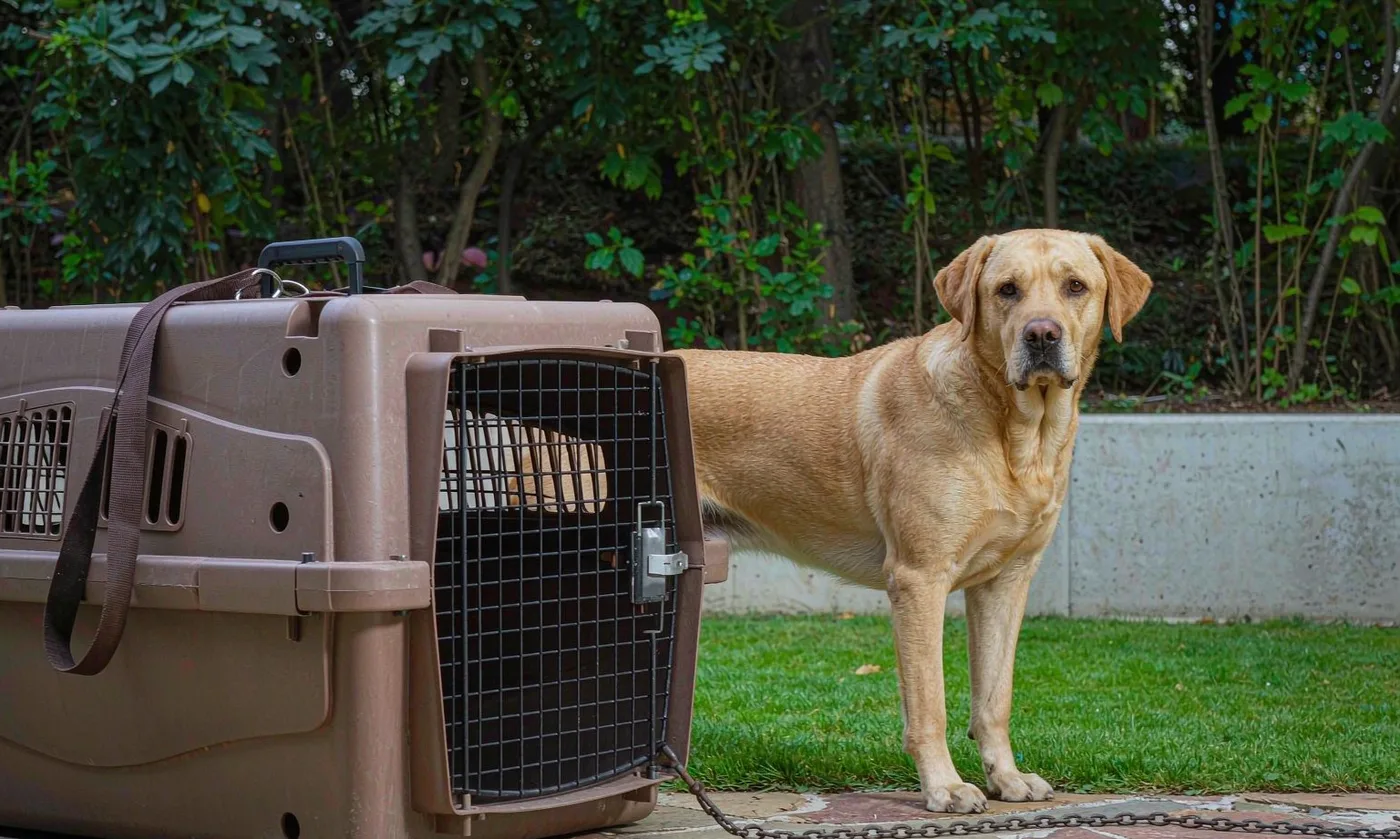
The frame in this class is a structural frame in the engineering sense, not a stiffener. It carries bending, it defines the compartment section, and it provides the attachment points for everything else. Two configurations are used and the choice between them sets the product's cost, weight and packability.
The perimeter tube frame is the standard answer. A continuous loop of aluminium tube at 16-20 mm outside diameter and 1.5-2.0 mm wall, formed at the corners and closed with an internal ferrule and a rivet or a bolt, runs around the top edge of the compartment and down both rear corners to the floor structure. Section modulus for a 20 mm by 1.8 mm tube is roughly 470 cubic millimetres, and with the animal's load carried by the floor and the shell in tension over the frame, deflection at mid-length stays inside 8 mm at working load. Mass is 900-1,400 g and cost is 9.60-16.40 USD.
The collapsible frame is the second configuration and is worth the engineering at this size because of freight. A frame that breaks at four points with internal ferrules and spring-loaded buttons stows alongside the folded shell, cutting packed height from 300 mm to about 180 mm. That is a 40% cube reduction, and at 0.31 cubic metres per unit it is worth 3.20-5.60 USD per unit on landed freight against an added engineering and qualification cost of 2.80-5.20 USD. Above roughly 1,500 units a year it pays back.
Material choice is aluminium by default. A 20 mm steel tube of equivalent section modulus weighs roughly three times as much and corrodes at the cut ends. A fibre-reinforced polymer tube saves 25-35% of the mass at 40-70% higher cost and is harder to terminate reliably, which matters when the termination is carrying 3.1 kN.
Termination is where frames fail and deserves the most design attention. A tube end closed with a plastic cap pushed into a fabric pocket will pull out at loads well below the rated figure, because the load path runs through the fabric rather than through metal. The specification is a moulded or cast termination with a bearing area above 600 mm², a mechanical capture of the tube by a through-fastener rather than by friction, and a reinforcement patch extending 60 mm beyond the bearing area.
The frame also does one job that is easy to overlook: it holds the compartment open under the animal's own weight when the product is set down. A soft shell without a frame collapses onto a 70 kg animal, and the animal will not tolerate it. This is the single reason the frame is mandatory rather than recommended.
Floor Engineering at a 1000 mm Span
A 1000 mm span loaded to 105 kg working is the most demanding floor case in the range, and the arithmetic is unforgiving. Deflection scales with the cube of span, so a board that holds 4 mm at 700 mm shows about 12 mm at 1000 mm with no change in section. Reaching the same 4-5 mm limit at the longer span requires roughly three times the second moment of area, which in practice means either a much thicker board or a ribbed tray.
Two constructions reach the target. A 12 mm polypropylene hollow-board works and is the low-tooling answer at 1,400-1,800 g and 2.20-3.60 USD, but it is heavy and it is at the practical limit of what hollow board will do at this span. A moulded tray with ribs of 20-24 mm depth on a 55-70 mm pitch is the correct answer above 2,000 units a year: 900-1,300 g, deflection of 3-4 mm at working load, and a moulded upstand of 30-40 mm that provides liquid containment as a free benefit.
Point load is the governing criterion rather than distributed load, because a standing Great Dane puts 70 kg through four paws with a total contact area under 200 square centimetres. Per paw that is roughly 17.5 kg over about 50 cm², or 35 kPa, which is not extreme in pressure terms but is applied through a claw with a contact area of a few square millimetres at the edges. The specification is a 400 N claw point load through a 6 mm hemispherical indenter for 60 seconds with perforation and a permanent indent under 1.5 mm.
The board-to-frame connection is the detail that decides whether the floor system works. A board floating in a sleeve with no connection to the frame carries its load entirely through the shell, and the shell has no bending stiffness. The specification is a positive mechanical connection: the board or tray is bolted or riveted to the frame at four points minimum, six at this span, with a load-spreading washer of at least 25 mm diameter on the underside.
One construction is worth rejecting explicitly. A hammock floor — fabric slung between two frame rails with no board — is sometimes proposed at this size to save weight and it is wrong. At 70 kg the fabric stretches, the animal's paws sink below the frame rails, and the animal's spine is loaded in a curve it cannot stabilise. Any floor specification without a rigid element should be rejected at design review regardless of the weight saving.
Traction and mat specification close the section: a bonded moulded mat of 10-14 mm closed-cell foam with a bidirectional tread of 3-4 mm depth, compression set under 10%, bonded to the board rather than laid loose, because a loose mat at this size shifts under the animal and becomes a trip surface for the paws.
Handling Systems: Two-Person Lift, Grab Handles and Wheel Options
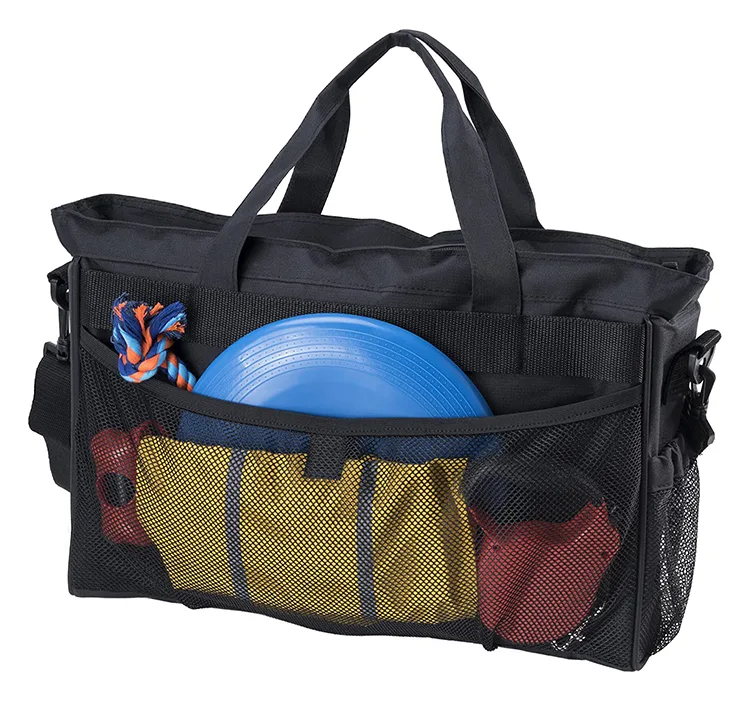
Handling is a design problem in this class rather than an instruction. A loaded product at 70 kg of animal plus 6-9 kg of product is a two-person lift, and the product has to make that lift possible: handles in the right places, at the right heights, rated to the load, and positioned so that the two lifters do not fight each other.
Handle specification is four handles at the four upper corners, each rated to 1.5 kN minimum breaking strength with a 750 N proof test, each attached to the frame rather than to the shell, and each with a clear grip opening of at least 120 mm by 30 mm so a gloved hand fits. The 1.5 kN figure is not the load — two lifters share 75 kg statically — it is the transient figure for an uneven lift, where one handle can momentarily carry the whole load.
Handle height and spacing matter as much as rating. Handles should be 250-350 mm apart across the width at each end so two people can lift without their hands colliding, and they should sit at the top edge rather than below it so the lifters are not forced into a stoop that puts the load further from their bodies.
A shoulder carry system is the alternative for two-person use and is worth specifying for veterinary transfer work. Two 50 mm webbing slings with padded sections, attached to the frame at the four corners, let two people carry the load at hip height with the weight taken on the shoulders rather than in the hands. Rating is the same 1.5 kN per attachment and the slings are adjustable over a 400 mm range so two people of different heights can level the load.
Wheeled configurations are frequently requested at this size and need an honest answer. A rolling frame with two 100-125 mm wheels at one end and a pull handle at the other converts the product into a trolley, which is genuinely useful on smooth surfaces and useless on gravel, sand or snow. Wheel specification is a 75-100 kg dynamic load rating per wheel, a sealed bearing, and a solid or foam-filled tyre rather than pneumatic because punctures cannot be managed in the field. The added cost is 8.60-15.40 USD and the added mass is 1.2-2.0 kg.
Vehicle loading is the last handling case and is worth designing for. Most users will put this product into the back of an estate car, a van or an SUV, which means a maximum external width of 620-680 mm and a clear lift height of 500-700 mm. A product wider than 680 mm does not fit a vehicle tailgate aperture and should not be specified at all.
Carton, Pallet and Container Engineering for Oversize Product
At 0.28-0.34 cubic metres per carton this product is a freight item, and the freight engineering is as important as the product engineering. The numbers below are the ones that decide whether a programme is commercially viable.
Flat-packed with a collapsible frame, the unit measures about 1,150 mm by 640 mm by 180 mm, which is 0.132 cubic metres of product volume, but the carton cannot be that shape because a 1,150 mm long carton is not palletisable in the standard 1,200 by 800 millimetre pattern with two across. The practical carton is 1,180 mm by 660 mm by 400 mm at 0.311 cubic metres, holding one unit with the frame, the mat and the accessories packed alongside it.
That carton palletises four per layer in a 1,200 by 800 pattern with a 20 mm overhang on two sides, and it stacks three layers high before carton compression becomes the limit, giving 12 cartons per pallet at 1.72 metres stacked height and roughly 145 kg gross. A 40-foot high-cube at 68 cubic metres takes 200-218 cartons on 17-18 pallets. A 20-foot container takes 82-90 cartons on seven pallets.
| Parameter | Value | Consequence |
|---|---|---|
| Carton volume | 0.311 m³ | Freight-class item, not parcel |
| Cartons per pallet | 12 (4 per layer, 3 layers) | 1.72 m stacked height |
| Cartons per 40-foot high-cube | 200-218 | Volume-limited, not weight-limited |
| Cartons per 20-foot container | 82-90 | Only viable for small reorders |
| Volumetric weight, air (divisor 6,000) | 51.8 kg per carton | Air is 6-7 times sea per unit |
| Typical sea freight per unit | 6.80-11.40 USD | 6-10% of FOB cost |
| Typical air freight per unit | 42-68 USD | Not viable except for samples |
Three freight levers are available and each has been worth chasing on real programmes. The collapsible frame cuts carton height from 400 mm to 300 mm, lifting a 40-foot container from 200 to 262-280 cartons. A carton redesign to 1,180 by 660 by 360 with the mat shipped flat and inserted at destination recovers a further 8-10%. And shipping the frame as a separate bundled item alongside a folded shell allows two units per carton in some configurations, which halves the cube but doubles the destination assembly labour.
Carton specification itself needs upgrading at this size. A single-wall corrugated board is not adequate for a 1.18 metre carton stacked three high: the specification is a double-wall BC-flute at 600-700 g/m² with a burst strength above 1,400 kPa, edge crush resistance above 9 kN per metre, and internal corner posts at all four vertical edges because a long carton fails by buckling at the corners rather than by crushing.
Destination handling is the final consideration. A carton of this size is not deliverable by a parcel carrier in most markets, so the programme needs a freight forwarder, a palletised delivery appointment and, for a consumer-facing programme, a returns process that assumes a pallet rather than a parcel.
Validation at Oversize: Load Frames, Ballast and Test Rig Limitations
Testing a product this large is itself an engineering task, and it is where many oversize programmes quietly fail. Standard test frames have a working area of 600-800 mm and a load capacity of 2-5 kN, and neither is sufficient for a compartment 1,150 mm long loaded to 210 kg proof.
The proof test needs a frame with a 1,500 mm clear span and a 5 kN capacity, and it needs a ballast system that distributes load in the specified 52:48 ratio rather than uniformly. Water ballast is the practical answer at this size: sealed bladder bags of 40 litres each, placed to reproduce the standing-paw case, four bags at the paw positions with a fifth distributed along the spine. Water has the advantage of conforming to the floor and the disadvantage of leaking, so bladders are double-bagged and the test is run over a drain.
Deflection is measured at five positions rather than three, at 200 mm intervals along the span, because a 1,150 mm compartment has two plausible failure positions rather than one. Acceptance is under 5 mm at the 105 kg working load and under 10 mm at the 210 kg proof, with permanent set under 0.6 mm after recovery.
The lateral case is tested with the product on a low-friction surface and a horizontal load applied through a pulley and a falling weight, rather than on a standard tensile frame, because the load path is horizontal and the reaction has to be taken by the floor rather than by the frame. A 70 kg animal leaning generates roughly 350 N of sustained lateral load and a transient well above it, so the test applies 500 N sustained and 1.0 kN transient.
Handling tests are specific to this class and are frequently omitted. Each grab handle is proof-tested at 750 N for 60 seconds with the product loaded, each frame termination is proof-tested to 3.1 kN, and the two-person lift is performed with the rated ballast by two operators of different heights to verify that the handles are usable and that the product does not rotate.
The rig limitation is worth stating plainly: most third-party laboratories cannot test a product this large, and programmes that require independent certification should confirm capacity before committing. Where independent evidence is needed, the restraint and containment benchmarks published by the Center for Pet Safety and the test-method references maintained by ASTM International are the two sources buyers most often ask about, and both should be checked for size coverage early.
Programme Economics: When to Build, When to Decline
Unit cost for a compliant Great Dane-class build lands at 58-94 USD FOB Xiamen. The frame is 9.60-16.40 USD, the floor assembly 4.60-8.20 USD, panels and mesh 11.40-17.60 USD, webbing, handles and hardware 9.80-16.40 USD, lining and mat 4.20-7.60 USD and labour 14.60-22.40 USD. Against a large-breed carrier of the same construction quality the premium is 28-48 USD, and most of it is square-metre-driven: this product uses 3.4-4.2 square metres of fabric against 1.6-2.0 for a 40 kg class product.
Add sea freight at 6.80-11.40 USD and the landed cost is 65-105 USD before duty, against a realistic retail of 180-320 USD. That is a viable margin but it is a thin one for the volume, because the addressable market is small: the population of dogs above 45 kg is a few percent of the total, and the subset whose owners will buy a dedicated transport device is smaller still.
Tooling is the deciding variable. Pattern development runs 1,600-2,800 USD, a moulded tray at this size is 16,000-28,000 USD, a custom frame extrusion and bending tool is 6,000-12,000 USD, and a collapsible-frame mechanism is 4,000-9,000 USD. A full tooling programme is 26,000-52,000 USD, which needs roughly 3,000-4,000 units over three years to recover.
The guidance that follows from those numbers is specific. Build the programme if the buyer has a veterinary, rescue or working-dog channel that will take 800-1,200 units a year, if the product is sold as a freight item through a forwarder rather than as a parcel, and if the range already carries the 25-40 kg grades so that the oversize product is an addition rather than a standalone.
Decline or defer if the channel is consumer e-commerce with parcel delivery, if the forecast is below 600 units a year, or if the buyer expects the product to fold small enough for standard shipping. Those expectations cannot be met at this span and the programme will fail for reasons that have nothing to do with the engineering.
A made-to-measure alternative is worth offering instead in the deferred case: a stock 40 kg-class platform with a graded-up panel set and a reinforced floor, produced at the standard 500-piece minimum, covers animals to roughly 55 kg and ships as a parcel. It is the right product for most buyers who ask for a Great Dane carrier.
Why brands source here
- Pet carrier programs run since 2014; founding team in sewn goods since 2004
- SGS-verified production floor of 4,950 m² with 137 workers across 7 lines
- Monthly capacity of 200,000 units, audited to BSCI and ISO 9001
People Also Ask
At what size does a soft carrier stop working?
Near 900 mm of compartment length, where the shell's lack of bending stiffness governs and the compartment folds at mid-length. Adding fabric weight does not help, because the problem is section modulus.
Why is the frame mandatory for Great Danes?
Beyond carrying bending, the frame holds the compartment open under the animal's own weight when the product is set down. A frameless shell collapses onto a 70 kg animal, which the animal will not tolerate.
What board thickness works at a 1000 mm span?
12 mm hollow board at 1,400-1,800 g, or a moulded tray with 20-24 mm ribs at 900-1,300 g above 2,000 units a year. Deflection scales with the cube of span, so the section modulus has to roughly triple.
How many people are needed to carry a loaded unit?
Two. At 70 kg of animal plus 6-9 kg of product, four corner handles rated to 1.5 kN each and attached to the frame are specified, with 250-350 mm spacing so hands do not collide.
How many units fit a 40-foot high-cube?
200-218 cartons on 17-18 pallets at 12 cartons per pallet, with a carton of 1,180 by 660 by 400 millimetres at 0.311 cubic metres.
When should the programme be declined?
If the channel is parcel-delivered consumer e-commerce, if the forecast is below 600 units a year, or if the buyer expects the product to fold small enough for standard shipping. None can be met at this span.
Frequently Asked Questions
What interior dimensions suit the Great Dane class?
520-620 mm wide, 1000-1150 mm long and 700-820 mm high, from a body length of 900-1,100 mm, shoulder height of 710-810 mm and chest girth of 90-120 cm.
What load ratings apply at 70 kg declared?
105 kg working, 210 kg proof and 315 kg ultimate, roughly 3.1 kN, with 50 mm webbing at 22-26 kN and hardware proof-tested above 4.0 kN.
Why is the standing case specified rather than the lying case?
A compartment large enough for a Great Dane to stand in will be stood in, and a standing animal puts 70 kg through four paw patches rather than distributing it along the body.
What overturning moment does the floor joint carry?
Roughly 0.45 times mass times lateral acceleration. At 70 kg with a 0.5 g event that is about 154 Nm, resisted only by the side-to-floor connection, which is why that seam is the most heavily specified in the range.
Why must the frame termination be mechanical?
A plastic cap in a fabric pocket pulls out well below rating because the load path runs through fabric. A moulded termination with a through-fastener and bearing area above 600 mm² carries the 3.1 kN case.
Is a collapsible frame worth the engineering cost?
Above roughly 1,500 units a year. It cuts packed height from 400 mm to 300 mm and lifts a 40-foot container from 200 to 262-280 cartons, worth 3.20-5.60 USD per unit against 2.80-5.20 USD of cost.
Why are four ballast bags used instead of one mass?
The standing-paw case is four concentrated loads, not a distributed one. Four 40 litre sealed bladders at the paw positions plus one along the spine reproduce it and conform to the floor.
How is the lateral case tested at this size?
On a low-friction surface with a horizontal load applied through a pulley and falling weight, so the reaction is taken by the floor. 500 N sustained and 1.0 kN transient.
What carton specification is required?
Double-wall BC-flute at 600-700 g/m², burst strength above 1,400 kPa, edge crush above 9 kN per metre and internal corner posts, because a 1.18 metre carton fails by corner buckling rather than crushing.
Why is a hammock floor rejected?
Fabric stretches at 70 kg, the paws sink below the frame rails and the spine is loaded in a curve the animal cannot stabilise. Any floor without a rigid element is rejected at design review.
What does a compliant build cost?
58-94 USD FOB Xiamen, with the frame at 9.60-16.40 USD and labour at 14.60-22.40 USD. Landed before duty is 65-105 USD against a realistic retail of 180-320 USD.
How much tooling does a full programme need?
26,000-52,000 USD across patterns, tray, frame tooling and a collapsible mechanism, recovering over roughly 3,000-4,000 units across three years.
What is the alternative for most buyers?
A stock 40 kg-class platform with a graded-up panel set and reinforced floor at the standard 500-piece minimum, covering animals to roughly 55 kg and shipping as a parcel.
Talk to QUANZHOU JUNYUAN BAGS about a pet carrier program: MOQ 500 pieces per colourway, samples in 6-10 working days, bulk production in 35-50 days under AQL 2.5 inspection.
Get a free quote Request a sampleKeep reading
- Dog Carrier Backpack for Mastiffs: Giant Breed
- Dog Carrier Backpack for Large Dogs: Design Considerations
- Dog Carrier Backpack for Alaskan Malamutes: Heavy Duty
- Dog Carrier Backpack Size: Sizing Chart and Specifications
- Dog Carrier Backpack Straps: Webbing Width and Strength
- Dog Carrier Backpack Bottom: Reinforcement Options