Dog Carrier Backpack for Siberian Huskies: Cold Climate
A cold-climate carrier for the 16-27 kg Husky class is specified by low-temperature material behaviour, not by insulation. Require coating flex retention to minus 40 °C with no cracking, hardware and webbing rated and tested after conditioning at minus 40 °C, a welded floor with ice-abrasion resistance above 40,000 cycles, and a condensation path that keeps liquid water off the interior floor.
This page covers the material and moisture problems that appear when a soft carrier is used below freezing. The animal is not the constraint: a Siberian Husky is comfortable well below the temperature at which the product's own materials start to fail. The constraints are coating cold-crack, hardware and webbing embrittlement, ice abrasion at the floor, and condensation freezing on the interior surface, which turns a ventilation requirement into a water management requirement. Each is addressed with a measurable specification and a conditioning protocol. Commercial terms follow the standard programme: MOQ 500 pieces per colourway, prototypes in 6-10 working days, bulk production 35-50 days after sample approval, final random inspection to AQL 2.5, T/T 30/70 payment and FOB Xiamen loading. Test data quoted here is generated by our production team at SGS-verified production base partner facilities.
Working as a pet carrier manufacturer on dog carrier backpack ranges means the technical file is shared before any quotation: pattern, bill of materials, test report and packing specification.
Cold-Climate Duty: Ambient Envelope and Temperature Bands
Cold-climate specification starts by defining the ambient envelope, because everything downstream depends on it. Three bands are used. Band one is temperate winter, 0 to minus 10 °C, covering most of Europe, the northern United States and coastal Canada. Band two is continental winter, minus 10 to minus 30 °C, covering the interior of North America, Scandinavia and northern China. Band three is extreme, minus 30 to minus 50 °C, covering northern Canada, Alaska, Siberia and high-altitude alpine use. A product declared for band two is specified to minus 30 °C and proof-tested at minus 40 °C.
Declaring the band is a commercial decision with an engineering cost attached. Materials that pass at minus 20 °C often fail at minus 40 °C, and the step from band two to band three typically adds 2.80-5.60 USD of unit cost in coating chemistry and hardware. Programmes sold across mixed markets should declare band two and state the limit, because a product declared for band three costs more in every market and a product declared for band one generates returns in band two.
The animal sets almost no lower limit. A Siberian Husky with a working double coat is comfortable to roughly minus 40 °C at rest and lower in motion, and it will overheat in a well-insulated compartment above about 5 °C. The thermal engineering problem is therefore asymmetric: there is no heating requirement and there is a substantial heat-removal requirement at the top of the range.
Mass and geometry for the class are 16-27 kg, body length 580-680 mm, height at the shoulder 510-600 mm, chest girth 65-85 cm. Derived interior dimensions are 380-440 mm wide, 650-740 mm long and 500-580 mm high. This is a shorter, lighter envelope than the retriever grades, which is why the cold-climate build can be lighter overall and why the floor board can sit at 8 mm rather than 10 mm.
Wind is the environmental factor most often omitted. A carrier carried in wind at minus 20 °C experiences a convective heat loss several times that of still air at the same temperature, and shell fabrics are permeable to wind in a way that a coated panel at rest is not. Wind resistance is specified as air permeability below 20 cubic centimetres per square centimetre per second, measured on the exterior panel, with a windproof membrane or a tightly woven face where that figure cannot be reached.
The duty profile therefore has four elements: a stated minimum temperature with a margin, a wind permeability limit, a heat-removal requirement at the top of the range, and a condensation path. Cold-climate engineering is moisture management and material retention, and insulation is the least important of the four.
Coating and Film Behaviour Below Zero: Cold Crack and Flex Retention
The dominant material failure below freezing is coating cold-crack. A polymer coating on a woven substrate becomes stiffer as temperature falls, and below its glass transition it loses the ability to deform with the fabric. When the fabric is then folded — which happens every time the product is collapsed, packed or stepped on — the coating cracks along the fold line. Once cracked it delaminates, and the exposed weave wets out and abrades.
Polyvinyl chloride coatings are the worst performers and are the reason cheap cold-climate products fail in their first season. Standard PVC has a glass transition near minus 20 °C and becomes brittle below it unless plasticised for low temperature, and the plasticisers that deliver low-temperature flexibility are increasingly restricted. PVC should not be specified below band one.
Polyurethane performs better: a well-formulated aliphatic PU coating retains flexibility to roughly minus 30 °C, and aromatic grades to minus 25 °C. Thermoplastic polyurethane reaches minus 40 °C and below with margin, and a polyolefin or silicone-modified coating reaches the extreme band. TPU at 45-60 g/m² of dry solids is the working specification for band two and the default for band three.
Testing is specific and cheap. The cold-crack or cold-flex method conditions a coated sample at the declared minimum temperature for four hours and then bends it around a mandrel of specified diameter while still cold, with inspection for cracking at ten times magnification. Mandrel diameter is set by the tightest fold in the product, which for a collapsible carrier is typically 25 mm. A coating that passes at 25 mm and fails at 12 mm is declared with a folding instruction rather than being downgraded.
Adhesion after conditioning matters as much as cracking, because a coating can stay flexible and still let go of the substrate. Cross-hatch adhesion is tested before conditioning and again after 500 thermal cycles between plus 20 °C and the declared minimum, with acceptance of no more than one grade of loss on the standard scale. Cycles matter more than a single soak here, because real products cycle rather than sit.
Print and trim are part of the same problem. Plastisol prints crack at low temperature before the coating does, and the specification is a heat-transfer or a woven label in cold-climate programmes. Hook-and-loop tape becomes stiff and loses peel strength below minus 20 °C and is replaced with a mechanical closure wherever it carries load.
Hardware, Webbing and Thread at Low Temperature
Hardware failure in cold conditions is sudden and total rather than gradual, which is why it needs explicit specification. Two mechanisms are involved: polymer embrittlement in moulded buckles and adjusters, and differential thermal contraction between a metal component and the polymer or webbing it is assembled with.
Moulded hardware is specified by resin. Polyamide, standard in most buckles, retains useful toughness to about minus 20 °C and becomes notch-sensitive below it; polyoxymethylene retains toughness to about minus 40 °C; and polypropylene, common in cheap hardware, is brittle near 0 °C and is prohibited in cold-climate programmes. The specification for band two is polyoxymethylene or a low-temperature-modified polyamide with a notched impact test at the declared minimum temperature, run to the polymer impact methods published by ASTM International.
The test is straightforward and should be run on production hardware rather than on a datasheet: condition the buckle at the declared minimum for four hours, then apply the proof load of 1.5 times ultimate design load while still cold, and hold for 60 seconds. A component that survives warm and fails cold is a resin problem, and it is invisible in any ambient-temperature test programme.
Metal hardware has a different issue. Zinc alloy and aluminium contract at roughly 23 and 23 micrometres per metre per kelvin, and a steel pin or spring in a zinc body will change its fit over a 50 K swing. The practical consequence is a spring-loaded adjuster that slips when cold or binds when warm, and the control is a spring in stainless rather than in plated carbon steel, plus a functional check on the adjustment mechanism across the full temperature range.
Webbing behaves less dramatically but measurably. Polyester webbing loses 8-14% of its breaking strength at minus 40 °C and stiffens enough that it feeds through an adjuster differently, which changes the adjustment feel and can cause a strap to slip. Polyamide is slightly better. Either way the specification is to rate webbing at the conditioned figure rather than at the ambient one, which means taking the 9-12 kN ambient rating for 25 mm webbing as 8-11 kN for design purposes.
Thread is the quiet failure. Bonded nylon loses strength and becomes brittle below minus 20 °C; bonded polyester holds to minus 40 °C and is the cold-climate specification. Seam efficiency is re-measured on conditioned samples rather than assumed, with acceptance at 70% of the unconditioned figure, and the floor joint is re-tested after 500 thermal cycles for this reason.
Differential contraction between the floor board and the shell is the last item. Polypropylene contracts roughly 1.5 millimetres per metre over a 50 K fall against roughly 0.4 for a coated polyester shell, so a 700 mm board shrinks about 0.8 mm more than the fabric around it. A sleeve with no allowance will buckle the board when cold, and the specification is 3-4 mm of sleeve clearance on a board of this length.
Insulation Strategy: Floor, Walls and the Condensation Problem
Insulation in this class exists to manage condensation rather than to warm the animal. A husky in a sealed, insulated compartment at 5 °C ambient will overheat, and the same compartment at minus 20 °C will accumulate frost on its interior surface from the animal's respiratory moisture. Designing for warmth is the wrong objective and produces a product that is worse on both counts.
The physics is straightforward. A 20 kg animal exhales roughly 15-25 grams of water per hour, and in a compartment of 0.15 cubic metres that vapour raises humidity to saturation within minutes regardless of ambient temperature. The vapour then condenses on the coldest surface it reaches. In a cold-climate product that surface is the shell fabric at the exterior side of the insulation, or the floor if the floor is uninsulated and in contact with cold ground or a cold vehicle surface.
The consequence is that insulation placement is a condensation control. If insulation is placed on the interior side of the shell, the shell stays cold and condensation forms at the insulation interface where it cannot be seen, cannot dry and will mildew over a season. If insulation is placed on the exterior side — that is, outside a continuous vapour-control layer — the dew point falls outside the interior surface and condensation does not form in the compartment.
The specification that results is an interior vapour-control layer, a mid insulation layer and an exterior shell, with the vapour-control layer continuous and sealed at the seams. In practice this means a welded or seam-sealed liner of 40-70 micrometre film, 6-10 mm of closed-cell foam or a 150-250 g/m² synthetic batt, and the coated shell outside it. Insulation value is a secondary benefit; the layering order is the point.
The floor is the exception and is the one place insulation genuinely matters. A carrier set down on snow, ice or a cold vehicle floor loses heat by conduction at a rate that no wall insulation compensates for, and an animal lying on a conductive floor will chill even though its coat is adequate. The floor specification is a closed-cell foam layer of 8-12 mm under a welded basin, with a thermal resistance sufficient to hold the interior floor surface within 3 °C of the animal's resting surface after 30 minutes on a minus 15 °C substrate.
Removability closes the insulation specification. Any absorbent layer in a cold-climate product will be wet for most of its service life, so the mat and any wall liner are specified as removable and washable, with a drying time target of under four hours at 20 °C and 50% relative humidity so the product is usable the following day.
Ventilation in Cold Air: Frost, Ice and Moisture Management
Ventilation in cold air is a dehumidification requirement disguised as an airflow requirement. The animal needs fresh air, but every cubic metre of minus 20 °C air brought into the compartment carries almost no water and leaves carrying a great deal, so the ventilation that removes moisture also removes heat. The engineering task is to size the airflow for moisture removal and no more.
Open area of 20-26% suits the class, lower than the warm-climate figure for a dog of this mass. Intake is placed low and forward, exhaust high and rear, and both are closable so the user can throttle airflow when the product is stationary in wind. Closable vents are not optional in a cold-climate product; a fixed-open vent at minus 30 °C with any wind will chill an animal that is otherwise comfortable.
Frost formation at the exhaust is the specific failure. Warm, saturated interior air reaching a cold vent panel deposits frost in the aperture, and the aperture closes over the course of an hour. The specification is a minimum aperture dimension of 6 mm rather than the 3-4 mm used on a mesh panel, a hydrophobic treatment on the vent fabric so ice does not bond to it, and an exhaust area 20-30% larger than the intake so partial closure still passes the design flow.
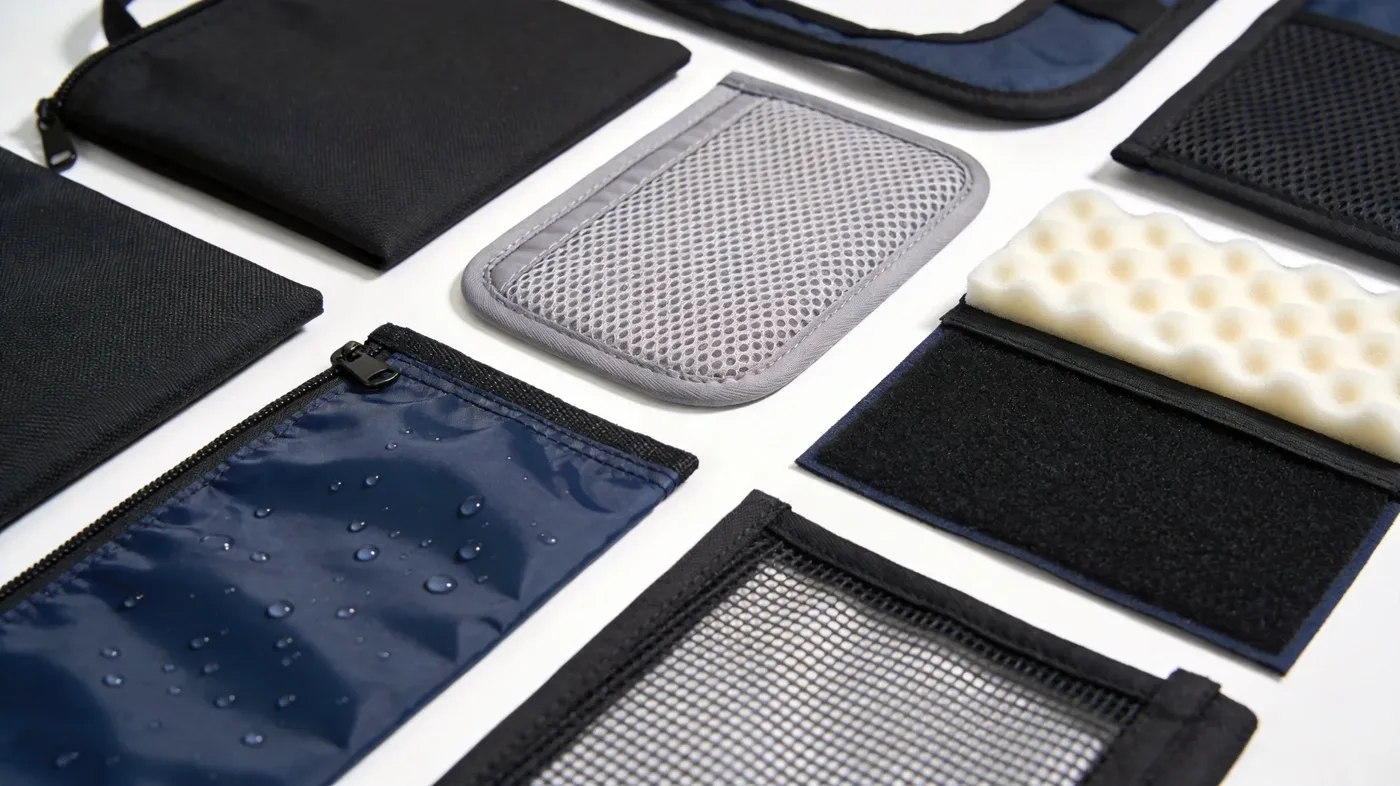
Mesh icing is the related problem on the intake side. Snow and freezing rain entering a mesh panel freeze in place and block it completely. The controls are a storm flap over the intake with a 30-40 mm standoff so snow sheds rather than packing, and a mesh specification with a monofilament yarn of 0.25-0.40 mm diameter, which presents less surface for ice to bond to than a multifilament yarn.
Moisture is then managed on the interior side. Because condensation will occur somewhere, the product needs somewhere for it to go: a welded floor basin with a 20-30 mm upstand, a drain path at the rear corner that opens outside the vapour-control layer, and a mat of closed-cell foam that does not absorb anything. Absorbent mats are the wrong specification here; they saturate, freeze and stop working.
Verification is a frost chamber run: two hours at minus 20 °C with a simulated moisture load and a heated block, logging exhaust aperture occlusion, interior humidity and the mass of water collected in the basin. Acceptance is exhaust occlusion under 30% after two hours and no liquid water on the interior floor surface.
Floor Specification: Ice Abrasion, Snow Load and Traction
The floor in a cold-climate product takes a load case that has no warm-climate equivalent: the product is set down on ice and snow, sometimes dragged, and the underside is abraded by frozen granules that are far more aggressive than soil or sand. Ice abrasion is a cutting action rather than a rubbing one, and it removes coating and fabric quickly.
The specification is an abrasion resistance of 40,000 cycles or better on the underside fabric to the Martindale method, with wool abradant replaced by a specified frozen-particulate rig for the cold-specific test. A coated 1680D at 400-480 g/m² is the working material on the underside rather than the 900D used elsewhere, and the coating is TPU rather than PU because the coating is what takes the abrasion.
An external skid or rail is the better answer at band three. Two moulded polypropylene or TPU skids of 8-12 mm height running along the length of the underside keep the fabric off the ground entirely, cost 0.80-1.80 USD and completely remove the abrasion mechanism. They also provide the thermal break that the floor insulation section described, so they do two jobs for one part.
Traction on ice is a user safety issue rather than an animal comfort one. A product set down on a frozen surface slides, and a sliding product with a 25 kg animal inside is a handling hazard. The specification is a skid material with a coefficient of friction above 0.35 on wet ice — a thermoplastic elastomer or a soft TPU rather than a hard polypropylene — and a transverse tread with a 3-4 mm depth so it keys into snow rather than sitting on it.
Snow load is minor but not zero. Snow packed against the sides of a set-down product exerts a lateral load of 0.5-1.5 kPa, which over a 0.4 square metre side panel is 200-600 N. That is well inside the panel specification but it is a sustained load applied at a low temperature where the fabric is stiff, so it is worth including as a case in the cold validation rather than assuming it away.
The board itself needs one cold-specific instruction. A hollow-board floor that has taken any water through a pinhole will freeze, and freezing water expands roughly 9% and splits the board internally. The specification is a sealed sleeve, a welded or sealed floor basin above the board, and a board material with a closed cell structure so there is no internal void to hold water.
Cold-Chamber Validation Protocol
Cold validation is a conditioning protocol applied before and around the standard structural tests, and it is what separates a declared cold-climate product from a standard product with a thermal claim. The sequence has six stages and is run on first articles and on one pulled unit per 5,000 in production.
Stage one is coating cold-flex. Samples conditioned four hours at the declared minimum are bent around a 25 mm mandrel while still cold, ten times, with inspection at ten times magnification for cracking and a cross-hatch adhesion check immediately afterwards.
Stage two is functional operation cold. Every closure, buckle, adjuster, zipper and vent is operated twenty times at the declared minimum temperature, with acceptance of full function and no component fracture. This is the stage that finds moulded hardware problems, and it is run on the finished product rather than on components.
Stage three is the structural proof cold. The unit is loaded to 1.5 times the declared maximum — 40 kg for a 27 kg class — conditioned for four hours at the declared minimum, and proof-tested to 81 kg while cold. Acceptance is no seam opening above 6 mm and no hardware fracture. The cold figure is stricter than the ambient figure because materials have less margin.
Stage four is thermal cycling: 500 cycles between plus 20 °C and the declared minimum, with a seam efficiency re-measurement and a cross-hatch adhesion check at the end. Cycling finds differential contraction problems that a single soak does not.
Stage five is the frost chamber run described in the ventilation section, logging exhaust occlusion, interior humidity and water collection over two hours at minus 20 °C.
Stage six is recovery and inspection: the unit is brought to ambient, dried, and fully inspected for coating cracking, delamination, seam damage and corrosion, then re-tested on the ambient structural proof. A product that recovers fully is declared; one that does not is not.
| Test | Band one (0 to -10 °C) | Band two (-10 to -30 °C) | Band three (-30 to -50 °C) |
|---|---|---|---|
| Mandrel cold-flex diameter | 12 mm | 25 mm | 32 mm |
| Coating specification | Aliphatic PU | TPU, 45-60 g/m² | TPU or polyolefin, 60-80 g/m² |
| Hardware resin | Polyamide | Polyoxymethylene | Polyoxymethylene with impact test |
| Thread | Bonded nylon or polyester | Bonded polyester | Bonded polyester, Tex 135 |
| Operational cycles cold | 10 | 20 | 30 |
| Thermal cycles | 200 | 500 | 800 |
| Frost chamber duration | Not required | 2 h at -20 °C | 4 h at -35 °C |
Documentation is the same as for any declared product: dated reports with photographs and measured values, retained for the life of the style plus two years. Where a programme is sold alongside cold-weather safety claims, guidance from the American Veterinary Medical Association on cold-weather limits is the reference most buyers recognise.
Cost, Weight and Programme Parameters
Cold-climate specification adds cost in three places and removes it in one. The additions are the coating chemistry at 1.20-2.80 USD, the hardware resin upgrade at 0.60-1.60 USD and the insulation and vapour-control package at 2.40-4.60 USD. The removal is that no heating element, no thermal lining on the animal side and no heavy frame is required, and the shorter Husky envelope keeps the floor board at 8 mm rather than 10 mm, saving 0.35-0.70 USD.
Net unit cost for a band two compliant build is 26-40 USD FOB Xiamen against 20-32 USD for the same envelope in a temperate specification, so the cold-climate premium is 5.20-8.40 USD. Band three adds a further 2.80-5.60 USD, mostly in coating weight, hardware resin and the external skid set.
Weight runs 2.8-4.0 kg empty for the middle of the class, which is 400-700 g above the temperate equivalent. Most of that is the insulation package and the skid set, and both are worth their weight: the alternative is a product that fails in its first winter.
Packaging and freight are unchanged in method but not in numbers. The unit flat-packs to roughly 740 mm by 440 mm by 210 mm, or 0.068 cubic metres, at 2 per carton giving 0.156 cubic metres and about 9.0 kg gross. A 40-foot high-cube takes 415-445 cartons and is volume-limited. One cold-specific packaging requirement applies: the product must be shipped dry. Any unit packed with a residual moisture content above 8% will arrive with mildew, and the specification is a moisture barrier bag and a desiccant at 10-20 grams per carton for sea freight.
Market and programme notes close the economics. Cold-climate SKUs sell in a narrow season: 70-80% of orders place between June and September for an October to December delivery, so production capacity should be reserved early in the calendar year rather than at the standard 35-50 day window, because the window collides with peak season for every other programme in the range.
Finally, a declaration warning. Any product sold with a cold-climate claim should carry the declared minimum temperature on a permanent label, together with the instruction that the animal, not the product, sets the exposure limit. Claims without a number are the ones that generate warranty disputes.
Production capability
- SGS-verified production space of 4,950 m², 149 machines, 7 assembly lines
- Pet carrier and pet bag output since 2014 from a 137-person team
- 200,000 units shipped monthly under BSCI and ISO 9001 systems
People Also Ask
What temperature should a cold-climate carrier be declared to?
Declare by band: band one 0 to minus 10 °C, band two minus 10 to minus 30 °C, band three minus 30 to minus 50 °C. A band two product is specified to minus 30 °C and proof-tested at minus 40 °C.
Which coating survives below freezing?
TPU at 45-60 g/m² of dry solids for band two and TPU or polyolefin at 60-80 g/m² for band three. Standard PVC has a glass transition near minus 20 °C and should not be specified below band one.
Why does insulation go on the exterior side?
If insulation sits on the interior side of the shell, the shell stays cold and condensation forms at the interface where it cannot dry. A continuous vapour-control layer inside the insulation keeps the dew point out of the compartment.
How is frost blocked at the exhaust vent?
An aperture of at least 6 mm, a hydrophobic treatment on the vent fabric and an exhaust area 20-30% larger than the intake, so partial closure still passes design flow.
Which hardware resin is used in cold programmes?
Polyoxymethylene, which retains toughness to about minus 40 °C. Standard polyamide becomes notch-sensitive near minus 20 °C and polypropylene is brittle near 0 °C.
How much does cold-climate specification add?
5.20-8.40 USD for band two, from coating at 1.20-2.80, hardware at 0.60-1.60 and the insulation package at 2.40-4.60 USD. Band three adds a further 2.80-5.60 USD.
Frequently Asked Questions
Does a Husky actually need insulation?
No. A working double coat is comfortable well below minus 40 °C, and a husky will overheat in an insulated compartment above about 5 °C. Insulation exists to control condensation, not to warm the animal.
What interior dimensions suit the class?
380-440 mm wide, 650-740 mm long and 500-580 mm high, from a body length of 580-680 mm and shoulder height of 510-600 mm at 16-27 kg.
How is coating cold-crack tested?
Condition four hours at the declared minimum, bend around a mandrel of 25 mm while still cold, ten times, then inspect at ten times magnification and run a cross-hatch adhesion check.
Why are thermal cycles tested rather than a single soak?
Real products cycle between warm interiors and cold exteriors. Differential contraction between a polypropylene board and a polyester shell is about 1.1 millimetres per metre over 50 K, and only cycling exposes the resulting buckling and seam loading.
How much sleeve clearance does a cold board need?
3-4 mm on a 700 mm board. The board contracts roughly 1.5 mm per metre over a 50 K fall against 0.4 for the shell, so a tight sleeve buckles the board when cold.
Why is hook-and-loop replaced in cold programmes?
It stiffens and loses peel strength below minus 20 °C. Where it carries load, a mechanical closure is specified instead; plastisol prints are replaced with heat-transfer or woven labels for the same reason.
How much moisture does the animal produce?
Roughly 15-25 grams of water per hour from respiration, which saturates a 0.15 cubic metre compartment within minutes regardless of ambient temperature. Ventilation is sized for moisture removal, not for maximum airflow.
Why must absorbent mats be avoided?
They saturate, freeze and stop working. The specification is a welded basin with a 20-30 mm upstand, a drain path outside the vapour-control layer and a closed-cell mat that absorbs nothing.
What underside abrasion resistance is required?
40,000 cycles or better, with coated 1680D at 400-480 g/m² rather than 900D. External skids of 8-12 mm remove the mechanism entirely for 0.80-1.80 USD and double as a thermal break.
What traction is needed on ice?
A coefficient of friction above 0.35 on wet ice using a thermoplastic elastomer or soft TPU skid with a 3-4 mm transverse tread, so it keys into snow rather than sitting on it.
How is structural proof run cold?
Load to 1.5 times declared maximum, condition four hours at the declared minimum, then proof-test to three times declared mass while cold, accepting no seam opening above 6 mm and no hardware fracture.
What packaging requirement is specific to cold programmes?
Ship dry. Residual moisture above 8% arrives as mildew, so a moisture barrier bag and 10-20 grams of desiccant per carton are specified for sea freight.
When should cold-climate production capacity be reserved?
Early in the calendar year. 70-80% of orders place between June and September for October to December delivery, which collides with peak season across the rest of the range.
Talk to QUANZHOU JUNYUAN BAGS about a pet carrier program: MOQ 500 pieces per colourway, samples in 6-10 working days, bulk production in 35-50 days under AQL 2.5 inspection.
Get a free quote Request a sampleKeep reading
- Dog Carrier Backpack for Large Dogs: Design Considerations
- Dog Carrier Backpack for Alaskan Malamutes: Heavy Duty
- Dog Carrier Backpack Bottom: Reinforcement Options
- Dog Carrier Backpack Mesh: Airflow and Durability
- Best Dog Carrier Backpack Materials: A Complete Comparison
- Dog Carrier Backpack with Side Pockets: Design