Dog Carrier Backpack with Side Pockets: Design
Side pockets are dimensioned from the load, not from the panel: a 500 ml bottle of 65-70 mm diameter needs a gusset of 75-85 mm and a pocket height of 190-210 mm to retain it under a 1.5 G vertical acceleration. Pocket mouths carry an elastic binding stretched to 85% of its relaxed length, and every pocket-to-shell joint is bar-tacked over 12 mm. Filled pockets shift the centre of gravity rearward by 25-40 mm, which must be accounted for in the harness geometry before the pattern is cut.
This page treats side pockets as a structural subsystem of the pet carrier backpack rather than a styling detail. It covers gusset derivation from bottle geometry, pocket volume maths, the way a filled pocket moves the combined centre of gravity, shell and lining selection by abrasion zone, four closure systems and their cycle-test results, reinforcement details including bar-tack length and seam allowance, and the pull, slosh and drop tests used to release a design. Commercial terms are unchanged across the program: MOQ 500 pieces per colourway, prototypes in 6-10 working days, bulk production 35-50 days after approval, final random inspection to AQL 2.5, T/T 30/70 and FOB Xiamen. Pocket count is one of the few variables that moves both unit cost and sewing time substantially, so the configuration should be frozen at the tech pack stage rather than adjusted after the golden sample.
Wholesale pet carrier buyers usually consolidate to fill one container; for dog carrier backpack assortments our production team mixes sizes and colourways inside a single 500-piece minimum.
Pocket Geometry: Deriving Gusset Width from Bottle Dimensions
Pocket geometry starts with the object the pocket has to hold. A 500 ml cylindrical bottle in PET is typically 65-70 mm in diameter and 200-230 mm tall; a 750 ml aluminium bottle runs 73-80 mm in diameter; a folded silicone bowl or a 300 g treat pouch behaves as a rectangular prism and needs a different set of numbers entirely. The pocket is then built with clearance: gusset width equal to the object diameter plus 8-12 mm of ease, and pocket height equal to the object height minus 25-35 mm so that the object stands proud of the mouth and can be grasped.
That last point is the one most often missed. A pocket that fully swallows a bottle is unusable in the field — the wearer cannot get a hand around it — and it is also a retention risk, because the bottle can rotate out under acceleration without anything to stop it. Retention depends on the mouth sitting at 60-70% of object height, with the elastic binding gripping across the exposed section. For a 210 mm bottle this puts the binding line at roughly 140 mm above the pocket floor.
Gusset construction is a three-piece assembly: two side gussets and a continuous front band. On a woven shell the gusset is cut on the bias at 45 degrees so that it can take the compound curve around the bottle without puckering; on a coated shell the gusset is cut on grain and the curvature is taken by a slight taper in the pattern of 4-6 mm over the pocket height. Cutting the gusset on grain with a coated fabric produces a permanent crease line that reads as a defect after packing.
Volume is checked by water displacement during development, not by calculation, because the usable volume of a soft pocket is always less than its geometric volume. A pocket with a 90 mm mouth and a 210 mm height has a nominal capacity near 1.3 L but a usable capacity closer to 0.9 L once the fabric cannot take the corners. Specify pocket capacity as the measured water volume retained with the closure engaged, not as the nominal geometric figure.
Load Path: How a Filled Pocket Shifts the Centre of Gravity
A carrier is a suspended load: the animal sits in the compartment, the wearer's shoulders carry it, and stability depends on the combined centre of gravity staying close to the wearer's spine. Adding 500 g of water and 300 g of accessories in a side pocket moves that combined centre rearward and, if only one pocket is filled, laterally as well. On a carrier built for a 8 kg animal, a single filled side pocket shifts the combined centre of gravity roughly 25-40 mm rearward and 15-25 mm off-axis.
Those millimetres matter because they are multiplied by the moment arm of the shoulder attachment. A 40 mm rearward shift on an 8 kg combined load adds a measurable overturning moment that the wearer compensates for by leaning forward, which increases lumbar loading and reduces the time the product can be worn comfortably. Asymmetric loading is worse than symmetric loading: two half-full pockets are stable, one full pocket is not, which is why the pattern should place pockets symmetrically even if only one is likely to be used.
The structural consequence is that pocket attachment becomes part of the load path. A pocket hung from the shell panel alone transfers its weight through the shell fabric into the base seam; a pocket whose upper edge is captured in the same seam as the shoulder-strap attachment shares load with the harness. The second construction is stronger and is the one specified wherever pocket height exceeds 150 mm. Below that height the shell-mounted version is adequate and cheaper.
There is also an animal-side constraint. A pocket that bulges into the compartment reduces the usable interior width, and on a carrier sized for a specific chest girth the intrusion can push the animal's ribs against the shell. Pocket depth into the compartment should be limited to 20-25 mm on any carrier where interior width is already at the minimum for the target weight class, and the lining panel behind the pocket should be a flat spacer rather than a loose drape so that the bulge does not create a pressure point.
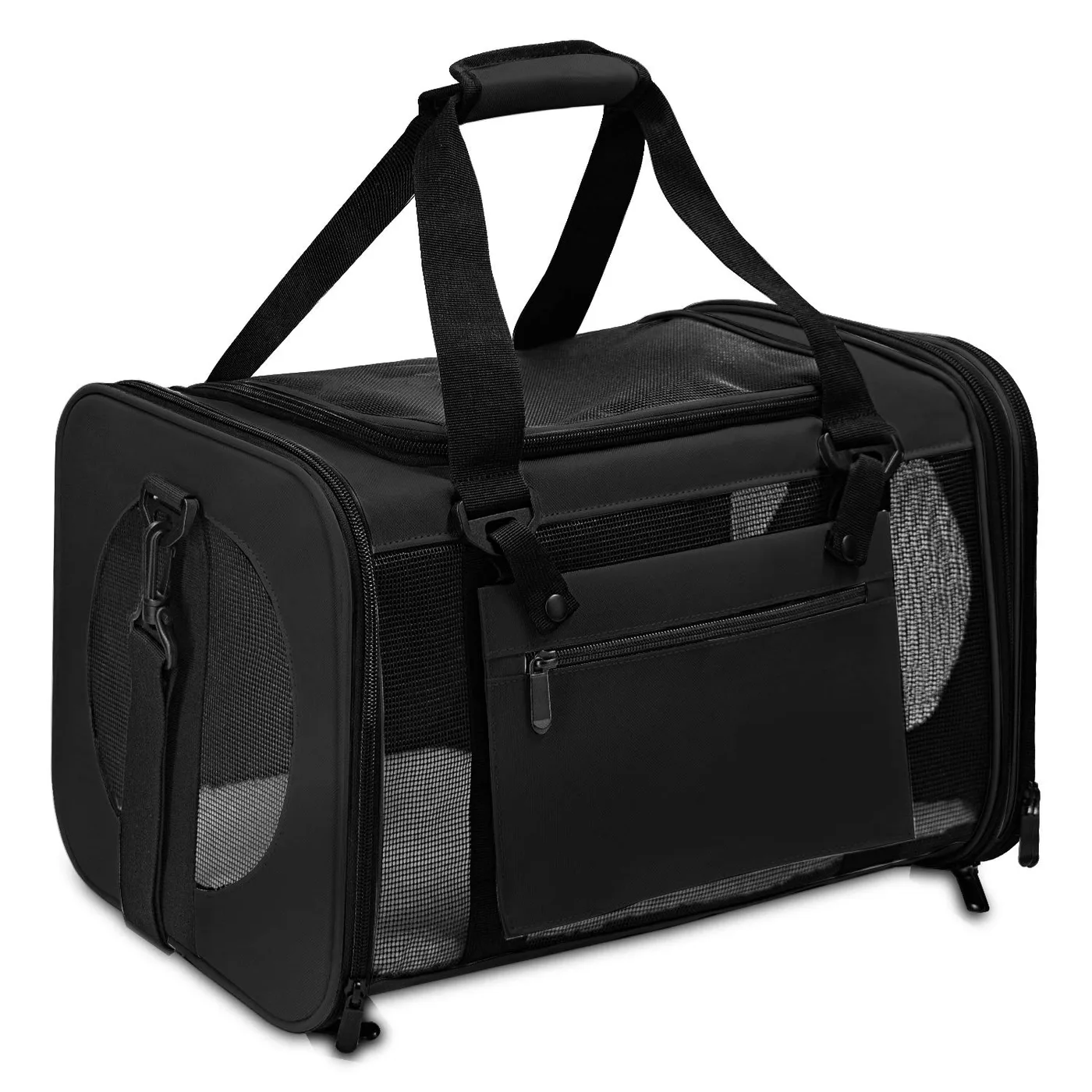
Shell and Lining Selection by Abrasion Zone
Side pockets wear out in one place: the mouth. Everything the wearer puts in and takes out passes across that edge, and the failure mode is abrasion of the binding followed by fraying of the shell underneath. Material selection therefore differs between the pocket body, which can be light, and the mouth, which cannot. A typical build uses 600D polyester for the pocket body and 900D or 1000D for a 25-30 mm binding band folded over the mouth, with the heavier fabric hidden inside the fold.
Lining choice is driven by drainage and by cleanability. An uncoated 210D nylon lining dries slowly and holds odour; a PU-coated 210D lining dries faster but traps moisture at the seam if the seam is not sealed. The practical answer for pockets that may hold a wet bowl or a leaking bottle is a coated lining with a sealed bottom seam and a 6 mm drain grommet at the lowest point, positioned so that it cannot sit against the wearer's back. Grommets need a bonded backing patch of 20 mm diameter to prevent tear-out.
Mesh pockets are a third option, used where drainage is the priority and abrasion is low. Polyester knit mesh at 250-300 g/m² drains freely and adds almost no weight, but it snags: a bottle with a carabiner or a metal cap ring will pull threads within a few cycles. Mesh is acceptable for soft items — a folded rain cover, a collapsible bowl — and unacceptable for anything with a hard edge. Where mesh is used, the mouth should be bound with webbing rather than with a folded fabric band, because webbing distributes the abrasion load around the full perimeter.
Colourfastness deserves a note because pockets are high-contact. Crocking resistance to both dry and wet rubbing should be grade 4 or better on the pocket panel, tested to the standard rubbing route. Dark pocket linings in a light carrier show rub marks from hardware quickly; specifying a mid-tone lining avoids the complaint without changing cost.
Closure Systems: Elastic Binding, Drawcord, Zipper and Buckle
Four closure systems are used on side pockets and each has a different cost, cycle life and retention profile. Elastic binding is the default: a 20-25 mm knitted elastic band folded over the mouth, stretched to 85% of relaxed length during assembly so that it holds constant tension without compressing the contents. Retention is good for cylindrical objects and poor for flat ones. Cycle life is limited by elastic fatigue — natural rubber latex loses tension in 12-18 months, while a polyester or polyolefin elastomer core holds above 80% of initial force after 5,000 extension cycles.
A drawcord with a cord lock is the second option and is the right one for tall, narrow loads such as a folded tripod or a rolled mat. The cord is 3-4 mm braided polyester with a spring-loaded lock; the lock itself must be tested for holding force, because low-cost locks slip under a 20 N pull. Drawcords add two components and roughly 25 seconds of assembly, and they create a snag point that some retail compliance teams flag for children's-product-style review.
Zippered pockets are the secure option and the most expensive. A #5 coil zipper with an auto-lock slider, a garage at both ends, and a storm flap over the coil gives containment that elastic cannot match; it is the specification for pockets intended to hold a phone, keys or a wallet. Cost is 0.40-0.75 USD per pocket above an elastic mouth, and failure modes shift from elastic fatigue to slider and tape failure, so the cycle test changes from extension cycles to zipper cycles — 5,000 open-close cycles with no tooth separation.
A side-release buckle strap over the top is the fourth route, used mainly on pockets carrying a long object such as a folded bowl or a travel umbrella. The strap is 20 mm webbing with a 20 mm acetal buckle; buckle pull-off strength should be 150 N or better and the strap anchor must be bar-tacked, because the load is carried entirely by one joint. Retention choice should follow the object's shape, not the product's price point: a cylindrical bottle needs elastic, a flat object needs a zipper, and a tall object needs a strap.
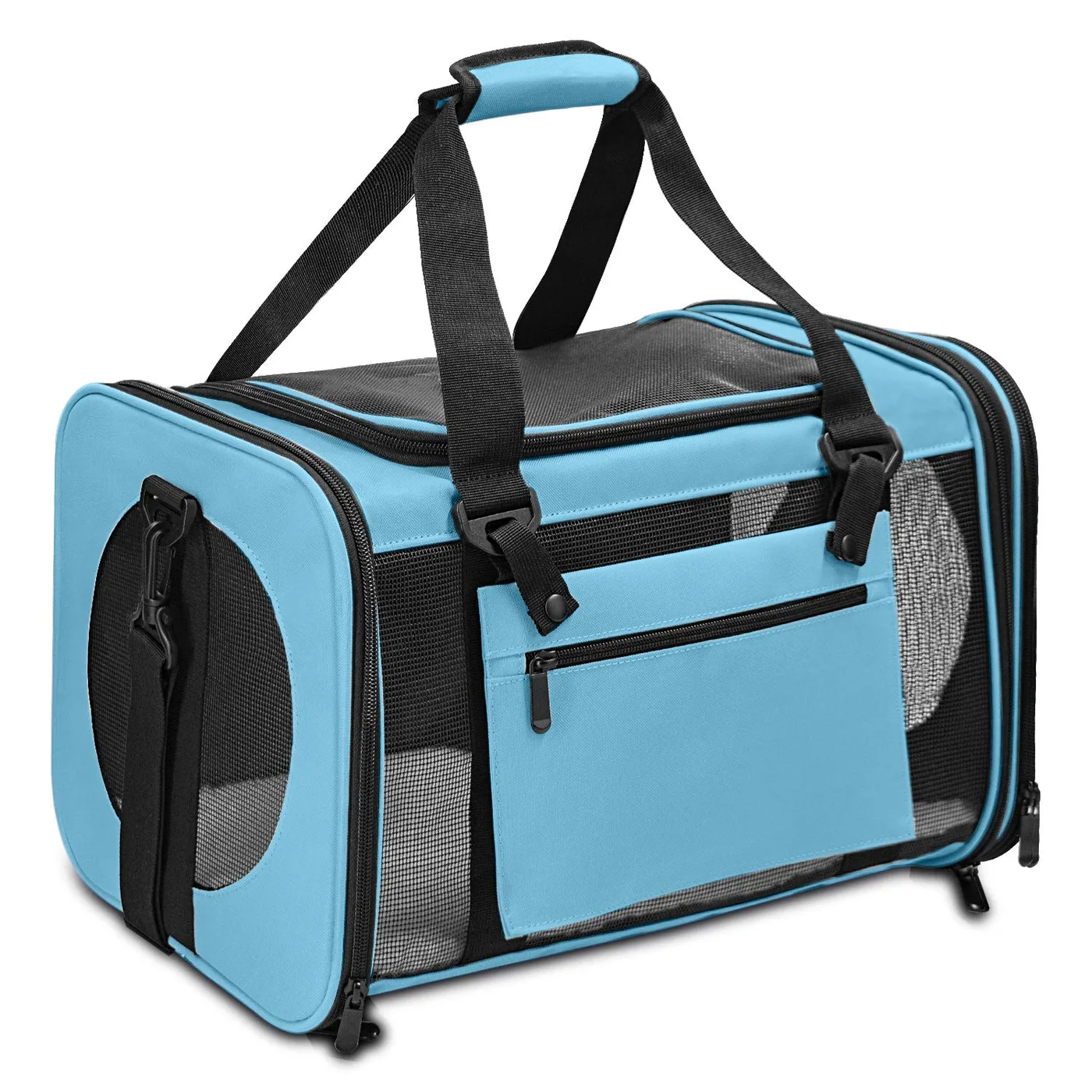
Reinforcement Details: Bar-Tack Length, Seam Allowance and Binding
Every pocket failure that reaches a warranty claim starts at a joint, not in the middle of a panel. The reinforcement specification is therefore the most consequential part of the pocket drawing. Corner joints where the gusset meets the shell are bar-tacked over a minimum of 12 mm with a bar-tack width matched to the seam width, using a dense zigzag or a dedicated bar-tack program at 8-10 stitches per millimetre. A 6 mm bar-tack on a pocket carrying 800 g is the single most common under-specification in this category.
Seam allowance is the second variable. Pocket-to-shell seams are loaded in peel, not in shear, which is unusual for a backpack and drives the allowance up: 12 mm minimum, folded and topstitched, rather than the 8 mm used on non-loaded decorative seams. Where the pocket upper edge is captured in the harness attachment seam, the allowance goes to 15 mm and the assembly is sewn in two passes so that the harness stitch line and the pocket stitch line are separated by at least 5 mm — stacked stitch lines on the same perforation path create a tear line.
Binding the mouth is a three-fold operation on woven shells and a two-fold operation on coated shells, and the difference is not cosmetic. Coated shells resist folding sharply and a three-fold binding creates bulk that will not feed under a standard binding attachment; forcing it produces skipped stitches at the fold. The correct approach is a two-fold binding with a 25 mm webbing insert, which also solves the abrasion problem at the same time.
Thread and needle selection complete the detail. Bonded polyester thread in Tex 40 for structure and Tex 30 for topstitching, an 18/110 needle for the bar-tack station and a 14/90 for the binding operation. Thread breaks at the bar-tack are usually a needle-heat problem rather than a thread-strength problem; dropping to a 16/100 with a silicone lubricant and reducing bar-tack speed to 1,500 spm resolves most of them without changing the specification.
Testing Pocket Integrity: Pull, Slosh, Abrasion and Drop
Four tests release a pocket design, and they are ordered so that each one exposes the assembly to the damage the previous one started. Static pull is first: the pocket is loaded to 2 kg, held for 24 hours at 23 °C, and the mouth opening and any joint displacement are measured. Acceptance is a permanent stretch of the mouth of no more than 3 mm and no visible distortion at any bar-tack. This test catches elastic that is too weak and seam allowances that are too narrow.
| Configuration | Gusset (mm) | Usable volume (L) | Closure | Test load | BOM add (USD) |
|---|---|---|---|---|---|
| Flat slip pocket, no gusset | 0 | 0.20-0.35 | None | 0.5 kg / 24 h | 0.15-0.25 |
| Elastic bottle pocket, 500 ml | 75-85 | 0.55-0.75 | 20 mm elastic | 0.8 kg / 24 h | 0.35-0.55 |
| Elastic bottle pocket, 1 L | 90-105 | 1.00-1.30 | 25 mm elastic | 1.2 kg / 24 h | 0.50-0.75 |
| Zippered valuables pocket | 50-60 | 0.45-0.70 | #5 coil zip | 5,000 cycles | 0.80-1.30 |
| Mesh drain pocket | 70-80 | 0.60-0.90 | Webbing-bound | 0.6 kg / 24 h | 0.30-0.50 |
| Buckle-strap utility pocket | 60-70 | 0.80-1.10 | 20 mm buckle | 150 N pull-off | 0.70-1.05 |
Slosh testing follows, and it is the one that separates a pocket that holds a bottle at rest from one that holds it while walking. The loaded carrier is mounted on a test fixture and cycled vertically at 1.5 G peak acceleration for 20,000 cycles, roughly equivalent to 10 km of brisk walking. Acceptance is zero ejection and no more than 10 mm of vertical migration of the object within the pocket. Bottles that migrate more than this either need a deeper gusset or a higher binding line.
Abrasion is run on the mouth only: 12,000 Martindale cycles against the pocket binding with the standard wool abradant, then inspection for pilling, fraying and exposure of the underlying shell. Drop testing closes the sequence — the loaded carrier is dropped six times from 600 mm onto a concrete surface in the orientations most likely to load the pocket, and the pocket seams and bar-tacks are inspected for any stitch breakage. Test methods and conditioning follow the general frameworks published by ASTM International, with textile components screened against OEKO-TEX criteria.
None of these tests are exotic, but running them in this order means a design that passes has been through the same damage sequence a real product sees, and the results are what supports a performance claim in retail copy.
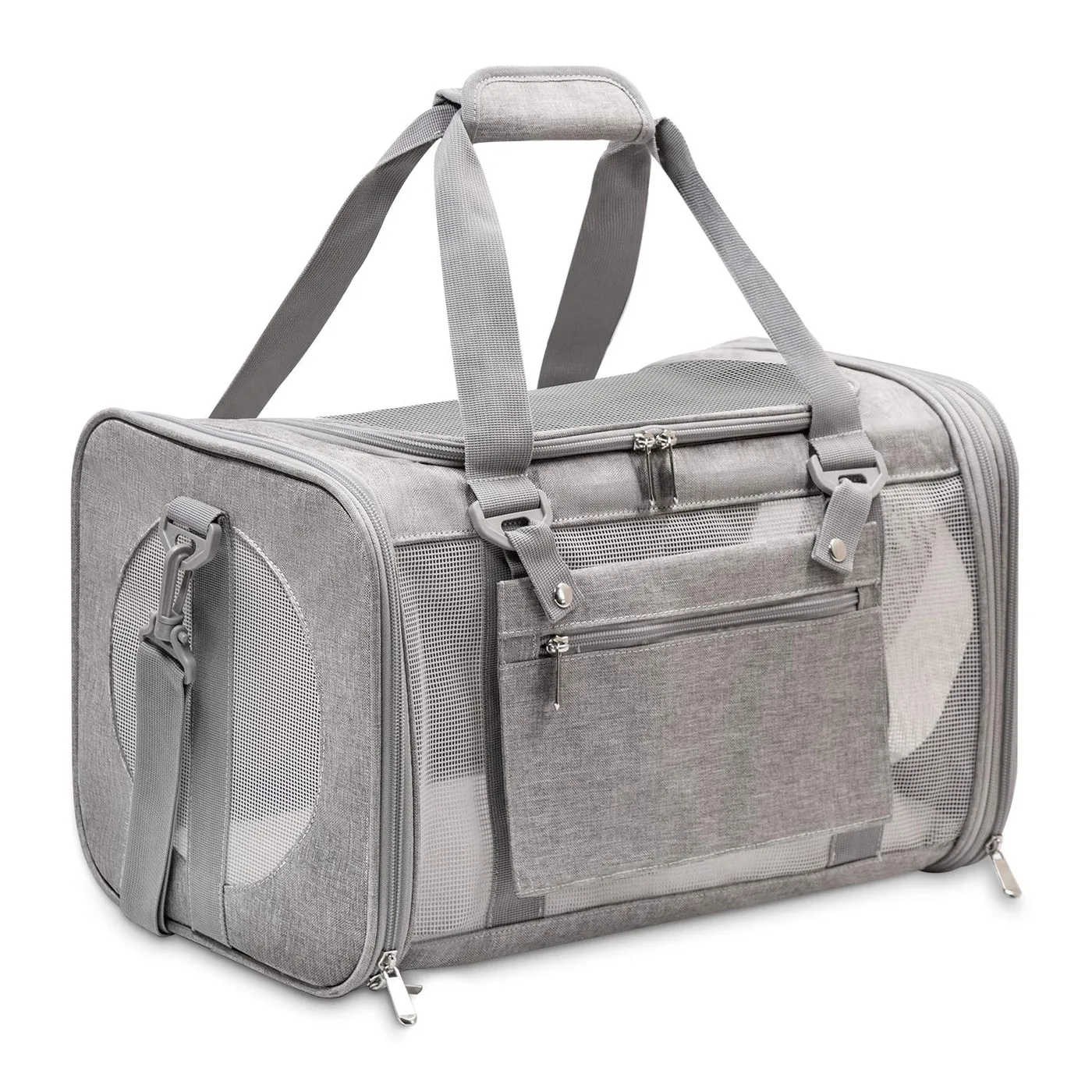
Manufacturability: Cutting, Sewing Sequence and Flat-Pack Impact
Pocket count drives sewing time more than almost any other feature on a carrier. A flat slip pocket adds roughly 45 seconds; an elastic bottle pocket with a bar-tacked gusset adds 150-190 seconds across cutting, binding, assembly and finishing. Two bottle pockets therefore add around six minutes of direct labour per unit, which on a 200,000-unit-per-month capacity plan is the difference between one line and one and a half lines for the same output.
Nesting efficiency is the hidden cost. Gusset pieces are small and irregular, and a pocket-heavy pattern can drop marker efficiency from 82% to 74%, adding several percent to fabric consumption even though the pockets themselves are minor. The fix is to design gussets as rectangles rather than as tapered shapes wherever the shell permits, accepting a slightly less refined curve in exchange for a marker that nests cleanly. Cutting with a straight-knife or an automated single-ply cutter changes this calculus: on automated cutting, irregular shapes cost nothing extra.
Sewing sequence matters for quality. Pockets should be assembled flat and joined to the shell before the compartment is closed, so that the bar-tack station has access to the joints. Attempting to add a pocket after closure is possible but requires a post-machine with a narrow arm, and the resulting stitch quality is visibly lower. For this reason a pocket added late in development — after the golden sample — frequently forces a partial re-engineering of the sequence rather than simply an extra operation.
Flat packing is the last manufacturability question. Carriers shipped flat for e-commerce fulfilment have pockets compressed under vacuum or strap pressure for weeks, and a gusset that holds its crease will arrive with a permanent fold. Testing flat-packed units after 30 days of compression, then hanging them for 24 hours and measuring recovery, is the only reliable way to know. Gussets in 600D polyester recover well; gussets with a heavy PVC coating recover poorly and should be avoided in flat-pack programs.
Cost, MOQ and Sampling for Pocket Configurations
Pocket configuration is a pricing decision as much as a design one. Each pocket adds material, components and labour: a flat slip pocket adds 0.15-0.25 USD, an elastic bottle pocket 0.35-0.75 USD, and a zippered pocket 0.80-1.30 USD depending on zipper grade and whether a storm flap is specified. On a carrier quoted at 12-16 USD FOB, moving from two flat pockets to two zippered pockets moves the unit price by roughly 8-12%, which is usually enough to change the retail price band.
MOQ interacts with pocket hardware rather than with pockets themselves. Custom-coloured elastic, branded zipper pulls and moulded buckles all carry component minimums, typically 3,000-5,000 pieces per colour, that sit above the program MOQ of 500 pieces per colourway. The resolution is to specify stock components in standard colours for the first two orders and move to custom components once annual volume justifies the buy. Brands that insist on a custom pull at 500 units usually pay for 5,000 and warehouse the balance.
Sampling follows the standard path and should be used to settle pocket geometry rather than to admire it. Prototypes arrive in 6-10 working days and should be evaluated with the actual objects the pocket is meant to carry — the specific bottle, bowl and pouch from the retail assortment — rather than with a convenient substitute. A pocket designed around a 68 mm bottle will not retain a 73 mm one, and that difference is invisible until the retail kit is finalised.
Bulk production runs 35-50 days after sample approval with final random inspection to AQL 2.5. Pocket defects are mostly visual and dimensional: bar-tack placement within ±2 mm, no skipped stitches in the binding, mouth circumference within ±4 mm of the pattern, and no asymmetry between left and right pockets beyond 3 mm. Writing those tolerances into the inspection sheet is what prevents the slow drift in pocket geometry that appears across a long production run. A pocket that is specified in millimetres and inspected in millimetres stays consistent from the first carton to the last.
Production capability
- SGS-verified production space of 4,950 m², 149 machines, 7 assembly lines
- Pet carrier and pet bag output since 2014 from a 137-person team
- 200,000 units shipped monthly under BSCI and ISO 9001 systems
People Also Ask
How wide should a side pocket gusset be for a 500 ml bottle?
Take the bottle diameter — typically 65-70 mm for a 500 ml PET bottle — and add 8-12 mm of ease, giving a gusset of 75-85 mm. Pocket height should be 25-35 mm shorter than the bottle so the bottle stands proud and can be grasped.
Do side pockets change how the carrier carries?
Yes. A single filled pocket moves the combined centre of gravity about 25-40 mm rearward and 15-25 mm off-axis on an 8 kg load, so pockets should be placed symmetrically even when only one is likely to be used.
Which lasts longer, elastic or zipper pocket closures?
They fail differently. Polyester-elastomer binding holds above 80% of initial force after 5,000 extension cycles, while a #5 coil zip is rated to 5,000 open-close cycles. Elastic suits cylindrical objects; zippers suit flat ones.
What bar-tack length should a pocket joint use?
A minimum of 12 mm with stitch density of 8-10 per millimetre. A 6 mm bar-tack on a pocket carrying 800 g is the most common under-specification in this category.
Can mesh pockets hold a water bottle?
No. Mesh at 250-300 g/m² drains well but snags on metal cap rings and carabiners within a few cycles. Use mesh for soft items and bind the mouth with webbing rather than folded fabric.
Why do pockets arrive creased from e-commerce fulfilment?
Flat-packed units compress gussets for weeks. Test after 30 days of compression plus 24 hours hanging. Polyester gussets recover well; heavy PVC-coated gussets recover poorly.
Frequently Asked Questions
What seam allowance is used on pocket-to-shell joints?
Pocket seams load in peel rather than shear, so the allowance is 12 mm minimum, folded and topstitched. Where the pocket edge is captured in the harness attachment seam, allowance rises to 15 mm and the two stitch lines stay at least 5 mm apart.
How much sewing time does a bottle pocket add?
Around 150-190 seconds per pocket across cutting, binding, assembly and finishing, against roughly 45 seconds for a flat slip pocket. Two bottle pockets add about six minutes of direct labour per unit.
How is pocket volume verified during development?
By water displacement with the closure engaged, not by geometric calculation. A pocket with a 90 mm mouth and 210 mm height has about 1.3 L nominal but around 0.9 L usable capacity.
What test proves a bottle will not fall out while walking?
Slosh testing: the loaded carrier is cycled vertically at 1.5 G peak acceleration for 20,000 cycles, roughly 10 km of brisk walking. Acceptance is zero ejection and no more than 10 mm of vertical migration.
Should pocket lining be coated or uncoated?
Coated 210D is better for pockets that may hold a wet bowl, paired with a sealed bottom seam and a 6 mm drain grommet on a 20 mm bonded backing patch. Uncoated nylon dries slowly and holds odour.
How far may a pocket bulge into the animal compartment?
Limit intrusion to 20-25 mm where interior width is already at the minimum for the target weight class, and use a flat spacer lining behind the pocket so the bulge cannot form a pressure point on the ribcage.
What needle and thread are specified for pocket assembly?
Bonded polyester Tex 40 for structure and Tex 30 for topstitching, an 18/110 needle at the bar-tack station and 14/90 for binding. Reducing bar-tack speed to 1,500 spm resolves most thread breaks.
Why do coated shells need a two-fold binding?
Coated shells resist sharp folding and a three-fold binding will not feed under a standard binding attachment, producing skipped stitches. A two-fold binding with a 25 mm webbing insert solves both the feed problem and mouth abrasion.
What tolerances apply to pocket inspection?
Bar-tack placement within ±2 mm, mouth circumference within ±4 mm of pattern, left-right asymmetry under 3 mm, and no skipped stitches in the binding, checked inside the AQL 2.5 plan.
Do custom pocket components raise the order minimum?
The program MOQ stays at 500 pieces per colourway, but custom elastic colours, branded pulls and moulded buckles carry component minimums of 3,000-5,000 pieces. Stock components are recommended for the first two orders.
How long do samples and bulk take for pocket designs?
Prototypes in 6-10 working days, evaluated with the actual retail bottle and bowl rather than substitutes. Bulk runs 35-50 days after approval, inspected to AQL 2.5 with T/T 30/70 and FOB Xiamen.
What colourfastness is required on pocket panels?
Crocking resistance to dry and wet rubbing at grade 4 or better. Mid-tone linings are specified in light-coloured carriers to avoid visible rub marks from hardware.
How does pocket count affect fabric consumption?
Irregular gusset shapes can drop marker efficiency from 82% to 74%. Rectangular gussets nest cleanly, and automated single-ply cutting removes the penalty entirely.
Talk to QUANZHOU JUNYUAN BAGS about a pet carrier program: MOQ 500 pieces per colourway, samples in 6-10 working days, bulk production in 35-50 days under AQL 2.5 inspection.
Get a free quote Request a sample