Pet Carrier Elevated Bowl: Neck Friendly
A 120-millimetre feeding height suits many small-dog elevated bowl programs, but the correct range is set from elbow height, carrier clearance and supervised posture trials. Keep the rim near 55-75% of standing elbow height, limit loaded stand deflection to 3 millimetres, and require the assembly to resist a 15-newton rim push without tipping. Describe posture and access results, not unproven medical benefits.
An elevated travel bowl is a structure, a food-contact vessel and a user-adjustment mechanism in one product. Engineering starts with representative standing geometry rather than a universal neck-friendly claim. The selected height must let the animal reach food without pressing its throat on a rim, while the stand must fit inside or beside the carrier and remain stable when the bowl is nearly empty. Frame span, foot polygon, centre of gravity and joint play determine tipping and rattle. The insert needs a controlled seat, safe rim, documented 304, 316 or food-contact polymer, and full removal for cleaning. Adjustable versions add pinch points, locking proof loads and misuse positions; folding versions add cycle life and assembly risk. Packaging must protect the bowl while exploiting a flat frame to reduce freight cube. Standard commercial terms are MOQ 500 pieces per colourway, samples in 6-10 working days, bulk production 35-50 days after written approval, and final random inspection to AQL 2.5. T/T 30/70 and FOB Xiamen apply. The specification below separates measurable ergonomic fit, structural integrity, food-contact documentation, sanitation, pack design and quality gates so buyers can approve evidence instead of relying on a lifestyle image.
Private label pet bags sit at the centre of most pet carrier accessory briefs we handle: the buyer owns the brand, the barcode and the artwork, while our production team holds the pattern.
Working Height From Elbow Reference and Carrier Clearance
Elevated bowl height should be selected from a defined animal group and use position. A practical starting point places the feeding rim at about 55-75% of standing elbow height for many dogs, then confirms reach on representative forms or supervised users. This is a product-fit heuristic, not a treatment recommendation, and different body proportions or clinical needs require professional advice.
For toy dogs, working heights of 60-100 millimetres cover many travel scenarios. Small dogs commonly use 100-150, medium dogs 150-240, and a broad cat platform may use only 40-80. The number is measured from the supporting floor to the food-side rim with the bowl seated and the frame loaded, not to an unloaded decorative top.
| User group | Elbow reference | Rim height | Bowl opening | Usable volume | Front clearance | Stand footprint |
|---|---|---|---|---|---|---|
| Cat | 90-140 mm | 40-80 mm | 120-145 mm | 300-500 mL | 45 mm | 190 × 180 mm |
| Toy dog | 130-190 mm | 60-100 mm | 125-155 mm | 400-650 mL | 55 mm | 220 × 200 mm |
| Small dog | 180-260 mm | 100-150 mm | 145-180 mm | 600-900 mL | 70 mm | 270 × 235 mm |
| Medium dog | 260-380 mm | 150-240 mm | 175-215 mm | 900-1,500 mL | 90 mm | 340 × 285 mm |
Carrier clearance sets an upper boundary. The animal needs room above and around the head, and a raised stand should not reduce turning area or block a door. Check the smallest nominated carrier with the bowl filled, the animal-form shoulder line marked and at least 20-30 millimetres around removable components.
Posture verification records neck angle, foreleg position, rim contact and food left inaccessible. A product may be described as elevated or designed for easier access when measurements support it; claims that it prevents joint, swallowing or digestive conditions need separate evidence and legal review. Rim height should be derived from a defined elbow-height range and validated inside the actual carrier, not assigned from pet weight alone.
Tipping Moment, Frame Deflection and Foot Polygon
Elevation increases the lever arm applied by a muzzle, so a stand that is stable at 60 millimetres may tip at 180 even with the same base. The relevant calculation compares the overturning moment at the rim with the restoring moment from the assembly mass and support polygon. Physical testing then captures floor softness, water movement and animal contact that a simple calculation omits.
A small elevated set can target resistance to a 15-newton horizontal rim force from four directions; a medium design may use 20-25. The assembly should slide before overturning where friction allows, and the opposite feet should not lift more than 5 millimetres at the proof load. Test at 25%, 50% and 100% fill because the light condition is usually worst.
Foot placement matters more than decorative bulk. Legs or pads should sit near the outer corners, with the front projection sufficient to oppose the expected muzzle direction. A rear-heavy frame can still tip forward. If a carrier strap anchors the stand, it is secondary retention and should not be used to disguise an unstable freestanding geometry.
Loaded deflection affects both posture and spill. Measure the rim at four quadrants under the full bowl plus a 20-newton vertical load. A maximum deflection of 3 millimetres and residual set below 1 millimetre are useful targets. Slender moulded columns need ribs aligned with the load path; metal tube frames need controlled weld or fastener play.
An inclined-plane check at 5 degrees adds a realistic uneven-floor condition. Water must remain below the spill lip at the marked fill and the frame must not creep more than the agreed distance. A stable elevated bowl is demonstrated by quantified rim-force, deflection and incline tests at low and full fill, not by the width of its base in a photograph.
Insert Seat, Rim Retention and Noise Control
The removable bowl-to-frame interface must achieve three opposing goals: easy lifting for cleaning, no release under carrier vibration and minimal rattle. A continuous tight fit rarely achieves all three because polymer shrink, metal roundness and temperature stack up. Three- or four-point seating with controlled resilient contacts is more repeatable.
For a stainless insert, radial clearance of 0.4-0.9 millimetres around the seat is a useful starting range. Silicone bumpers at three points locate the rim while allowing water to drain. A 10-18 millimetre seat depth resists lateral movement. A finger relief of 22-35 millimetres wide lets a user lift the insert without levering against a sharp edge.
Retention choices include gravity, flexible tabs, a twist lock and a removable crossbar. Gravity is the most cleanable but may release if the stand is carried assembled. Tabs can target 12-25 newtons of release force, measured after wash ageing. Twist locks are secure, although lugs and tracks require broad radii and full exposure when disassembled.
Rattle testing belongs in the assembled carrier. A four-hour packed vibration sequence is followed by inspection for polish marks, loose bumpers and seat wear. The bowl should not jump out, and any sound target should be measured at a defined microphone position rather than judged as quiet. Resilient contacts must touch before steel meets the rigid frame.
Never use an absorbent foam tape at the food-area seat. It traps water and loses compression; moulded silicone or TPR pads with visible drainage are preferable. A controlled multi-point seat with 0.4-0.9 millimetre clearance and aged release-force data prevents both an irritating rattle and a jammed bowl.
Food-Contact Insert and Frame Material Separation
The bowl insert is normally 304 stainless, 316 stainless or a declared food-contact polymer. Grade choice follows exposure: 304 covers ordinary dry food, wet food and water programs; 316 earns its premium under frequent chloride or coastal duty. A PP insert offers low mass and colour but needs exact resin, pigment and repeated-use migration evidence.
The frame may use PP, glass-filled nylon, coated steel, aluminium or bamboo composite. It can be classified as non-food-contact only when foreseeable food and splash remain within the removable insert. A low insert rim or open seat may allow wet food onto the frame; if the soil trial shows contact, that surface enters the food-contact assessment.
Stainless documentation should connect the finished article to heat number, grade verification, surface finishing and passivation. Polymer documentation covers grade, masterbatch, additives and mould release. Silicone feet or bowl bumpers need cure system, hardness and formulation control. A natural-colour declaration does not automatically qualify a dark or metallic pigment version.
Market substance review may draw on the authoritative chemical resources maintained by ECHA and the California lists published by OEHHA. Applicable migration limits, simulants and exposure conditions should be named in the lab request for the destination market and intended food.
Change control is essential in a mixed assembly. No steel grade, coating, resin, colorant, rubber compound, adhesive or cleaner should change without document review and risk-based retesting. Material separation is valid only when the actual elevated assembly keeps food within the documented insert under foreseeable filling, feeding and cleaning.
Adjustable and Folding Mechanisms Without Pinch Hazards
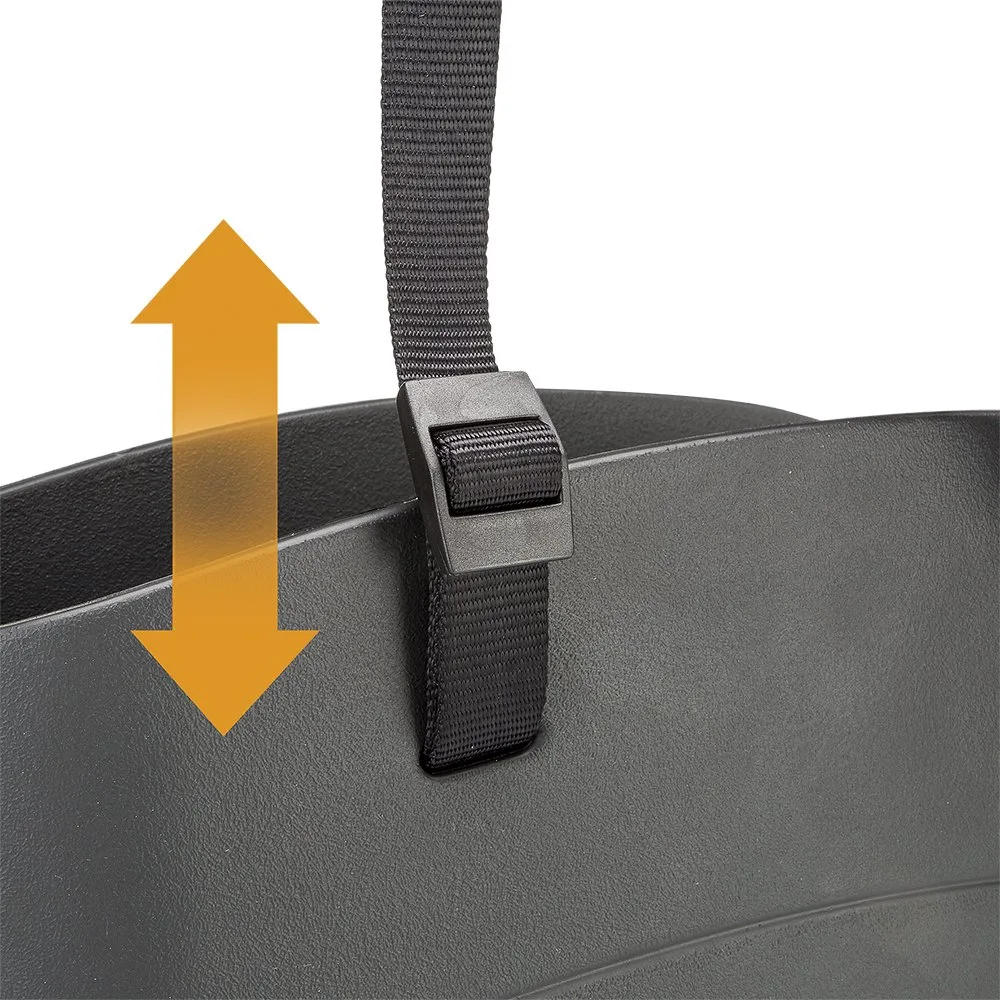
Height adjustment broadens the user range but creates joints, pinch points and incorrect settings. A two-position stand is often more reliable than a continuous telescopic column because each position can have a positive mechanical stop. The selected setting should be visible and should not depend only on friction that relaxes during washing or vibration.
Locking proof is applied at the worst extension. The frame carries the full bowl plus a vertical proof of at least twice the expected user contact load for ten seconds, with no release and residual height change below 1 millimetre. A separate 15-25 newton side load checks joint play. Buttons and latches should remain operable with wet fingers.
Pinch gaps change while a stand folds. Any accessible moving gap should either remain too small for contact, remain broad through the motion, or be shielded. The product instruction cannot substitute for removing an obvious shearing edge. Slow-close friction may improve feel, but it should not prevent full lock engagement.
Cycle testing should reproduce both clean and contaminated use. Operate the height or folding mechanism 5,000 times, including periodic water and dry-food dust exposure, then repeat proof load, release force and rattle checks. Metal pivots need corrosion evaluation where wash water collects; polymer hinges need whitening and crack inspection at the root.
Tool-free assembly reduces returns, but every loose fastener creates an omission risk. Captive screws, keyed legs and audible latches are preferable. If a user can assemble a leg backward, production should redesign the key rather than print a warning. An adjustable elevated bowl is robust when every position has a positive stop, measurable proof load and pinch-safe motion after 5,000 contaminated cycles.
Cleaning the Bowl, Stand and Hidden Interfaces
Raising a bowl adds surfaces beneath food that are easy to overlook. The insert must lift out completely, the seat must drain, and the stand should expose every splash path. An enclosed hollow leg or a decorative cap can collect wash water and create odour even when the bowl itself is spotless.
Design internal corners at 3 millimetres or more where a cloth or brush must pass. Bowl-support pads should be separated by visible drain gaps of 4-8 millimetres. A stand top can slope 1-2 degrees away from the central seat so water does not remain under the rim. Drain outlets should not empty into a carrier seam.
A soil-removal trial applies coloured protein-and-fat material to the insert rim, seat pads, latch and leg joints, lets it dry, then follows the labelled wash procedure. White-light and ultraviolet inspection after five cycles reveals residue. The product fails if disassembly requires a sharp tool or if a closed cavity retains water after the stated drain period.
Dishwasher claims should be component-specific. A stainless or PP insert may be top-rack safe while a bamboo composite or coated frame requires hand washing. The label and carton must say which part receives which treatment. Testing the complete stand at an insert's temperature can warp joints or damage coating.
Drying position should be illustrated. A removable bowl can stand on edge; a folding frame may need to open halfway so water leaves its pivots. Cleanability of an elevated feeder is governed by the seat, latch and leg cavities, because the removable food bowl is usually the easiest component to wash.
Flat-Pack Structure and Carton Volume Optimization
A raised frame ships air unless it folds, nests or assembles from flat components. For a stand 180 millimetres high with a 280 by 240 footprint, assembled retail cube may exceed 12 litres. Folding legs or a knock-down frame can reduce effective master-carton volume to 4.5-7.0 litres, a saving of roughly 40-60% after protective material.
The best pack architecture follows the product structure. The bowl nests in a protected column, frame tops stack with positive stops, and legs sit in a counted paper envelope or captive recess. Metal fasteners should not be loose inside stainless inserts. A pack-weight check can identify a missing leg or hardware set before sealing.
Flat packing moves work to the user, so assembly must be validated. A target of under three minutes, no more than six actions and no specialist tool is practical for travel accessories. Keyed parts, captive fasteners and clear line drawings reduce reversed legs. The fully assembled stand then receives the same proof and tip tests as a production-assembled unit.
Compression should transfer through strong frame zones, not through the food bowl rim or a locking button. Carton design uses actual nested production samples and a pallet pattern with less than 10% unused void. Warm-storage conditioning checks whether polymer legs creep when stacked for weeks.
Distribution trials can draw methods from ASTM International, but the protocol must state the chosen sequence and severity. Inspect for missing hardware, cosmetic contact, permanent leg set, assembly time and post-pack wobble. A folding or knock-down frame can remove 40-60% of carton cube only when assembly controls preserve the same structural performance as a fixed stand.
Pilot Validation, Inspection Plan and Order Terms
The first validation lot should include every height, bowl material and colour combination that changes fit or friction. A pilot of 30-80 units captures mould cavity, tube bend, fastener and assembly variation. Measurements include working height under load, footprint, rim level, insert clearance, release force, deflection, tip resistance, friction, drainage and pack volume.
Use limit samples alongside numbers. One sample represents maximum permitted joint play, one the minimum acceptable bowl-seat retention and one the cosmetic boundary for coating or polish. Inspectors can then make consistent decisions while variable measurements reveal trend. A visually attractive golden sample alone does not show where rejection begins.
Final random inspection at AQL 2.5 covers appearance, dimensions, assembly, function, marks and packaging. Sharp edges, locking collapse, wrong food-contact material and severe instability should be controlled under separately agreed critical criteria. Records can be organized within the process model described by ISO 9001, with product-specific values held in the signed control plan.
MOQ 500 pieces per colourway supports controlled material and finishing lots. Samples in 6-10 working days begin after height and bowl inputs are frozen; bulk production 35-50 days follows approved pre-production samples. T/T 30/70 and FOB Xiamen are written with the inspection and packing clauses.
Our production team coordinates carrier-fit trials and retains load data through the SGS-verified production base. A reorder cannot substitute a cheaper hinge, foot compound or bowl grade without review.
Any deviation approved during a pilot must state whether it is temporary or becomes a drawing revision. This distinction prevents a hand-adjusted sample from becoming an unwritten production standard. The release file should identify which stand height, insert diameter, foot compound, packing orientation and assembly instruction were tested together. When one element changes, the team repeats the affected checks rather than assuming the complete system remains qualified. A revised leg can alter footprint, a revised bumper can alter bowl height, and a revised carton can preload the folding joint. Recording those links keeps later reorders comparable and narrows corrective action to the affected lots.
Release depends on measured posture access, structural proof, food-contact traceability, complete cleaning and verified flat-pack recovery—not on an unsupported neck-health promise.
Size Labels, Use Instructions and Retail Claim Boundaries
A height program needs a selection system that a buyer can use without interpreting an engineering drawing. The retail panel should lead with measured rim height and bowl capacity, then give a suggested elbow-height band and minimum carrier floor area. Weight can appear as a secondary guide, but it should not be the only selector because body proportions vary widely within the same mass.
Measurement instructions must define the animal standing naturally on a level surface and the vertical distance from floor to elbow. A simple diagram can then map that result to the platform range. If the stand has two settings, both loaded rim heights should be printed; labels such as small and large are too vague. Product dimensions should include the feet, knobs and widest point so the buyer can verify door clearance.
Use instructions should separate assembly, adjustment, feeding and cleaning. Users need to hear or feel every latch engage, place the stand on a level carrier floor, fill only to the marked level and remove it before moving the carrier unless the exact restraint configuration was tested. An instruction to supervise first use helps identify an unsuitable height or a pet that pushes the structure unusually hard.
Claim language should stay within measured evidence. Elevated feeding position, defined rim height, stable-base result and easier reach for a tested form are product statements. Neck friendly may describe the intended design angle, but it should not promise prevention or treatment of orthopedic, swallowing or digestive conditions. Any stronger wellness statement requires a separate evidence plan and review in each sales market.
Label durability is part of the product. Height marks, load limits, lot code and material identification should remain legible after 100 wash or wipe cycles. Adhesive labels near a wet seat can peel into the food area, so permanent laser, moulded or protected markings are preferable. Printed packaging may carry the longer explanation, but essential warnings and setting identification should stay on the frame.
Translation control matters in multi-market orders. Numeric dimensions and pictograms reduce ambiguity, while every translated caution should be approved against the same master text and version. The carton, instruction sheet and online listing must use matching heights and capacities. Retail quality review should compare a physical production unit with every published diagram, because an old image can show a latch position, bowl depth or height setting that no longer matches the approved construction. This artwork-to-product audit is recorded before cartons are printed and repeated after every structural, dimensional or packaging revision. A responsible retail system tells the buyer how to measure, states actual loaded dimensions and limits comfort wording to the posture evidence the product can demonstrate.
Why brands source here
- Pet carrier programs run since 2014; founding team in sewn goods since 2004
- SGS-verified production floor of 4,950 m² with 137 workers across 7 lines
- Monthly capacity of 200,000 units, audited to BSCI and ISO 9001
People Also Ask
How high should an elevated pet bowl be?
A starting range is about 55-75% of standing elbow height, measured to the loaded bowl rim, then verified with representative posture trials inside the nominated carrier.
Are elevated bowls medically better for pets?
This product can demonstrate height, posture and access, but medical or disease-prevention benefits require separate evidence and professional, market-specific review.
How is an elevated bowl tested for stability?
Apply 15 N at the rim for small stands or 20-25 N for medium designs from four directions, at several fill levels and on a 5-degree incline.
What material should the removable bowl use?
Verified 304 stainless suits normal food and water; 316 suits repeated chloride exposure; declared food-contact PP reduces mass and supports colour.
How durable should a folding stand be?
Run about 5,000 fold or height-change cycles with periodic water and food dust, then repeat locking proof, joint play and rattle checks.
How much space does flat packing save?
A folding or knock-down stand can reduce effective master-carton cube by roughly 40-60% compared with shipping the elevated frame assembled.
Frequently Asked Questions
Why is pet weight alone insufficient for height selection?
Animals of equal weight can have very different leg and neck proportions. Standing elbow height and actual carrier clearance are more relevant dimensions.
What is loaded working height?
It is the floor-to-rim distance with the insert seated and filled, including any frame deflection rather than the unloaded catalogue dimension.
Why test stability when the bowl is nearly empty?
Food or water adds restoring mass. At 25% fill, the frame is more likely to slide, lift a foot or tip under muzzle force.
How much stand deflection is acceptable?
A useful target is no more than 3 mm under the full bowl plus a 20 N vertical load, with residual set below 1 mm.
How is bowl rattle reduced?
Use three or four silicone or TPR seating contacts that touch before metal reaches the rigid frame, with controlled radial clearance.
What insert release force works for flexible tabs?
About 12-25 N can balance one-hand removal against retention during vibration, subject to confirmation after wash ageing.
Can absorbent foam tape be used under the bowl?
It is not recommended because it traps water and loses compression. Moulded, drainable silicone or TPR pads are more controllable.
What creates a pinch hazard in a folding stand?
A moving gap that closes through finger or paw dimensions. Geometry should shield it or keep it safely narrow or broad throughout travel.
Should every component go in the dishwasher?
No. The insert may be top-rack safe while a coated metal, bamboo composite or jointed frame requires hand washing.
How can missing flat-pack parts be prevented?
Use captive hardware, counted envelopes, keyed recesses and a finished-pack weight check before carton sealing.
Why test a user-assembled stand again?
Assembly tolerance or a reversed part can change stability. The completed user configuration must meet the same proof and tip tests.
Which defects require tighter than normal AQL handling?
Sharp edges, lock collapse, wrong food-contact material and severe instability should use separately agreed critical acceptance rules.
Talk to QUANZHOU JUNYUAN BAGS about a pet carrier program: MOQ 500 pieces per colourway, samples in 6-10 working days, bulk production in 35-50 days under AQL 2.5 inspection.
Get a free quote Request a sample