Pet Carrier Leash: Matching Set
A matching leash is specified by five numbers: webbing tensile break of 2.4 kN minimum, handle seam strength of 1.2 kN, abrasion life of 25,000 Martindale cycles at the hook eye, 5,000 torsion cycles without kink, and reflective thread holding 120 cd/(lx.m²) after 20 washes. Width is 20-25 mm at 1.2-1.8 m.
A leash looks like the simplest product in the range and is one of the more demanding to specify, because it is the only item where the load path, the hand interface and the wear point are all in different places. The load path runs from the hook through the webbing to the handle; the hand interface is a foam or neoprene grip that has to be comfortable for an hour and strong enough to hold a load; and the wear point is the hook eye, where the webbing abrades against metal under every step of every walk. This page covers all three, plus the torsion behaviour that decides whether a leash lies flat or kinks, the reflective specification, and the test protocol with numeric thresholds. It also covers what a matching set adds to the specification and how it changes the ordering pattern. Commercial terms are standard: MOQ 500 pieces per colourway, prototypes in 6-10 working days, bulk production 35-50 days after sample approval, final random inspection to AQL 2.5.
Pet carrier OEM and ODM work on pet carrier accessory platforms splits at the pattern - OEM builds to your drawing, ODM adapts an existing platform and removes the tooling cost.
Length, Width and the Working Envelope
Leash length is a control problem before it is a preference. Too short and the animal is held at heel constantly, which is tiring for the handler and frustrating for the animal; too long and the handler cannot recover control quickly enough in traffic. The working envelope is set by the distance at which a handler can still react, which is roughly 1.4-2.0 seconds of reaction time at walking speed.
That gives the standard tiers. A 1.2 m lead is a traffic and training length, holding the animal within 0.6-0.9 m of the handler. A 1.8 m lead is the general-purpose length and the volume product. A 3.0 m lead is a training and recall length, and a 5.0 m or longer line is a tracking line rather than a walking lead and is specified differently.
Width follows the same logic as a collar: it is set by the load and by the hand, not by appearance. A 15 mm lead is adequate under 9 kg and uncomfortable to hold above that, because the grip pressure on the handler's hand rises as the width falls. A 20 mm lead covers 9-30 kg and a 25 mm lead covers 30-60 kg.
| Tier | Length | Width | Animal mass | Webbing mass | Total weight | Primary use | Share of range |
|---|---|---|---|---|---|---|---|
| Traffic | 1.2 m | 15-20 mm | Under 18 kg | 30-42 g/m | 52-88 g | Urban, training | 18-26% |
| General | 1.8 m | 20-25 mm | 9-45 kg | 34-52 g/m | 88-142 g | Daily walking | 48-58% |
| Long line | 3.0 m | 20-25 mm | 9-45 kg | 34-52 g/m | 142-214 g | Recall training | 12-20% |
| Tracking | 5.0-10.0 m | 20-25 mm | 18-60 kg | 38-58 g/m | 238-620 g | Field work | 4-9% |
| Hands-free waist | 1.4-2.0 m | 20-25 mm | 18-60 kg | 38-58 g/m | 168-268 g | Running, hiking | 6-12% |
| Double, coupler | 1.2-1.5 m | 15-20 mm | Two under 18 kg | 30-42 g/m | 96-158 g | Two animals | 3-7% |
Weight is specified because it is felt. A 1.8 m lead at 142 g is noticeably heavier in the hand after forty minutes than one at 88 g, and the difference is nearly all in the webbing linear mass. The specification therefore sets a maximum weight per tier as well as a minimum strength, which is what forces the tighter, lighter weave rather than a heavier one.
Length tolerance is tighter than buyers expect. A nominal 1.8 m lead is cut at plus or minus 15 mm, because a lead at 1.85 m behaves differently from one at 1.75 m in a heel position and because a set sold as matching has to look consistent on a display hook. Length is checked on a fixed jig rather than with a tape, at ten units per carton.
The working envelope also sets where a second handle goes. A traffic handle positioned 200-300 mm from the hook gives a handler a short grip in a confined space without changing the product, and it is the single most valued feature in the tier data above. It costs 0.14-0.32 USD in webbing and stitch.
Set length in tiers with a tolerance of plus or minus 15 mm, cap weight per tier, and place a traffic handle 200-300 mm from the hook.
Webbing Construction: Weave, Linear Mass and Abrasion Life
Webbing is the leash. Everything else is an attachment, and the webbing specification determines the strength, the weight, the hand feel and the service life. Three parameters describe it: weave structure, linear mass and the finish applied after weaving.
Weave structure decides how the webbing behaves under load and against metal. A flat tight weave lies flat, resists rolling and presents the full width to the hook eye. A looser weave is softer in the hand but rolls under load, which concentrates the contact at the eye onto a narrow band and accelerates wear. Tubular webbing is strongest per gram and softest, but it is bulky and it does not take a print well.
Linear mass is the practical control. A 20 mm polyester webbing runs 26-34 g/m in a standard weave and 34-44 g/m in a tight weave; a 25 mm runs 34-46 g/m and 44-58 g/m respectively. The tight weave costs 12-20% more and returns 25-40% more abrasion life, which is why it is specified on every lead above the economy tier.
| Construction | Width | Linear mass | Tensile break | Abrasion cycles | Roll under load | Cost (USD/m) | Verdict |
|---|---|---|---|---|---|---|---|
| Polyester, standard weave | 20 mm | 26-34 g/m | 5.4 kN | 14,000-22,000 | Moderate | 0.28-0.52 | Economy |
| Polyester, tight weave | 20 mm | 34-44 g/m | 6.7 kN | 22,000-34,000 | Low | 0.34-0.64 | Standard |
| Polyester, tight weave | 25 mm | 44-58 g/m | 8.9 kN | 26,000-40,000 | Low | 0.42-0.82 | Standard, large blocks |
| Polyester, tubular | 25 mm | 52-68 g/m | 11.2 kN | 30,000-46,000 | Very low | 0.58-1.10 | Premium, bulky |
| Recycled PET, tight weave | 20 mm | 36-46 g/m | 6.2 kN | 20,000-32,000 | Low | 0.52-0.96 | Sustainability briefs |
| Nylon 6.6, flat | 20 mm | 30-40 g/m | 7.4 kN | 18,000-28,000 | Moderate | 0.36-0.68 | Wet-strength penalty |
Abrasion life is measured at the hook eye, which is where the failure occurs, and the test is run with a grit challenge rather than clean. The webbing is cycled over a metal eye at 12 kPa for the stated number of cycles and the retained tensile strength is measured afterwards. Acceptance is 25,000 cycles with 80% or more of the original strength retained.
Finish is the variable that is easy to overlook. A resin finish stiffens the webbing and improves abrasion resistance by 15-25% but makes it harsher in the hand and slower to dry. A soft finish is comfortable but wears faster. The compromise used on this product is a light resin finish at 2-4% add-on, which is measurable and specified rather than left to the mill.
Wet behaviour matters for a product used in rain. Polyester loses 0-3% of its strength when saturated and nylon loses 10-15%, which is the reason the table shows polyester throughout and the reason wet tensile is tested as a separate line rather than assumed from the dry figure.
Specify a tight weave at 34-58 g/m with 25,000 grit-challenged abrasion cycles and 80% retained strength, and test wet tensile separately rather than assuming it.
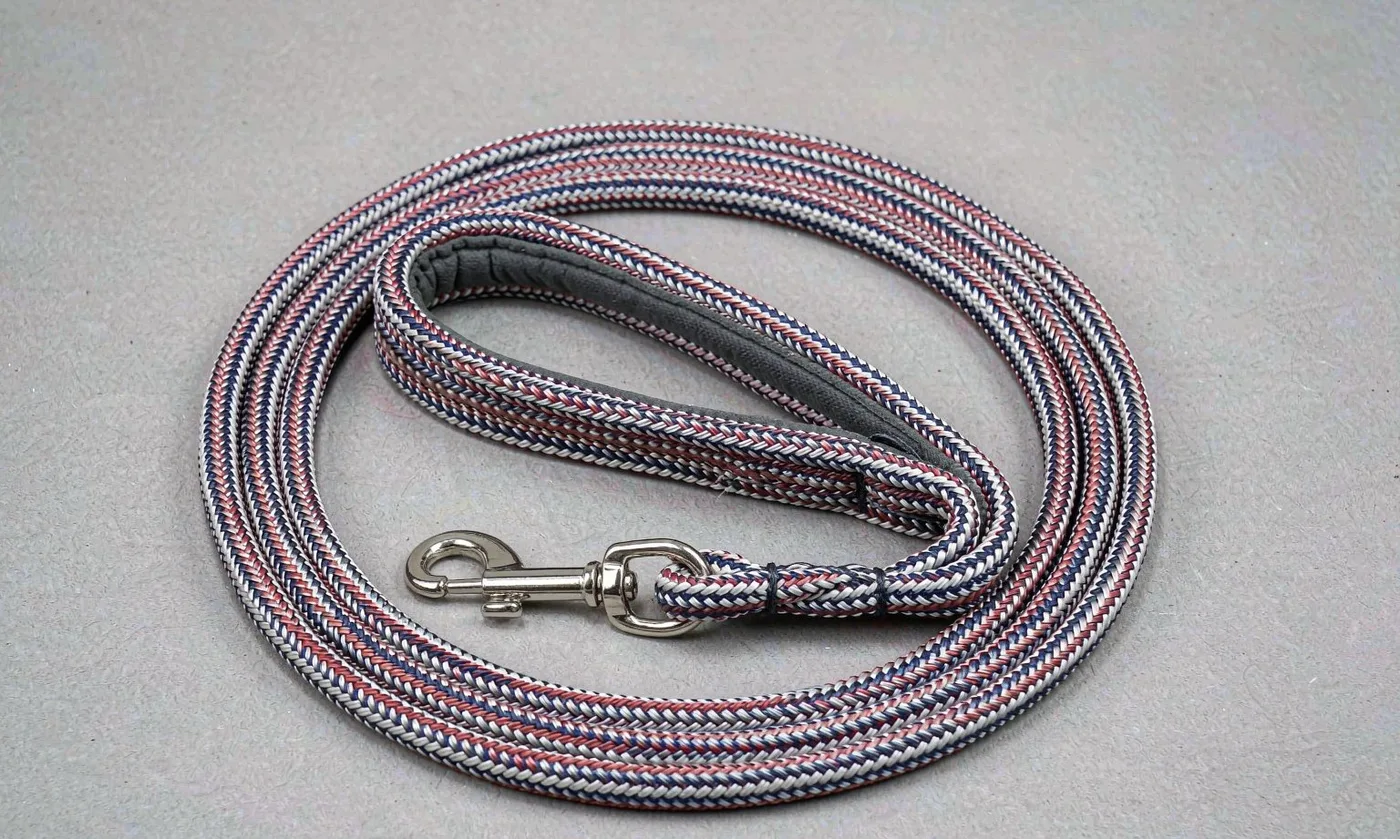
Handle Engineering: Foam, Neoprene and Grip Pressure
The handle is the interface the customer remembers, and it is specified by two quantities that pull against each other: grip comfort and seam strength. A thick soft pad is comfortable and weak at its attachment; a thin hard one is strong and causes pressure in the palm after twenty minutes.
Pad material is the first choice. Closed-cell foam at 45-70 kg/m³ is the volume answer, at 3-6 mm thickness and 0.14-0.34 USD. Neoprene at 3-5 mm is softer and grips better when wet, at 0.22-0.48 USD, and it is preferred on a hands-free or running product where the hand is sweaty. A gel insert is the most comfortable and the most expensive at 0.42-0.92 USD, and it is used only at the premium end.
Seam strength is the constraint the pad has to respect. The pad is closed over the webbing with a stitch group, and that group is loaded in a way the rest of the product is not: in shear, along its length, every time the handler holds the lead. Acceptance is 1.2 kN on the handle seam with slip under 8 mm at 0.6 kN.
| Construction | Pad material | Thickness | Grip pressure | Seam strength | Slip at 0.6 kN | Cost (USD) | Suits |
|---|---|---|---|---|---|---|---|
| Padded loop, single stitch | Foam 45 kg/m³ | 4 mm | 1.8-2.6 N/cm² | 0.9 kN | 12-20 mm | 0.16-0.32 | Below threshold |
| Padded loop, bar-tack | Foam 55 kg/m³ | 5 mm | 1.4-2.1 N/cm² | 1.3 kN | 4-8 mm | 0.24-0.46 | Standard |
| Padded loop, bound | Foam 65 kg/m³ | 6 mm | 1.1-1.7 N/cm² | 1.5 kN | 2-5 mm | 0.32-0.60 | Preferred |
| Neoprene sleeve | Neoprene 3 mm | 3 mm | 1.2-1.8 N/cm² | 1.2 kN | 5-9 mm | 0.28-0.56 | Wet-hand use |
| Gel insert, moulded | Gel plus TPE | 7 mm | 0.7-1.2 N/cm² | 1.4 kN | 3-6 mm | 0.52-1.04 | Premium |
| Unpadded, webbing fold | None | n/a | 3.1-4.4 N/cm² | 1.6 kN | Under 3 mm | 0.06-0.14 | Tracking lines only |
Grip pressure is measured with a pressure pad in the palm at a steady hold of 60 N, and acceptance is 2.1 N/cm² or less. The unpadded row shows why a bare webbing fold is only acceptable on a tracking line, where the lead is held loosely for most of its use and the load is intermittent.
Loop circumference is a fit item that is rarely specified and frequently wrong. A loop of 130-160 mm internal circumference suits most adult hands over a glove; below 120 mm it constricts the fingers and above 180 mm the hand slides. The loop is measured on a mandrel at incoming inspection rather than flat, because a flat measurement understates the usable circumference.
Moisture in the pad is a durability issue. A foam pad that absorbs water stays wet, becomes slippery and eventually delaminates from the webbing. Closed-cell foam at 2-4% water absorption is specified, and the pad is bonded to the webbing with a seam rather than an adhesive alone, so a delamination cannot propagate past the stitch line.
Specify a bound padded loop at 1.5 kN seam strength, grip pressure at or below 2.1 N/cm², and an internal loop circumference of 130-160 mm checked on a mandrel.
Hardware at Both Ends: Hook, Swivel and Traffic Handle
A leash has two ends and they are loaded differently. The hook end carries the full dynamic load of the animal and rotates constantly. The handle end carries the handler's hold and, in a hands-free configuration, the load of the body. Each is specified separately.
The hook is rated on its cross-gate figure, as elsewhere in this range: a bolt snap at 2.9 kN axially is a 0.9-1.6 kN component across the gate, and a leash is loaded off axis most of the time. For a general-purpose lead on a medium block the specification is 2.4 kN axial and 0.9 kN cross-gate minimum, rising to 4.6 and 1.6 on a large block.
A swivel at the hook end is standard rather than optional. The hook rotates through 180-360 degrees repeatedly, and without a swivel that rotation is taken up by the webbing, which twists, kinks and eventually loads the stitch group in torsion. A swivel rated at or above the hook costs 0.16-0.38 USD and removes the entire class of failure.
| Configuration | Hook rating | Swivel | Traffic handle | Weight | Cost (USD) | Suits |
|---|---|---|---|---|---|---|
| Bolt snap, no swivel | 2.9 kN | No | No | 18 g | 0.24-0.48 | Economy |
| Bolt snap plus swivel | 2.9 kN | Yes, 3.4 kN | No | 26 g | 0.40-0.78 | Standard |
| Bolt snap, swivel, traffic handle | 2.9 kN | Yes, 3.4 kN | Yes, at 250 mm | 34 g | 0.54-1.02 | Preferred, general |
| Twist-lock carabiner plus swivel | 5.2 kN | Yes, 5.6 kN | Yes, at 250 mm | 52 g | 0.94-1.86 | Large and strong animals |
| Double-ended coupler | 2.4 kN each | Yes, both | No | 44 g | 0.78-1.52 | Two animals |
| Waist belt plus shock section | 4.2 kN | Yes | Yes, at 300 mm | 128 g | 1.42-2.86 | Hands-free running |
Traffic handle placement is measured from the hook rather than from the middle, at 200-300 mm, because that is the distance a handler needs to bring an animal to heel in a doorway or at a kerb. It is closed with its own bar-tack group rated at 1.2 kN, and it is tested independently of the main handle because it is used differently.
A shock-absorbing section is the optional element and it is application-specific. On a hands-free running lead it reduces the peak transmitted to the handler's back, and it is specified as a bungee section with 15-25% extension rather than the 40-60% seen in cheap products, which introduces a bounce that is tiring over an hour. It is deliberately excluded from a general walking lead, where a consistent length is the point.
Hardware finish is matched to the coordinating item at Delta-E 1.2, measured against a retained master per plating load, and all fittings for a colourway are ordered in one load. The rule is the same as for a harness set and it exists for the same reason: two bath loads of gunmetal are visibly two colours.
Specify a swivelled bolt snap at 2.9 kN with a traffic handle at 200-300 mm from the hook, and restrict shock sections to hands-free products at 15-25% extension.
Torsion, Kinking and How a Leash Behaves in Use
Torsion is the failure mode that no static test predicts and every user notices. A leash that twists into a rope is unpleasant to hold, shortens itself, and eventually kinks permanently. The behaviour is a property of the webbing construction and of whether a swivel is fitted, and both are specified.
The mechanism is simple. An animal circling the handler puts a full turn of twist into the lead every circuit. With no swivel, that twist accumulates in the webbing; with a swivel, it is released at the hook. A lead without a swivel accumulates 6-14 turns in a twenty-minute walk, and at 8-12 turns a flat webbing begins to rope.
Roping is reversible and kinking is not. A roped webbing can be untwisted; a kinked one has taken a permanent set where the weave has been deformed, and it will not lie flat again. The transition is measured on a torsion rig: webbing is twisted under a 40 N tension to a specified number of turns, released, and measured for residual curl.
| Construction | Swivel | Turns accumulated | Residual curl | Kink onset | Recovery after 24 h | Verdict |
|---|---|---|---|---|---|---|
| Standard weave, flat | No | 9-14 | 18-28 degrees | 3,200 cycles | 52-68% | Fails |
| Standard weave, flat | Yes | 1-3 | 4-8 degrees | Above 12,000 | 88-96% | Acceptable |
| Tight weave, flat | No | 8-13 | 14-22 degrees | 4,600 cycles | 60-74% | Marginal |
| Tight weave, flat | Yes | 1-2 | 2-5 degrees | Above 15,000 | 94-99% | Preferred |
| Tubular | Yes | 1-2 | 1-3 degrees | Above 20,000 | 96-100% | Best, bulky |
| Resin-finished, tight weave | Yes | 1-2 | 3-6 degrees | Above 14,000 | 92-98% | Preferred |
The acceptance in this programme is 5,000 torsion cycles with residual curl of 8 degrees or less and 90% or better recovery after 24 hours relaxed. Only the swivelled configurations meet it, which is the empirical justification for making the swivel standard rather than optional.
Coil memory is the related property on a product that is stored coiled. A lead stored on a hook for months takes a set and does not hang straight. Memory is measured by coiling a lead around a 60 mm mandrel for 30 days at 25 degrees and measuring the residual curvature after release, with acceptance at 12 degrees or less per metre.
Cold behaviour is worth checking for a product sold in northern markets. Polyester webbing stiffens below freezing, and a lead that is supple at 20 degrees is boardy at minus 10. The specification requires full flexibility at minus 10 degrees after 4 hours of conditioning, tested by bending around a 100 mm mandrel with no cracking of the finish.
Fit a swivel as standard, accept 5,000 torsion cycles at 8 degrees residual curl or less, and require full flexibility at minus 10 degrees for cold-market programmes.
Reflective Thread, Piping and Night Visibility
Night visibility on a leash is achieved differently from a collar or a harness, because a leash is a long thin object seen edge-on rather than a broad surface seen face-on. What works is continuous running detail along the length, not a patch.
Reflective thread sewn along both edges is the most effective method and the least obtrusive. A reflective polyester thread gives 90-150 cd/(lx.m²) as sewn, and because it runs continuously the lead reads as a line of light from any angle. It is also the most durable option, because it is stitched into the construction rather than applied to it.
Applied piping is the alternative, at 220-330 cd/(lx.m²), and it is brighter but it stiffens the edge and it is the first thing to fail in the abrasion test at the hook eye. A printed reflective stripe is the cheapest and the least durable, losing 30-45% after 20 washes.
| Method | As-new | After 20 washes | Edge stiffness | Survives eye abrasion | Cost (USD/m) | Verdict |
|---|---|---|---|---|---|---|
| Reflective sewing thread, both edges | 90-150 cd/(lx.m²) | 88-96% retained | None | Yes | 0.06-0.14 | Preferred |
| Reflective yarn woven in | 70-120 cd/(lx.m²) | 90-98% retained | None | Yes | 0.12-0.26 | Preferred, integrated |
| Applied piping tape | 220-330 cd/(lx.m²) | 62-78% retained | Moderate | Peels at eye | 0.10-0.22 | Acceptable, avoid eye |
| Printed reflective stripe | 50-110 cd/(lx.m²) | 55-70% retained | None | Wears off at eye | 0.04-0.10 | Below threshold |
| Reflective webbing, full width | 180-280 cd/(lx.m²) | 74-86% retained | Slight | Yes | 0.34-0.68 | Premium |
| Clip-on reflective tag | 300-420 cd/(lx.m²) | n/a | n/a | n/a | 0.18-0.42 | Accessory only |
The specification is 120 cd/(lx.m²) after 20 domestic wash cycles, measured on a retroreflectometer at the standard geometry. Reflective sewing thread and woven-in yarn both meet it; printed stripes do not, which is why they are excluded from a programme making a visibility claim.
Abrasion at the hook eye is the reason several of the brighter options fail. The eye is a metal-on-fabric contact under constant micro-movement, and anything applied to the surface there is removed within weeks. Where piping or a reflective webbing is used, the reflective element is terminated 60-120 mm short of the eye and the last section is finished in plain webbing.
Stitch placement for reflective thread is a production detail with a real consequence. Running the reflective thread as the needle thread rather than the bobbin puts it on the upper face, which is the face that catches light. It also means two thread types on the machine, which adds 0.02-0.05 USD in setup and is worth it.
Use reflective sewing thread on both edges at 120 cd/(lx.m²) after 20 washes, and terminate any applied reflective 60-120 mm short of the hook eye.
Test Protocol with Numeric Thresholds
The leash protocol has eight checks and it is run per style and per size block, because the load conditions differ and because the handle and hook are specified per block. Total cost is 830-1,940 USD per style, running 16-30 working days.
Tensile on the assembly is the base check and it is performed wet as well as dry. The lead is pulled to destruction at 100 mm per minute with the hook engaged to a representative D-ring, and acceptance is 2.4 kN minimum on a medium block and 4.2 kN on a large one. Failure is required at the hook or its attachment rather than in the webbing mid-span.
The handle seam is tested separately in shear, because that is how it is loaded in use. A 0.6 kN load is held for 60 seconds with acceptance at 8 mm or less of slip, followed by a pull to destruction with acceptance at 1.2 kN.
| Test | Condition | Sample | Threshold | Failure sought | Cost (USD) |
|---|---|---|---|---|---|
| Assembly tensile, dry | 100 mm/min | 5 units | 2.4-4.2 kN by block | Mid-span webbing failure | 90-190 |
| Assembly tensile, wet | Saturated, 2 h | 3 units | 95% of dry figure | Wet strength loss | 60-130 |
| Handle seam shear | 0.6 kN, 60 s hold | 5 units | 8 mm slip, 1.2 kN break | Pad separation | 80-170 |
| Abrasion at eye | 12 kPa, grit challenge | 3 units | 25,000 cycles, 80% retained | Webbing thinning | 140-300 |
| Torsion cycling | 5,000 cycles, 40 N | 3 units | 8 degrees curl, 90% recovery | Kink and roping | 110-240 |
| Hook cross-gate | 90 degrees to axis | 5 units | 0.9-1.6 kN by block | Gate release | 90-190 |
| Retroreflection after 20 washes | Retroreflectometer | 3 units | 120 cd/(lx.m²) | Visibility loss | 60-140 |
| Colour fastness panel | Rub, wash, light | Per colourway | Grade 4, light 4-5 | Dye transfer to hand | 180-420 |
Wet tensile is included because the dry figure does not predict it. Polyester loses 0-3% when saturated and nylon loses 10-15%, so a programme that tests dry only and specifies nylon is shipping a lead that is materially weaker in the rain than the certificate says.
Colour fastness on a leash has a specific consequence: dye transfer to the handler's hand. A lead is held for an hour at a time, often with a warm and slightly damp hand, which is close to ideal conditions for dye migration. Perspiration fastness is therefore held at grade 4 and it is tested on the handle pad as well as on the webbing.
Chemical compliance is issued per colourway against OEKO-TEX criteria for the textile components and the REACH annex limits for the metal ones, with lead content checked to the 100 ppm limit under the consumer framework administered by the U.S. Consumer Product Safety Commission. Declarations for the metal components are issued against ECHA guidance, and test methods are referenced to ASTM International practice.
Test wet as well as dry, require failure at the hook rather than mid-span, and include perspiration fastness on the handle pad because it is held for an hour.
Set Coordination, Cost and Production Planning
A leash sold as part of a matching set carries one obligation beyond the product: it has to match the coordinating item under the lighting conditions where they are seen together. That obligation changes the ordering pattern more than the specification.
The target is Delta-E 1.5 between leash webbing, harness fabric and carrier shell under three illuminants, with hardware at Delta-E 1.2. A leash is the easiest component to match and the easiest to get wrong, because it is usually a webbing while the coordinating item is a fabric, and the two take dye differently.
The ordering rule that solves it is a single dye lot per colourway across all set components. Webbing ordered with the harness fabric from the same approved lot achieves Delta-E 0.4-0.9; ordered separately to the same specification it achieves 0.9-1.8, which is outside the target on the wide end.
| Element | 500 units | 2,000 units | 5,000 units | Note |
|---|---|---|---|---|
| Webbing, 1.8 m at 20 mm | 0.62-1.16 | 0.50-0.94 | 0.42-0.80 | Tight weave, 34-44 g/m |
| Handle pad and stitch | 0.32-0.60 | 0.26-0.48 | 0.22-0.40 | Bound, foam 55-65 kg/m³ |
| Hook plus swivel | 0.40-0.78 | 0.33-0.64 | 0.28-0.54 | Bolt snap, steel |
| Traffic handle | 0.14-0.32 | 0.12-0.26 | 0.10-0.22 | At 250 mm from hook |
| Reflective thread | 0.11-0.25 | 0.09-0.20 | 0.08-0.17 | Both edges |
| Labour | 0.48-0.94 | 0.40-0.76 | 0.34-0.64 | Cut, seal, stitch, pack |
| Content subtotal | 2.07-4.05 | 1.70-3.28 | 1.44-2.77 | |
| Amortised engineering | 1.66-3.88 | 0.42-0.97 | 0.17-0.39 | Dips, tooling, testing |
| Landed unit cost | 3.73-7.93 | 2.12-4.25 | 1.61-3.16 | Before duty and freight |
Scheduling follows the standard structure and the critical path is the hardware. Webbing runs 14-26 days, hardware 18-30 days, and the hook is ordered at sample approval rather than at bulk start because a rejected hook lot has no recovery time inside a 35-50 day production window. Sampling takes 6-10 working days and final random inspection runs to AQL 2.5.
Set packing is the last step and it is where a coordination failure is caught. Pairs are assembled from one dye lot and checked side by side under a D65 booth at 800-1,200 lux, taking 8-14 seconds per set at 0.18-0.44 USD. A pair showing a visible difference is split and re-matched rather than shipped.
Inspection classification puts hook function, handle seam integrity and length into the critical class, and colour match into the major class. Within the standard production window the programme is planned backwards from the packing date, and the production team holds lot records and one retained unit per lot for 24 months.
Order all set webbing from one approved dye lot, order hooks at sample approval, and check pairs under D65 at packing before they are bagged.
Production capability
- SGS-verified production space of 4,950 m², 149 machines, 7 assembly lines
- Pet carrier and pet bag output since 2014 from a 137-person team
- 200,000 units shipped monthly under BSCI and ISO 9001 systems
People Also Ask
What tensile strength should a dog leash have?
2.4 kN minimum on a medium block and 4.2 kN on a large one, measured as an assembly with the hook engaged, wet as well as dry. Failure should occur at the hook rather than mid-span.
How long should a standard walking leash be?
1.8 m for daily walking, with 1.2 m for traffic and training and 3.0 m for recall work. Tolerance is plus or minus 15 mm so a set looks consistent on a display hook.
Why does a leash need a swivel at the hook?
Without one the lead accumulates 6-14 turns of twist in a twenty-minute walk and ropes at 8-12 turns. With a swivel it accumulates 1-3 turns and residual curl stays under 8 degrees.
How strong does the handle seam need to be?
1.2 kN at break with slip under 8 mm at a 0.6 kN hold for 60 seconds. The seam is loaded in shear every time the handler holds the lead.
What abrasion life should leash webbing have?
25,000 Martindale cycles at the hook eye with a grit challenge, retaining 80% or more of original strength. A tight weave returns 25-40% more life than a standard one.
Where should a traffic handle be placed?
200-300 mm from the hook, measured from the hook rather than from the middle, closed with its own bar-tack group rated at 1.2 kN.
How much reflective performance should a leash carry?
120 cd/(lx.m²) after 20 washes, best achieved with reflective sewing thread on both edges at 90-150 as new and 88-96% retained.
Why is wet tensile tested separately?
Polyester loses 0-3% of strength when saturated and nylon loses 10-15%, so a dry-only certificate overstates the strength of a nylon lead in the rain.
Frequently Asked Questions
What determines the working envelope for leash length?
Handler reaction time of roughly 1.4-2.0 seconds at walking speed, which sets 1.4-2.0 m as the distance at which control can still be recovered in traffic.
Why is width graded by animal mass?
Grip pressure on the handler's hand rises as width falls. A 15 mm lead suits under 9 kg, 20 mm covers 9-30 kg and 25 mm covers 30-60 kg.
Why is weight capped as well as strength specified?
A 1.8 m lead at 142 g is noticeably heavier after forty minutes than one at 88 g, and the difference is nearly all in the webbing linear mass.
What is the difference between roping and kinking?
Roping is reversible accumulation of twist; kinking is a permanent set where the weave has deformed. On a torsion rig, kink onset arrives at 3,200 cycles without a swivel and above 15,000 with one.
How is coil memory measured?
By coiling around a 60 mm mandrel for 30 days at 25 degrees and measuring residual curvature after release, with acceptance at 12 degrees or less per metre.
What cold-temperature requirement applies?
Full flexibility at minus 10 degrees after 4 hours of conditioning, tested by bending around a 100 mm mandrel with no cracking of the finish.
Why is applied piping kept away from the hook eye?
The eye is a metal-on-fabric contact under constant micro-movement and removes anything applied to the surface within weeks. Reflective elements terminate 60-120 mm short.
Why is reflective thread run as the needle thread?
It then sits on the upper face, which is the face that catches light. Running two thread types adds 0.02-0.05 USD in setup and is worth it.
What makes a closed-cell foam pad preferable?
Water absorption of 2-4% against an open-cell pad that stays wet, becomes slippery and delaminates. The pad is also seamed rather than bonded alone so delamination cannot propagate.
How is handle loop circumference checked?
On a mandrel rather than flat, because a flat measurement understates usable circumference. The target is 130-160 mm internal.
When is a shock-absorbing section appropriate?
On a hands-free running lead, at 15-25% extension. It is excluded from general walking leads, where consistent length is the point, and 40-60% bungee introduces a tiring bounce.
Why is perspiration fastness tested on a leash?
The lead is held for an hour with a warm, slightly damp hand, which is close to ideal conditions for dye migration to the handler. Grade 4 is required on the pad as well as the webbing.
Why is the hook ordered at sample approval rather than bulk start?
An 18-30 day hardware lead against a 35-50 day production window leaves no recovery time for a rejected lot.
What defect class does colour match fall into?
Major, while hook function, handle seam integrity and length are critical. A lead one shade off is a commercial defect; one with a weak handle seam is a safety defect.
Talk to QUANZHOU JUNYUAN BAGS about a pet carrier program: MOQ 500 pieces per colourway, samples in 6-10 working days, bulk production in 35-50 days under AQL 2.5 inspection.
Get a free quote Request a sample