Pet Carrier Toy Holder: Entertainment
A toy holder is a load path between a moving animal and a carrier panel. Specify elastic cord with 8-14 N extension at 150% stretch, a break strength of 180-420 N at the joint, and stainless or aluminium hardware. Validate 10,000 extension cycles and a 60-second chew hold at 220 N.
Of every small accessory on a carrier programme, the toy holder carries the most unpredictable load, because the load is an animal pulling in a direction nobody designed for. That makes it a structural part wearing the costume of a soft good, and it should be engineered as one. This page sets out the load path from the toy to the carrier panel, the elastic specifications that keep tension useful without becoming a hazard, the joint strength required so that failure happens at a replaceable component rather than at the bag, and the cycle fatigue testing that predicts whether the holder survives a season of daily use. It also covers chew resistance as a measured property rather than a marketing word, the hardware choice between zinc alloy, stainless and aluminium, and the entanglement and small-part considerations that make this the one accessory on the range with a genuine safety case. Commercial terms follow the standard accessory programme: MOQ 500 pieces per colourway, prototypes in 6-10 working days, bulk production 35-50 days after sample approval, final random inspection to AQL 2.5, T/T 30/70 and FOB Xiamen.
Audit records from a dog carrier factory remain the fastest way to separate a real pet carrier accessory production base from a trading office with a photo catalogue.
The Load Path: From Toy to Carrier Panel
A toy holder looks like a strap with a clip on each end. Structurally it is a chain of five elements in series: the toy attachment, the elastic or webbing span, the mid-point hardware if there is one, the panel attachment, and the panel fabric itself. The assembly is only as strong as the weakest element, and the specification should decide which element that is.
That decision is deliberate rather than accidental. The correct design puts the weakest element at the toy end or at a replaceable mid-point component, so that a failure costs a 0.30 USD part and not a carrier. A holder whose panel attachment is stronger than the panel fabric will tear the bag, which is the outcome to design out.
Load is not steady. A dog pulling on a toy applies a static pull of 40-120 N depending on size, but the real load is impulsive: a head shake delivers a peak of 180-420 N over 80-200 milliseconds. Static testing alone will pass a holder that fails in the first week.
| Animal | Static pull (N) | Shake peak (N) | Peak duration (ms) | Cycles per session | Design load (N) |
|---|---|---|---|---|---|
| Cat, 3-6 kg | 20-45 | 60-140 | 60-140 | 40-120 | 140 |
| Small dog, 4-10 kg | 40-90 | 120-260 | 80-180 | 80-260 | 260 |
| Medium dog, 10-22 kg | 70-150 | 200-380 | 90-200 | 120-380 | 380 |
| Large dog, 22-40 kg | 110-220 | 300-540 | 100-220 | 150-450 | 540 |
Angle is the variable that defeats most designs. A holder loaded in line with its webbing carries its full rated strength. The same holder loaded at 45 degrees carries 62-74% of it, and at 90 degrees through the hardware it carries 38-55%. Because an animal pulls in whatever direction it likes, the specification should be written at 45 degrees, not in line.
The panel side of the load path is usually the unexamined half. A 260 N load applied to a single bar-tack on a 420D panel produces a peel force that exceeds the fabric tear strength of 180-320 N, so the panel tears before the holder fails. The fix is to distribute: a webbing ladder or a reinforcement patch of 60-90 mm square raises the panel capacity to 420-780 N.
Redundancy is cheap insurance on this product. A holder with two attachment points rather than one halves the load on each, and if one fails the other holds the toy long enough to be noticed. It costs 0.06-0.18 USD and it converts a sudden failure into a visible one.
Specify the load path at 45 degrees, not in line, and put the deliberate weak point at the toy end: the same holder rated 380 N in line carries 236-282 N at the angle an animal actually pulls.
Elastic Cord and Webbing: Extension, Recovery and Set
Elastic is used in a toy holder for a specific reason: it keeps tension on the toy so the animal stays engaged, while absorbing the impulsive peak that would otherwise go straight into the panel. Getting the extension curve right is the difference between a holder that works and one that is either dead or dangerous.
The specification is a force at a defined extension, not a length. The working target is 8-14 N at 150% of relaxed length for a small to medium dog, and 14-24 N for a large dog. Below 6 N the toy hangs slack and the animal loses interest; above 30 N the holder becomes a shock cord that snaps back hard enough to be a hazard.
Cord construction drives the curve. A braided polyester sheath over a latex core gives a smooth, progressive curve and good UV resistance, and it is the standard for this product. A bare latex cord is cheaper and degrades in 6-14 months of outdoor UV exposure. A woven elastic webbing gives a flatter curve and is used where a flat profile is needed against the body.
| Cord | Diameter (mm) | Force at 150% (N) | Break load (N) | UV life (months) | Cost (USD/m) |
|---|---|---|---|---|---|
| Braided polyester over latex, 4 mm | 4.0 | 6-10 | 180-320 | 24-48 | 0.22-0.42 |
| Braided polyester over latex, 6 mm | 6.0 | 12-20 | 320-560 | 24-48 | 0.32-0.62 |
| Braided polyester over latex, 8 mm | 8.0 | 20-34 | 520-880 | 24-48 | 0.48-0.92 |
| Bare latex cord, 6 mm | 6.0 | 10-18 | 240-420 | 6-14 | 0.12-0.26 |
| Woven elastic webbing, 25 mm | n/a | 14-26 | 420-720 | 18-36 | 0.38-0.78 |
| Non-elastic webbing, 20 mm | n/a | n/a | 600-1,200 | 36-72 | 0.14-0.30 |
Permanent set is the property that decides service life. A quality braided cord stretched to 150% for 1,000 hours recovers to a set of 4-9%. A cheap cord recovers to 18-32%, which means the holder is visibly stretched and slack within two months. The specification should state a maximum set of 10% after 1,000 hours at 150% extension.
Extension limit is a safety feature, not a convenience. An elastic cord that can be stretched to 300% stores enough energy to be dangerous if it fails. A mechanical travel limiter — a non-elastic webbing span in series that reaches its full length at 160-180% cord extension — caps the stored energy and costs 0.05-0.12 USD.
Covering matters for chew resistance and for UV. A braided polyester sheath of 0.6-1.0 mm wall over the latex core resists a single tooth penetration for 4-12 seconds, which is often long enough for the animal to lose interest. The same sheath with a UV-stabilised yarn lasts 24-48 months outdoors against 6-14 for an unstabilised one.
Specify force at extension, not length: 12-20 N at 150% from a 6 mm braided cord, with a maximum set of 10% after 1,000 hours and a travel limiter at 160-180%.
Grip Interfaces: Clip, Loop, Snap Hook and Sleeve
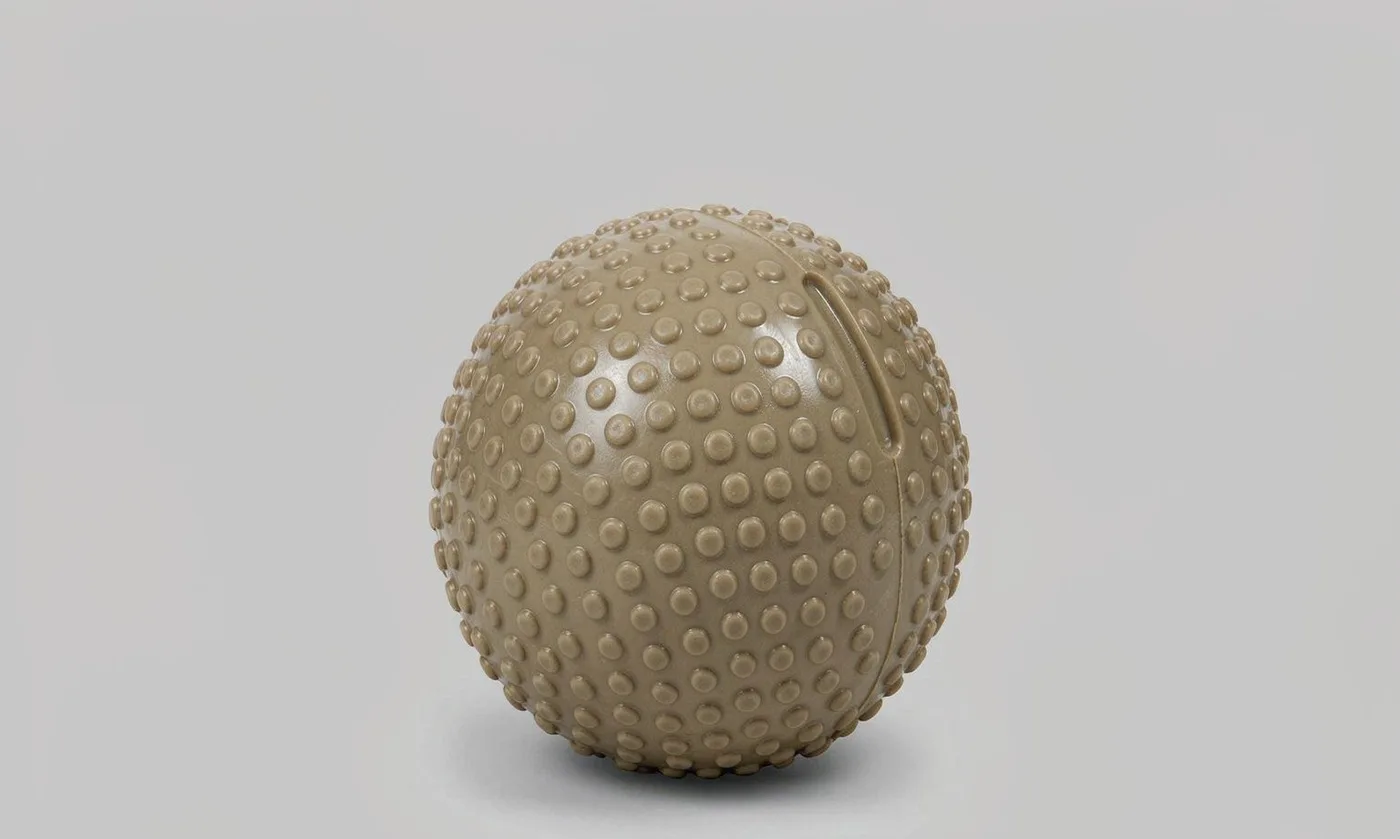
The toy end of the holder has to grip something with no standard shape, which is the hardest interface problem in the accessory range. Four methods are in production: a snap hook through a toy's own loop, a cinch loop that tightens on a shaft, a moulded sleeve that grips a ball, and a hook-and-loop wrap for plush toys.
A snap hook is the most versatile and the most likely to open unintentionally. A hook with a spring gate rated to 0.3-0.6 kN costs 0.14-0.38 USD and opens under a sideways load of 40-90 N, which an animal can generate. A twist-lock or screw-gate hook does not open unintentionally, costs 0.32-0.85 USD, and needs two hands.
A cinch loop is the most secure and the least versatile. A loop of 4 mm cord with a sliding cord lock grips anything from a 12 mm shaft to a 70 mm ball, and it tightens under load, which is exactly the behaviour wanted. Its weakness is that a determined animal can undo the cord lock in 20-90 seconds.
| Interface | Grip range (mm) | Retention at 200 N | Unintentional release | Cycles | Cost (USD) |
|---|---|---|---|---|---|
| Spring snap hook, 0.4 kN | Loops only | 94-99% | Yes, at 40-90 N side load | 15,000-40,000 | 0.14-0.38 |
| Twist-lock hook, 0.6 kN | Loops only | 99-100% | No | 20,000-50,000 | 0.32-0.85 |
| Cinch loop with cord lock | 12-70 | 96-100% | No | 3,000-9,000 | 0.10-0.24 |
| Moulded TPE sleeve | 45-80 ball | 88-96% | No | 2,000-6,000 | 0.22-0.48 |
| Hook-and-loop wrap, 25 mm | Any soft toy | 72-88% | No | 4,000-12,000 | 0.08-0.20 |
Hook-and-loop deserves a specific note because it is the cheapest and the most frequently mis-specified. A 25 mm wrap with a standard nylon hook tape gives a peel strength of 8-22 N and a shear strength of 60-140 N, which is marginal at the design load. A moulded hook tape gives 18-42 N peel and 140-320 N shear at 0.05-0.11 USD more, and it is the only version worth specifying on a load path.
The interface should be replaceable independently of the span. A holder built with the hook sewn into the webbing requires the whole holder to be replaced when the hook wears at 15,000-40,000 cycles. A holder with a webbing loop and a separate hook lets the hook be swapped, at an incremental cost of 0.04-0.09 USD and a spare-part revenue line.
Standardising the toy end across the range is the commercial version of this decision. One hook specification across the toy holder, the tether and the leash clip means one hardware purchase, one spare-part stock and one test report, and it is the reason most programmes converge on a single 0.4 kN spring hook.
A webbing loop with a separate 0.4 kN spring hook lets the wear item be replaced without discarding the holder, for 0.04-0.09 USD more than sewing the hook in permanently.
Chew Resistance: Tension, Shear and Tooth Penetration
Chew resistance is a word used loosely and it should be three measured numbers: the tension the assembly holds without joint failure, the shear it takes at a stitched or welded joint, and the time a covering resists penetration by a single tooth. All three are testable on a tensile frame and none of them is expensive.
Tension is the straightforward one. The assembly is gripped at both ends and pulled at a 100 mm per minute crosshead speed. The acceptance figure depends on the animal: 180 N for a cat or small dog, 320 N for a medium dog and 480 N for a large dog. Failure should occur at the toy-end hardware or at a deliberate weak point, never at the panel attachment.
Shear is the test that catches the real failure. A stitched joint loaded in shear at 90 degrees to the stitch line carries 38-55% of its tensile figure, and an animal chewing sideways produces exactly that loading. A joint rated 320 N in tension must be re-tested in shear with an acceptance of 122-176 N.
| Covering | Wall (mm) | Time to penetration (s) | Tension hold (N) | Shear hold (N) | Verdict |
|---|---|---|---|---|---|
| Braided polyester sheath, UV stabilised | 0.8 | 4-12 | 320-560 | 122-308 | Pass, medium dog |
| Braided polyester sheath, standard | 0.6 | 2-7 | 240-420 | 91-231 | Pass, small dog |
| Bare latex core | n/a | Under 1 | 240-420 | 91-231 | Fail |
| TPE sleeve over cord | 1.5 | 12-38 | 380-680 | 145-374 | Pass, large dog |
| 25 mm nylon webbing | 1.2 | 18-55 | 600-1,200 | 228-660 | Pass, all sizes |
| Nylon webbing plus TPE sleeve | 1.2 plus 1.5 | 40-110 | 600-1,200 | 228-660 | Exceeds spec |
Penetration testing uses a standardised fixture: a single tooth form of 4 mm radius loaded to 220 N against the covering, held for 60 seconds, with the criterion being no penetration through to the load-bearing core. A braided sheath resists 4-12 seconds at that load; a TPE sleeve of 1.5 mm resists 12-38 seconds.
The important conclusion from that table is that no soft covering is chew-proof, and the product should never be marketed as such. What a covering buys is time: long enough for a supervised animal to lose interest, and long enough for an unsupervised one to be noticed. The specification should state a penetration time, not an absolute claim.
The design consequence is that the toy holder is a supervised-use product, and the instruction sheet has to say so. That is a documentation item costing nothing, and it is the correct answer to the liability question rather than an over-specified covering.
No soft covering is chew-proof: a 0.8 mm braided sheath resists a 220 N tooth for 4-12 seconds, and the honest specification is a penetration time plus a supervised-use instruction, not an absolute claim.
Cycle Fatigue: 10,000 Extensions and Elastic Recovery
A toy holder is cycled more than any other accessory on the range — hundreds of times in a single session, tens of thousands over a season. Fatigue, not static strength, is what determines whether it survives, and fatigue is the test most accessory programmes never run.
The protocol is a fixture that extends the assembly to 150% and releases, at 0.5 to 1 Hz, to 10,000 cycles, with inspection at 1,000, 2,500, 5,000 and 10,000. Failure criteria are a loss of more than 20% of the initial extension force, any visible core exposure through the sheath, or any hardware deformation.
The failure distribution is informative. In a typical run, 60-75% of failures are at the joint between the elastic and the hardware, 15-25% are sheath abrasion, and 10-20% are hardware. Almost nothing fails in the middle of the cord span, which tells you where to spend the engineering effort.
Joint construction is therefore the whole game. A cord end that is simply bar-tacked through the sheath fails at 1,500-4,000 cycles because the stitch saws through the braid. A cord end that is sleeved in a 20 mm webbing wrap before stitching fails at 8,000-20,000. A cord end captured in a moulded or crimped ferrule reaches 15,000-35,000.
| Joint | Cycles to 20% force loss | Failure location | Force loss at 5,000 | Cost (USD) | Recommended |
|---|---|---|---|---|---|
| Bar-tack through sheath | 1,500-4,000 | Stitch line | 24-46% | 0.02 | No |
| Webbing wrap, then tack | 8,000-20,000 | Wrap edge | 8-18% | 0.08 | Yes |
| Crimped aluminium ferrule | 15,000-35,000 | Cord inside ferrule | 4-11% | 0.14 | Yes |
| Moulded end cap over cord | 18,000-40,000 | Cord inside cap | 3-9% | 0.22 | Premium |
| Sewn loop with binding | 5,000-12,000 | Binding edge | 12-28% | 0.05 | Marginal |
Test method discipline applies here as everywhere. Conditioning and tensile procedures are published by ASTM International, and a fatigue result is only comparable between suppliers if the extension percentage, the frequency and the conditioning are stated. A result quoted without all three is not a result.
Recovery is measured separately, after the fatigue run. The assembly is rested for 24 hours and re-measured; a quality braided cord recovers to within 92-96% of its original extension force, a cheap cord to 68-84%. That single number is the best predictor of whether the customer notices degradation in month two.
A crimped ferrule joint at 0.14 USD reaches 15,000-35,000 cycles against 1,500-4,000 for a bar-tack through the sheath, which is the highest-value 0.12 USD on the bill of materials.
Hardware: Zinc Alloy, Stainless and Aluminium
Hardware on a toy holder is small, cheap and load-critical, and the material choice is a trade between strength, corrosion resistance, weight and cost. Three materials cover the market and each has a clear place.
Zinc alloy die casting is the volume option. A 0.4 kN spring hook in zinc alloy weighs 8-14 g, costs 0.14-0.38 USD and survives 24-48 hours of neutral salt spray with a standard nickel plating, or 96-200 hours with a sealed electrophoretic topcoat. Its limitation is ductility: a zinc hook deforms rather than bends back, so an overload event leaves it permanently weakened.
Stainless steel is the durability option. A 304 stainless hook of the same size weighs 10-18 g, costs 0.32-0.95 USD and survives 200-500 hours of salt spray. It is the correct choice for a product used near water or in a coastal market, and it is the only choice where the hook is expected to be chewed, because it does not have a plating to break through.
| Material | Break load (kN) | Weight (g) | Salt spray (h) | Cost (USD) | Best application |
|---|---|---|---|---|---|
| Zinc alloy, nickel plated | 0.3-0.6 | 8-14 | 24-48 | 0.14-0.38 | Volume retail |
| Zinc alloy, electrophoretic topcoat | 0.3-0.6 | 8-14 | 96-200 | 0.18-0.46 | Outdoor year-round |
| 304 stainless | 0.5-1.2 | 10-18 | 200-500 | 0.32-0.95 | Coastal, chew-prone |
| 6061 aluminium, anodised | 0.4-0.9 | 5-9 | 120-300 | 0.28-0.75 | Lightweight premium |
| POM engineering polymer | 0.15-0.35 | 3-6 | n/a | 0.06-0.18 | Cat and toy-only use |
Anodised aluminium is the premium lightweight option and the one that reads as quality. A 6061-T6 body with a type II anodised layer of 8-15 microns gives a hard, coloured, corrosion-resistant surface at 0.28-0.75 USD, and it weighs 40-50% less than the zinc equivalent. Its weakness is thread and gate wear, so it suits a twist-lock more than a spring gate.
Plating specification is where the cost pressure shows up. A zinc hook with 5-8 microns of nickel passes a casual visual check and fails salt spray at 24-48 hours. The same hook with a copper underlayer, 10-14 microns of nickel and a sealed topcoat passes 96-200 hours, and the difference is 0.03-0.08 USD. That is the cheapest durability upgrade available.
Nickel release is a compliance item in the EU for items in prolonged skin contact, and a toy holder is handled constantly. A sealed topcoat reduces nickel release below the REACH threshold; bare nickel plating may not. Restrictions are maintained by ECHA, and the test is done on the finished hardware.
A sealed electrophoretic topcoat on a zinc alloy hook takes salt spray from 24-48 hours to 96-200 hours for 0.03-0.08 USD, and it is also what keeps nickel release inside the REACH threshold.
Safety: Entanglement, Small Parts and Supervision
The toy holder is the one accessory on the range with a genuine safety case, and it comes from three sources: entanglement of an elastic span around a neck or limb, a small part that becomes a choking hazard if the assembly fails, and the stored energy in an over-extended elastic.
Entanglement risk is governed by length and by tension. An elastic span longer than 180-220 mm can form a loop large enough to go around a small dog's neck, and once formed, a cord under 8-20 N of tension tightens. The design answer is a maximum relaxed length of 140-180 mm, which cannot form a neck-sized loop, plus a breakaway feature.
A breakaway is a mechanical weak point that releases at a defined load, and it should release below the load that causes injury. For a small animal that is 60-110 N, which is well below the 180-420 N the assembly is rated to hold. A breakaway at the panel end costs 0.06-0.14 USD and it converts the worst-case scenario into a lost toy.
| Feature | Releases or limits at | Risk addressed | Cost (USD) | Effect on function |
|---|---|---|---|---|
| Maximum relaxed span 140-180 mm | n/a | Neck loop formation | 0.00 | None |
| Breakaway at panel end | 60-110 N | Entanglement under tension | 0.06-0.14 | Releases under overload only |
| Travel limiter at 160-180% | Extension | Stored energy, snap-back | 0.05-0.12 | Caps extension |
| Hardware above 8 mm minimum dimension | n/a | Small-part choking | 0.02-0.08 | None |
| No detachable caps or ferrules under 30 mm | n/a | Small-part choking | 0.00-0.05 | None |
| Supervised-use instruction sheet | n/a | Chew-through | 0.01-0.03 | None |
Small parts are the second risk and they arise at failure rather than in normal use. If a crimped ferrule, a moulded end cap or a cord lock can detach, it becomes a part small enough to swallow. The rule is simple: no detachable component smaller than 30 mm in any dimension, and every permanent end fitting crimped or moulded rather than clipped on.
General pet safety guidance and crash-test work on restraint products is published by the Center for Pet Safety, and the US consumer product framework is administered by the CPSC. Neither sets a specific standard for a toy holder, which is why the programme should write its own specification and have it verified.
The supervised-use instruction is the honest answer to chew-through, and it belongs in the packaging rather than buried in a manual. One line on the hangtag costs 0.01-0.03 USD and it is the correct allocation of responsibility for a product that no covering can make chew-proof.
A 140-180 mm relaxed span, a breakaway at 60-110 N and a travel limiter at 160-180% address all three real risks, and together they cost under 0.30 USD.
Production, Spare Kits and Set Bundling
A toy holder is a low-value assembly with a high spares potential, because the hardware and the elastic are both wear items with different lives. Designing for that from the start turns a 1.50 USD accessory into a product with a service tail.
The component lives are different enough to justify separate part numbers. The elastic span is rated to 10,000 cycles, the hook to 15,000-40,000 and the panel attachment to 18,000-36,000. Since the elastic fails first, a holder that lets the span be replaced without the hardware doubles the service life for 0.08-0.18 USD of design cost.
MOQ is 500 pieces per colourway on the assembled holder. Because the assembly is cut-and-sew with hardware insertion, the mixed-colourway rule applies at 200 per colourway against a 500-piece total, and there is a second, lower structure for spare parts: a spare span reorder starts at 300 pieces and a hook reorder at 300 pieces.
| Line | Minimum | Unit cost (USD) | Service life | Spare strategy |
|---|---|---|---|---|
| Assembled holder | 500 per colourway | 1.10-2.60 | 10,000 cycles | Ship with one spare span |
| Assembled, three colourways | 600 total | 1.18-2.78 | 10,000 cycles | Shared hardware purchase |
| Spare elastic span | 300 | 0.34-0.78 | 10,000 cycles | Reorder line |
| Spare hook, 0.4 kN | 300 | 0.14-0.38 | 15,000-40,000 cycles | Standardised across range |
| Spare kit, span plus hook | 300 | 0.52-1.14 | n/a | Retail spares line |
Standardising the hook across the toy holder, the interior tether and the leash clip is the single most valuable decision on this programme. It collapses three hardware purchases into one, gives one test report for the whole range, and lets a customer replace any of the three with the same part. The cost of standardisation is zero.
Bundling works best with the toy itself. A holder plus a compatible toy, packed as one unit, solves the interface problem commercially: the toy is specified with a loop that matches the hook, so there is no fit question at retail. At a retail index of 2.4-3.2 against the holder alone, it is the highest-margin structure in this part of the range.
Packaging has to address the safety case. The supervised-use line goes on the hangtag, the maximum extension goes on the insert card, and the spare span goes in the same carton. All three cost under 0.10 USD together, and they are what separates a defensible product from an exposed one. The wider spare structure is set out in accessory spare component planning.
Standardising one 0.4 kN hook across the holder, the tether and the leash clip collapses three purchases into one, one test report and one spare-part stock, at zero cost.
Order and quality terms
- MOQ 500 pieces per colourway; samples in 6-10 working days
- Bulk production 35-50 days after approval; AQL 2.5 inspection standard
- T/T 30/70 terms, FOB Xiamen, full document set per shipment
People Also Ask
How strong does a pet toy holder need to be?
Rate it at the 45-degree design load, not in line: 140 N for a cat, 260 N for a small dog, 380 N for a medium dog and 540 N for a large dog. A holder rated 380 N in line carries only 236-282 N at the angle an animal actually pulls.
What elastic strength is right for a toy holder?
8-14 N at 150% extension for cats and small dogs, 14-24 N for large dogs. Below 6 N the toy hangs slack and the animal loses interest; above 30 N the holder becomes a shock cord that snaps back hard enough to be a hazard.
Are toy holders chew proof?
No soft covering is chew proof. A 0.8 mm UV-stabilised braided sheath resists a 220 N tooth load for 4-12 seconds and a 1.5 mm TPE sleeve for 12-38 seconds. Specify a penetration time plus a supervised-use instruction rather than an absolute claim.
How long should a toy holder cord be?
140-180 mm relaxed maximum. A span longer than 180-220 mm can form a loop large enough to fit around a small dog's neck, and a cord under tension will then tighten. Add a breakaway that releases at 60-110 N.
Which hardware material is best for a toy holder?
304 stainless for chew-prone or coastal use at 0.32-0.95 USD, and zinc alloy with a sealed electrophoretic topcoat for volume at 0.18-0.46 USD. The topcoat takes salt spray from 24-48 hours to 96-200 hours for 0.03-0.08 USD.
How many cycles should a toy holder survive?
10,000 full extension cycles with less than 20% loss of extension force. A crimped ferrule joint reaches 15,000-35,000 cycles; a bar-tack sewn through the sheath fails at 1,500-4,000 because the stitch saws through the braid.
Frequently Asked Questions
What is the MOQ for a custom toy holder?
MOQ 500 pieces per colourway, dropping to 200 per colourway against a 500-piece total where colourways share the cord and differ only in webbing or binding. Spare spans and spare hooks reorder at 300 pieces.
How long does sampling take?
Samples are produced in 6-10 working days. Fatigue testing to 10,000 cycles takes a further 5-8 days, so a programme requiring validated fatigue data before approval should budget 3 weeks total.
What is the bulk production lead time?
Bulk production runs 35-50 days after sample approval. Holders using a standardised hook from stock sit at the short end; a custom hardware finish adds 10-16 days.
Which inspection standard applies?
Final random inspection is to AQL 2.5, with a tensile check at 20 pieces per 500 units and a shear check at 8 pieces per 500 units, since shear capacity is only 38-55% of tensile.
Can the holder be made in the carrier's own fabric?
Yes. The non-elastic span and any panel reinforcement can be cut from the carrier's shell fabric, which produces a coordinated set and carries no change to MOQ or lead time.
Is the elastic replaceable?
Yes, and it should be. The elastic fails at 10,000 cycles while the hook lasts 15,000-40,000, so a holder designed with a replaceable span doubles service life for 0.08-0.18 USD of design cost.
What is the breakaway release load?
60-110 N for a small animal, set well below the 180-420 N the assembly is rated to hold. It releases only under overload, so it has no effect on normal use and it converts a worst-case entanglement into a lost toy.
Do you test for small parts?
Yes. Every detachable component is required to be above 30 mm in any dimension, and permanent end fittings are crimped or moulded rather than clipped. The check is part of the sample approval, not an afterthought.
Can the hook be branded?
Yes. A laser mark on a stainless or anodised aluminium body costs 0.04-0.12 USD and survives abrasion. A printed mark on a plated zinc hook abrades off in 2-6 months and is not recommended.
What is the UV life of the elastic?
24-48 months for a UV-stabilised braided polyester sheath, and 6-14 months for a bare latex core. The sheath is not cosmetic; it is the component that sets both UV life and chew penetration time.
How should the holder be packed?
One polybag per unit, 150-260 units per export carton, with the elastic relaxed rather than stretched in the bag, since storing under extension accelerates permanent set.
Can the holder attach to an existing carrier?
Yes. Two attachment points are recommended at 0.06-0.18 USD: they halve the load on each and convert a sudden failure into a visible one. A single bar-tack on a 420D panel will tear the fabric at 180-320 N.
What payment and shipping terms apply?
T/T 30/70, FOB Xiamen, with a full document set per shipment. Hardware is purchased against the deposit, because finishes are lot-specific and cannot be reused across runs.
Are spare kits available at retail?
Yes. A spare kit of one elastic span plus one standardised hook is packed at 0.52-1.14 USD factory cost and retails at 3-5 times that. Because the hook is standardised across the range, one kit serves three products.
Talk to QUANZHOU JUNYUAN BAGS about a pet carrier program: MOQ 500 pieces per colourway, samples in 6-10 working days, bulk production in 35-50 days under AQL 2.5 inspection.
Get a free quote Request a sample