Budget Dog Carrier Backpack: Cost Optimization Tips
A budget dog carrier backpack is costed down through yield and standardisation, not through thinner material. Four levers deliver 18 to 27 percent off a 12.40 USD FOB base: marker efficiency from 82 to 91 percent, shared tooling on hardware, panel count reduced from 41 to 28 pieces, and packaging cube cut by 22 percent. Fabric GSM, seam strength and hardware function stay protected.
Executive summary. Cost optimisation on a budget programme is an engineering exercise with a protected list. This note breaks a 12.40 USD FOB unit into its eleven cost elements, shows which four levers move the number and by how much, and states the specifications that must not be touched. The protected list is short and non-negotiable: load-bearing seam strength, buckle release force, base board deflection and substance compliance, all of which remain at the values used on premium programmes. Terms follow the standard structure: MOQ 500 pieces per colourway, samples in 6-10 working days, bulk production in 35-50 days, release under AQL 2.5 inspection. The realistic outcome of a full optimisation round is 18 to 27 percent off the unit price on a first order and a further 4 to 6 percent on the second, once amortised tooling drops out of the calculation and the line has climbed its learning curve. The four levers are independent, so a buyer can adopt two of them on a small first order and hold the remaining two for the second season, when quantity makes them economic.
Pet carrier OEM and ODM work on dog carrier backpack platforms splits at the pattern - OEM builds to your drawing, ODM adapts an existing platform and removes the tooling cost.
Cost Structure: Where the Money Sits in a Budget Carrier
A budget carrier is not a cheap product with a cheap bill of materials; it is a product whose cost has been engineered out of the places that do not matter. The first step is to know where the money actually is. On a typical size M unit at 12.40 USD FOB Xiamen, fabric is 3.10 USD, hardware and trim 2.55 USD, foam and board 1.85 USD, direct labour 2.20 USD, packaging 0.85 USD, overhead absorption 1.15 USD, and the remainder is testing, documentation and margin. That distribution already tells a buyer something useful: fabric, which gets most of the negotiation attention, is only a quarter of the cost, while labour and hardware together are 38 percent.
The second useful observation is that cost scales differently by element. Fabric cost scales with area and therefore with size; labour scales with piece count and operation count; hardware scales with the number of discrete parts regardless of size. That is why panel count reduction is the single most effective lever on a budget programme and why it is an engineering task rather than a purchasing one.
| Cost element | USD per unit | Share | Scales with |
|---|---|---|---|
| Shell fabric and coating | 3.10 | 25 percent | Surface area |
| Hardware and trim | 2.55 | 21 percent | Discrete part count |
| Foam and board | 1.85 | 15 percent | Volume and thickness |
| Direct labour | 2.20 | 18 percent | Operation count |
| Packaging | 0.85 | 7 percent | Cube and print |
| Overhead absorption | 1.15 | 9 percent | Line hours |
| Testing, documents, margin | 0.70 | 5 percent | Programme, not units |
The third observation concerns fixed cost. Tooling, testing and documentation are programme-level costs that do not fall with unit price but do fall per unit as quantity rises. A 6,000 USD tooling package is 1.20 USD per unit at 5,000 pieces and 0.30 USD at 20,000. A budget programme is therefore always cheaper per unit on the second order than on the first, and a buyer comparing quotes across suppliers should confirm whether tooling is included or amortised before comparing the headline number.
Finally, a budget programme should not be confused with a low-margin one. The exercise described here typically moves gross margin by 3 to 5 points at a constant retail price, which is usually the actual objective. Cutting price and cutting cost are different projects with different tools, and mixing them up leads to specifications that cannot pass inspection.
One more element deserves mention because it is invisible in the bill of materials and large in the outcome: re-work. A line running a specification it knows well produces a first-pass yield of 96 to 97 percent; the same line running an unfamiliar construction for the first time produces 88 to 91 percent. The gap is absorbed either as scrap or as re-work labour, and on a budget programme with thin margins it is frequently larger than the material saving that triggered the change. This is the strongest argument for simplifying towards known constructions rather than towards novel ones.
Fabric and Material Levers That Cost Nothing in Performance
Fabric offers three levers that reduce cost without reducing performance, and one that does not. The three good levers are specification simplification, stock colour selection and coating rationalisation. The bad lever is GSM reduction below the abrasion floor, which saves 0.30 to 0.45 USD and produces warranty claims costing several times that.
Specification simplification means choosing a fabric that is already running on the line rather than a bespoke construction. A mill will weave to a custom specification, but the minimum is usually 3,000 metres and the price carries a 12 to 18 percent premium over a stock construction of equivalent performance. Moving from a bespoke 380D to a stock 420D oxford at the same GSM typically saves 0.35 USD per unit with no measurable difference in abrasion or tear.
- Stock colourway: avoids a dye-lot minimum of 300 to 500 metres and saves 6 to 14 percent on fabric.
- Single-sided coating: on the base and lower panels only, saves 0.18 to 0.26 USD where the brief allows.
- Standard width: 150 cm roll width rather than a custom width avoids a 9 percent cutting yield penalty.
- Shared lining: one lining specification across the whole programme reduces SKU count at the mill.
- Avoid: GSM reduction below the level that clears 18,000 Martindale cycles.
Foam and board offer a similar set. Zoning the foam rather than reducing its density keeps performance where it matters and removes material where it does not, which typically saves 0.22 USD. Moving the base board from a custom thickness to a stock 4 mm honeycomb PP saves 0.15 USD and removes a mill minimum. Both changes are invisible to the end user and neither appears in a warranty claim.
What should be avoided at any price point is a material substitution that changes the compliance position. A cheaper coating that alters the substance profile forces a new screening round and can invalidate an existing document set, which costs more in delay than the substitution saves in material. Substance documentation is verified to OEKO-TEX criteria where the market requires it, and that verification is not worth repeating to save a few cents.

Component Standardisation and Shared Tooling
Hardware is 21 percent of unit cost and it is the element most responsive to standardisation, because the cost of a part is dominated by tooling and order quantity rather than by material. A bespoke buckle needs a moulding tool at 3,500 to 6,000 USD and a minimum order of 10,000 pieces. A standard part from the approved catalogue carries no tooling and no minimum beyond the supplier stock level.
The practical rule is that a budget programme may have one custom part, and it should be the part the brand is recognised by: usually the zipper pull or the front label. Everything else comes from the approved catalogue. That single rule typically removes 0.60 to 0.95 USD per unit and, more importantly, removes two to three weeks from the development schedule because there is no tooling lead time.
- Approved catalogue: roughly 240 hardware items already tested and released, no tooling cost.
- Colour matching: standard black or grey avoids a custom colour run with a 5,000 piece minimum.
- Zipper sizing: standardise on one chain size across the programme to consolidate the order.
- Webbing: one width per function across all sizes, which also simplifies the cutting operation.
- Labels: woven labels have a 1,000 piece minimum and are cheap; printed transfers have a 5,000 minimum and delaminate earlier.
There is a second benefit to standardisation that only appears in the second season. A standard part already has a test history, so when the part appears in a new programme the laboratory cycle is shorter and the incoming inspection can run at a reduced level. Over three programmes, that compounding effect is worth more than the direct unit saving, which is why the approved catalogue is treated as a strategic asset rather than as a purchasing convenience.
Marker Efficiency and Cutting Yield
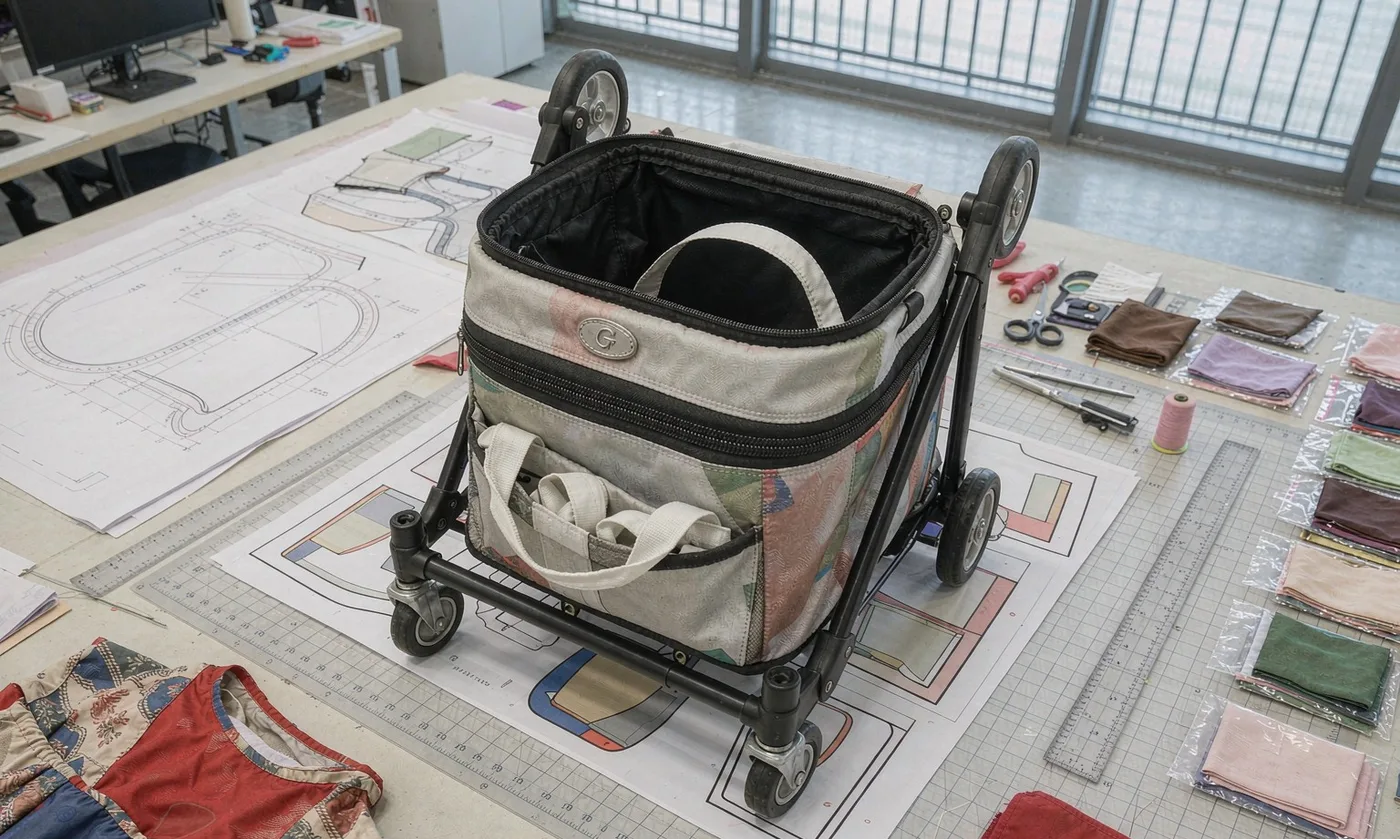
Marker efficiency is the ratio of pattern area to fabric consumed, and it is the least discussed and most profitable lever in soft goods. A well-nested marker on a 41-piece carrier pattern reaches 82 percent. Re-engineering the pattern to 28 pieces with attention to grain lines and to the roll width pushes that to 91 percent. On a unit consuming 1.85 square metres of fabric at 2.60 USD per metre and 150 cm width, the improvement removes 0.31 USD per unit of fabric with no change to the product.
Three engineering decisions drive the improvement. The first is piece count: every seam that is removed eliminates two seam allowances and one handling operation. The second is symmetry: panels that can be cut as mirrored pairs nest more efficiently than panels with a fixed orientation. The third is width discipline: designing to a 150 cm roll rather than to an arbitrary dimension avoids a selvedge waste band that can cost 6 to 9 percent of the marker.
Grading matters too. A five-size programme that is graded from a single base pattern shares markers across sizes more efficiently than five independently drafted patterns. The shared approach typically yields 3 to 4 percent better utilisation across the size run, and it also keeps the proportions consistent between sizes, which reduces fit complaints that are really grading complaints.
Finally, cutting method is a cost decision. Stack cutting is fast and suited to high-volume runs but accumulates a 3 to 5 mm variance through the stack. Single-ply cutting with a digital cutter holds 1 mm and produces better nesting on complex shapes, at a slower rate. For a budget programme running above 5,000 units, stack cutting on simple panels combined with single-ply cutting on the complex ones is usually the optimum.
Construction Simplification: Seams, Panels and Operations
Every seam is a cost. It consumes thread, it consumes machine time, and it consumes the operator attention that determines whether the seam is straight. A typical budget carrier starts at 41 pattern pieces and 34 sewing operations and can be engineered to 28 pieces and 23 operations without the customer noticing any difference. That reduction removes about 2.6 minutes of labour, which at a loaded labour rate is 0.48 USD per unit, and it also removes 11 opportunities for a defect.
The most productive simplifications are consistent across programmes. Replace a bound seam with a turned seam on non-visible edges. Combine two lining panels into one folded panel. Replace a separate binding tape with a self-binding edge where the fabric allows. Use a single continuous zipper run instead of two. Each saves 8 to 20 seconds of machine time and a small amount of material, and together they are the largest single labour lever available.
- Bound to turned seam: saves 14 seconds and the binding tape, where the edge is not visible.
- Folded lining panel: removes one seam and one piece, saves 11 seconds.
- Self-binding edge: removes 1.2 metres of tape per unit.
- Single zipper run: saves 22 seconds and one slider.
- Pre-assembled sub-modules: door and panel built off-line and married, saving 18 seconds.
One caution applies to simplification: it must be validated on the load path. A turned seam is not equivalent to a bound seam on a strap anchor, and a single zipper run changes the load distribution on the door. Every simplification is therefore reviewed against the structural test results before it is released, and any change affecting a load-bearing seam triggers a repeat of the seam strength and static load tests.
Operator sequence matters alongside operation count. Two units with the same number of operations can differ by 30 seconds of handling time depending on how the work is sequenced, because every time an operator puts a panel down and picks it up again costs 4 to 6 seconds. Sequencing the operations so sub-assemblies flow directly into the next station without an intermediate stack typically recovers 20 to 35 seconds per unit at no engineering cost, which is why process review belongs in a cost programme and not only in a productivity programme.
Packaging, Freight and Duty Optimisation
Packaging is 7 percent of unit cost and it is frequently over-specified. A carrier shipped flat in a plain carton occupies 22 percent less cube than the same carrier shipped assembled in a printed retail box, and on a 40 foot container that difference is 900 to 1,400 units of additional capacity. At 2.10 USD per unit of freight allocation, the cube reduction is worth more than the retail presentation costs.
The decision is a channel decision rather than a cost one. E-commerce fulfilment benefits from a plain shipper because the unit goes into a parcel network anyway. Brick-and-mortar retail needs the printed box. A programme selling into both should specify a plain shipper with a separate printed sleeve applied at the destination, which captures most of the freight saving and keeps the shelf presentation.
Freight consolidation is the other lever and it interacts with the order structure. A 5,000 unit order split across four colourways ships as one consolidation if all four finish within the same week, and as four partial shipments if they do not. Consolidating colourways into a single production window typically saves 0.18 to 0.35 USD per unit in freight and documentation, and it is one of the reasons the standard MOQ is set per colourway rather than per order.
Duty is worth modelling before the specification is frozen, because classification depends on construction. A carrier classified as a textile article and the same carrier classified as a travel good can differ by several points of duty in some markets, and the distinguishing feature is usually the outer surface material. Where the destination market has a significant duty differential, the outer face specification should be reviewed with the importer before production, not after the goods have been shipped.
The Protected List: Specifications That Must Not Move
Every cost programme needs a protected list, and it should be written into the specification before the optimisation starts. The list is short because a long list is not respected, and it contains only items where a reduction creates a safety, regulatory or warranty risk rather than a commercial one.
| Protected item | Minimum value | Why it is protected | Cost of a breach |
|---|---|---|---|
| Load-bearing seam strength | 200 N | Structural failure under load | Recall and liability |
| Buckle release force | 150 N minimum engagement | Unintended release | Recall and liability |
| Base board deflection | Under 15 mm at rated load | Floor collapse | Warranty returns |
| Substance compliance | Full documented screening | Market access | Seizure and delisting |
| Zipper cycle life | 5,000 cycles | Closure failure in service | Warranty returns |
| Interior free edges | Under 15 mm | Entanglement and escape | Recall and liability |
| Colour fastness to rubbing | Grade 4 dry | Transfer onto clothing | Retailer chargeback |
The economics of the protected list are straightforward. A seam strength reduction saves about 0.06 USD per unit in thread and stitch density. A single recall event costs a multiple of the entire order value. The asymmetry is so large that the protected list is applied without exception, and any cost proposal that touches it is declined at specification review rather than negotiated.
Buyers should ask for the protected list explicitly, because its absence is the clearest signal that a supplier is optimising without guardrails. A supplier that cannot state which specifications it refuses to change is not running an engineering process; it is running a purchasing process, and the difference shows up in the second season rather than in the first.
The protected list is maintained inside the quality management system rather than in a commercial document, and that distinction matters. Because it is maintained to ISO 9001, a decision to breach it requires a documented deviation with a named approver, which is exactly the friction that prevents a marginal saving from being approved in a busy week. Commercial pressure applied directly to a specification, with no such friction, is how most cost-driven quality failures happen.
Building a Cost Roadmap Across Volume Tiers
Cost reduction is best planned as a roadmap rather than as a single negotiation, because the available levers change with volume. At 500 to 2,000 pieces the levers are stock colour, catalogue hardware and packaging simplification, worth 8 to 12 percent. At 2,000 to 10,000 pieces, custom colourways, marker re-engineering and construction simplification become economic, adding 10 to 15 percent. Above 10,000 pieces, fabric woven to order, bespoke hardware tooling and line dedication add a further 6 to 9 percent.
A first order at MOQ 500 pieces per colourway therefore should not be expected to reach the lowest unit price. What it should do is establish the specification, the approved sample and the test baseline, so that the second order can be optimised without re-validation. Buyers who try to reach the volume-tier price on the first order usually end up with a specification that has to be re-engineered later, which costs more than the saving.
The schedule interacts with cost in one specific way. Fabric reservation and hardware ordering sit on the critical path for the 35-50 day bulk window, and a cost optimisation that changes either one late in the process pushes the delivery date. The practical rule is to freeze the material specification at sample approval and to confine any later cost work to packaging and process, which do not affect the critical path.
Finally, the second season is where the compounding happens. With tooling amortised, the line climbed its learning curve and the test history established, a repeat programme typically lands 4 to 6 percent below the first without any specification change at all. That is the cheapest cost reduction available in this category and it is the reason to plan a two-season programme rather than a single order.
The roadmap itself should be written down and reviewed once per season, because the levers expire. A stock colourway that saved 9 percent can be discontinued by the mill; a catalogue part can go out of production; a freight lane can reprice. Recording each lever with its saving and the condition under which it remains valid lets a buyer separate structural savings from opportunistic ones, and it prevents a second season quote from being judged against a first season number that rested on a temporary condition.
Production capability
- SGS-verified production space of 4,950 m², 149 machines, 7 assembly lines
- Pet carrier and pet bag output since 2014 from a 137-person team
- 200,000 units shipped monthly under BSCI and ISO 9001 systems
People Also Ask
How much can a budget pet carrier programme realistically save?
18 to 27 percent on a first order from a 12.40 USD base, through marker efficiency, hardware standardisation, panel count reduction and packaging cube. A repeat programme adds a further 4 to 6 percent once tooling is amortised.
What is the biggest cost element in a dog carrier backpack?
Fabric at 25 percent, followed by hardware and trim at 21 percent and direct labour at 18 percent. Fabric gets most of the negotiation attention but labour and hardware together are a larger share.
Can fabric GSM be reduced to cut cost?
Only down to the level that clears 18,000 Martindale cycles and 18 N tear. Below that the saving of 0.30 to 0.45 USD produces warranty claims worth several times as much.
How does marker efficiency affect unit cost?
Going from 82 to 91 percent efficiency on a 1.85 square metre unit removes about 0.31 USD of fabric with no product change. The gain comes from lower piece count, mirrored panels and designing to a 150 cm roll width.
Should hardware be customised on a budget programme?
One part only, and it should be the one the brand is recognised by, usually the zipper pull or the front label. Standard catalogue parts carry no tooling cost and no minimum beyond stock level.
Does flat packing really save money?
Yes, about 22 percent of cube, which is 900 to 1,400 extra units per 40 foot container. Where retail presentation is needed, a plain shipper with a printed sleeve applied at the destination captures most of the saving.
Which specifications should never be value engineered?
Load-bearing seam strength at 200 N, buckle engagement at 150 N, base board deflection under 15 mm, substance compliance, zipper cycle life at 5,000 cycles, interior free edges under 15 mm and colour fastness at grade 4 dry.
Frequently Asked Questions
Why is the first order more expensive than the repeat order?
Tooling, testing and documentation are programme-level costs. A 6,000 USD tooling package is 1.20 USD per unit at 5,000 pieces and 0.30 USD at 20,000, and the difference drops out automatically on a repeat order.
How is unit cost split on a 12.40 USD carrier?
Fabric 3.10, hardware and trim 2.55, direct labour 2.20, foam and board 1.85, overhead 1.15, packaging 0.85, and testing, documents and margin 0.70 USD per unit.
What does a custom fabric specification cost?
A mill minimum of about 3,000 metres plus a 12 to 18 percent premium over a stock construction of equivalent performance. Moving from a bespoke 380D to a stock 420D at the same GSM typically saves 0.35 USD per unit.
How much does a custom buckle tool cost?
3,500 to 6,000 USD with a 10,000 piece minimum order. A standard catalogue part carries no tooling and no minimum beyond the supplier stock level, which is why budget programmes are allowed one custom part only.
How many pattern pieces should a budget carrier have?
Around 28 pieces and 23 sewing operations, engineered down from a typical 41 pieces and 34 operations. That removes about 2.6 minutes of labour, worth roughly 0.48 USD per unit, and 11 defect opportunities.
What is the risk of turning a bound seam into a turned seam?
None on non-visible edges, but a turned seam is not equivalent on a strap anchor. Every simplification is reviewed against structural test results, and any change affecting a load-bearing seam triggers a repeat of the seam strength and static load tests.
How does order quantity change the available cost levers?
Below 2,000 pieces only stock colour, catalogue hardware and packaging are economic. From 2,000 to 10,000 pieces, custom colourways and marker re-engineering open up. Above 10,000, fabric woven to order and bespoke tooling become viable.
Why should the material specification be frozen at sample approval?
Fabric reservation and hardware ordering sit on the critical path of the 35-50 day bulk window. Late material changes push delivery, while packaging and process changes do not.
How much does packaging affect landed cost?
Around 0.85 USD of the unit plus the freight effect. Flat packing in a plain shipper reduces cube by 22 percent and, at a 2.10 USD freight allocation, is worth more than the retail presentation costs.
Should duty classification be checked before production?
Yes. A textile article and a travel good can differ by several points of duty, and the distinguishing feature is usually the outer surface material, which is a specification decision made before production.
What is the cost of a seam strength reduction?
About 0.06 USD saved per unit, against a recall exposure that is a multiple of the whole order value. That asymmetry is why seam strength is on the protected list and is never negotiated.
How do colourways affect freight cost?
Four colourways finished in the same week ship as one consolidation; finished separately they ship as four partials. Consolidating the production window saves 0.18 to 0.35 USD per unit in freight and documentation.
What indicates a supplier is optimising without guardrails?
The absence of a protected list. A supplier that cannot state which specifications it refuses to change is running a purchasing process rather than an engineering one, and the difference appears in the second season.
Talk to QUANZHOU JUNYUAN BAGS about a pet carrier program: MOQ 500 pieces per colourway, samples in 6-10 working days, bulk production in 35-50 days under AQL 2.5 inspection.
Get a free quote Request a sample