Expandable Dog Carrier Backpack: Design Features and Benefits
An expandable dog carrier backpack adds 30-45% internal volume through a zip-released gusset, typically taking a medium unit from 49 to 68 litres. The engineering cost is a rearward centre-of-gravity shift of 40-70 mm and a 20-30% reduction in side-wall stiffness, so the base board and strap roots must be specified for the expanded state. MOQ 500 per colourway, samples in 6-10 working days, bulk 35-50 days, AQL 2.5.
Executive Summary. An expandable panel is one of the most commercially attractive features in this category and one of the easiest to engineer badly. Expansion changes three things at once: it moves the centre of gravity rearward, it removes structure from the side wall it replaces, and it adds a zipper that must survive being operated under load. All three are manageable and all three are usually ignored in the first sample.
This article sets out how our production team specifies an expandable carrier: the mechanism options and their cost, the gusset geometry, what must be reinforced to keep the expanded unit stable, how the expansion zipper is specified and tested, and what the feature adds to cost and schedule. Programme terms: MOQ 500 pieces per colourway, samples in 6-10 working days, bulk production 35-50 days after gold seal, inspection to AQL 2.5. The QUANZHOU JUNYUAN BAGS production network runs 7 partner production lines with 149 machines and 137 people across an SGS-verified production base of 4,950 m2, at 200,000 units per month under BSCI and ISO 9001, on T/T 30/70 and FOB Xiamen.
Most buyers ask a pet bag supplier the same opening question: can the dog carrier backpack line be reordered in the original colour six months later? The answer depends on dye-lot control, not on goodwill.
What Expansion Does to the Load Case
Before choosing a mechanism, quantify what expansion does to the physics. Adding 60-90 mm of rearward depth to a medium carrier raises internal volume by 30-45%, which is the commercial benefit. It also moves the pet's mass centre rearward by roughly half that distance, because the animal does not distribute itself evenly into the new space; it settles against the rear panel.
That rearward shift has a direct consequence for the wearer. A 12 kg dog sitting 60 mm further from the wearer's back increases the moment at the shoulder by roughly 25-30%, and the increase is felt, not theoretical. It is why an expandable carrier needs a sternum strap and, above 15 kg, a load-lifter strap geometry that a non-expandable unit of the same size does not require.
- Volume gain: +30-45% typical, 49 L to 68 L on a medium unit
- Mass centre shift: 40-70 mm rearward when occupied
- Shoulder moment increase: 25-30% at 12 kg
- Side-wall stiffness reduction: 20-30% where the panel is replaced by fabric
- Base bending moment increase: 15-25% under the same pet mass
Write all five into the load case before the pattern is cut. An expandable carrier designed to the collapsed state and merely enlarged in the expanded state is the product that gets returned as uncomfortable and unstable, and the return reason the customer gives will be about the dog rather than about the geometry.
There is a second consequence that belongs in the load case: the dynamic behaviour changes. An expandable unit has more internal volume, which means the animal has more room to move, which in turn means the wearer experiences lateral and vertical impulses that a snug carrier does not transmit. Under a walking gait this is a modest effect; on uneven ground, or when the wearer turns quickly, it is significant. Our production team applies a higher dynamic amplification factor to expandable designs, 2.0x rather than the 1.6-1.8x used for a snug soft carrier, and sizes the strap roots and the base perimeter band accordingly.
Decide also whether the product is sold on its expanded or its collapsed dimensions. Customers compare the collapsed number against airline and storage constraints and the expanded number against comfort, and publishing only one of them invites the wrong purchase. Publish both, and state plainly which applies in transit.
Mechanism Options and What Each Costs
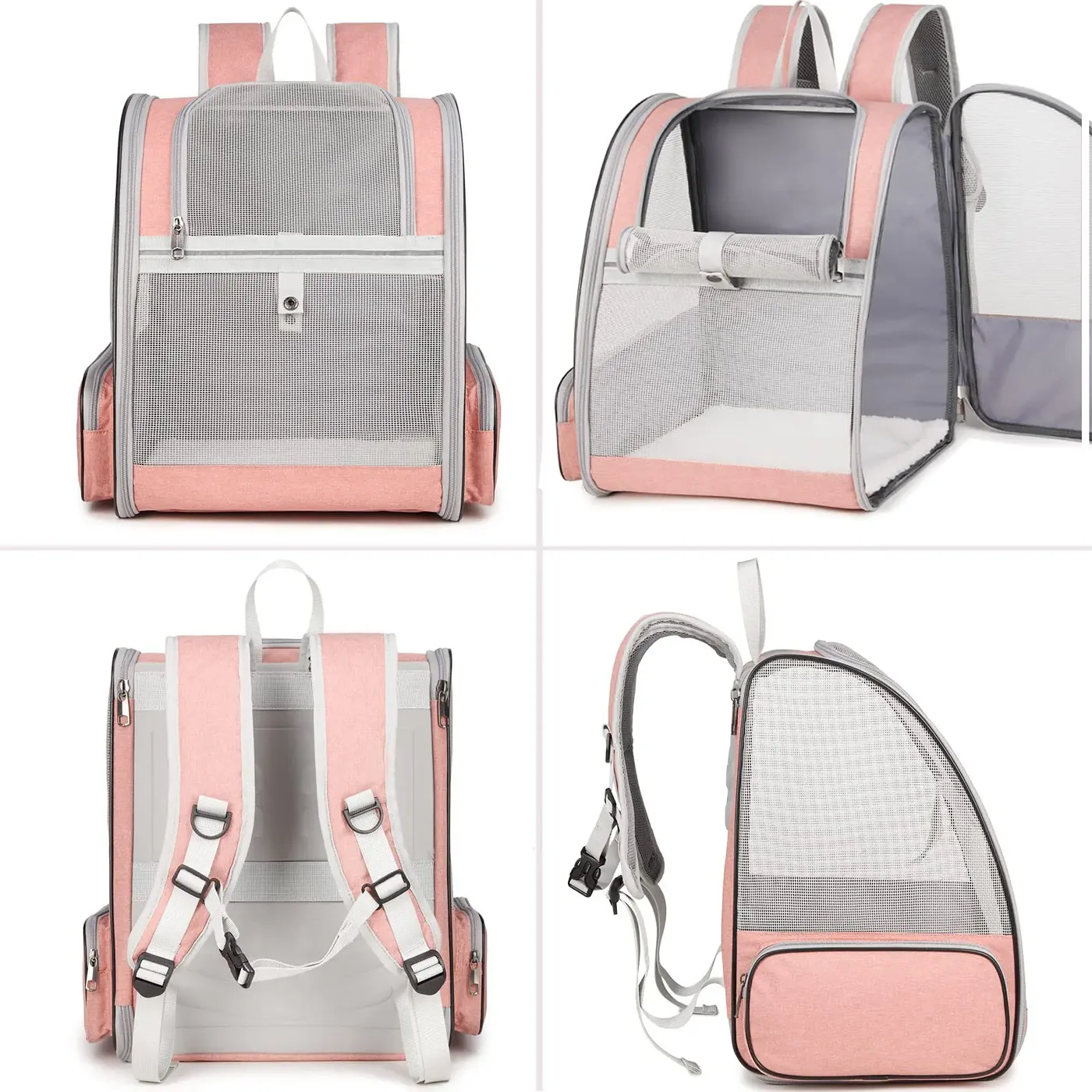
Four mechanisms are in production use, and the choice is a trade between volume gain, structural cost and ease of operation. The dominant solution is the zip-released gusset: a pleated fabric panel folded and zipped flat against the side wall, released to open into a box. It gives the largest volume gain, it collapses neatly, and the zip line is the entire mechanism.
| Mechanism | Volume gain | Structure removed | Operation | Added cost |
|---|---|---|---|---|
| Zip-released pleated gusset | 30-45% | Moderate | One zip pull | $1.10-$2.30 |
| Fold-out rear panel | 20-30% | High | Unzip and fold down | $1.60-$2.90 |
| Accordion side wall | 25-35% | Low | Pull out, snap stays | $2.20-$3.80 |
| Roll-top extension collar | 15-25% | Minimal | Unroll, clip | $0.85-$1.60 |
| Two-position zip track | 20-28% | Moderate | Re-zip on second track | $1.40-$2.60 |
Note the structure column. The fold-out rear panel removes the most structure because it replaces the panel that carries the load into the back foam; it requires a perimeter frame to compensate and it is the most expensive to engineer correctly. The roll-top collar removes almost nothing but gains the least, and it is the right answer where the expansion is occasional rather than routine.
Our production team recommends the zip-released pleated gusset for most programmes. It is the best balance, it is the most familiar to customers, and critically, the pleat fabric carries no load in the collapsed state, so the structural deficit only exists in the expanded state where it can be compensated by the base and the frame.
Operation effort is the remaining selection criterion and it is where the two-position zip track earns its place. It gives two discrete, defined volumes rather than a continuum, which means the product behaves predictably in both states and the user cannot half-deploy it. For a carrier sold into a market where the expanded state will be used daily, a defined two-position track is worth the additional $1.40-$2.60.
Whichever mechanism is chosen, one specification line should not be skipped: the collapsed-state retention. Something has to hold the gusset flat when it is zipped closed, whether that is the zip itself, a snap, or a hook-and-loop tab, because a pleat that lifts even 10 mm in the collapsed state looks like a manufacturing fault at shelf even though it is functioning correctly.
Gusset Geometry and Pattern Engineering
The pleated gusset is a pattern problem before it is a sewing problem. Three dimensions govern it: the pleat depth, which sets the volume gain; the pleat count, which sets how neatly it collapses; and the pleat fold direction, which sets whether the gusset stows inside the bag or bulges outside it.
Pleat depth should be 60-90 mm for a medium carrier. Deeper pleats give more volume but they also stack thicker when collapsed, and a stack thicker than roughly 25 mm starts to intrude on the usable internal width even in the collapsed state, which defeats the purpose of having a compact mode. Pleat count should be even, typically two or four, so the folds alternate and the stack lies flat rather than leaning.
Fold direction is the decision most often made by accident. An inward-folding pleat stows inside the carrier, keeps the external silhouette clean, and risks being clawed from inside. An outward-folding pleat keeps the interior smooth, is safe from claws, and makes the collapsed bag look slightly bulbous at the rear. Our production team specifies inward-fold with a bound edge at the claw line, because the interior smoothness of the outward fold is worth less than a clean external silhouette at shelf.
One more pattern detail: the gusset must be cut with its own ease allowance, and that ease is different in each state. In the collapsed state the gusset is folded and therefore shorter; in the expanded state it is flat and therefore longer. The panel has to be cut to the expanded state and the folded state is achieved by the pleat, which means the collapsed silhouette is determined by how neatly the pleat lies rather than by the panel dimension.
Keeping the Expanded Unit Structurally Honest
The expanded state is the weak state and it should be the design state. Three components carry the penalty: the base, the perimeter and the strap roots.
The base needs to be specified for the expanded footprint, not the collapsed one. If the base board is sized to the collapsed envelope, the expanded volume overhangs it and the overhang becomes an unsupported cantilever under the animal's mass. Either the board is sized to the expanded footprint, which makes the collapsed bag heavier and stiffer than it needs to be, or a fold-out base extension is added to the mechanism. The second is better and it is what our production team specifies: a hinged board flap that folds out with the gusset, giving a supported base in both states at an added cost of roughly $0.70-$1.40.
The perimeter needs a frame if any load-bearing panel is replaced by fabric. A 25 mm internal webbing band sewn into the base seam is sufficient for the 3-15 kg bands; above 15 kg, where the rear panel is removed entirely, a moulded or a wire perimeter frame is required, and that is a tooling conversation with a 20-30 day lead-time consequence.
The strap roots need re-evaluation because the load line moves. When the mass centre shifts rearward, the strap root is no longer directly above the load and the back panel is asked to carry a bending component it was not designed for. The fix is a load spreader: a 40-60 mm wide webbing band running from one strap root to the other across the top of the back panel, which converts the bending load into a tension load the panel can carry.
The back panel itself needs attention in an expandable design, because it is doing something unusual: it is carrying a bending load while also being the surface against the wearer. A 10-15 mm foam panel that works in a fixed carrier will feel soft and unstable in an expandable one at the same load. Our production team specifies a semi-rigid insert behind the back foam for expandable units above 12 kg, typically a 3 mm PE sheet in a slip pocket, which restores the panel's ability to distribute the load without making it uncomfortable.
Finally, consider the strap geometry. A rearward mass centre is best managed by moving the strap attachment point forward and up rather than by widening the straps. A 10-15 mm forward shift of the root position has more effect on comfort than a 6 mm increase in strap width, and it costs nothing to specify at pattern stage.
The Expansion Zipper: Specification and Durability
The expansion zipper is the single most-stressed component in the product, and it is usually specified as an afterthought. It must run around corners, it is operated while the bag is loaded or partly loaded, and it is exposed to dirt and claw contact at the lower run.
Specify it as a #8 coil at minimum, with a reverse coil where the run is exposed, and require a cycle life of 5,000 operations on the finished assembly rather than on a coupon. Use two sliders on a longer run so the user can open from either end and so the load on any single slider is reduced. Add a garage: a fabric cover at the end of the run that shelters the slider when closed, which is the cheapest single measure that extends zip life in the field.
- Size: #8 coil minimum, #10 where the run exceeds 700 mm
- Type: reverse coil on exposed runs, water-resistant tape on outdoor programmes
- Sliders: two, with moulded pulls, on runs over 500 mm
- Cycle life: 5,000 operations tested on the finished assembly
- End treatment: a fabric garage at the closed end, bar-tacked slider stop at the open end
The failure mode to design against is zip separation under load, where the coil opens behind the slider because the bag is straining the run while it is being operated. It is prevented by a slider stop at the open end and by instructing the user, on the care label, to unzip before placing the animal. That instruction is a specification line and it costs nothing.
Consider also where the zip run terminates relative to the base seam. A run that ends at the base corner puts the highest-stress point of the whole closure exactly where the base board creates a hard edge, and it is the usual origin of slider damage. Terminating the run 40-60 mm above the base line, on flat fabric, is a drawing decision that removes a disproportionate share of field failures.
Lubrication and cleanliness matter more here than on a pocket zip because the run is long and exposed. A coil zip with a water-resistant tape resists dirt ingress better than an open tape, and where the programme is sold into an outdoor channel our production team specifies a water-resistant tape and a garage at both ends rather than one.
Ventilation and Thermal Behaviour in Both States
Expansion changes the thermal picture in a way that is easy to get backwards. More internal volume means more air to heat, which sounds beneficial, and it is: a 68-litre envelope with a 10 kg dog inside warms more slowly than a 49-litre envelope with the same dog. But expansion usually also means the rear panel becomes fabric rather than a padded, vented structure, and the expanded volume is often the part of the bag with the least airflow.
The practical rule is that mesh area should be specified as a percentage of the expanded internal surface, not of the collapsed one. If a carrier has 25% mesh in the collapsed state and expands by 40%, the same absolute mesh area is only 18% of the expanded surface. Specify mesh by absolute area against the expanded state and the percentage takes care of itself.
Where the expansion panel itself is a candidate for mesh, be careful. A mesh expansion panel is excellent for airflow and poor for structure, and it is within claw reach when the animal turns around. If mesh is used in the expansion panel, it should be 210 gsm air mesh or heavier with a bound edge, and the panel should be excluded from any structural role. Veterinary guidance on heat risk for confined animals is published by the American Veterinary Medical Association and it is the right reference when setting the ventilation target.
Airflow path matters as much as area in the expanded state, because the geometry changes. In the collapsed state the inlet and outlet may be on opposite walls with a clear path between them; once the gusset opens, the rear panel moves away and the path lengthens and bends. Our production team checks the convective path in both states rather than assuming it survives expansion, and where it does not, the fix is usually to move the outlet higher on the opposite wall rather than to add more mesh.
There is one more thermal consideration specific to expandable designs. The pleat stack in the collapsed state is an insulating layer of folded fabric against one wall, which is a benefit in cold weather and a penalty in hot weather. Where a programme is sold into both, publish the care guidance for the collapsed state rather than leaving the customer to work it out.

Testing an Expandable Carrier: What to Measure
A standard carrier test protocol does not cover the expandable case. Four additional tests are required, and each measures something the collapsed-state protocol misses.
- Expanded-state base deflection: load the expanded carrier to the top of the rated band for 24 hours and measure centre deflection. Acceptance: under 8 mm, against 6 mm for a non-expandable unit.
- Centre-of-gravity measurement: measure the horizontal distance from the wearer's back plane to the loaded mass centre in both states. Report it; the design target is a rearward shift under 60 mm.
- Zip cycle under partial load: operate the expansion zip 500 times with 40% of rated mass in the bag. Acceptance: no coil separation, no slider deformation, no tape damage.
- Collapse-cycle durability: expand and collapse 500 times and re-measure the pleat stack height. Acceptance: stack height growth under 15%, which is the point at which the collapsed bag stops looking compact.
Run all four on production units built with production tooling, because the pleat behaviour in particular depends on how the gusset was pressed and folded on the line rather than on how it was drawn. Test methods for textile and hardware durability are published by ASTM International; where the product is marketed for vehicle travel, the restraint protocols maintained by the Center for Pet Safety are the reference buyers cite.
Our production team adds one more check that is not a formal test: a fit trial with a live animal in the expanded state, observed for twenty minutes. It catches the behaviours no bench test predicts, including where the animal actually chooses to sit, which is almost never where the pattern assumed.
Record the results in a form that can be compared across programmes. Four numbers are enough: expanded deflection in millimetres, rearward centre-of-gravity shift in millimetres, zip cycles survived before any coil damage, and pleat stack growth as a percentage. Those four make an expandable design comparable with a previous one and they make a cost-reduction proposal checkable, which is what stops value engineering quietly removing the reinforcement that made the first version work.
Inspect the expanded state in production too, not only in the laboratory. Our production team expands and collapses every inspection sample once before measuring it, because a pleat pressed badly on the line will not seat correctly on first deployment and that defect is invisible on a collapsed unit.
Failure Modes and the Cost of Getting It Wrong
Expandable carriers fail in four ways, and three of them are design failures rather than manufacturing defects. The gusset sags: the pleat fabric was too light and it takes a permanent set, so the collapsed bag never looks flat again. The zip separates: the run was operated under load, or the slider stop was omitted. The base creases: the board was sized to the collapsed footprint and the overhang flexed until it took a fold. And the collapsed silhouette bulges: the pleat stack was thicker than the allowance and the rear panel stands proud.
Each has a specific fix and each fix is cheaper at design stage. A 210 gsm gusset fabric instead of 150 gsm costs roughly $0.30. A slider stop costs cents. A fold-out base extension costs $0.70-$1.40. A thinner pleat stack costs nothing and merely requires the pleat count to be chosen deliberately. Together, the difference between a well-engineered expandable unit and a poorly engineered one is about $2.00 of FOB on a core-tier carrier, which is 12-18% and entirely recoverable in reduced returns.
On schedule, an expandable feature adds 2-4 days inside the 35-50 day bulk window: one extra sample iteration is typical because the pleat behaviour is difficult to predict from the drawing, and the additional tests add a day. Our production team budgets both rather than discovering them, and the sample iteration is the reason we recommend starting an expandable programme two weeks earlier than a fixed-format one.
Order and quality terms
- MOQ 500 pieces per colourway; samples in 6-10 working days
- Bulk production 35-50 days after approval; AQL 2.5 inspection standard
- T/T 30/70 terms, FOB Xiamen, full document set per shipment
People Also Ask
How much extra space does an expandable pet carrier give?
Typically 30-45%. A medium unit goes from roughly 49 litres collapsed to 68 litres expanded, achieved through a zip-released pleated gusset of 60-90 mm depth.
Is an expandable carrier stable when expanded?
Yes if the base board is sized to the expanded footprint or has a fold-out extension, and if the perimeter is framed. Without both, the expanded volume overhangs the base and flexes.
What zipper should an expansion panel use?
A #8 coil minimum, with a reverse coil on exposed runs, two sliders on runs over 500 mm, a fabric garage at the closed end and a bar-tacked slider stop at the open end.
Does expansion make the bag hotter for the dog?
No, more volume heats more slowly, but mesh area drops as a percentage of internal surface. Specify mesh by absolute area against the expanded state.
What is a pleated gusset?
A folded fabric panel stowed flat against the side or rear wall and released by a zipper to open into a box. Pleat depth sets volume, pleat count sets how neatly it collapses.
Why does an expandable carrier feel heavier to carry?
Because the animal's mass centre moves 40-70 mm rearward, increasing the moment at the shoulder by 25-30% at 12 kg. A sternum strap and a load spreader compensate.
Can an expandable carrier be used on an aircraft?
Depends on the collapsed external dimensions, which is what an airline measures. Expansion is a ground feature and should not be used in flight.
Frequently Asked Questions
Should the pleat fold inward or outward?
Inward, with a bound edge at the claw line. It keeps the external silhouette clean in the collapsed state, which is how the product is presented at shelf, and the bound edge handles claw contact.
How deep should the pleat be?
60-90 mm for a medium carrier. Beyond roughly 25 mm of collapsed stack thickness the pleat begins to intrude on usable internal width in the compact mode.
Do I need a different base board for an expandable unit?
Yes. Either size the board to the expanded footprint or add a hinged fold-out extension. A board sized to the collapsed envelope leaves an unsupported cantilever when expanded.
What is a load spreader and do I need one?
A 40-60 mm webbing band across the top of the back panel linking the two strap roots. It converts the bending load created by the rearward mass shift into tension the panel can carry.
How many pleats should the gusset have?
An even number, typically two or four, so the folds alternate and the stack lies flat. An odd count produces a stack that leans and looks bulky when collapsed.
What fabric should the gusset use?
210 gsm or heavier. A 150 gsm gusset takes a permanent set within a season, so the collapsed bag never lies flat again, and the upgrade costs about $0.30.
How much does an expandable feature add to FOB?
Roughly $1.10-$2.30 for a zip-released pleated gusset including the mechanism, plus $0.70-$1.40 if a fold-out base extension is specified.
Does an expandable feature delay production?
Typically 2-4 days inside the 35-50 day bulk window: one extra sample iteration because pleat behaviour is hard to predict from a drawing, plus a day for the additional tests.
What causes an expansion zip to separate?
Operating the run while the bag is loaded, which puts the coil in tension behind the slider. It is prevented by a slider stop at the open end and a care-label instruction to unzip before loading.
How is the expanded state tested?
Four added tests: 24-hour expanded base deflection under 8 mm, centre-of-gravity shift under 60 mm, 500 zip cycles at 40% rated load, and 500 collapse cycles with pleat stack growth under 15%.
Can the expansion panel be mesh?
Yes, but only in a non-structural role and only at 210 gsm or heavier with a bound edge, because the panel sits within claw reach when the animal turns around.
Should I start an expandable programme earlier?
Yes, by about two weeks. The pleat usually needs one sample iteration beyond a fixed-format carrier and the additional tests add a day to the qualification.
Talk to QUANZHOU JUNYUAN BAGS about a pet carrier program: MOQ 500 pieces per colourway, samples in 6-10 working days, bulk production in 35-50 days under AQL 2.5 inspection.
Get a free quote Request a sampleKeep reading
- How to Choose the Right Dog Carrier Backpack for Your Brand
- Dog Carrier Backpack Size Guide: Sizing Chart and Specifications
- Best Dog Carrier Backpack Materials: A Complete Comparison
- Dog Carrier Backpack with Side Pockets: Design
- Dog Carrier Backpack Testing: Quality Assurance
- Custom Dog Carrier Backpack: OEM Production Process