Dog Carrier Backpack for Newfoundlands: Water Rescue
A Newfoundland water-rescue carrier is specified for 55-70 kg of animal plus 4-7 kg of water retained in the coat. Require a welded basin draining 90% of its volume in under 90 seconds, hardware passing 500 hours of salt spray, a closed-cell buoyancy reserve of 8-14 kg, a hydrophobic lining and a full dry in under five hours.
This page covers the wet-state engineering of a water-rescue product. The animal enters the compartment saturated and carrying 4-7 kg of water, the product is deployed on or beside water, and it is exposed to salt spray, ultraviolet and continuous moisture with a turnaround of hours rather than days. The governing requirements are drainage rate, corrosion resistance, buoyancy provision and drying time, and they are largely independent of the structural load case, which at this mass is a solved problem. The sections below cover the wet-state mass, the envelope, corrosion engineering, drainage and buoyancy, hydrophobic material selection, drying turnaround, a salt spray and immersion validation protocol, and the cost and documentation parameters. Commercial terms follow the standard programme: MOQ 500 pieces per colourway, prototypes in 6-10 working days, bulk production 35-50 days after sample approval, final random inspection to AQL 2.5, T/T 30/70 payment and FOB Xiamen loading.
A pet bag supplier running dog carrier backpack orders at 500 pieces per colourway can consolidate several sizes into one cutting window and hold the dye lot across reorders.
Water-Rescue Duty: Wet-State Mass and the Drainage Requirement
The defining parameter of a water-rescue product is wet-state mass. A Newfoundland leaving the water carries 4-7 kg of water in its coat, and a dog that has been working in surf carries more. That water does not stay in the coat: roughly 60-70% of it drains or is shaken off within the first two minutes inside the compartment, which means the product has to handle a 3-5 litre fluid surge almost immediately, followed by a slower 1-2 litre trickle over the next twenty minutes.
This is a drainage-rate problem rather than a containment problem, and the specification is written in those terms: the basin must drain 90% of a 4 litre test volume in under 90 seconds through its normal outlet, with the product level. A basin that contains 12 litres but drains through a 10 millimetre outlet fails that test by a wide margin, because drainage through a small orifice is laminar and slow.
Outlet sizing follows from the requirement. A 25-30 millimetre bore outlet with a short, steeply sloping approach drains 4 litres in 60-80 seconds; a 12 millimetre bore takes 6-9 minutes. The specification is therefore an outlet bore of 25-30 millimetres, a formed sump with a 5-8 degree fall to it, and a closure that opens fully rather than one that throttles.
Wet-state mass also changes the structural case, though less than buyers expect. The 4-7 kg of retained water is carried in the coat, on the animal, and it adds to the floor load rather than to the shell load. The declared structural envelope rises from 70 kg to 77 kg, giving a working load of 115 kg and a proof load of 231 kg, and the floor is specified to that figure with the usual margins.
The second wet-state effect is on handling. A loaded product at 70 kg of animal plus 5 kg of water plus 9 kg of product is 84 kg and it is wet, which makes every grip less secure. Handles are specified with a closed-cell grip sleeve and a larger grip opening than a dry product needs, and the lift procedure is documented as a four-person lift rather than a two-person one.
Deployment frequency is the last input. A water-rescue product is deployed 100-250 times a year, always wet, frequently in salt water, and it is expected to be ready again within hours. The product is specified around turnaround: drain fast, resist salt, dry in hours, and stay structurally honest while wet.
Geometry and Envelope for the 55-70 kg Band
Newfoundlands run 55-70 kg, with males at 60-70 kg and females at 45-55 kg. Height at the shoulder is 640-740 mm, body length 850-1,000 mm, chest girth 100-130 cm and chest depth 340-400 mm. Derived interior dimensions are 560-660 mm wide, 930-1,080 mm long and 660-760 mm high, with a declared structural limit of 70 kg of animal plus 7 kg of retained water.
The breed is shorter and more compact than the Saint Bernard at a similar mass, and that has a useful consequence: the compartment span of 930-1,080 mm is at the lower end of the giant range, and the floor can be specified at a 10-12 mm board or a tray with 20-24 mm ribs rather than the 22-26 mm ribs the Mastiff class needs. The mass is similar but the pressure is lower because the animal is not standing in a compartment that just fits it.
Load rating with the wet allowance gives 77 kg declared, 115 kg working, 231 kg proof and 347 kg ultimate, roughly 3.4 kN. The frame specification is a 25 by 20 millimetre aluminium section at 2.0 millimetre wall, and in a water-rescue programme it is specified in a marine-grade anodised or coated finish rather than in the mill finish used inland, because the finish is the first line of defence against salt.
Buoyancy provision affects the geometry and has to be designed in rather than added. A closed-cell buoyancy reserve is required because the product operates beside water and will occasionally go into it, and it is placed as high and as far outboard as possible so that it provides righting moment rather than just lift. Practically, that means buoyancy in the top edge of the side panels and in the upper rear corner rather than under the floor.
Access follows the giant-class rule with one addition. A full-length side opening is required, and in a water-rescue product the opening should be on both sides, because a dog recovered from water may need to be placed from either side depending on how the handler is standing and which way the boat or the bank lies.
External geometry is constrained by the deployment platform. A water-rescue product has to fit on a rescue boat deck, in an inflatable, or in the back of a response vehicle, which sets a practical maximum length of 1,100 mm and a maximum width of 680 mm. Anything larger will not deploy from the platform it is bought for.
Corrosion Engineering: Salt Spray, Galvanic Pairs and Fastener Selection
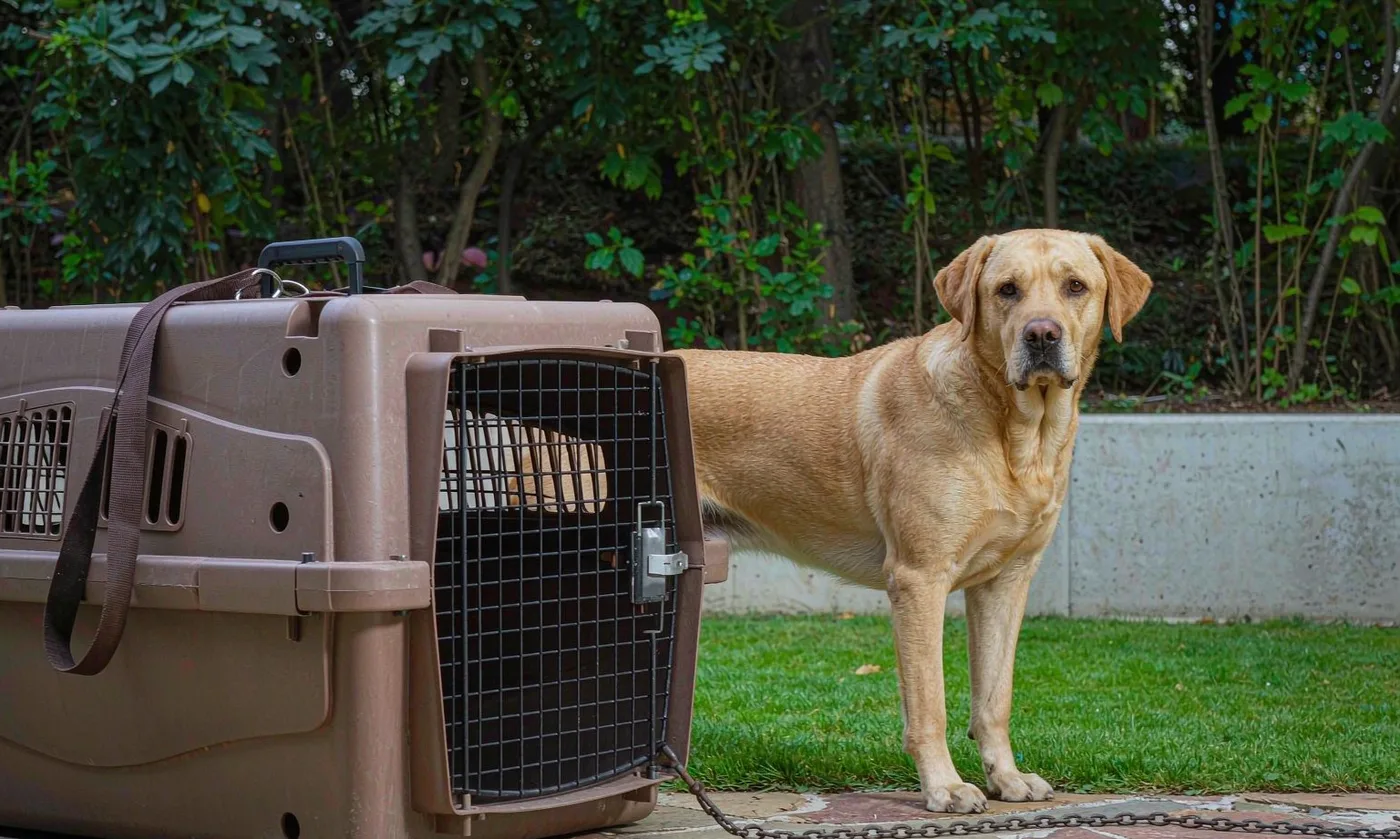
Salt water is the dominant durability agent in this class and corrosion is the failure that ends programmes. It attacks in three ways, and each has a separate specification: general surface corrosion of metals, galvanic corrosion between dissimilar metals in contact, and crevice corrosion at joints and under fastener heads.
Surface corrosion is addressed by material and finish. Every metal component in a salt-water programme is stainless steel of 316 grade or aluminium with a marine-grade anodised or powder-coated finish. Zinc alloy hardware is prohibited outright, including on non-load-bearing trim, because a zinc component will show white corrosion products within 50-100 hours of salt exposure and will seize within a season. Plated carbon steel is prohibited for the same reason and is worse, because the plating is breached at the first scratch and the substrate then corrodes underneath it.
Galvanic corrosion is the one that is designed in by accident. Aluminium and stainless steel in contact in an electrolyte form a galvanic couple in which the aluminium is the anode and corrodes, and a frame with stainless fasteners through aluminium tube is precisely that couple. The controls are isolation: a plastic or nylon bush and washer at every stainless-to-aluminium interface, a compatible sealant in the joint, and — the cheapest and most effective — a fastener material closer in the galvanic series, which in practice means a tin-plated or a polymer-coated fastener rather than a bare stainless one.
Crevice corrosion is the third mechanism and it is why welded joints are preferred to bolted ones in the frame. A bolted joint has a crevice, the crevice holds electrolyte, and the oxygen-depleted environment inside it drives corrosion even in 316 stainless. Where a bolted joint is unavoidable, the specification is a sealed joint with a marine sealant and a drain path so the crevice cannot hold water.
Fastener selection deserves its own line in the tech pack. Self-tapping screws into aluminium are prohibited because they cut a thread in a thin wall, the thread strips, and the stripped joint then corrodes. Through-bolts with a nut and a washer, or rivets with a sealed tail, are the specification, and each fastener is listed with its material and its isolation requirement.
Verification is a neutral salt spray test to the standard method, conditioned and inspected at 96, 240 and 500 hours, with acceptance of no base-metal corrosion at 500 hours and no functional loss at any stage. That is a much harder criterion than the 96-hour figure most consumer hardware is bought to, and it typically eliminates two thirds of a catalogue.
Drainage, Buoyancy and Flotation Provision
Drainage and buoyancy are specified together because they conflict. A basin that drains freely through large openings cannot be made buoyant by sealing it, and a sealed buoyant compartment cannot drain. The resolution is to separate the functions: an open draining basin below, and a dedicated closed-cell buoyancy reserve above and outboard.
The drainage system has four elements. A formed sump with a 5-8 degree fall from all corners. A 25-30 millimetre bore outlet at the sump, positioned at the lowest external point so it is not obstructed when the product is set down. A closure that opens fully and is captive, specified as a quarter-turn bayonet rather than a screw plug because it can be operated with one gloved hand and cannot be cross-threaded. And a coarse strainer over the outlet, because coat hair and debris will otherwise block it within a few deployments.
Buoyancy is calculated rather than guessed. A loaded product at 84 kg needs to stay afloat with a person's weight on it in a rescue scenario only in the sense that it should not sink immediately if it goes overboard; the realistic requirement is a reserve of 8-14 kg of positive buoyancy, which keeps the top edge above water with the animal inside and allows recovery. At a closed-cell foam density of 30-45 kg per cubic metre, that is 0.20-0.45 cubic metres of foam, which is a lot, and the practical answer is lower: 6-9 kg of reserve placed high and outboard, accepting that the product floats low but does not sink.
Foam specification matters more than volume. Closed-cell foam at 30-45 kg per cubic metre with water absorption below 2% by volume is required; open-cell foam absorbs water and becomes dead weight; and any foam used has to be bonded or sealed so it is not exposed to damage. Ethylene-vinyl acetate and closed-cell polyethylene are the two materials used, and both are compatible with the welding and bonding methods in the rest of the product.
Placement is the design decision that makes the reserve useful. Foam in the top edge of both side panels and across the upper rear panel gives righting moment and keeps the openings above water; foam under the floor gives lift but no righting and it is the wrong place for it. The specification is a minimum of 70% of the reserve above the mid-height line.
A flotation collar is the alternative and is worth considering for programmes where the product is deployed from a boat. An inflatable or foam-filled collar around the top edge provides buoyancy exactly where it is wanted and can be removed for inland use, at a cost of 12.40-22.80 USD and a penalty of 600-1,100 g.
Material Selection: Hydrophobicity, UV plus Salt, and Mildew Control
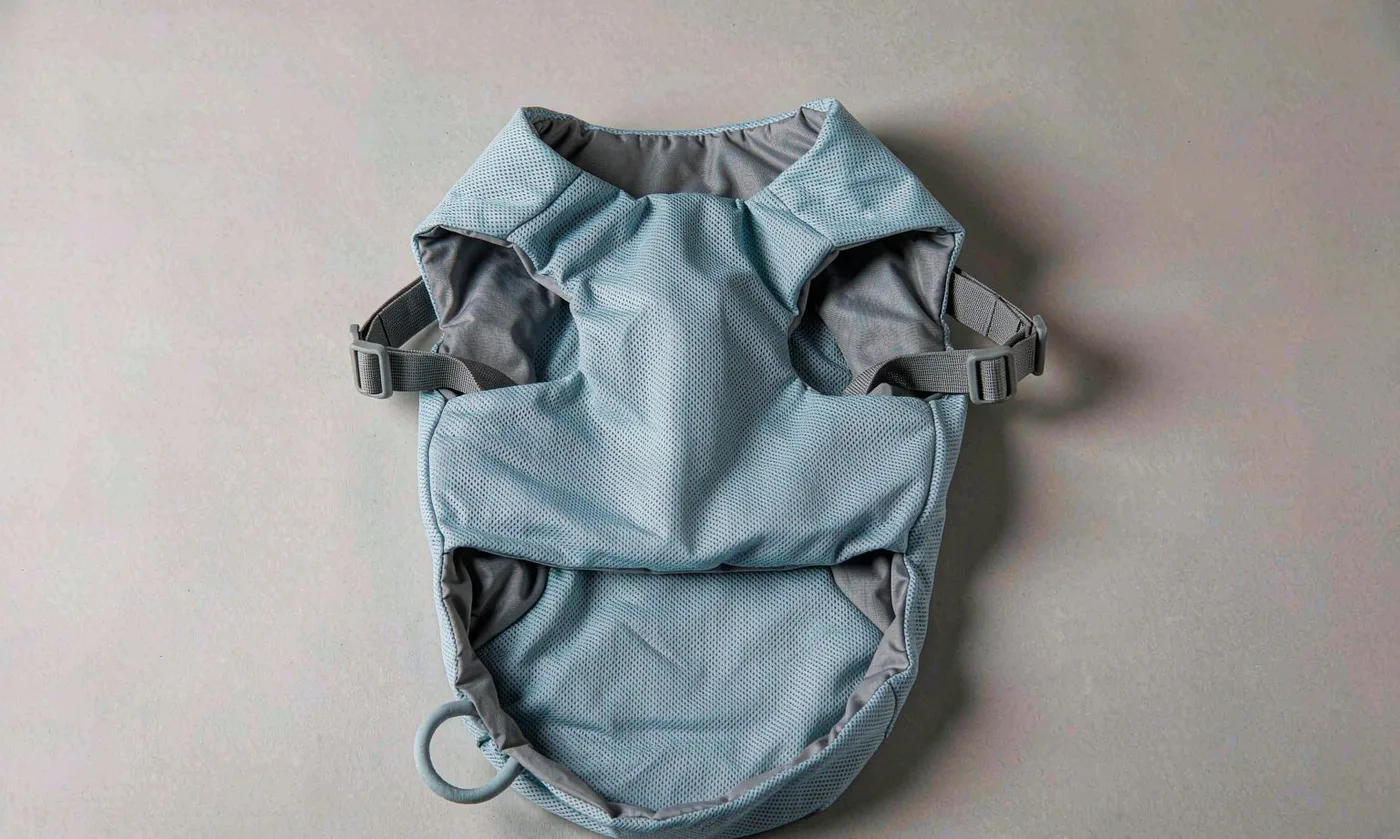
Material selection in a water-rescue product has to survive three simultaneous aggressions: continuous liquid water, salt, and ultraviolet exposure on open water where there is no shade. Most coated textiles are specified for one of those and not for all three.
Hydrophobicity is the first requirement and it is a coating and finish specification rather than a fabric one. The exterior face is treated to a spray-test rating and a water-repellency finish durable over 30 wash cycles; the interior lining is a welded film, as in the working-dog class, because a textile lining will hold water and slow the drying requirement. The specification is that no interior surface below the 150 mm line absorbs more than 1% of its mass in water after 30 minutes of immersion.
Salt and ultraviolet together are the harder combination. Ultraviolet degrades the polymer coating; salt accelerates the degradation and, critically, salt crystals that form as the product dries abrade the degraded surface. A coating that survives 500 hours of ultraviolet alone may lose half its cycle life with intermittent salt exposure. The specification is a combined cyclic test: alternate ultraviolet exposure and salt spray in 8-hour blocks over 500 hours, with acceptance of no cracking, no chalking above grade 3 and a retained abrasion cycle life above 70% of the unconditioned figure.
Solution-dyed yarn is specified as standard here, for the same reason as in the cold-climate class and more strongly: piece-dyed fabric loses light fastness quickly under reflected ultraviolet from water, and a water-rescue product is exposed to roughly double the effective dose because of reflection off the surface.
Mildew control follows from the drying requirement and is specified as material selection rather than as a biocidal finish. A product that dries in under five hours does not mildew; one that takes eighteen hours does, regardless of treatment. The controls are a non-absorbent welded lining, no textile below the 150 mm line, ventilation that cannot be closed, and a 14-day humidity chamber test at 30 °C and 90% relative humidity with no growth.
Hardware and webbing specification closes the section. Webbing is polyester, which holds its rating wet and resists mildew; hardware is 316 stainless or marine-coated aluminium as specified above; and any hook-and-loop closure is eliminated entirely, because it holds water, it clogs with salt and hair, and it will not function after a season in this environment.
Drying and Turnaround Between Deployments
Turnaround is the operational requirement that decides whether a water-rescue product is usable. A rescue team that deploys twice in a day needs the product dry, or at least drained and non-mildewing, in the window between deployments, and that window is typically four to eight hours.
The specification is a full dry in under five hours at 15 °C and 60% relative humidity with the vents open and the drain open, measured as a residual moisture content below 8% at eight points in the lining, the mat and the panel foam. Five hours is achievable only with a non-absorbent interior and an airflow path; it is not achievable with any textile lining, which is the reason the welded film lining is mandatory rather than preferred.
Airflow is the mechanism and it has to be designed for the drying case rather than for the animal's comfort case. Drying airflow wants to pass over the wet surfaces, which are the floor and the lower walls, so the intake is placed at floor level on both sides and the exhaust at the top. That is the reverse of the arrangement used for a hot-climate companion product, and it is one of the few places in the range where the ventilation geometry inverts.
Assisted drying is worth designing for and is a differentiator in this channel. A drainage and drying stand that holds the product at 10-15 degrees with the drain open and the vents clear cuts the drying time by 30-45%, and a provision for a low-pressure blower attachment — a 40-60 millimetre port at the low intake — cuts it by another 20-30%. Both cost under 2.00 USD to provide and they are the difference between a five-hour and a two-hour turnaround.
Salt management is part of turnaround and is often forgotten. A product used in salt water and then dried leaves salt crystals in the lining, at the seams and in the zipper coil, and those crystals hold moisture and abrade the coating. The specification includes a fresh-water rinse procedure, a rinse port if a fixed installation is provided, and a documented rinse interval. A product that is rinsed after every salt deployment lasts roughly twice as long as one that is not.
Storage closes the loop. A water-rescue product is stored open, elevated and in moving air; the specification is a storage configuration in which the vents cannot be closed and the product stands on its rails rather than on its floor, and the care documentation states it.
Validation: Salt Spray, Immersion and Buoyancy Protocol
Validation for the class adds a corrosion and immersion track to the structural and hygiene sequences used elsewhere, and the corrosion track is the one that determines whether the product is viable. Seven tests are specified.
Salt spray is run to the standard neutral method on the finished product rather than on components, because the galvanic and crevice mechanisms only appear in an assembly. Inspection is at 96, 240 and 500 hours, with acceptance of no base-metal corrosion at 500 hours, no seizure of any mechanism at any stage, and full function after a fresh-water rinse.
Cyclic ultraviolet and salt alternates 8-hour blocks over 500 hours, as described in the material section, with coating condition and retained abrasion life measured at the end.
Immersion tests the drainage and buoyancy systems together. The product is loaded with the rated ballast, immersed to the top edge for 60 seconds, lifted, and timed for 90% drainage; then the buoyancy reserve is measured by immersing the empty product with the drain closed and recording the force required to hold it at a defined waterline.
Drying is tested to the five-hour criterion at eight measurement points. Structural proof is run wet, because wet webbing and wet fabric behave differently and a product that passes dry should be confirmed wet: 231 kg for 60 seconds after a 30-minute saturation.
| Test | Condition | Duration or cycles | Acceptance |
|---|---|---|---|
| Salt spray, finished product | Neutral salt spray | 500 h, inspect at 96, 240, 500 | No base-metal corrosion, full function after rinse |
| Cyclic ultraviolet and salt | 8 h alternating blocks | 500 h | No cracking, abrasion life above 70% |
| Drainage rate | 4 litres, product level | Timed | 90% drained under 90 s |
| Buoyancy reserve | Empty, drain closed, defined waterline | Single measurement | 6-9 kg positive, 70% above mid-height |
| Drying | Saturated, 15 °C, 60% RH, vents open | 5 h | Residual moisture under 8% at 8 points |
| Structural proof, wet | 231 kg after 30 min saturation | 60 s hold | No seam opening over 6 mm |
| Mildew | 30 °C, 90% RH | 14 days | No growth on lining or mat |
Two tests are run on components as well as on the product, because a component failure is cheaper to find early: fastener salt spray on every fastener type, and a galvanic couple check on every dissimilar-metal interface in the assembly, both at 240 hours.
Documentation follows the standard format with one addition: a corrosion declaration listing every metal component with its material, finish and isolation method. It is the document a rescue organisation's procurement function actually reads, and it is the one that distinguishes a marine-specified product from a land product with a waterproof claim. Independent method references from ASTM International and the quality-system framework at ISO are the two sources buyers ask to see cited.
Cost, Programme and Documentation Parameters
Unit cost for a compliant water-rescue build lands at 92-146 USD FOB Xiamen. The welded drainage system is 16.40-27.80 USD, the buoyancy reserve 6.80-14.20 USD, the marine-grade frame and hardware 22.60-38.40 USD, panels and mesh 13.80-22.40 USD, webbing and handles 10.40-17.60 USD and labour 22.00-33.40 USD.
The marine hardware line is the striking figure: at 22.60-38.40 USD it is two to three times the hardware cost of a land product of the same size, and it is almost entirely the move from zinc alloy and plated steel to 316 stainless and marine-coated aluminium. It is also the single largest source of field failure when it is skipped, and a programme that tries to hold a land-hardware cost in a salt-water product will be replacing components within a season.
Tooling is moderate: pattern development 1,600-2,900 USD, a welded-basin tool 11,000-20,000 USD, welding fixtures 3,000-7,000 USD and, if a flotation collar is specified, a collar tool at 5,000-10,000 USD. A full programme is 21,000-40,000 USD and is recoverable over roughly 1,800-2,600 units across three years.
Channel and price point are favourable compared with the giant class. Rescue organisations, coastguard and lifeboat services, veterinary and animal-rescue charities, and water-rescue training providers all buy at institutional volumes and at a retail of 320-580 USD, and they replace on a defined cycle rather than on failure. The documentation burden is the barrier to entry rather than the price.
Documentation for the channel is the substantial deliverable: a technical file with the corrosion declaration, material declarations, the drainage and drying procedure, the rinse interval, the buoyancy certificate, the test reports and an inspection schedule. Producing it costs 1,400-3,200 USD of engineering time and it is what makes the product tenderable.
Two schedule notes close the section. The welded drainage system adds 3-5 days to the first-article stage, so prototypes in this class sit at the upper end of the 6-10 working day window. And the 500-hour salt spray test cannot be compressed: at roughly 21 days of continuous exposure it runs in parallel with bulk production rather than before it, which means the first production shipment is released on the structural and drainage results with the corrosion report following.
Why brands source here
- Pet carrier programs run since 2014; founding team in sewn goods since 2004
- SGS-verified production floor of 4,950 m² with 137 workers across 7 lines
- Monthly capacity of 200,000 units, audited to BSCI and ISO 9001
People Also Ask
How much water does a Newfoundland carry inside?
4-7 kg retained in the coat, of which 60-70% drains or is shaken off in the first two minutes. The product handles a 3-5 litre surge immediately, then a 1-2 litre trickle over twenty minutes.
Why is drainage rate specified rather than capacity?
A 12 litre basin draining through a 10 millimetre outlet takes 6-9 minutes to clear. The specification is 90% of 4 litres in under 90 seconds, which needs a 25-30 millimetre bore outlet and a formed sump.
Why is stainless-to-aluminium prohibited without isolation?
The two form a galvanic couple in an electrolyte with aluminium as the anode. Every such interface needs a nylon bush and washer, a compatible sealant, or a fastener closer in the galvanic series.
Where should buoyancy be placed?
High and outboard, with at least 70% above the mid-height line. Foam under the floor gives lift but no righting moment, and the openings then go under water.
How fast must the product dry?
Under five hours to below 8% residual moisture at 15 °C and 60% relative humidity, which is achievable only with a welded film lining and no textile below the 150 mm line.
Why is a fresh-water rinse part of the specification?
Salt crystals left after drying hold moisture and abrade the coating. A product rinsed after every salt deployment lasts roughly twice as long as one that is not.
Frequently Asked Questions
What interior dimensions suit the Newfoundland class?
560-660 mm wide, 930-1,080 mm long and 660-760 mm high, from a body length of 850-1,000 mm, shoulder height of 640-740 mm and chest girth of 100-130 cm.
What load ratings apply with the wet allowance?
77 kg declared including 7 kg of retained water, giving 115 kg working, 231 kg proof and 347 kg ultimate, roughly 3.4 kN, with the floor specified to the wet figure.
Why can the same basin not provide both drainage and buoyancy?
A basin that drains through large openings cannot be sealed, and a sealed buoyant compartment cannot drain. The functions are separated: an open draining basin below and a closed-cell reserve above and outboard.
Which closure is specified for the drain?
A quarter-turn bayonet rather than a screw plug. It opens fully with one gloved hand and cannot be cross-threaded, and it is captive so it cannot be lost on deployment.
Why are welded joints preferred to bolted ones in the frame?
A bolted joint has a crevice that holds electrolyte, and the oxygen-depleted environment inside it drives crevice corrosion even in 316 stainless. Where a bolt is needed, the joint is sealed and given a drain path.
Why are self-tapping screws prohibited?
They cut a thread in a thin aluminium wall, the thread strips, and the stripped joint then corrodes. Through-bolts with a nut and washer or rivets with a sealed tail are specified.
What foam specification is used for buoyancy?
Closed-cell ethylene-vinyl acetate or polyethylene at 30-45 kg per cubic metre with water absorption below 2% by volume, bonded or sealed so it is not exposed to damage.
Why is solution-dyed yarn standard in this class?
Piece-dyed fabric loses light fastness quickly under ultraviolet reflected off water, and a water-rescue product receives roughly double the effective dose because of that reflection.
Why is hook-and-loop eliminated?
It holds water, clogs with salt and hair, and will not function after a season in this environment. Mechanical closures and welded seams replace it throughout.
Why is the ventilation geometry inverted here?
Drying airflow has to pass over the wet floor and lower walls, so the intake sits at floor level and the exhaust at the top, which is the reverse of the hot-climate companion arrangement.
What does a drainage and drying stand save?
30-45% of drying time when the product is held at 10-15 degrees with the drain open, and a further 20-30% with a low-pressure blower attachment at a 40-60 millimetre intake port.
How long does the salt spray test take?
Roughly 21 days of continuous exposure at 500 hours. It runs in parallel with bulk production, so the first shipment is released on structural and drainage results with the corrosion report following.
What does a compliant water-rescue build cost?
92-146 USD FOB Xiamen, with marine-grade frame and hardware at 22.60-38.40 USD, two to three times a land product, against a retail of 320-580 USD in institutional channels.
Talk to QUANZHOU JUNYUAN BAGS about a pet carrier program: MOQ 500 pieces per colourway, samples in 6-10 working days, bulk production in 35-50 days under AQL 2.5 inspection.
Get a free quote Request a sampleKeep reading
- Dog Carrier Backpack for Saint Bernards: Working Dog
- Dog Carrier Backpack for Mastiffs: Giant Breed
- Waterproof Dog Carrier Backpack Manufacturing Standards
- Dog Carrier Backpack Hardware: Zinc Alloy vs Iron
- Dog Carrier Backpack for Large Dogs: Design Considerations
- Best Dog Carrier Backpack Materials: A Complete Comparison