Dog Carrier Backpack for Saint Bernards: Working Dog
A Saint Bernard working-dog carrier is specified for 55-80 kg and for a fluid load of 250-600 ml of saliva per hour. Require a welded fluid basin of 12-18 litres with a drain path, a saliva-resistant TPU coating at 60-80 g/m², a drying time under six hours, and hoist or lift interfaces proof-tested to 4.0 kN for rescue deployment.
This page treats the working-dog class as a fluid-handling and deployment problem. A Saint Bernard produces more saliva than any other breed in the range by a wide margin, and a working carrier is deployed wet, cold and repeatedly, in conditions where it cannot be dried between uses. Saliva is an aggressive fluid: it is mildly alkaline, it carries enzymes, it wicks through textile structures and it supports bacterial growth. The sections below cover the deployment profile, the envelope, saliva as an engineering fluid, drainage and drying, material compatibility, rescue deployment interfaces, a hygiene validation protocol and the cost and documentation parameters. Commercial terms follow the standard programme: MOQ 500 pieces per colourway, prototypes in 6-10 working days, bulk production 35-50 days after sample approval, final random inspection to AQL 2.5, T/T 30/70 payment and FOB Xiamen loading.
Audit records from a dog carrier factory remain the fastest way to separate a real dog carrier backpack production base from a trading office with a photo catalogue.
Working-Dog Duty: Deployment Profile and Fluid Load
A working-dog programme is specified from the deployment rather than from the animal. The carrier is used for transferring an animal to and from a working site, for veterinary evacuation, and in the rescue and alpine context for moving an injured or exhausted dog. It is deployed in wet and cold conditions, it is frequently contaminated, it is used several times in a day, and it may not be dried between deployments.
That profile has three engineering consequences that a companion-animal product never encounters. The product is regularly loaded wet, which roughly doubles the fluid volume it has to handle. It is used repeatedly without a drying cycle, which makes microbial growth a design problem rather than a maintenance note. And it is deployed by handlers wearing gloves, in poor light, often at night, which makes every closure and every attachment a usability specification.
Saliva is the dominant fluid and the breed is exceptional in producing it. A large Saint Bernard can produce 250-600 ml per hour at rest and considerably more with the panting that follows exertion, against 20-60 ml per hour for a breed of average size. Over a two-hour deployment that is 0.5-1.2 litres of fluid entering the compartment, and it does not stay where it lands: it wicks, it pools at the lowest point, and it finds every stitch hole in its path.
Secondary fluids are snowmelt and environmental water. A working deployment in snow or rain adds 1.5-3.0 kg of water held in the coat, plus whatever is tracked in. The design fluid load for the class is therefore 2.5-4.5 litres per deployment, which is a containment and drainage specification of an entirely different order from the splash resistance of a companion product.
The duty cycle is the last input. A working product is deployed perhaps 150-300 times a year, cleaned after every deployment, and expected to last three to five years. That is 450-1,500 clean cycles, which is three to five times the family-class figure and is the reason the coating and seam specification in this class is the most severe in the range.
A working-dog carrier is a fluid-handling device that happens to contain an animal; the structural specification is straightforward and the fluid specification is what decides whether the product survives.
Geometry and Envelope for the 55-80 kg Band
Saint Bernards run 55-80 kg, with males at 64-80 kg and females at 55-70 kg. Height at the shoulder is 700-900 mm, body length 900-1,100 mm, chest girth 100-130 cm and chest depth 350-420 mm. Derived interior dimensions are 580-680 mm wide, 980-1,130 mm long and 700-820 mm high, with a hard declared limit of 80 kg.
Load rating follows the standard convention: declared 80 kg gives a working load of 120 kg, a proof load of 240 kg and an ultimate of 360 kg, roughly 3.5 kN. That is below the Mastiff class despite a similar animal mass, because the Saint Bernard is proportionately longer and leaner, and because the deployment case for a working product is a carried transfer rather than a static load carried on wheels. Programme by programme, this is the class where the handling system and the fluid system take the design effort and the frame is a solved problem.
The compartment is long enough that a perimeter frame is mandatory, and the specification is the same rectangular aluminium section used in the giant class: 25 by 20 millimetres at 2.0 millimetres wall, with welded and gusseted corners. At a 980-1,130 mm span the frame does double duty, carrying bending and holding the compartment open under the animal when the product is set down on snow, which is the deployment reality.
Vehicle clearance is a severe constraint. At 580-680 mm wide and 1,130 mm long the product does not fit a standard car boot and does not fit through a standard tailgate aperture without being angled. Working programmes are specified for van, trailer or sled transport, and the product documentation should state the vehicle requirement rather than leaving the buyer to discover it.
Access follows the giant-class rule: a full-length side opening, because a chest girth of 130 cm will not pass an end opening and because an injured animal must be moved in laterally without being turned. For rescue deployment the opening should be openable from either side, so the product can be approached from whichever side the terrain allows.
One dimension is specific to the working role and is worth specifying explicitly: the product should be capable of being opened flat. A rescue deployment on a slope, at night, with an injured animal, is not the moment to work a zipper around a corner. A design in which the top and one side open completely and lie flat converts a threading operation into a lateral transfer, and it costs nothing beyond the zipper length.
Saliva as an Engineering Fluid: Chemistry, Volume and Containment
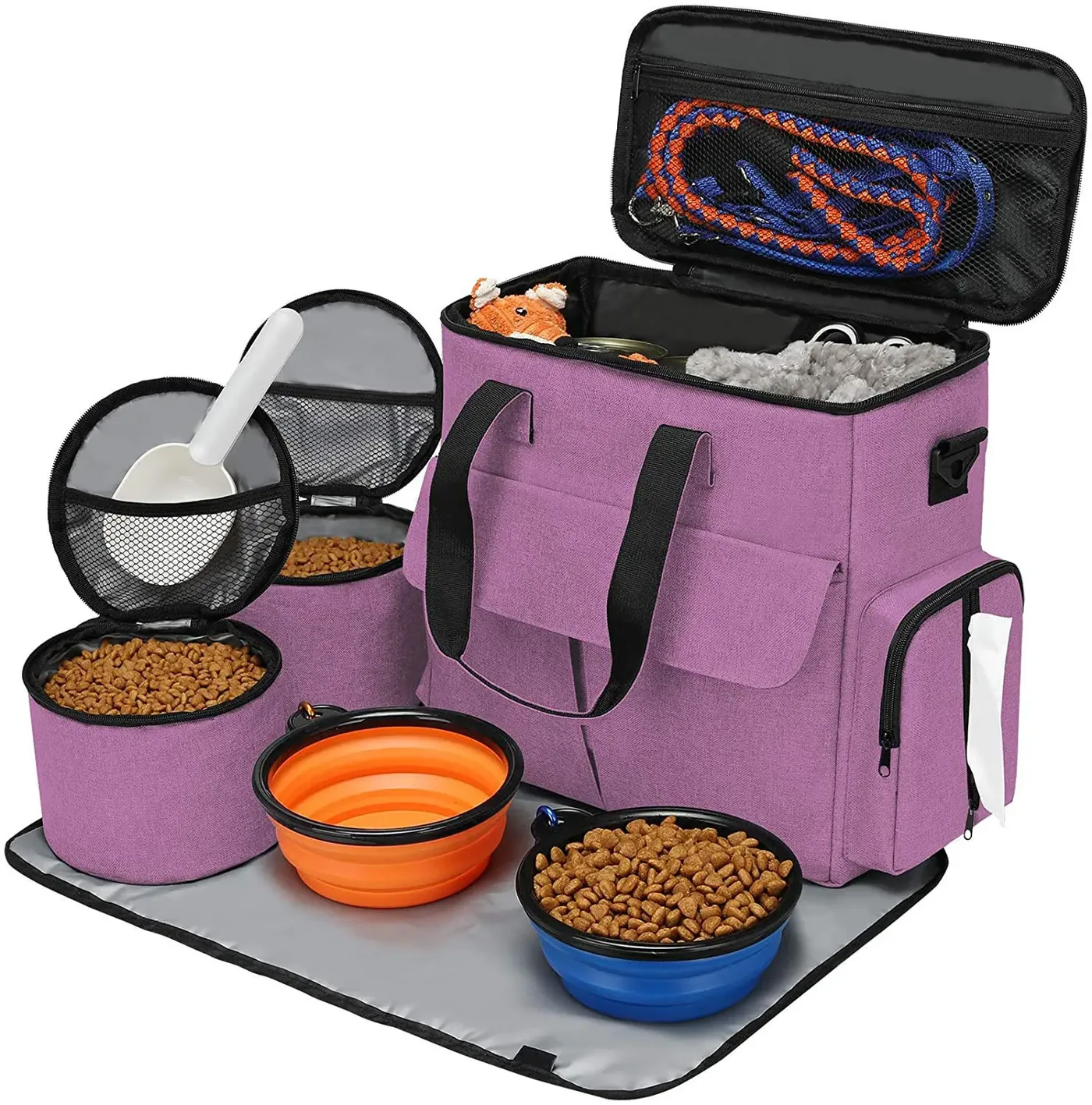
Saliva is treated as a process fluid in this class and specified as one: composition, volume, surface tension, and the barrier required to contain it. It is mildly alkaline at pH 7.4-8.0, it contains amylase and other enzymes, it has a lower surface tension than water because of its mucin and protein content, and it supports rapid bacterial growth at ambient temperature. Each of those is a specification input.
Low surface tension is the property that does the damage. Water at 72 millinewtons per metre will not penetrate a small aperture in a coated fabric readily; saliva at 45-55 millinewtons per metre will, and it wicks along a stitch hole, into a board sleeve and along a yarn bundle with ease. Any seam that is not sealed is a wick, and in a product with 40-60 metres of seam, an unsealed seam is the dominant fluid path.
Containment therefore starts at the floor and works outward. The floor is a welded basin rather than a sewn pocket: a high-frequency-welded or hot-air-welded tray or lined floor with formed corners, a perimeter upstand of 35-50 mm, and no stitch holes anywhere below the upstand line. Capacity of 12-18 litres contains the design fluid load of 2.5-4.5 litres with a wide margin, and the margin exists because a deployment on a slope pools the fluid at one end rather than distributing it.
Seam sealing is the second requirement and applies to every seam below 150 mm from the floor. Three methods are available: a hot-air-welded tape over the stitch line, a liquid-applied seam sealer, or a welded construction with no stitch at all. Welded tape is the production answer at 0.35-0.70 USD per metre applied and it is durable over the duty cycle; liquid sealers are cheaper and fail after 100-200 clean cycles.
The lining is the third barrier and is specified as a film rather than as a fabric: a thermoplastic polyurethane or polyolefin film of 60-100 micrometres, welded at the seams, bonded to a light non-woven backing for handleability. A coated fabric lining is not adequate here, because coating continuity at the stitch hole is exactly the problem being solved.
Documentation of the containment specification is simple and worth stating on the product: a declared fluid capacity, a stated cleaning method, and a stated drying time. Those three numbers are what a working handler actually needs, and they are what distinguish a working product from a companion product with a wipe-clean claim.
Fluid Management: Drainage, Absorbency and Drying Time
Containment alone is not sufficient, because a product that contains 4 litres and cannot be emptied is unusable on a second deployment. Fluid management has three parts: a drain path, a controlled absorbent layer, and a drying specification.
The drain path is a formed outlet at the lowest corner of the basin, outside the lining, with a closure that can be operated with a gloved hand. Two designs are used: a screw plug on a moulded boss, and a quarter-turn bayonet. The screw plug is cheaper and is the specification, on the condition that it is captive — a plug that comes free is lost on the first deployment — and that it seals against a moulded face rather than against a gasket that can be mis-seated in the cold.
Drain position is a terrain specification. A product set down on a slope drains to one end, so a single drain at one corner fails half the time. The specification is a drain at each of the two rear corners, or a single drain at the lowest point of a basin with a formed sump, which is the better answer because it also concentrates the fluid for cleaning.
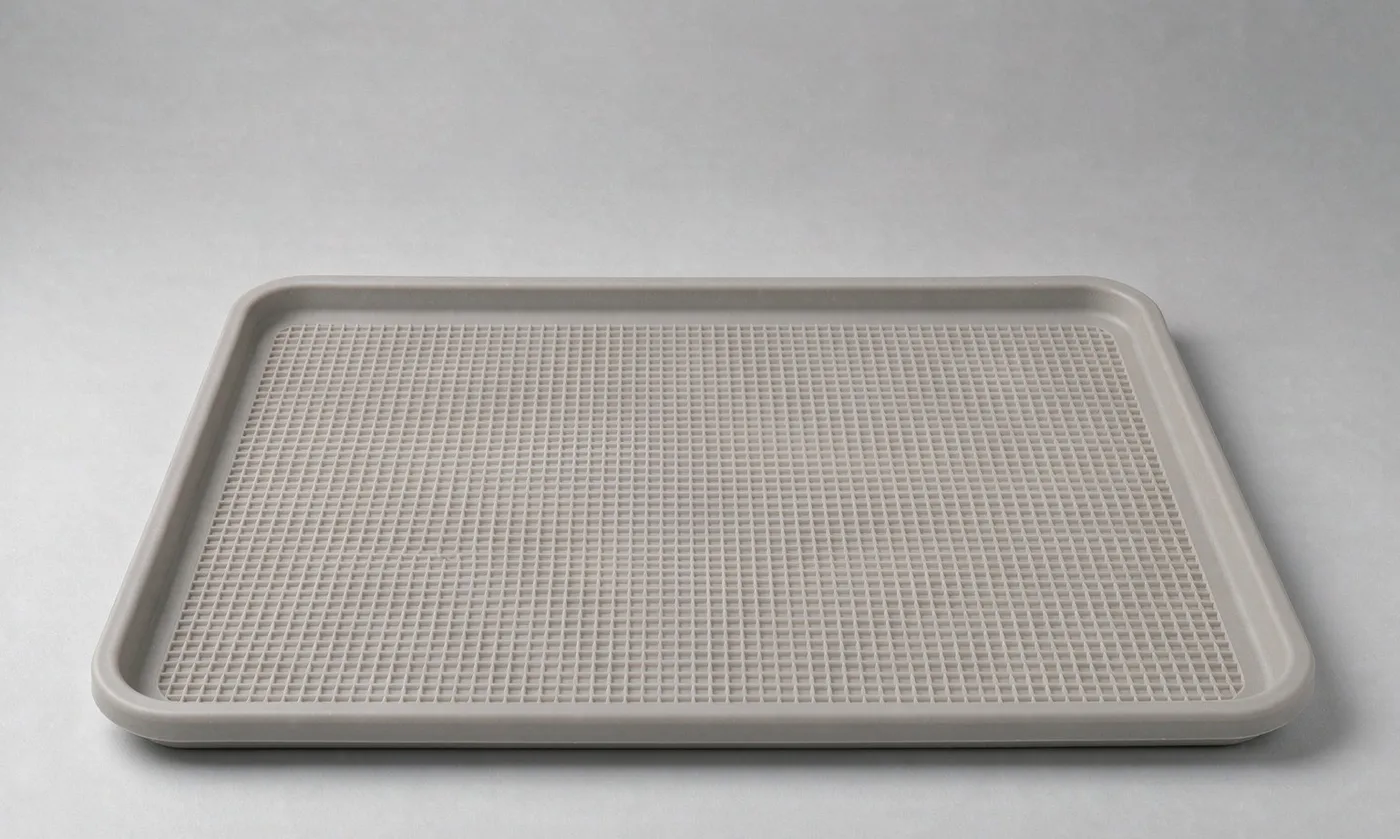
Absorbency is deliberately limited rather than maximised. A highly absorbent layer holds fluid against the lining, takes days to dry and becomes a microbial substrate; a non-absorbent layer lets fluid reach the drain and dries in hours. The specification is a removable, non-absorbent mat of closed-cell foam with a formed channel pattern that directs fluid to the sump, plus a small absorbent pad of 300-500 ml capacity at the animal's head position only, where drool concentrates.
Drying time is the metric that makes the specification real. The acceptance test is a loaded wet state — the compartment wetted with 3 litres of saline and the mat saturated — followed by drying at 15 °C and 60% relative humidity with the vents open and the drain open, and a target of under six hours to a residual moisture content below 8% in the lining and the mat. A product that cannot dry in six hours cannot be redeployed the same day and is not a working product.
Ventilation design supports drying rather than competing with it. Open area of 24-30% is maintained, and the vents are specified to remain open when the product is stored, with no closable panel that a handler can forget to reopen. A closed product stored wet will mildew within 48 hours regardless of the lining specification.
Finally, a note on the absorbent pad: it is the only consumable in the product and the programme should include it as a spare part. A working handler will replace it rather than launder it, and a pad that is not available as a spare will be replaced with a towel, which defeats the drainage design.
Material Compatibility: Saliva, Cleaning Agents and Coating Selection
Material selection in this class is a chemical compatibility exercise with three agents: saliva, the cleaning agents used in working kennels, and the environmental water the product meets. Each attacks a different component, and the failures are cumulative rather than independent.
Saliva attacks coatings and adhesives. Its enzyme content hydrolyses ester-based polyurethanes slowly, and its alkalinity accelerates the process; a standard aromatic PU coating in continuous saliva contact shows visible degradation in 200-400 hours and fails by chalking at the fold lines. Thermoplastic polyurethane and polyolefin coatings are substantially more resistant, and a TPU coating at 60-80 g/m² of dry solids is the specification for every interior surface.
Adhesives are the hidden failure. A laminated construction held with a solvent-based polyester adhesive will delaminate in continuous fluid contact long before the coating fails, and the delamination is invisible until the lining separates from the shell. The specification is a welded or flame-laminated construction with no adhesive in any below-waterline location, and an adhesive compatibility test on any bonded assembly that remains.
Cleaning agents in working kennels are more aggressive than domestic detergents. Phenolic disinfectants, peracetic acid formulations and chlorine-releasing agents are all used, and chlorine is the one that matters: it attacks polyamide, it oxidises some coatings and it corrodes untreated metal. The specification is a declared compatible-agent list generated from a 100-cycle test, and — importantly — a stated incompatible list, because a handler will use whatever is on the shelf. Declarations are written against the substance framework administered by ECHA, which is the reference European institutional buyers expect to see cited.
Metal components need specific attention for the first time in this range. A working product is disinfected daily, and a zinc alloy buckle or a plated steel rivet will corrode within a season. The specification is stainless steel or a marine-grade coated finish on every metal component, including the frame fasteners, because the fasteners are the ones that cannot be replaced.
Thread and webbing are specified for the same environment: bonded polyester thread throughout, because bonded nylon loses strength in chlorine and in continuous moisture; and polyester webbing, which holds its rating wet and resists mildew, against nylon, which absorbs up to 8% water by weight and loses strength accordingly.
Testing closes the section with a combined exposure: 500 hours of continuous saliva simulant contact at 40 °C, followed by 100 disinfection cycles, followed by a repeat of the structural proof test. A product that loses more than 15% of its seam strength across that sequence is not specified for working duty, and the simulant is a defined buffer at pH 8.0 with an amylase content rather than water.
Lift, Hoist and Rescue Deployment Interfaces
A working product is deployed in conditions where lifting by hand is not possible or not safe, and the interfaces for mechanical handling are part of the base specification. Two cases are designed for: a two-to-four person manual carry, and a hoist or winch lift.
Manual carry uses eight handles rather than the four of a companion product: two at each upper corner, oriented vertically and horizontally, so that handlers on uneven ground can each take a grip that suits their position. Each handle is rated to 2.0 kN minimum breaking strength with a 1.0 kN proof test, attached to the frame, with a clear grip opening of 130 mm by 35 mm so a gloved hand fits. Grip material is a closed-cell sleeve rather than webbing, because a webbing handle rolls in the hand and a gloved grip on a wet webbing handle is not secure.
Hoist interfaces are the distinctive requirement. Four lift points at the upper corners, each a fabricated stainless steel eye or a rated webbing loop with a thimble, each proof-tested to 4.0 kN and each marked with its rating. The four-point geometry is specified so that a standard four-leg sling lifts the product level: the points form a rectangle centred on the loaded centre of mass, and the product is marked with the lift point at the front so the sling is rigged the same way every time.
The hoist case has a dynamic component that the static rating does not capture. A winch lift on a slope, or a helicopter hoist, produces a snatch load of 1.5-2.5 times the static weight, and a 80 kg animal plus 10 kg of product at 2.5 times is 225 kg, or 2.2 kN, shared between four points. The 4.0 kN rating per point is set by that case rather than by the static one.
Restraint during a hoist is a separate requirement that is frequently omitted. An animal in a moving compartment will shift, and a shifting 80 kg mass at the end of a hoist is dangerous. The specification is two interior restraint points at floor level, fore and aft, in addition to the tether, so the animal can be secured against movement in both directions before the lift begins.
Sled and vehicle deployment is the last interface. Two longitudinal rails as described in the cold-climate class, plus four external lashing points rated to 1.5 kN each so the product can be secured to a sled, a trailer or a vehicle floor. Lashing points are recessed so they do not snag, and they are positioned so a strap over the product passes over the frame rather than over the shell.
Hygiene Validation: Fluid, Odour and Microbiological Protocol
Hygiene validation is the part of the protocol with no equivalent in a companion product, and it runs alongside the structural sequence rather than after it. Five tests are specified, and each has a numeric acceptance criterion rather than a pass or fail judgement.
Fluid containment is tested by filling the basin with the declared volume plus 50%, holding it level for 30 minutes and then at 15 degrees of tilt for a further 30 minutes, with acceptance of no strike-through to the exterior at any seam and no leakage at the drain when closed.
Wicking is tested separately and is the test that catches seam-sealing failures. A dyed simulant at pH 8.0 is ponded to a depth of 20 mm for four hours, and the product is then disassembled and every seam below the 150 mm line is inspected for dye travel. Acceptance is zero travel beyond the sealed zone.
Drying is tested to the six-hour criterion described earlier, with the residual moisture measured at six points in the lining and the mat by a pin-type moisture meter, accepted below 8%.
Odour is measured rather than judged. A headspace sample is taken from the sealed product after 24 hours following a contaminated deployment simulation, and volatile nitrogen compounds and sulfur compounds are measured by detector tube or by gas chromatography, with acceptance below a defined threshold established on a reference product. It is a comparative test rather than an absolute one, which is the only practical way to specify odour.
| Test | Condition | Duration | Acceptance |
|---|---|---|---|
| Fluid containment | Declared volume plus 50%, level then 15 degree tilt | 30 min plus 30 min | No strike-through, no drain leak |
| Seam wicking | Dyed simulant at pH 8.0, 20 mm pond | 4 h, then disassemble | Zero dye travel past the sealed zone |
| Drying | 3 litres saline, 15 °C, 60% RH, vents open | 6 h | Residual moisture under 8% |
| Chemical exposure | Saliva simulant at 40 °C | 500 h, then 100 disinfection cycles | Under 15% seam strength loss |
| Odour headspace | Sealed 24 h after contamination simulant | 24 h | Below reference threshold |
| Microbial surface | Contact plate on lining after deployment cycle | 30 cycles | Below defined colony count |
| Structural re-proof | 240 kg after full chemical sequence | 60 s hold | No seam opening over 6 mm |
Microbial surface testing is the criterion buyers argue about, and the honest position is that a soft product in working use will carry a microbial load. The specification is not sterility; it is that the lining does not support growth above a defined count after a standard clean, and that the materials do not contribute nutrients. Non-absorbent welded linings meet that; textile linings do not.
Occupational hygiene guidance for handlers is worth referencing in the product documentation, and the general animal-handling material published by the American Veterinary Medical Association is the source most buyers recognise.
Cost, Programme and Documentation Parameters
Unit cost for a compliant working-dog build lands at 88-138 USD FOB Xiamen. The welded fluid system — basin, lining, drain and sealed seams — is 18.60-30.40 USD and is the single largest cost block after labour. The frame is 12.40-21.60 USD, panels and mesh 14.20-22.80 USD, the lift and hoist interface set 9.80-17.40 USD, webbing and hardware 11.60-19.80 USD and labour 21.40-32.60 USD.
The fluid system is therefore roughly 20% of the product cost and it is the part a buyer under cost pressure will target first. It should not be. A sewn floor with a coated lining instead of a welded basin saves 9.40-16.20 USD and produces a product that wicks within a season, delaminates and smells, which is precisely the failure that ends a working programme.
Tooling is moderate compared with the giant class: pattern development 1,700-3,000 USD, a welded-basin tool 12,000-22,000 USD, and high-frequency welding fixtures 3,000-7,000 USD. The welding fixtures are the item buyers forget, and they are what make the welded seams repeatable rather than operator-dependent.
Documentation for a working programme is more extensive than for a retail one and should be budgeted: a technical file with the material declarations, the chemical compatibility list, the test reports, a cleaning and drying procedure, an inspection schedule, and a lift-point certificate. Producing that set costs 1,200-2,800 USD of engineering time and it is what makes the product saleable to an institutional buyer.
Programme viability is better than the giant class because the buyer is institutional and the price point is defensible: a working carrier at a retail of 300-520 USD replaces equipment and labour that cost more. The viable channels are rescue and alpine organisations, working-kennel suppliers, veterinary evacuation services and, in some markets, military and civil-defence procurement. The last of those carries its own documentation requirements and should be quoted separately.
One scheduling note closes the section. The welded fluid system adds 3-5 days to the first-article stage and it is the reason prototypes in this class sit at the upper end of the 6-10 working day window rather than the lower end. Bulk production stays inside the standard 35-50 days provided the welding fixtures are ordered at sample approval.
Order and quality terms
- MOQ 500 pieces per colourway; samples in 6-10 working days
- Bulk production 35-50 days after approval; AQL 2.5 inspection standard
- T/T 30/70 terms, FOB Xiamen, full document set per shipment
People Also Ask
How much saliva does a Saint Bernard produce?
250-600 ml per hour at rest and considerably more when panting after exertion, against 20-60 ml for an average breed. With snowmelt and environmental water the design fluid load is 2.5-4.5 litres per deployment.
Why must the floor be welded rather than sewn?
Saliva has a surface tension of 45-55 millinewtons per metre against water's 72, so it wicks through stitch holes readily. Every seam in a product with 40-60 metres of stitching becomes a fluid path.
Why is absorbency deliberately limited?
An absorbent layer holds fluid against the lining, takes days to dry and becomes a microbial substrate. A non-absorbent channelled mat lets fluid reach the drain and dries in hours.
What drying time is specified?
Under six hours to a residual moisture content below 8% at 15 °C and 60% relative humidity with vents and drain open. A product that cannot dry in six hours cannot be redeployed the same day.
Which coating resists saliva?
TPU at 60-80 g/m² of dry solids on every interior surface. Aromatic PU degrades visibly in 200-400 hours of continuous saliva contact and fails by chalking at fold lines.
How many lift points and what rating?
Four hoist points proof-tested to 4.0 kN each, set by the snatch load of 1.5-2.5 times static weight in a winch or helicopter hoist, plus eight manual handles rated to 2.0 kN.
Frequently Asked Questions
What interior dimensions suit the Saint Bernard class?
580-680 mm wide, 980-1,130 mm long and 700-820 mm high, from a body length of 900-1,100 mm, shoulder height of 700-900 mm and chest girth of 100-130 cm, with a hard declared limit of 80 kg.
What load ratings apply at 80 kg declared?
120 kg working, 240 kg proof and 360 kg ultimate, roughly 3.5 kN, with a 25 by 20 millimetre aluminium frame at 2.0 millimetre wall and welded gusseted corners.
Why should the product open completely flat?
A rescue deployment on a slope at night with an injured animal is not the moment to work a zipper around a corner. A top and side that open fully converts threading into a lateral transfer.
What basin capacity is specified?
12-18 litres against a design load of 2.5-4.5 litres, with a 35-50 mm upstand. The margin exists because a deployment on a slope pools fluid at one end rather than distributing it.
How are seams below the waterline sealed?
Hot-air-welded tape over the stitch line at 0.35-0.70 USD per metre applied, on every seam below 150 mm from the floor. Liquid sealers are cheaper and fail after 100-200 clean cycles.
Why is the drain positioned at a formed sump?
A product set down on a slope pools at one end, so two corner drains or a single drain at a formed sump is specified. The sump also concentrates fluid for cleaning.
Why is adhesive prohibited below the waterline?
A solvent-based polyester adhesive delaminates in continuous fluid contact before the coating fails, and the delamination is invisible until the lining separates. Welded or flame-laminated construction is specified instead.
Which metals are used in working programmes?
Stainless steel or a marine-grade coated finish on every metal component including frame fasteners, because daily disinfection corrodes zinc alloy and plated steel within a season.
Why is polyester specified for thread and webbing?
Bonded nylon loses strength in chlorine and in continuous moisture, and nylon webbing absorbs up to 8% water by weight and loses strength accordingly.
How is odour specified?
Comparatively rather than absolutely: a headspace sample after 24 hours following a contamination simulation, with volatile nitrogen and sulfur compounds measured against a threshold established on a reference product.
Is sterility ever specified?
No. A soft product in working use carries a microbial load. The specification is that the lining does not support growth above a defined count after a standard clean and that materials contribute no nutrients.
What does a compliant working build cost?
88-138 USD FOB Xiamen, with the welded fluid system at 18.60-30.40 USD, about 20% of product cost, and labour at 21.40-32.60 USD, giving a retail of 300-520 USD.
What documentation does an institutional buyer need?
A technical file with material declarations, the chemical compatibility list, test reports, a cleaning and drying procedure, an inspection schedule and a lift-point certificate, costing 1,200-2,800 USD of engineering time to produce.
Talk to QUANZHOU JUNYUAN BAGS about a pet carrier program: MOQ 500 pieces per colourway, samples in 6-10 working days, bulk production in 35-50 days under AQL 2.5 inspection.
Get a free quote Request a sampleKeep reading
- Dog Carrier Backpack for Great Danes: Extra Large
- Dog Carrier Backpack for Mastiffs: Giant Breed
- Dog Carrier Backpack for Newfoundlands: Water Rescue
- Waterproof Dog Carrier Backpack Manufacturing Standards
- Dog Carrier Backpack for Large Dogs: Design Considerations
- Dog Carrier Backpack Bottom: Reinforcement Options