Dog Carrier Backpack for Shih Tzus: Small Breed
A Shih Tzu carrier is sized to the coat envelope rather than to the body: the class runs 4-7.25 kg over a 380-480 mm body, requiring 60-90 mm of added clearance for a long double coat, a hook-and-loop-free interior, snag-resistant closed surfaces, a hair-ingress-resistant closure, and ventilation of 24-32% against a dense-coat thermal load.
This page covers the engineering decisions behind a carrier for a small breed with a long, dense double coat and a brachycephalic skull. The mass is unremarkable and the structural work is light, so the product is defined by two interface problems and one physiological one. The interface problems are coat-driven: the animal's effective envelope is 60-90 mm larger than its body in every direction, and loose hook-and-loop anywhere within reach of a long coat snags, pulls and mats hair, which is painful for the animal and generates returns. The physiological problem is that a dense double coat over a restricted airway is a thermal load the compartment has to manage. All three convert into measurable specifications and none of them appear in a generic small-dog tech pack. Commercial terms follow the standard program: MOQ 500 pieces per colourway, prototypes in 6-10 working days, bulk production 35-50 days after sample approval, final random inspection to AQL 2.5, T/T 30/70 payment and FOB Xiamen loading.
Audit records from a dog carrier factory remain the fastest way to separate a real dog carrier backpack production base from a trading office with a photo catalogue.
Mass Class and the Coat Envelope: Sizing to Hair, Not to Body
Shih Tzu dimensions are compact and moderate. Adult mass runs 4-7.25 kg, height at the withers 200-280 mm, body length 380-480 mm and chest girth 400-520 mm. On a length-and-weight chart that places the breed squarely in the middle of the small-dog group and produces an unremarkable compartment of 280-340 mm by 480-580 mm by 280-340 mm.
That compartment is wrong, and the reason is the coat. The breed carries a long, dense double coat with a soft undercoat and a topcoat that reaches the floor on an ungroomed animal. In a clipped or puppy-cut animal the coat adds 20-40 mm to each dimension; in a full-coat animal it adds 60-90 mm and it does not compress, because the hair shafts are stiff relative to their length and resist the light contact pressures inside a carrier.
The correct sizing basis is therefore the coat envelope rather than the body. Interior dimensions of 320-400 mm wide, 540-660 mm long and 320-400 mm high cover the full-coat case, and they are 15-25% larger in volume than a body-based chart would give. This is one of the few places in the range where a larger compartment is the correct answer, and it runs directly against the snug-fit rule that governs most small-dog designs.
The conflict is resolved by making the extra volume adjustable rather than permanent. A removable liner or a fold-down divider allows the compartment to be reduced for a clipped animal and opened for a full-coat one, which is cheaper than two grades and more useful than either. Where the programme supports two grades, they should differ in the liner rather than in the shell.
Chest girth is the second sizing input and it interacts with the coat in the same way: a 400-520 mm girth becomes 520-660 mm measured over the coat, and an aperture sized to the body becomes a tight tunnel that the animal has to be pushed through. Entry geometry is specified at the over-coat girth, with a minimum opening dimension of 300 mm.
| Dimension | Body-based | Coat envelope | Delta | Consequence if body-based |
|---|---|---|---|---|
| Interior width | 280-340 mm | 320-400 mm | +13-18% | Coat compressed, animal resists entry |
| Interior length | 480-580 mm | 540-660 mm | +12-15% | Tail and rear coat bunched |
| Interior height | 280-340 mm | 320-400 mm | +14-18% | Topknot and dorsal coat crushed |
| Entry aperture | 250-300 mm | 300-360 mm | +18-20% | Animal pushed through a tunnel |
| Chest girth allowance | 400-520 mm | 520-660 mm | +25-27% | Lateral compression of thorax |
| Internal volume | 38-67 litres | 55-105 litres | +45-57% | Overheating, matting, resistance |
The volume figure is the one that surprises buyers: 55-105 litres for a 6 kg dog. Size the compartment to the hair, then make it adjustable for the clipped animal.
The Hook-and-Loop Prohibition and Snag-Resistant Interior Architecture
The single most important material rule in this product is absolute: no hook-and-loop fastening of any type anywhere within reach of the animal's coat. A moulded hook face does not merely catch long hair, it grips individual shafts and holds them while the animal moves, which pulls the hair at the follicle and tears out mats that have already formed. It is painful, it damages the coat, and it is the most common cause of a returned product in this category.
The prohibition covers more than the visible fastening. It includes hook-and-loop used to retain a mat, to close an interior pocket, to secure a liner and to hold a removable pad, and it includes the loop component alone, because a woven loop face snags hair nearly as effectively as a hook face does. Every one of those functions has an alternative: a zipper with a covered garage for a pocket, a welded pocket or a press-stud for a mat, and a channel-and-hem arrangement for a liner.
Press studs need their own caveat. A metal or moulded stud with a smooth domed face is acceptable; a stud with a sharp rolled edge or an exposed socket catches hair at the edge. The specification is a domed stud with a radius of 1.5 mm or greater at every exposed edge, pull-tested at 40 N and screened against a 31.7 mm small-parts gauge.
Beyond fastenings, the interior surface architecture is specified against snagging. The rule is a closed or tight-weave surface with no free fibre: no loop pile, no brushed or raised face, no open knit, no raw binding edge above 2 mm and no exposed seam allowance. Every binding is sewn flat and topstitched so the free edge is captured, and every interior seam is bound or welded rather than left as an overlocked edge, because an overlocked edge presents a row of thread loops to a long coat.
Floor mat selection is the last element and it is where the snag problem is most acute, because the coat is in continuous contact with the floor. The specification is a closed-cell or moulded surface with a fine texture rather than a textile pile, at a 3-6 mm thickness, with a coefficient of friction above 0.55 and a face that releases hair when shaken rather than holding it.
Hair Ingress: Closure, Seam and Maintenance Engineering
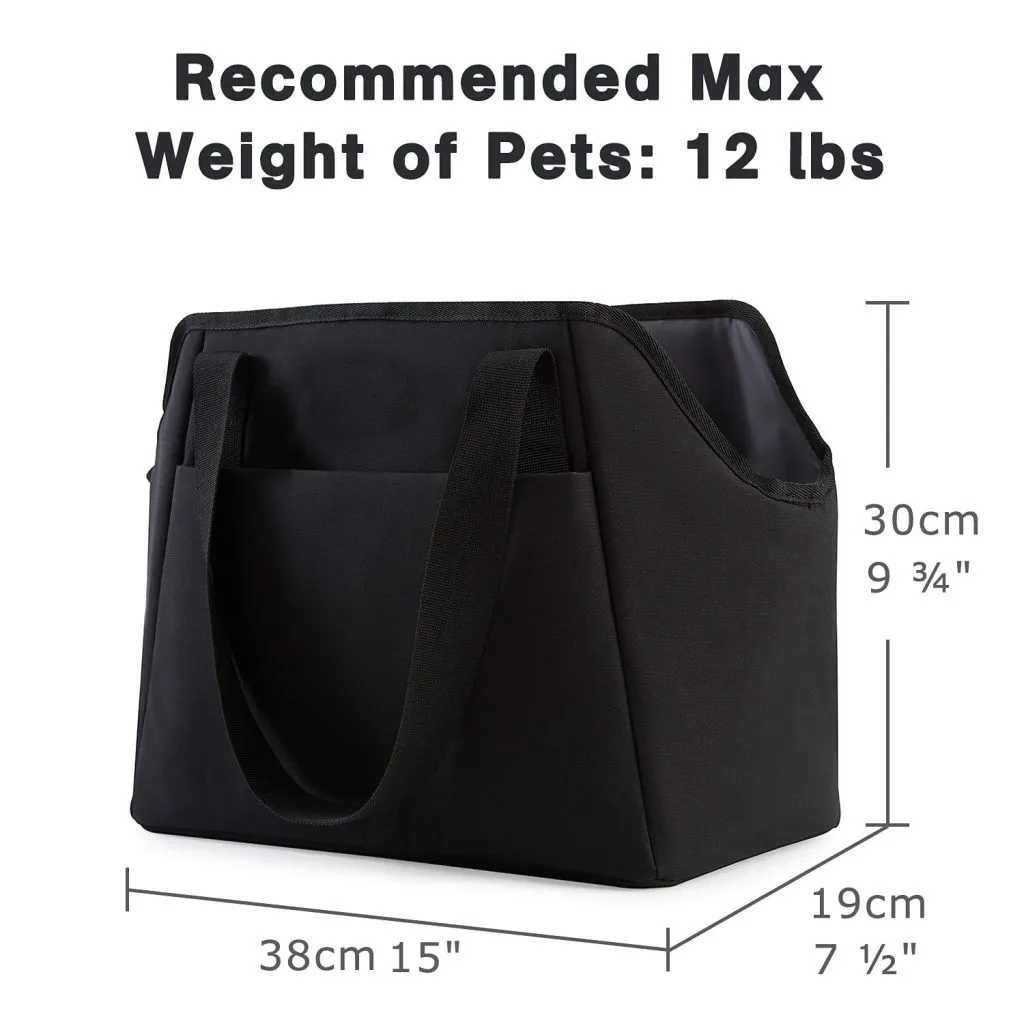
A long-coated breed sheds continuously and the hair is fine, short and highly mobile. It enters every mechanical element in the product, and the closure is the element that fails first. Hair packs into the zipper coil, accumulates at the slider, increases the pulling force and eventually jams the closure or tears the coil out of the tape.
Closure selection is the primary control. A reverse-coil zipper is the correct choice rather than a metal or moulded-tooth type, because the coil presents no interstices for hair to pack into and it can be flushed. The slider is specified with a brush-finished body and a covered garage at the head end so the entry point is screened, and the closure geometry should leave the slider channel accessible for cleaning rather than bound into a narrow tunnel.
Closure position is the second control and it is more effective than selection. A closure on the top face of the compartment collects hair by gravity; a closure on a vertical face collects less and sheds what it collects. Where the design allows, the primary closure is placed on a vertical or near-vertical face, and any horizontal closure is protected by a storm flap that sheds rather than traps.
Seam and corner geometry determine how much hair the product retains overall. Square corners accumulate packed hair that cannot be removed by shaking, so interior corners are radiused at R30 or greater and the floor mat is removable so it can be shaken out separately. A removable mat is not a convenience feature here, it is the primary maintenance path.
Maintenance validation closes the section and it is specific: after a standardised shedding exposure, the closure must complete 200 open-close cycles without an increase in pulling force above 20%, and the interior must release at least 80% of accumulated hair by shaking alone. Those two figures are measurable, they correlate with what owners complain about, and they belong in the tech pack rather than in the marketing copy.
Brachycephalic Airway and the Dense-Coat Thermal Load
The breed is brachycephalic, though typically less severely than the Pug or the French Bulldog. The same mechanical constraints apply at a lower intensity: a shortened muzzle, a compressed upper airway and a reduced capacity to increase ventilation by panting. The compartment therefore needs the neck-extended resting posture and the lateral rather than frontal ventilation placement used across the brachycephalic group, at somewhat relaxed figures.
Open area of 24-32% suits the class, between the 16-20% used for a mesocephalic small dog and the 30-38% used for a French Bulldog. Cross-flow is required for the same reason and is harder to achieve here, because the larger coat-envelope compartment has a longer internal path and a greater tendency to short-circuit. Intake low and lateral on two faces, exhaust across the upper rear face at 80% or more of intake area.
The thermal load is the part that distinguishes this breed from a Pug of similar mass. A dense double coat with a soft undercoat is an insulating layer the animal is wearing, and it retards heat loss in exactly the situation where the animal most needs to lose heat. The practical consequence is that the effective thermal ceiling is lower than the breed's moderate brachycephaly would suggest, and the working figure is a stated maximum ambient of 24 °C with active cooling required above 27 °C.
Ventilation has to reach the animal through the coat, which is a further argument for the elevated plenum floor. Air admitted underneath the animal passes through the thinner ventral coat and across the uninsulated skin of the abdomen, where convective and evaporative loss is greatest. A plenum floor of 15-25 mm costs 0.55-1.30 USD and is the most effective passive measure available for a coated breed.
Matting interacts with thermal performance and is worth stating. A coat that mats loses its loft and insulates less, so a matted animal is paradoxically at lower thermal risk and higher dermatological risk. The engineering response is the same in both cases: keep the coat dry, keep airflow moving through it, and avoid compression. Welfare framing is cross-checked against guidance from the American Veterinary Medical Association, and thermal conditioning methods follow standards published by ASTM International.
Ocular and Facial Moisture Management
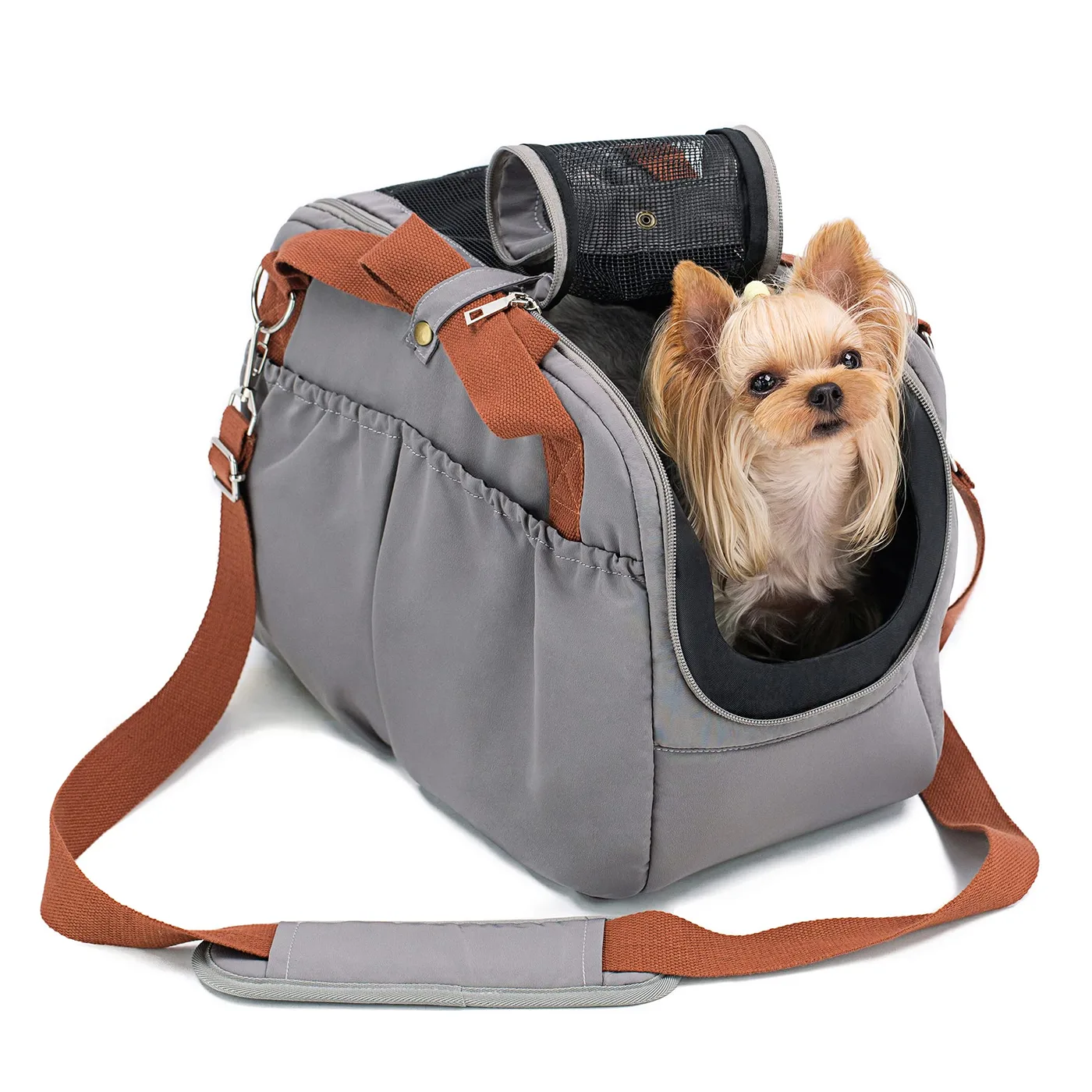
The breed has large, prominent eyes with a shallow orbit and a well-documented tendency to epiphora — excessive tearing — with consequent staining and periocular dermatitis. Facial hair around the eyes and the muzzle holds that moisture, and a carrier journey of an hour or more adds respiratory humidity to it. The product's contribution is to keep the head area as dry and as clean as the design allows.
Directed airflow is the primary control and it is the same measure that serves the airway: lateral ventilation that sweeps across the head position rather than frontal ventilation that blows into the face. The distinction matters because airflow directed into a flat face with prominent eyes dries the cornea, while airflow across the head carries moisture away without desiccating the eye.
The head-contact surface is the second control. A moisture-holding textile under the head becomes a wet pad against the facial hair within twenty minutes, so the specification is a wicking knit of 180-260 g/m² over an open spacer layer that moves moisture laterally and dries in use. It is the same construction used for the Pug product and for the same reason, though here the driver is dermatological rather than ocular.
That panel is removable and washable, rated to fifty machine cycles at 40 °C with dimensional change under 3%, because a wicking surface that holds sebum and tear staining needs washing more often than any other element in the product. It is the only interior panel specified this way.
Clearance around the head is the third control and it is less severe than the Pug requirement but not nil. Interior trim within 200 mm of the head position is limited to a 2 mm protrusion, every fastener in that zone is recessed under a welded washer or a cover, and no seam or binding edge in the zone stands above 2 mm. In a breed with prominent eyes and long facial hair, an interior protrusion is both a corneal hazard and a hair-pulling one.
Floor, Posture and Support for a Compact Brachycephalic Build
The breed is compact and brachycephalic without the extreme chondrodystrophy of a Dachshund or the extreme chest depth of a French Bulldog, so the floor and posture specification sits in the middle of the range with two specific features. The mass is low enough that structural work is trivial; the posture requirements are what remain.
Floor deflection under 3 mm at 8 kg measured at mid-span is the specification, over a span of 480-660 mm. That requires a board of 3.5-5.0 mm or a moulded tray with ribs of 10-16 mm depth. A flat, unbroken surface is required, with no contour above 3 mm across the width, for the same reason it is across the range: any contour produces the unsupported length that a spine cannot stabilise.
Posture support is the second feature and it follows the brachycephalic rule. The animal must be able to rest with the neck extended in line with the spine, which requires 320-400 mm of internal height with 40-80 mm of clearance above the crown and no forward obstruction within 150 mm of the muzzle. In a long-coated animal the crown clearance is measured to the top of the coat, not to the skull, which is another instance of the coat envelope governing the geometry.
A rear-down slope of 3-5 degrees is worth specifying, as it is for the other brachycephalic breeds, because it holds the extended posture by gravity and drains liquid toward the rear. With a long coat the drainage benefit is larger than usual, because a wet coat is heavy, mats readily and holds moisture against the skin.
Traction and mat specification follow the standard with one adjustment: a 4-6 mm captive mat with a coefficient of friction above 0.55 and a closed face that releases hair. A loose mat under a long-coated animal is worse than under a short-coated one, because the coat grips the mat and the mat moves with the animal, producing a bunched, unstable surface.
Cleaning, Grooming-Cycle Use and Material Durability
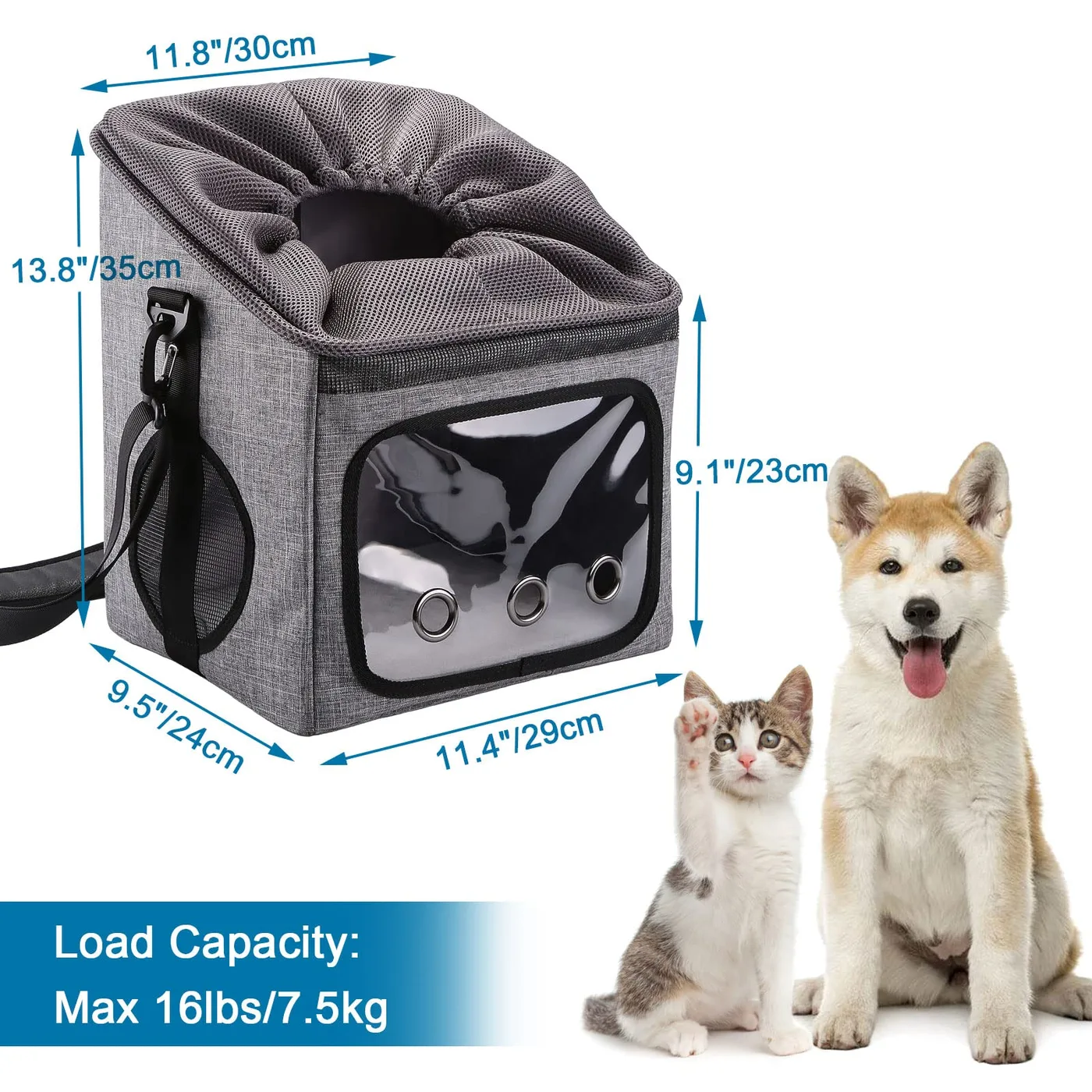
This product is used more often and cleaned more often than most carriers in the range, because the breed is carried to and from grooming appointments on a cycle of four to eight weeks and because the coat transfers sebum, saliva and debris into the interior on every journey. Material durability is therefore specified against a cleaning frequency roughly twice that of a general small-dog product.
Lining selection follows from that. A coated woven of 300-420 g/m² with a TPU or PU coating of 25-40 g/m² dry solids gives a surface that wipes clean and resists both sebum and the diluted biocides used between grooms. A lighter uncoated lining stains and holds odour within a few cycles, and a brushed or raised face — comfortable and quiet — is disqualified by the snag rule rather than by the cleaning rule.
Coating durability is validated over cycles rather than by a single test: fifty wipe cycles with a diluted biocide, then a full wash at 40 °C, accepting no coating degradation, no seam opening, no dimensional change above 3% on removable elements and no residual odour after 24 hours. The test is run on the lining, the head panel and the floor mat because all three are cleaned at different frequencies and fail for different reasons.
Colour fastness is a real commercial issue in this category and it is worth specifying explicitly. Tear staining produces a reddish-brown deposit on light-coloured interiors, and a pale lining shows it within weeks. The specification is a colour fastness to staining and to washing of grade 4 or better, or a deliberate choice of a mid-tone lining colour that does not show it. This is a styling decision with a measurable specification attached.
Hardware finishes are selected for the same environment. A declared powder coat or stainless, screened for heavy metals, with no brass or zinc die-cast, and a salt-spray or humidity check on plated finishes because the product is washed more often than a general carrier. Textile components are screened against OEKO-TEX criteria throughout.
Volume, Freight Economics and Packing Engineering
The coat-envelope decision has a consequence that reaches well past the tech pack: a 55-105 litre product is a bulky shipment, and for a category where freight is quoted on volumetric rather than actual weight, volume is the dominant cost driver. A carton of 620 x 420 x 420 mm at 0.109 m³ carries six units; the same carton at 700 x 480 x 480 mm and 0.161 m³ carries four. That is a 48% increase in freight cost per unit for a compartment increase that is clinically necessary, and it has to be recovered somewhere in the programme.
Compression packing is the first lever. The product ships with the compartment collapsed or nested where the construction allows, and the specification is a packed height no greater than 60% of the deployed height, achieved by a folding perimeter frame rather than by compressing the floor board. A board must never ship folded or curved, because a creased board is a permanent sag in the one component the breed's spine depends on.
Nesting is the second lever and it is worth designing for. Two units nested rather than side-by-side reduce the effective carton volume by 20-30%, at the cost of a slightly more complex pack-out instruction. For a programme shipping full containers the saving is material and the design change is small: a tapered shell profile of 3-5 degrees per face is enough to allow nesting without changing the internal envelope.
Retail packaging is the third consideration and it cuts the other way. A bulky product in a showroom competes on presence, and a heavily compressed retail pack undersells it, so the retail carton is usually specified at the deployed volume and the master carton at the compressed one. The two-pack specification is a real cost item and it belongs in the quotation rather than in a later value-engineering exercise.
Weight interacts with the same economics. The finished product at 1.1-1.7 kg is heavier than a generic small-dog carrier because of the larger shell and the plenum floor, and the carried mass is the animal plus the product. At a 6 kg animal that is a meaningful fraction of the total, and it is the reason the shell is specified at 300-420 g/m² rather than at the heavier weights used on a mid-size product.
Test Protocol, Cost and Programme Notes
Release testing for the class adds five checks to the standard dog protocol: a coat-envelope fit check, a snag survey, a hair-ingress closure test, an airflow measurement and a cleaning-cycle validation. The structural protocol runs at 4x the 8 kg rating, so 32 kg plus product mass, which is unremarkable for the range.
The coat-envelope fit check uses a gauge block sized to the body plus 60-90 mm of simulated coat, passed through the entry aperture and seated in the compartment on three production samples, with acceptance of no compression at any contact point. The snag survey is a documented review confirming no hook-and-loop of any type, no loop pile, no free binding edge above 2 mm and no exposed overlocked seam anywhere in the interior.
The hair-ingress test is the distinctive one: a standardised mass of shed hair is introduced into the compartment, the closure is cycled 200 times, and both the increase in pulling force and the proportion of hair released by shaking are measured. Acceptance is an increase under 20% and release above 80%. Airflow is measured as face velocity at the resting position, accepting 0.25-0.45 m/s.
Cost is driven by the larger compartment and by surface and closure quality rather than by structure. The enlarged shell adds 1.20-2.80 USD, the plenum floor 0.55-1.30 USD, the removable wicking head panel 0.60-1.40 USD, hair-resistant reverse-coil closure and storm flap 0.70-1.60 USD, and the closed-face mat and lining package 0.90-2.00 USD. Total increment over a generic small-dog carrier is 3.95-9.10 USD, landing the unit at 15-26 USD FOB.
Programme notes close the page. MOQ is 500 pieces per colourway, prototypes run 6-10 working days and bulk production 35-50 days after approval, with final random inspection to AQL 2.5 and the snag survey and closure ingress test written into the defect list. The hook-and-loop prohibition is the one item worth calling out to every supplier in the chain, because it is the specification most likely to be quietly reintroduced in a cost-down exercise. This is a coat-interface product; get the surfaces and the closure right and the structure takes care of itself.
Order and quality terms
- MOQ 500 pieces per colourway; samples in 6-10 working days
- Bulk production 35-50 days after approval; AQL 2.5 inspection standard
- T/T 30/70 terms, FOB Xiamen, full document set per shipment
People Also Ask
Why is a Shih Tzu carrier larger than its body size suggests?
The coat is stiff relative to its length and does not compress under light contact, adding 60-90 mm to every dimension on a full-coat animal. Interior dimensions of 320-400 mm by 540-660 mm by 320-400 mm cover the envelope, giving 55-105 litres.
Why is hook-and-loop banned inside a Shih Tzu carrier?
A moulded hook face grips individual hair shafts and holds them while the animal moves, pulling at the follicle and tearing out existing mats. The prohibition covers the loop component alone and every interior application, including mat and liner retention.
How is hair ingress into the zipper controlled?
A reverse-coil zipper with a brush-finished slider and a covered garage, placed on a vertical rather than horizontal face where the design allows, with the slider channel accessible for flushing. A metal or moulded-tooth type packs hair and jams.
How much ventilation does a Shih Tzu need?
24-32% open area in cross-flow, between the mesocephalic small-dog figure and the French Bulldog figure, with a 15-25 mm plenum floor so air reaches the thinner ventral coat and abdominal skin.
At what temperature is a Shih Tzu at risk?
A stated maximum of 24 °C ambient with active cooling required above 27 °C. A dense double coat is insulation the animal cannot remove, which lowers the effective ceiling below what moderate brachycephaly alone would suggest.
How is facial moisture and tear staining managed?
Lateral airflow sweeping across the head rather than frontal airflow into the face, plus a removable wicking knit of 180-260 g/m² over an open spacer layer, rated to fifty machine cycles at 40 °C.
How is the coat-envelope fit verified?
A gauge block sized to the body plus 60-90 mm of simulated coat is passed through the entry aperture and seated in the compartment on three production samples, accepting no compression at any contact point.
Frequently Asked Questions
What are the body dimensions of the class?
4-7.25 kg, 200-280 mm at the withers, 380-480 mm body length and 400-520 mm chest girth. Over the coat the girth becomes 520-660 mm, and the entry aperture is specified at that figure with a 300 mm minimum.
Should the programme use two grades?
Only if the volume supports it, and they should differ in the liner rather than in the shell. A removable liner or fold-down divider lets one compartment serve both the clipped and full-coat cases more cheaply than two patterns.
What press studs are acceptable near a long coat?
A domed metal or moulded stud with a radius of 1.5 mm or greater at every exposed edge, pull-tested at 40 N and screened against a 31.7 mm small-parts gauge. A sharp rolled edge or an exposed socket catches hair.
Why is an overlocked interior seam prohibited?
It presents a row of thread loops to a long coat. Every interior seam is bound or welded instead, and every binding is sewn flat and topstitched so the free edge is captured.
What floor mat suits a long-coated breed?
A closed-cell or moulded surface of 3-6 mm with a fine texture, a coefficient of friction above 0.55 and a face that releases hair when shaken. A textile pile both snags and retains hair.
Why are interior corners radiused?
Square corners accumulate packed hair that shaking cannot remove. Corners are radiused at R30 or greater and the floor mat is removable, which is the primary maintenance path rather than a convenience feature.
What is the hair-ingress acceptance test?
A standardised mass of shed hair introduced into the compartment, 200 closure cycles, then measurement of pulling-force increase and of the proportion released by shaking. Acceptance is under 20% increase and above 80% release.
Why is the plenum floor particularly effective here?
Air admitted underneath passes through the thinner ventral coat and across the abdominal skin, where convective and evaporative loss is greatest. It is the most effective passive measure available for a coated breed at 0.55-1.30 USD.
What clearance is required around the head?
Interior trim within 200 mm of the head limited to a 2 mm protrusion, every fastener recessed under a welded washer or cover, and no seam or binding edge above 2 mm. Crown clearance of 40-80 mm is measured to the top of the coat, not the skull.
What floor deflection is specified?
Under 3 mm at 8 kg measured at mid-span over 480-660 mm, requiring a 3.5-5.0 mm board or a moulded tray with 10-16 mm ribs, with no contour above 3 mm across the width.
Why is the rear-down slope useful for a long coat?
It holds the neck-extended posture by gravity and drains liquid toward the rear. With a long coat the drainage benefit is larger than usual because a wet coat is heavy, mats readily and holds moisture against the skin.
What lining specification suits grooming-cycle use?
A coated woven of 300-420 g/m² with a TPU or PU coating of 25-40 g/m² dry solids, wiping clean and resisting sebum and diluted biocide, validated over fifty wipe cycles plus a 40 °C wash.
Why is colour fastness called out explicitly?
Tear staining deposits a reddish-brown mark on light interiors within weeks. The specification is colour fastness to staining and washing of grade 4 or better, or a deliberate mid-tone lining that does not show it.
What does a Shih Tzu build cost?
15-26 USD FOB, an increment of 3.95-9.10 USD: enlarged shell 1.20-2.80 USD, plenum 0.55-1.30 USD, head panel 0.60-1.40 USD, closure and flap 0.70-1.60 USD, mat and lining 0.90-2.00 USD.
Talk to QUANZHOU JUNYUAN BAGS about a pet carrier program: MOQ 500 pieces per colourway, samples in 6-10 working days, bulk production in 35-50 days under AQL 2.5 inspection.
Get a free quote Request a sampleKeep reading
- Dog Carrier Backpack for Pugs: Flat-Faced Breed
- Dog Carrier Backpack for Chihuahuas: Breed-Specific
- Dog Carrier Backpack for Small Dogs: Compact Design
- Dog Carrier Backpack Mesh: Airflow and Durability
- Dog Carrier Backpack Bottom: Reinforcement Options
- Best Dog Carrier Backpack Materials: A Complete Comparison