Dog Carrier Backpack for Small Dogs: Compact Design
Compact carriers for the small-dog class are built to a body envelope of 2-8 kg, 30-52 cm chest girth and 25-42 cm back length, giving interior dimensions near 200 x 420 x 280 mm and a finished weight target under 900 g. Structure comes from panel tension and a 1.5-2.0 mm base stiffener rather than a frame sheet, harness webbing drops to 15-20 mm, and release testing is a 10 kg static load plus 300 mm drop.
This page approaches the small-dog carrier as a minimisation problem: every gram and every cubic centimetre has to be justified, because the value of the product is that it disappears when not in use. It covers body-parameter derivation, interior dimension maths and dead-space elimination, a gram-level weight budget, frameless structural design, harness scaling, opening geometry, and the test protocol appropriate to a 10 kg rated load. Commercial terms follow the standard program: MOQ 500 pieces per colourway, prototypes in 6-10 working days, bulk production 35-50 days after approval, final random inspection to AQL 2.5, T/T 30/70 payment and FOB Xiamen loading. Small-format carriers are the cheapest to make and the easiest to ship, which is why they are frequently the first SKU in a brand's range and the one that sets the cost baseline for everything that follows.
Private label pet bags and dog carrier backpack lines share one packaging standard here, so a mixed order does not add handling cost or a second carton size.
Body Parameter Envelope for the Small-Dog Class
The small-dog class spans a wider relative range than the large-dog class, which is the first thing engineers get wrong about it. A 2 kg animal and an 8 kg animal differ by a factor of four in mass but only by a factor of about 1.5 in linear dimensions, so a single pattern cannot serve the whole class comfortably. It has to be split, and the split should follow the body measurements rather than the weight bands printed on a size chart.
Chest girth is the controlling measurement. At 30-38 cm it sets an interior width of 155-190 mm; at 40-45 cm, 195-225 mm; at 48-52 cm, 230-260 mm. Back length sets interior length: 25-30 cm gives 300-360 mm, 32-36 cm gives 380-440 mm, 38-42 cm gives 450-520 mm. Interior height follows shoulder height at 55-60% for a standing animal, with 180-260 mm covering the class. These derivations use the same ease rules as larger formats but the tolerances are tighter in percentage terms, because 20 mm of unwanted ease is a much larger fraction of a 200 mm dimension than of a 400 mm one.
| Weight (kg) | Chest girth (cm) | Back length (cm) | Interior W x L x H (mm) | Rated load (kg) | Target weight (g) |
|---|---|---|---|---|---|
| 2-3 | 30-34 | 25-28 | 170 x 320 x 190 | 5 | 520-620 |
| 3-4 | 33-38 | 28-31 | 190 x 360 x 210 | 6 | 600-700 |
| 4-6 | 38-45 | 31-36 | 215 x 410 x 240 | 8 | 700-820 |
| 6-8 | 45-52 | 36-42 | 250 x 480 x 270 | 10 | 800-950 |
Rated load sits at roughly 1.3-1.5x body weight, which is lower than the multiplier used in the large-dog class. The reason is that small animals generate smaller absolute transients: a 4 kg dog shifting position produces a load spike of a few kilograms, not tens of kilograms. Rating at 1.5x covers that with margin without forcing the structure heavier than the compact brief allows.
Weight distribution within the class also differs. Small dogs carry a larger fraction of their mass forward, so the interior floor should be biased slightly toward the front of the compartment and the pad positioned accordingly. Getting this wrong produces a carrier that tips forward when set down — a defect that looks like a base problem and is actually a mass-distribution problem.
Volume Minimisation: Interior Dimension Derivation and Dead Space
Compact design is not small design; it is the removal of volume that does no work. A carrier can be reduced in three ways, and only two of them are legitimate. Removing dead space is legitimate. Removing the animal's postural envelope is not, and it produces a product that fits on paper and fails in use.
Dead space appears in four predictable places at this scale. Corners: a rectangular compartment wastes the four corner volumes an animal cannot occupy, so a pattern with radiused corners of R40-60 recovers 4-8% of internal volume for free. The space above the animal's back: interior height driven by a standing posture leaves 30-50 mm of unused headroom when the animal is lying down, which is why a soft-top panel that can compress under an external strap is worth specifying. Excess length beyond the tail: 60-80 mm is needed for the animal to turn, not 150 mm. And the pad cavity, which should be a removable item rather than a permanently thick bonded layer.
The external envelope is driven by use case rather than by the animal. Where the carrier has to fit under an aircraft seat, the external dimensions are constrained by the airline's published under-seat limits, and the useful reference for those is the guidance maintained by the U.S. Federal Aviation Administration. Where it has to pack flat for e-commerce, the constraint is folded thickness, which pushes toward a soft structure with no rigid board. Where it has to fit inside a larger tote, the constraint is the folded cross-section. The external envelope should be written into the brief as a hard dimension, not discovered at the sampling stage.
One caution about minimising length: the animal needs enough room to shift from a lying position on one side to the other, which requires interior length of at least 1.25x back length. Carriers built to 1.05x are comfortable for transport and unusable for rest, and they generate returns from owners whose animal refuses to settle. The compact target should be applied to external volume and to dead space, not to the animal's ability to change posture.
Weight Budget: Allocating Grams Across Shell, Structure and Hardware
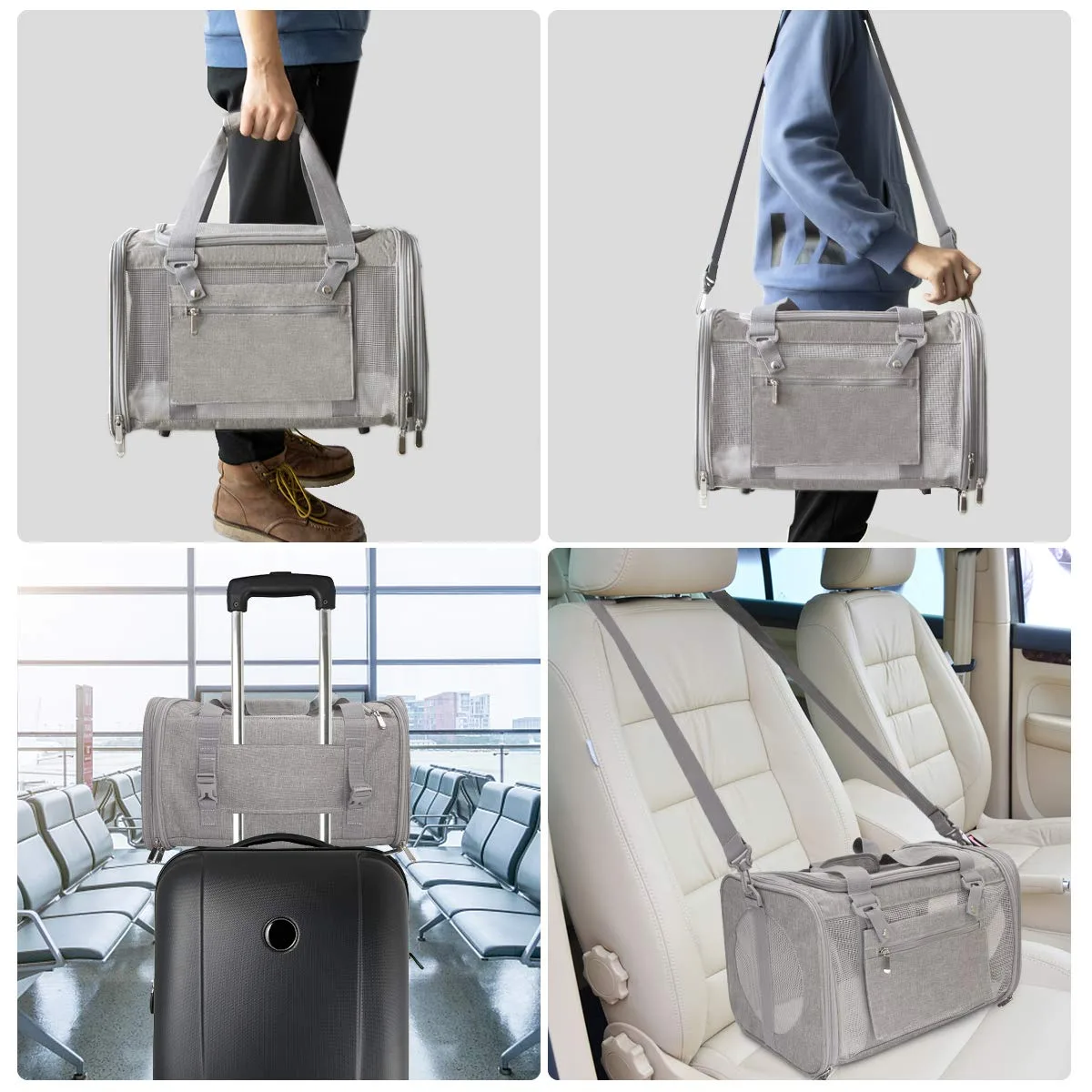
At this scale weight is a specification with a tolerance, not an aspiration. A finished target of 700-900 g for the mid-size small-dog model is achievable and is the number wearers notice: below about 650 g the carrier feels like a bag, above about 1,100 g it feels like luggage and the compactness argument is lost.
The budget is allocated before the first pattern is cut. Shell and lining at 300-380 g for a 420D or 600D polyester build; padding and stiffeners at 90-140 g; webbing and harness components at 80-120 g; zippers and pulls at 60-110 g; hardware at 40-80 g; mesh and binding at 40-70 g; thread, labels and consumables at 25-40 g. That totals 635-940 g, and the allocation is what prevents the common failure of over-specifying one subsystem — usually padding — and then discovering the target is missed by 200 g with no obvious place to recover it.
Fabric selection is the largest lever. Moving from 600D to 420D saves 60-90 g on a small-format carrier, and moving from a PU-coated to an uncoated finish with a separate water-repellent treatment saves another 20-35 g. Those savings are not free: 420D has roughly 30% lower tear strength, so the shell needs either a ripstop construction or a design that does not load the shell in tension. Ripstop at 420D with a 20 mm grid recovers most of the tear performance for a 10-15 g penalty and is usually the better trade.
Hardware is the second lever and the one with the best return. Swapping a zinc-alloy adjuster set for acetal saves 25-45 g per carrier, swapping a metal zipper pull for a moulded one saves 8-15 g, and eliminating a second zipper saves 30-50 g. Hardware weight is often 12-18% of the total at this scale, which is disproportionate to its function, and it is where compact programmes routinely find the last 100 g.
Weight verification is by weigh-in on the first ten units of every production run, not by calculation from the BOM. Thread and adhesive add 30-60 g that never appears in a component table, and a carrier whose actual weight drifts 8% above the spec sheet is a carrier whose specification is not being controlled.
Structural Approach Without a Frame Sheet
A small-dog carrier does not need a frame, and adding one is the most common way a compact programme fails its own brief. At a 10 kg rated load, panel tension and a light stiffener are sufficient, and the structure can be designed to be soft enough to fold — which is frequently the product's whole selling point.
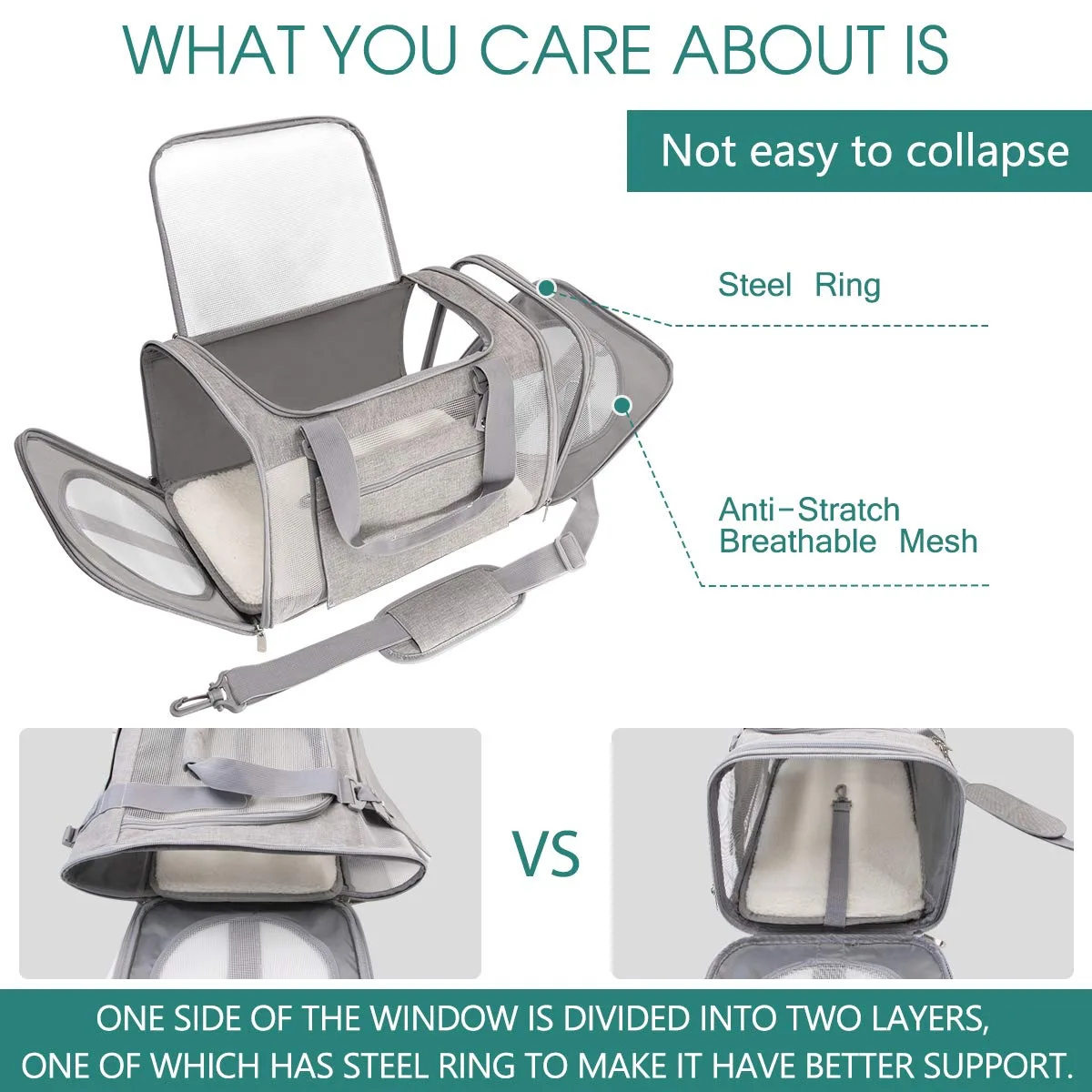
The structural system has three elements. First, a base stiffener: 1.5-2.0 mm of HDPE or PP, die-cut to the base profile and inserted in a sleeve, giving a flat platform without adding meaningful weight or fold resistance. Second, panel tension: the shell is cut slightly undersized relative to the lining so that the assembly is pre-stressed when sewn, which is what holds the shape. Third, a perimeter wire or cord at the top opening: a 2.0-2.5 mm PE cord in a bound channel, which keeps the mouth open without a rigid hoop.
Where the carrier needs to hold shape when empty — for retail presentation, or because the animal needs headroom — a light EVA perimeter frame of 3-4 mm thickness in the four vertical edges gives it. That adds 40-70 g and slightly reduces foldability, so it is a deliberate choice rather than a default. The alternative, a full moulded shell, adds 180-300 g and turns a compact carrier into a hard carrier, which is a different product category entirely.
Foldability needs its own specification if it is claimed. A carrier described as foldable should compress to a stated thickness — typically 60-90 mm for a small-dog model with a 2.0 mm base board — and should recover to full shape within 24 hours of being unpacked, with no permanent crease in any panel. Testing that recovery after 30 days of compressed storage is the only reliable check, because foam and coated fabrics both take a set that is invisible after a day and permanent after a month.
Seam engineering changes with a soft structure. Because there is no frame to carry load, the base-to-side seam carries more of it proportionally, so the allowance rises to 12-15 mm and the seam is bound rather than left raw. Bar-tacks at the four base corners are 10 mm minimum. A frameless carrier that fails in the field almost always fails at a base corner seam, not in the middle of a panel.
Harness Scaling: 15-20 mm Webbing and Low-Profile Padding
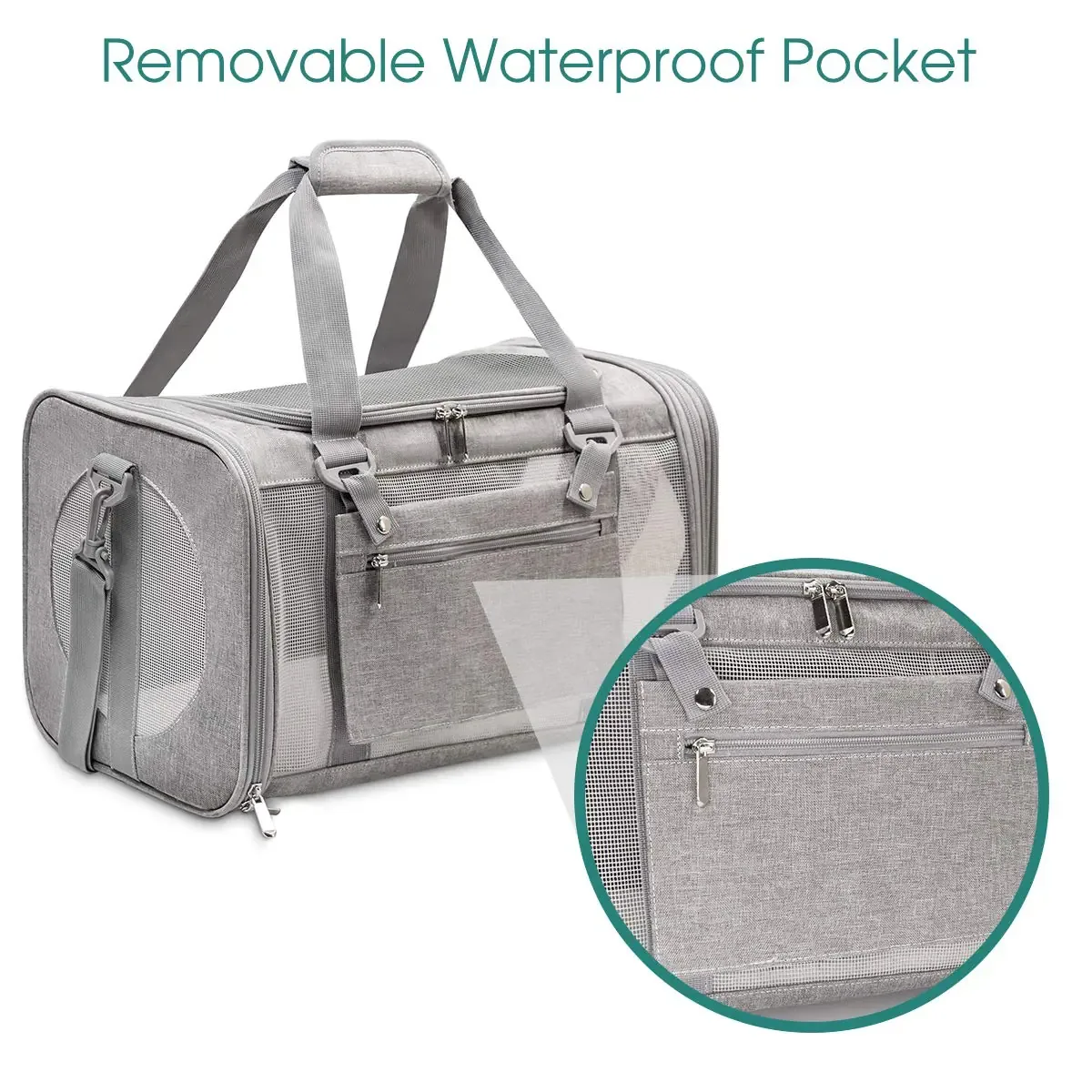
Harness components do not scale linearly with load, and the small-dog class is where over-specification does the most damage. A 25 mm webbing strap on a carrier carrying 6 kg is not safer than a 15 mm one — both are far above the required strength — but it is heavier, bulkier and harder to fold. The correct approach is to size the harness to the actual load and spend the saved weight on comfort where it matters.
Webbing at 15 mm is rated well above a 10 kg design load: a standard polyester webbing at 15 mm has a breaking strength of 2.0-3.0 kN, against a working load of under 200 N including transients. 20 mm is used where the strap crosses the shoulder and comfort matters more than weight. Above 20 mm there is no engineering justification in this class, only habit carried over from larger formats.
Padding is thin and dense rather than thick and soft. Shoulder straps carry 6-8 mm of closed-cell foam at 40-55 kg/m³ against 10-12 mm at the large-dog scale, and the back panel carries 8-10 mm of the same. Low-density foam in a thin section collapses immediately and provides no benefit, so density is the variable that matters at this thickness. Where the carrier is worn for long periods, a 3D spacer mesh back panel at 4-6 mm gives airflow with almost no weight and no compression set.
Adjuster hardware should be acetal at 15-20 mm with a smooth cam profile. Metal adjusters at this scale add weight and, more importantly, abrade the webbing: a metal cam on a thin webbing strap under light load wears the strap faster than an acetal cam does, because the acetal cam deforms slightly and distributes contact. Adjuster slip is tested at 150 N of pull, with acceptance of no movement beyond 3 mm.
Strap attachment is the last scaling question. At small scale the attachment patch can be 60 x 80 mm rather than 100 x 120 mm, sewn as a boxed-X with a bar-tack over 8-10 mm. The seam is loaded in shear rather than peel for most of its length, which is why a smaller patch works here and would not work at 45 kg. Every dimension in a small-dog harness can legitimately be about 40% of its large-dog equivalent, and the design only becomes unsafe when the scaling is applied to the rating rather than to the components.
Openings, Visibility and Containment at Small Scale
Openings on a compact carrier are harder to design than on a large one, because the same hardware takes up a much larger fraction of the available surface. A #5 zipper running across a 200 mm-wide front panel consumes 8-12% of that panel's area; the same zipper on a 400 mm panel consumes 5%. Progressively, the opening system dominates the design.
Three opening configurations are used. A front U-zip with a single #5 coil slider is the standard: it gives a large aperture for loading, uses one slider, and the zip line can double as a structural reinforcement if it is bound. A top-loading hatch with a 180-degree zip is preferred where the animal is placed in rather than stepping in, and it keeps the front panel clean for branding. A side-entry zip along the lower third suits animals that will walk in themselves and keeps the top panel available for a mesh window.
Visibility is delivered through mesh or clear film. Mesh is lighter and gives real airflow; clear TPU film gives visibility with no airflow and adds 60-120 g. At small scale, mesh is almost always the right answer, and the panel should run 20-25% of the front surface — a smaller fraction than in the large-dog class, because a small animal's metabolic heat load is much lower and the airflow requirement scales with mass.
Containment at this scale is about gaps rather than strength. A 3 kg animal can work a nose or a paw into any gap wider than 12-15 mm, and zippers with a coil pitch that leaves gaps at the corners are the usual culprit. Specifying zipper garages at both ends, a storm flap over the coil, and a lining that closes behind the zipper tape removes the gap entirely. An internal tether anchor, rated at 400-600 N, is standard and should be bar-tacked over 10 mm into the base-to-side seam rather than into a panel.
Escape resistance is tested rather than assumed: a 30 N outward force applied at five points around every opening for 60 seconds each, with acceptance of no gap opening beyond 8 mm and no slider movement. This test catches the corner gap problem that visual inspection never does, and it is the single most valuable test in the small-format protocol.
Testing at Small Scale: Load, Drop and Zipper Cycles
The test protocol for a 10 kg rated load is shorter than the large-format one but no less specific. Static load runs at 4x rated load — 40 kg for the top of the class — held for 24 hours, with acceptance of no seam failure, no hardware deformation and residual deflection under 3 mm. The lower absolute deflection limit reflects the smaller spans involved.
Drop testing is at 300 mm rather than 600 mm, six drops onto concrete in the orientations that load the base and corners. The lower height is not a relaxation; it reflects the fact that a compact carrier is carried closer to the body and set down from a lower height, and it matches the field failure data. Moulded components, where used, are cold-conditioned to -10 °C for a second set, because small EVA feet and clips are thin enough to become brittle in cold weather.
Zipper cycle testing is the test that matters most at this scale, because the zipper carries a larger share of the structural duty. 5,000 open-close cycles with no tooth separation, no slider deformation and no tape delamination, run with the carrier loaded to rated load so the zip is under hoop stress during the test. A zipper cycled unloaded passes a test it would fail in service.
Handle and strap testing is run to the attachment rather than to the webbing. Straps are pulled to failure or to 500 N, whichever comes first, with acceptance that failure occurs in the webbing rather than at the seam — seam efficiency above 80% is the controlling criterion and is measured separately on coupon tests. Handle attachments, which at this scale are frequently a single bar-tacked webbing loop, are tested to 300 N.
Colourfastness and abrasion round out the protocol: crocking at grade 4 or better, 8,000 Martindale cycles on the base and 5,000 on the panels, because small carriers are set down and picked up far more often per kilometre than large ones. General conditioning and test-method references follow practice published by ASTM International, and animal welfare considerations in transport are commonly cross-checked against guidance from the American Veterinary Medical Association.
Cost, MOQ and Production Efficiency at Small Format
Small-format carriers are the most production-efficient product in the range and the one where cost optimisation pays best. Material consumption is 0.7-1.2 m² of shell fabric per unit, line time is 14-22 minutes, and a standard line can run them at rate without the equipment changes large-format work demands. Unit cost for a well-specified compact carrier lands at 9-16 USD FOB depending on fabric and hardware grade.
Marker efficiency is the one inefficiency to manage. Small irregular panels nest poorly — typically 72-80% efficiency against 84-88% for large panels — and that waste is a larger fraction of a small BOM. Two mitigations work: designing panels as rectangles wherever the shape permits, and nesting two sizes of the same style in a single marker when the programme runs a two-size range. The second is worth 3-5 percentage points of efficiency and costs nothing.
MOQ is 500 pieces per colourway, and at small format that quantity is genuinely small in line-hours — roughly 120-180 line-hours for the whole order. This is what makes small-format carriers the right first SKU for a new brand: the order qualifies for the standard program without committing the capacity that a large-format run would, and the 6-10 working day prototype path means the design can be iterated cheaply before committing to bulk.
Shipping economics favour small format strongly. A 40-foot high-cube container holds roughly 3-5 times as many compact carriers as large-format ones, which drops the per-unit freight component by 60-75% and is frequently the deciding factor in a landed-cost comparison. Where the carrier folds flat, the ratio improves again. Bulk production runs 35-50 days after sample approval, with final random inspection to AQL 2.5 covering zipper operation on every sampled unit, weight within ±5% of the spec sheet, and opening escape-gap testing on five pieces per carton lot.
Programme sequencing is the practical conclusion. Start the range at small format to establish the cost baseline, the quality standard and the brand's retail price band, then extend upward into medium and large classes where the structural content and the unit price both rise. The small-dog SKU sets the process discipline for everything that follows it, because it is the one format where a specification error in grams or millimetres shows up immediately in the finished product.
Order and quality terms
- MOQ 500 pieces per colourway; samples in 6-10 working days
- Bulk production 35-50 days after approval; AQL 2.5 inspection standard
- T/T 30/70 terms, FOB Xiamen, full document set per shipment
People Also Ask
What interior size suits a 5 kg dog?
Interior dimensions near 215 x 410 x 240 mm, derived from a chest girth of 38-45 cm and a back length of 31-36 cm. Rated load is 8 kg and the finished weight target is 700-820 g.
How much should a compact dog carrier weigh?
700-900 g for the mid-size model. Below about 650 g it feels like a bag; above about 1,100 g it reads as luggage and the compactness argument is lost.
Do small dog carriers need a frame?
No. At a 10 kg rated load, panel tension plus a 1.5-2.0 mm base stiffener and a 2.0-2.5 mm perimeter cord are sufficient. Adding a frame sheet is the usual way a compact programme fails its own brief.
What webbing width is correct at this scale?
15 mm for general straps and 20 mm where the strap crosses the shoulder. A 15 mm polyester webbing breaks at 2.0-3.0 kN against a working load under 200 N, so wider webbing adds weight without adding safety.
What drop height is used in small-format testing?
300 mm, six drops onto concrete in base and corner orientations, with a cold-conditioned second set at -10 °C for any moulded components. The lower height reflects carry and set-down height, not a relaxed standard.
How many zipper cycles are required?
5,000 open-close cycles with the carrier loaded to rated load, so the zip is under hoop stress. Cycling an unloaded zipper passes a test it would fail in service.
Frequently Asked Questions
How is interior length derived from back length?
At least 1.25x back length so the animal can shift from lying on one side to the other. Carriers built to 1.05x are fine for transport but generate returns because the animal will not settle.
Where does dead space come from in a compact carrier?
Four places: sharp corners, recoverable with R40-60 radii for 4-8% of volume; unused headroom above the back; excess length beyond the tail beyond 60-80 mm; and a permanently thick bonded pad instead of a removable one.
Which fabric gives the best weight-to-strength trade-off?
420D ripstop with a 20 mm grid, saving 60-90 g against 600D and recovering most of the tear performance for a 10-15 g penalty. Plain 420D loses roughly 30% of tear strength.
How much weight can hardware swaps save?
Acetal adjusters instead of zinc alloy save 25-45 g, moulded zipper pulls save 8-15 g, and eliminating a second zipper saves 30-50 g. Hardware is often 12-18% of total weight at this scale.
What makes a foldable carrier actually recover?
A 60-90 mm folded thickness target and 24-hour recovery with no permanent crease, verified after 30 days of compressed storage. Foam and coated fabrics take a set that is invisible after a day and permanent after a month.
What padding density suits thin straps?
6-8 mm of closed-cell foam at 40-55 kg/m³ in shoulder straps and 8-10 mm in the back panel. Low-density foam in a thin section collapses immediately, so density is the variable that matters at this thickness.
Why do metal adjusters wear thin webbing faster?
An acetal cam deforms slightly under load and distributes contact, while a metal cam concentrates it. Adjuster slip is tested at 150 N with acceptance of no movement beyond 3 mm.
How much mesh does a small dog need?
20-25% of the front surface, less than the large-dog figure, because airflow requirement scales with metabolic mass. Clear TPU film gives visibility but no airflow and adds 60-120 g.
How is escape resistance tested?
A 30 N outward force applied at five points around every opening for 60 seconds each. Acceptance is no gap beyond 8 mm and no slider movement, which catches the corner gap problem visual inspection misses.
What is the internal tether anchor rated to?
400-600 N, bar-tacked over 10 mm into the base-to-side seam rather than into a panel, where the load would be carried by shell fabric alone.
What static load applies to the top of the class?
Four times rated load, so 40 kg for a 10 kg class carrier, held 24 hours. Acceptance is no seam failure, no hardware deformation and residual deflection under 3 mm.
How is strap attachment tested?
Pulled to failure or 500 N, whichever comes first, with acceptance that failure occurs in the webbing rather than at the seam. Seam efficiency above 80% is measured separately on coupons.
How much fabric does a compact carrier use?
0.7-1.2 m² of shell fabric per unit with 14-22 minutes of line time. Marker efficiency of 72-80% improves by 3-5 points when two sizes are nested in one marker.
Why start a product range at small format?
A 500-piece order is only 120-180 line-hours, the 6-10 working day prototype path allows cheap iteration, and freight per unit drops 60-75% against large format, so the cost baseline is set with minimal commitment.
Talk to QUANZHOU JUNYUAN BAGS about a pet carrier program: MOQ 500 pieces per colourway, samples in 6-10 working days, bulk production in 35-50 days under AQL 2.5 inspection.
Get a free quote Request a sampleKeep reading
- Dog Carrier Backpack for Large Dogs: Design Considerations
- Dog Carrier Backpack for Puppies: Safety Features
- Dog Carrier Backpack Material: 600D vs 900D Oxford
- Dog Carrier Backpack Zippers: YKK vs SBS Comparison
- Foldable Dog Carrier Backpack: Production Techniques
- Dog Carrier Backpack Size Guide: Sizing Chart and Specifications